The post Bitcoin Price Just Had Its Worst Q4 Since 2018. Is This a Market Breakdown or a Rest? appeared first on Coinpedia Fintech News Bitcoin’s price action inThe post Bitcoin Price Just Had Its Worst Q4 Since 2018. Is This a Market Breakdown or a Rest? appeared first on Coinpedia Fintech News Bitcoin’s price action in

Bitcoin Price Just Had Its Worst Q4 Since 2018. Is This a Market Breakdown or a Rest?

Bitcoin Price Crash

The post Bitcoin Price Just Had Its Worst Q4 Since 2018. Is This a Market Breakdown or a Rest? appeared first on Coinpedia Fintech News

Bitcoin’s price action in Q4 2025 has looked very different from previous years. After starting the quarter in a strong uptrend and pushing into fresh all-time highs early on, momentum shifted sharply as the quarter progressed. Instead of the usual year-end acceleration, price action turned corrective, with rallies sold into and volatility expanding to the downside. This change in trend has made Q4 2025 one of the most structurally unusual fourth quarters Bitcoin has seen in years.

Why Q4 2025 Broke the Historical Pattern

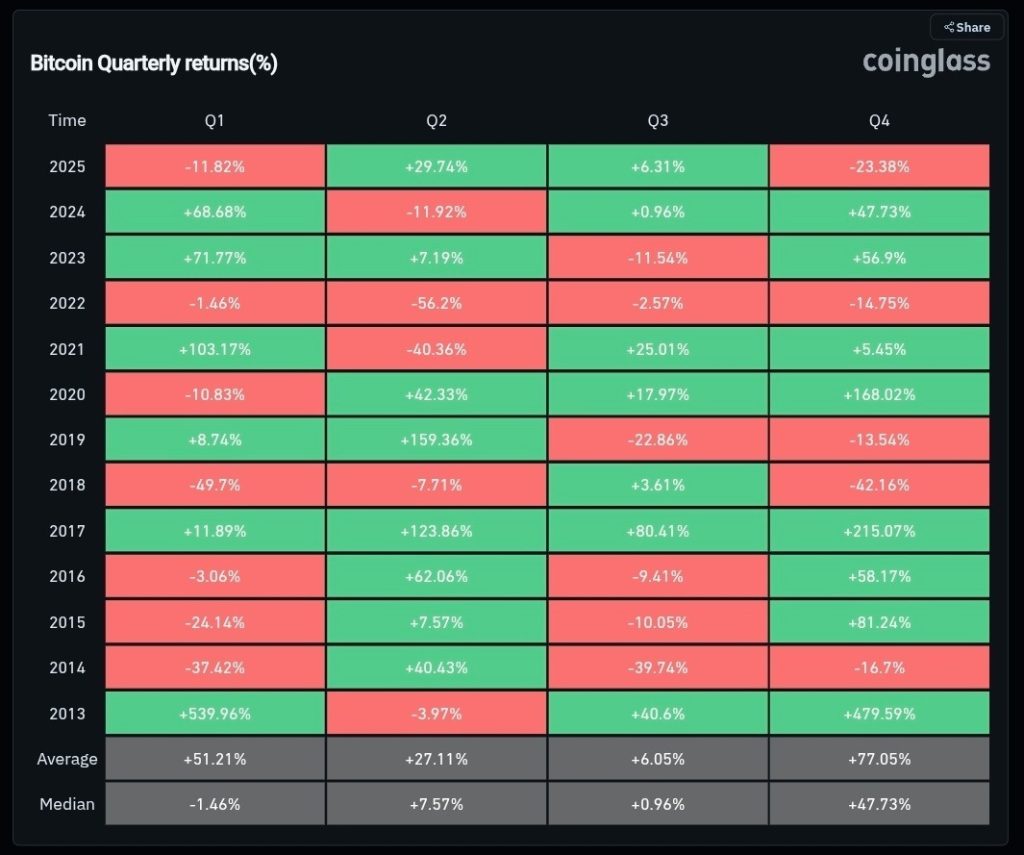
Bitcoin has closed Q4 2025 down nearly 23.8%, marking its second-worst fourth quarter on record, beaten only by the brutal 2018 Q4 crash (-42%). The drawdown stands in sharp contrast to history: Bitcoin’s average Q4 return is around +77%, making this year’s performance a major statistical outlier.

But context matters. This decline did not come from weakness at the lows—it followed a cycle peak near $126,000 in October, when optimism, leverage, and positioning peaked far earlier than usual.
bitcoin price

Bitcoin reached a new all-time high in October, pulling forward gains that historically arrive much later in the cycle. That rally was accompanied by elevated funding rates, aggressive derivatives positioning, and crowded long exposure. Once upside momentum slowed, profit-taking and forced deleveraging took over, creating a self-reinforcing downside move. In other words, Q4 didn’t fail because demand disappeared—it failed because positioning got ahead of structure.

What’s Next for the Bitcoin (BTC) Price Rally Ahead of the 2025 End

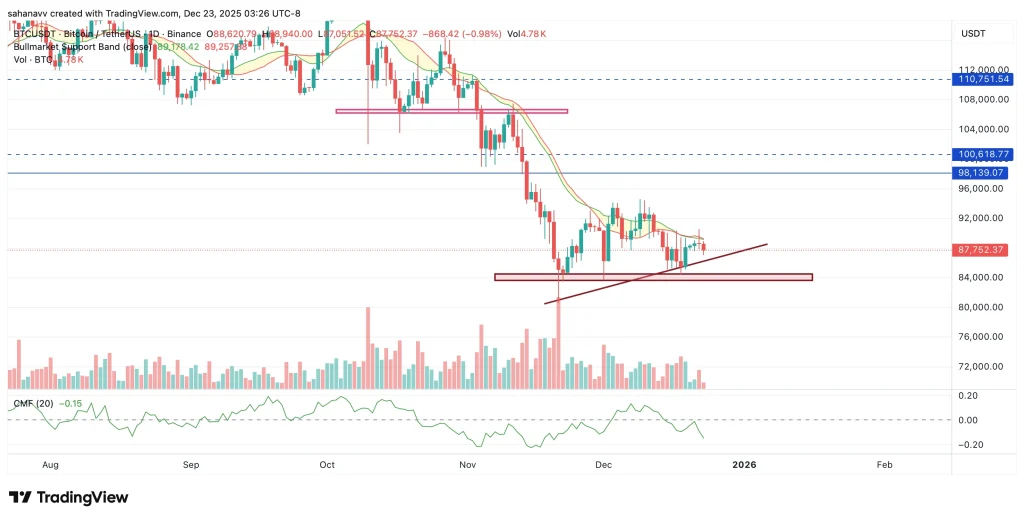
Bitcoin’s price action in Q4 2025 has shifted from expansion to correction, and the daily chart captures that transition clearly. After setting a cycle high in October, BTC entered a sustained downtrend marked by lower highs and heavy sell pressure. Price is now consolidating near a critical demand zone, making this phase less about upside momentum and more about whether the market is stabilising after a sharp leverage-driven reset.
bitcoin price

The chart shows BTC trading below the Bull Market Support Band, a sign that bullish momentum has weakened in Q4. Price is compressing above a rising trendline and horizontal demand zone near the mid-$80,000s, suggesting buyers are defending support. However, volume remains muted, and the Chaikin Money Flow (CMF) is negative, indicating capital outflows persist.

Together, this suggests Bitcoin is in a pause phase rather than a recovery phase. Price is holding key demand, but the lack of strong volume expansion and the negative CMF reading indicate buyers are still cautious. Until BTC reclaims the Bull Market Support Band with improving money flow, the structure remains one of controlled consolidation under pressure, not a confirmed trend reversal.

Conclusion

Bitcoin’s Q4 correction has shifted the focus from upside expansion to structural defence. As long as BTC holds the $84,000–$86,000 demand zone, the current move looks like consolidation after a leverage reset rather than a full trend breakdown. A sustained recovery would require reclaiming $92,000, followed by acceptance above $98,000–$100,000, where prior support turned resistance. If those levels are regained by year-end, bullish 2025 price projections remain valid—though the market is clearly signaling a slower, more volatile path forward.


Market Opportunity
USUAL Logo
USUAL Price(USUAL)
$0.02503
$0.02503$0.02503
+1.50%
USD
USUAL (USUAL) Live Price Chart
Disclaimer: The articles reposted on this site are sourced from public platforms and are provided for informational purposes only. They do not necessarily reflect the views of MEXC. All rights remain with the original authors. If you believe any content infringes on third-party rights, please contact service@support.mexc.com for removal. MEXC makes no guarantees regarding the accuracy, completeness, or timeliness of the content and is not responsible for any actions taken based on the information provided. The content does not constitute financial, legal, or other professional advice, nor should it be considered a recommendation or endorsement by MEXC.

You May Also Like

The Channel Factories We’ve Been Waiting For

The Channel Factories We’ve Been Waiting For

The post The Channel Factories We’ve Been Waiting For appeared on BitcoinEthereumNews.com. Visions of future technology are often prescient about the broad strokes while flubbing the details. The tablets in “2001: A Space Odyssey” do indeed look like iPads, but you never see the astronauts paying for subscriptions or wasting hours on Candy Crush.  Channel factories are one vision that arose early in the history of the Lightning Network to address some challenges that Lightning has faced from the beginning. Despite having grown to become Bitcoin’s most successful layer-2 scaling solution, with instant and low-fee payments, Lightning’s scale is limited by its reliance on payment channels. Although Lightning shifts most transactions off-chain, each payment channel still requires an on-chain transaction to open and (usually) another to close. As adoption grows, pressure on the blockchain grows with it. The need for a more scalable approach to managing channels is clear. Channel factories were supposed to meet this need, but where are they? In 2025, subnetworks are emerging that revive the impetus of channel factories with some new details that vastly increase their potential. They are natively interoperable with Lightning and achieve greater scale by allowing a group of participants to open a shared multisig UTXO and create multiple bilateral channels, which reduces the number of on-chain transactions and improves capital efficiency. Achieving greater scale by reducing complexity, Ark and Spark perform the same function as traditional channel factories with new designs and additional capabilities based on shared UTXOs.  Channel Factories 101 Channel factories have been around since the inception of Lightning. A factory is a multiparty contract where multiple users (not just two, as in a Dryja-Poon channel) cooperatively lock funds in a single multisig UTXO. They can open, close and update channels off-chain without updating the blockchain for each operation. Only when participants leave or the factory dissolves is an on-chain transaction…
Share
BitcoinEthereumNews2025/09/18 00:09
Nasdaq-listed iPower reaches $30 million convertible note financing agreement to launch DAT strategy.

Nasdaq-listed iPower reaches $30 million convertible note financing agreement to launch DAT strategy.

PANews reported on December 23 that, according to Globenewswire, Nasdaq-listed e-commerce and supply chain platform iPower announced it has reached a $30 million
Share
PANews2025/12/23 22:19
SelectCam AI Launches Flagship AI-Powered Video Telematics Solutions for Global Fleet Safety

SelectCam AI Launches Flagship AI-Powered Video Telematics Solutions for Global Fleet Safety

SHENZHEN, China–(BUSINESS WIRE)–SelectCam AI, a China-based, product-driven technology company, today announced the launch of its flagship AI video telematics solutions
Share
AI Journal2025/12/23 21:48