

Could Bitcoin Replace UTC? The Radical Timekeeping Idea Gaining Traction
Was this article first published on The Bit Journal: Will the ongoing chatter about the possibility of replacing UTC with the Universal Bitcoin time see the light of day? Read on to discover.
A concept of the Universal Bitcoin time, replacing the traditional coordinated universal time (UTC), rose a notch higher on December 27, 2025, after Bitcoin block 929,699 was mined. The growing concept holds that block height could serve as a calendar layer for markets that trade and settle across all jurisdictions.
According to data from the Bitcoin Block Explorer, chain tip 929,699, timestamped 27 Dec 2025 09:47:19 UTC, with a mempool of around 5,324 transactions at the time of the page update, could serve as a universal New Year reference instead of the civil calendar. As per the proposal, consensus-verified block counts could be treated as a shared time layer for cross-border settlement. The proposal states that custodians and exchanges could anchor their reports and tax rules to their jurisdictional time to the extent that users and institutions would have to navigate block time and wall-clock time in parallel.
 The idea resonates because midnight by civil time is a jurisdictional convention, while consensus height is enforced by nodes running common rules.
Bitcoin Nodes Can Enforce Consensus
The idea surrounding the Universal Bitcoin time echoes a bill since midnight in civil time is based on local legal conventions. However, Bitcoin nodes can enforce global consensus. This won’t be the first time the idea of dial time systems operating together has been discussed. For example, the United States had to consolidate hundreds of local times in 1883 when railroads adopted standardized time.
Universal Bitcoin time would make great sense, considering the fact that Bitcoin’s protocol makes it clear that there’s no way you can interchange block time with wall-clock time. The Bitcoin network uses a 10-minute average block interval that adjusts every 2,016 blocks, roughly every two weeks.
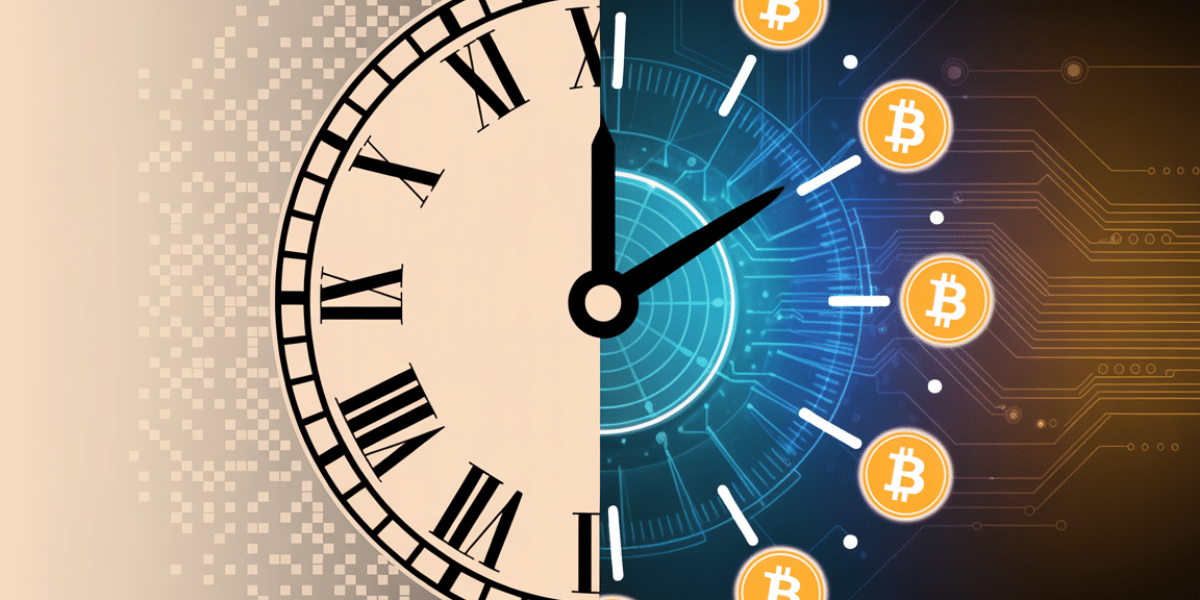 The real challenge lies in learning to operate with two overlapping notions of time.
Satoshi Side-Stepped the Existing Hierarchy
Historically, time signals have been based on the Earth’s rotation and national observatories. Leading nations combined their efforts and jointly developed the UTC, which was later formalized in 1960 as the global reference time. However, UTC carried political and technical compromises, including International Atomic Time and politically managed leap seconds, which most bodies have agreed to phase out by or before 2035.
The Universal Bitcoin time concept comes into play, considering that in creating Bitcoin, Satoshi actually side-stepped the existing hierarchy. The Bitcoin whitepaper describes a “peer-to-peer distributed timestamp server to generate computational proof of the chronological order of transactions.” According to Satoshi, the ledger is also a “timechain,” which is evidence that ordering events, not just transferring money, was the core design goal.
Conclusion
If a Bitcoin block time becomes culturally or financially significant, miners will face a new incentive in the future, which could center on propagation and block sniping. In the future, user interfaces would need to render block time so that regular users can understand dual countdowns showing both wall-clock time and Universal Bitcoin time. This means that the Universal Bitcoin time may not have to replace the traditional calendar to remain meaningful.
Glossary to Key Terms
Bitcoin: A type of digital currency in which a record of transactions is maintained and new units of currency are generated by the computational solution of mathematical problems, and which operates independently of a central bank.
Universal Bitcoin time: A concept that refers to using the Bitcoin block height (the sequential number of confirmed blocks in the blockchain) as a single, shared, and neutral reference for time across the globe, rather than relying on local civil time zones or Coordinated Universal Time (UTC).
UTC: UTC stands for Coordinated Universal Time, the primary time standard by which the world regulates clocks and time, serving as the modern successor to Greenwich Mean Time (GMT).
Frequently Asked Questions about the Universal Bitcoin Time Concept
What is “Universal Bitcoin Time” (UBT)?
The idea of using the sequence of blocks in the Bitcoin blockchain as a universal, verifiable clock or calendar. Every participant in the network can verify the absolute order of events by referring to a specific “block height,” which is the ordered count of blocks in the chain.
Why is a separate “Bitcoin Time” needed?
In a global, decentralized network, coordinating time using traditional clocks is challenging because clocks can be manipulated or vary across locations.
How is time measured in UBT?
Time is primarily measured in block height, where each new block represents one “tick” of the clock. The time interval between blocks, known as the “block time,” is targeted to be approximately 10 minutes on average.
References
Bitcoin Block Explorer
Museum of American History
Bitcoinit
Read More: Could Bitcoin Replace UTC? The Radical Timekeeping Idea Gaining Traction">Could Bitcoin Replace UTC? The Radical Timekeeping Idea Gaining Traction


You May Also Like

Binance Commits $500K to Scale National Ukraine Web3 Ecosystem Growth – Exchanges Bitcoin News

Why RWA Regulation Is the True Foundation of Tokenized Asset Infrastructure




