

Stellar (XLM) Price Prediction 2026: Can Lower Interest Rates Spark a Rebound?
As the Federal Reserve hints at cutting interest rates again in 2026, global markets are recalibrating their expectations. Stocks and bonds are reacting first, but digital assets like Stellar ($XLM) could soon follow. Historically, rate cuts fuel risk-on sentiment — yet the crypto market’s response depends on liquidity, investor confidence, and real-world adoption. With XLM price trading near $0.20 and trapped in a prolonged downtrend, the question now is whether these macro shifts can ignite a sustainable rally or if the coin risks sliding deeper before recovery.
Stellar Price Prediction: Rate Cuts May Not Be the Silver Bullet
The Fed’s plan to gradually reduce rates might look bullish on paper, but its impact will likely be uneven. Credit card and savings rates respond quickly to monetary policy, while auto loans and long-term mortgages remain sticky due to inflation expectations. This uneven relief could limit the short-term liquidity boost that crypto investors are hoping for.
If consumer spending and credit expansion stay muted, risk assets like XLM could continue facing headwinds. The key lies in how much confidence returns to retail markets. A dovish Fed typically signals weaker USD strength — a positive for crypto — but persistent inflation could cap gains.
Stellar Price Prediction: XLM Price Struggles Below Resistance
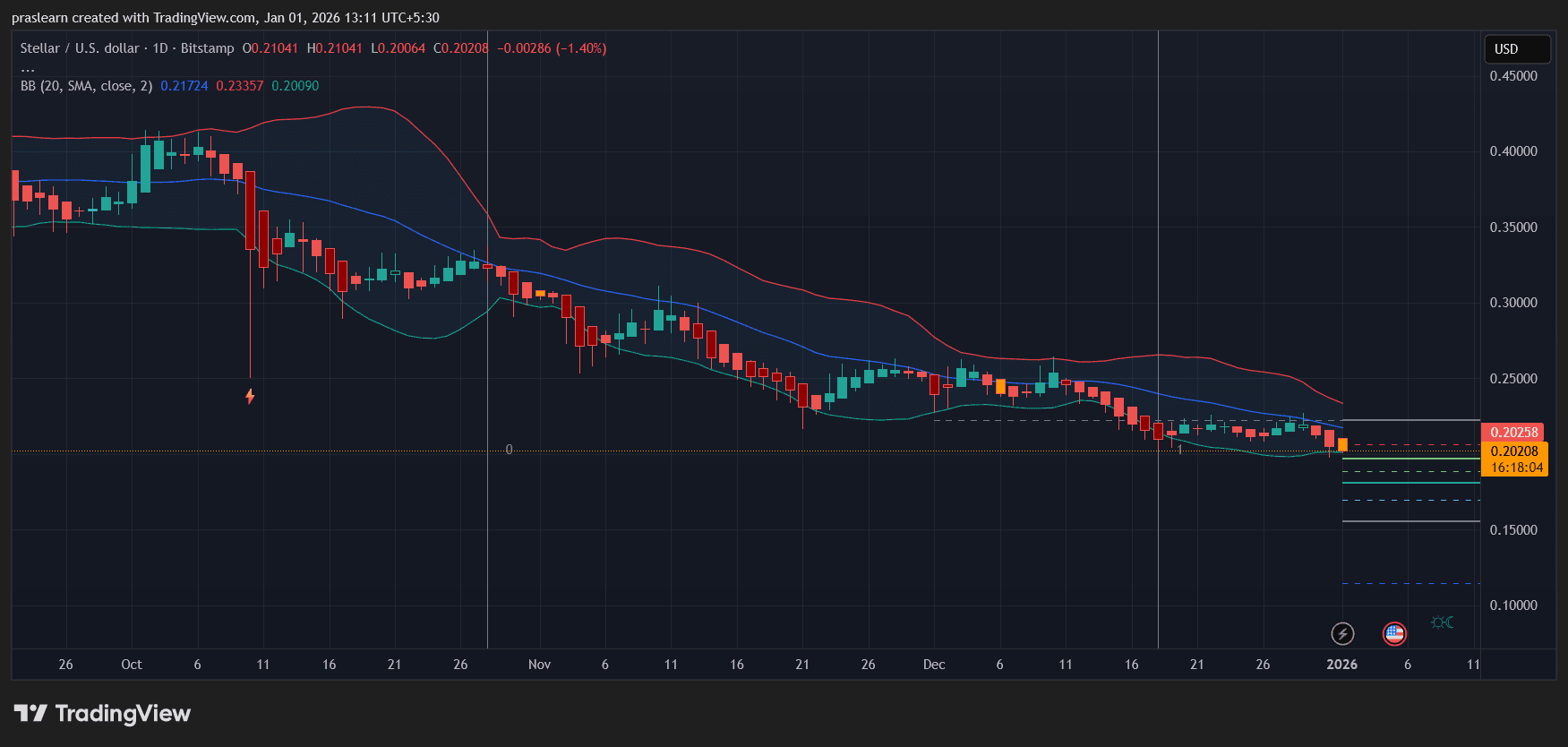 XLM/USD Daily Chart- TradingView
Looking at the daily TradingView chart, Stellar price technical posture reflects a market still under pressure:
- The Stellar price sits around $0.202, below the 20-day SMA (0.217) and the upper Bollinger Band at $0.233, signaling persistent bearish momentum.
- The bands remain moderately wide, showing volatility without clear breakout direction.
- Since October, XLM price has been forming consistent lower highs and lower lows, indicating that buyers remain hesitant.
- The psychological support level of $0.20 has held so far, but any breakdown below it could open the path toward $0.17 or even $0.15 — the next key support zones.
The market seems to be consolidating near the bottom of its range, which often precedes either capitulation or a reversal. For a trend shift, XLM price must close decisively above $0.23, aligning with its mid-Bollinger band and short-term moving averages.
Sentiment and Correlation: Crypto Waiting for Macro Confirmation
While Bitcoin and Ethereum have stabilized after recent selloffs, smaller-cap assets like Stellar are still struggling to attract inflows. The macro link is clear — lower rates increase speculative appetite, but traders are waiting for concrete Fed action before re-entering altcoins.
XLM, being a payment-focused asset, also reflects broader liquidity cycles. Historically, its rallies have aligned with expansions in credit markets and higher stablecoin transfer volumes. If the Fed’s cuts trigger credit easing by mid-2026, XLM price could benefit from renewed capital flow into risk assets.
Short-Term Stellar Price Prediction: Bearish but Near Exhaustion
Momentum indicators (like RSI and Bollinger positioning) show oversold conditions but not yet reversal signals. Bears remain in control, but the selling pressure is gradually weakening. The flat lower Bollinger Band hints that downside momentum might be losing strength. This could lead to sideways consolidation between $0.19–$0.22 before any breakout attempt.
In other words, Stellar price isn’t ready to rally yet — but the worst may be behind if macro tailwinds begin aligning.
Mid- to Long-Term XLM Price Prediction: Gradual Recovery in 2026
If the Fed successfully softens financial conditions without reigniting inflation, Stellar could stage a slow recovery through the second half of 2026. Expect potential targets as follows:
- Q2 2026: Range-bound between $0.18 – $0.23, with limited volatility.
- Q3 2026: Breakout potential above $0.25, contingent on Bitcoin stability and positive Fed commentary.
- Q4 2026: Possible return toward $0.30–$0.35, if risk-on sentiment fully returns and institutional liquidity expands.
The long-term recovery will depend on whether Stellar continues gaining traction in cross-border payment networks and fintech integrations — the core drivers behind its utility.
Conclusion
Right now, XLM price sits at a crossroads — technically weak, but macro conditions are shifting in its favor. The coming months will test whether dovish monetary policy can overcome fading investor enthusiasm. For traders, the key zone remains $0.20 support and $0.23 resistance. A breakout above this range could confirm a reversal, while a dip below $0.18 risks further decline.
In short, $XLM’s 2026 story depends less on rate cuts themselves and more on how much confidence they restore to risk markets. If the Fed’s easing cycle aligns with improving liquidity and lower inflation, Stellar could quietly prepare for its next big move upward.


You May Also Like

cirBTC Goes Live as Circle Eyes WBTC’s 85% Share

Zcash Ironwood Upgrade Locks In Consensus Rules, Eyes Late July Activation

Gov’t bolsters social protection



