

WIF price short squeezes into Fibonacci resistance at $0.50
WIF price has surged into the $0.50 Fibonacci resistance after a sharp short squeeze, raising the probability of rejection and a rotation back into its broader trading range.
- A short squeeze drove WIF sharply higher from $0.30 support.
- Price is testing strong resistance at $0.50 with multiple technical confluences.
- Failure to reclaim resistance could lead to a pullback toward the point of control and range continuation.
WIF (WIF) price has delivered an aggressive upside move in recent sessions, primarily driven by a short squeeze that accelerated the price into a significant resistance zone. While momentum has been strong, the rally is now testing a technically dense area near $0.50, where multiple resistance signals converge.
This region has historically served as a price ceiling, and early signs of hesitation are emerging. As a result, the market is approaching a critical decision point that will likely define short-term direction.
Wif price key technical points
- A short squeeze fueled the rally: Aggressive upside followed the reclamation of key support levels.
- $0.50 is a major resistance level: Fibonacci resistance aligns with the value-area high and high-time-frame resistance.
- Range continuation remains likely: Rejection could rotate the price back toward the point of control and the $0.30 support level.
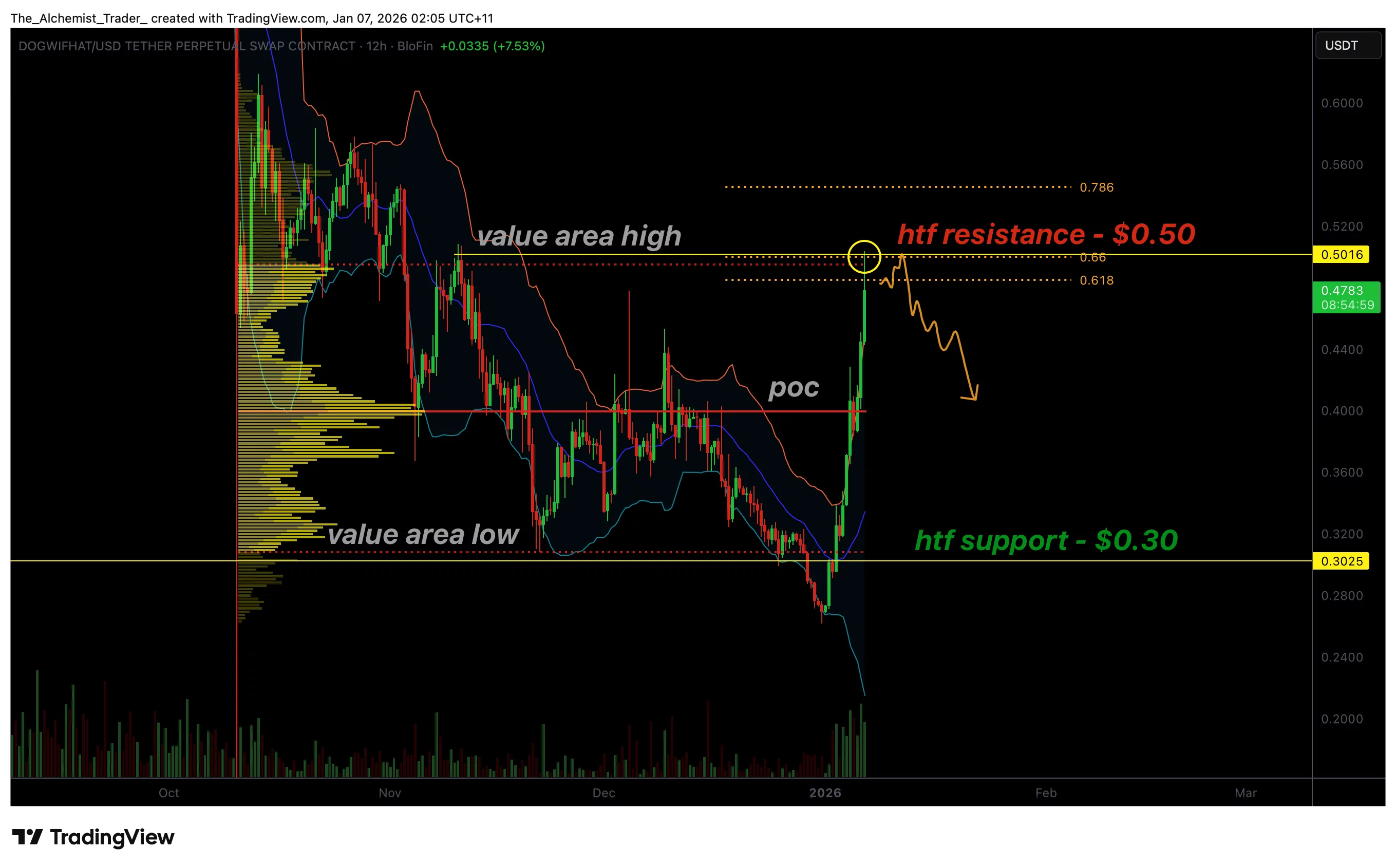
The current move began after WIF successfully reclaimed the $0.30 support level, which also aligned with the value area low. This reclaim marked a clear shift in short-term sentiment, triggering aggressive buying activity. Price advanced rapidly through the range, printing multiple bullish engulfing candles, each backed by noticeable volume inflows.
This type of price behavior is characteristic of short-squeeze dynamics, in which trapped sellers are forced to exit positions as the price rises. The resulting liquidation-driven buying often creates sharp, vertical moves, but these rallies tend to lose momentum once key resistance levels are reached.
Point of control break accelerates momentum
Following the reclaim of $0.30, WIF pushed through the point of control (POC), further accelerating the move higher. The POC represents the level at which the highest volume of recent trading occurred, and breaking above it typically signals a full-range rotation.
In this case, the break above the POC acted as the final catalyst, sending price directly into the upper boundary of the range. However, while momentum was strong into resistance, it is essential to note that such moves are often exhaustion-driven rather than trend-defining.
Heavy resistance at $0.50
Price is now trading into a high-confluence resistance zone around $0.50, where the 0.618 Fibonacci retracement, value area high, and high-time-frame resistance all align. This creates a technically significant ceiling, where sellers are more likely to defend positions and where upside continuation becomes more difficult.
Early signs of rejection are emerging, suggesting that buying pressure may be slowing. When rallies stall at major Fibonacci resistance following a short squeeze, it often signals that the move has reached maturity, at least in the short term.
Rejection would favor range continuation
If WIF fails to reclaim and hold above $0.50 with strong acceptance, the most likely outcome is a rotation back toward the point of control, followed by a potential move toward $0.30 support. This would keep price trading within the established high-time-frame range between $0.30 and $0.50, rather than transitioning into a sustained breakout.
Such behavior would be consistent with range-bound market dynamics, in which liquidity is absorbed at the highs before the price rebalances toward areas of higher participation.
What to expect in the coming price action
The next few sessions are critical for WIF. Continued rejection at $0.50 would confirm this area as a short-term top and increase the probability of a pullback toward the point of control and lower range support. For bulls to invalidate the rejection scenario, price would need to reclaim $0.50 with strong closes and expanding volume, conditions that have yet to materialize.
Until then, the technical outlook favors consolidation or a corrective rotation, keeping WIF confined within its broader $0.30–$0.50 trading range.


You May Also Like
FOMC Minutes Signal Fed Rate Cuts Still Possible as Iran War Poses Dual Risks

USD/JPY pulls back to 158.50 on Iran ceasefire optimism




