Colombia has taken a decisive step toward tightening oversight of its fast-growing crypto market, ordering exchanges and service providers to collect and reportColombia has taken a decisive step toward tightening oversight of its fast-growing crypto market, ordering exchanges and service providers to collect and report

Colombia Orders Crypto Exchanges to Report User Data in Tax Crackdown — Here’s What’s at Stake

Colombia has taken a decisive step toward tightening oversight of its fast-growing crypto market, ordering exchanges and service providers to collect and report detailed user data as part of a broader tax enforcement push.

The move places Bitcoin, stablecoins, and other digital assets firmly within the country’s national tax framework and shows a shift from partial disclosure to full transactional transparency.

Colombia Sets 2027 Deadline for First Nationwide Crypto Reports

Under Resolution 000240, issued by the Directorate of National Tax and Customs (DIAN) in late December 2025, Colombia has formally adopted the OECD’s Cryptoasset Reporting Framework.
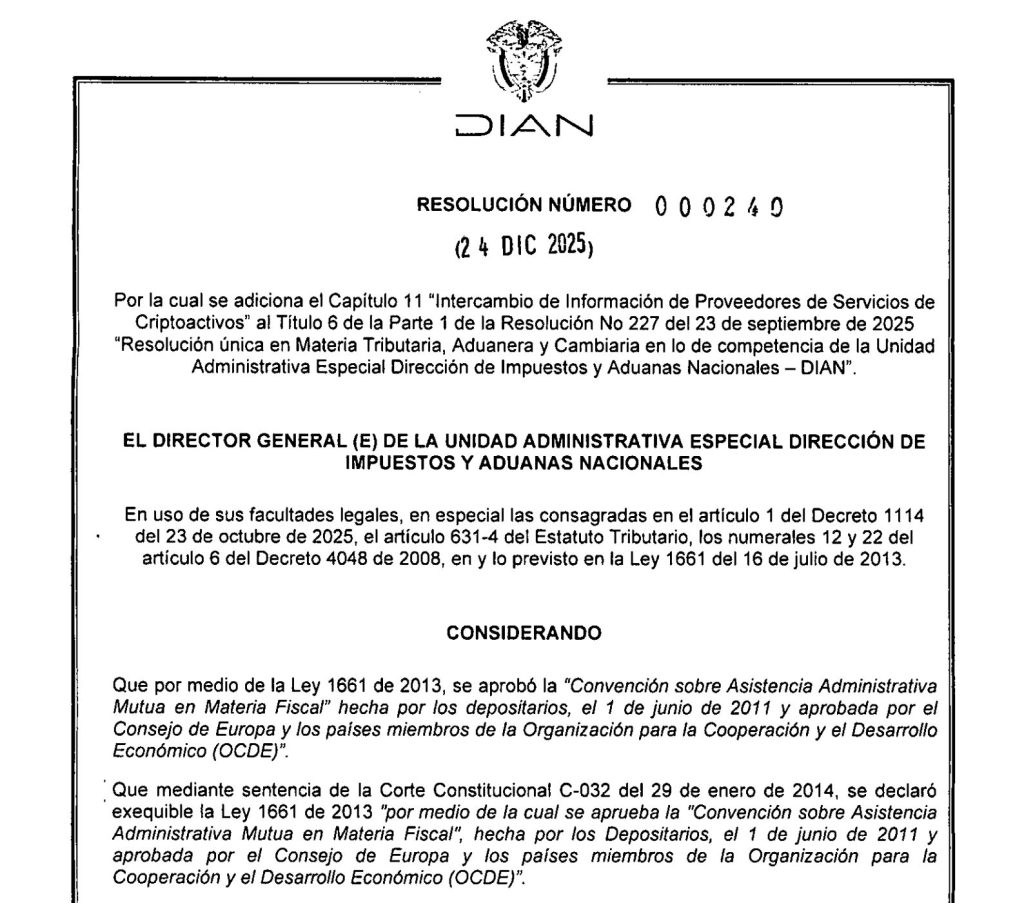
Source: DIAN

The rules require crypto exchanges, intermediaries, and other service providers operating in or serving Colombian residents to carry out enhanced due diligence and automatically share user and transaction data with tax authorities, including for international information exchanges.

Local outlet CriptoNoticias first reported the details of the resolution, saying the regulation applies from the 2026 tax year, with the first large-scale reporting deadline set for May 2027.

Answering that, each platform will be expected to provide detailed reports on all crypto activity performed in 2026.

This involves information on account ownership, transaction volumes, transactions on tokens moved, and the market value of each operation involving bitcoin, ether, and popular stablecoins, like the USDT and USDC.

Even though in 2025 the resolution was already in effect as of December 24, the first complete observation period will be in 2026.

From DIAN’s perspective, every transaction executed by Colombian users during the year will be logged by service providers and prepared for electronic submission.

Authorities have made clear that crypto activity will no longer be treated as opaque or informal within the tax system.

The scope of the reporting obligation is broad, as it covers both domestic and foreign platforms serving Colombian residents, regardless of whether they hold a specific crypto license.

Rising Crypto Adoption Meets Tougher Tax Rules in Colombia

Colombia does not yet have a comprehensive licensing regime for crypto exchanges, and digital assets are still classified as intangible assets rather than legal tender.

However, exchanges operating in the country are already expected to comply with general tax, anti-money laundering, and know-your-customer rules.

One provision likely to draw particular attention from retail users is the monitoring of large payments and transfers. Transactions exceeding $50,000 will trigger automatic alerts to DIAN.

Even below that threshold, platforms must report users’ tax residence information and net balances, excluding commissions, through standardized XML files processed electronically by the tax authority.

Penalties for non-compliance are significant, with companies that fail to report, or submit incomplete or incorrect data, facing fines of up to 1% of the value of the unreported transactions.

Legal experts have warned that the reporting calendar leaves little room for error, effectively making transparency a mandatory cost of doing business in Colombia’s crypto market.

For users, the immediate impact is a loss of practical anonymity.

While individuals were already required to declare crypto holdings as part of their income or wealth tax filings, enforcement previously relied largely on self-reporting.

DIAN will now be able to cross-check exchange data against individual tax declarations, increasing scrutiny of the origin of funds and capital gains.

The crackdown comes as crypto adoption in Colombia reaches new highs. Chainalysis data in October shows that the country recorded $44.2 billion in crypto transaction volume between July 2024 and June 2025, ranking fifth in Latin America.

Source: Chainalysis

This makes it the region’s second-fastest-growing market by value received. As of late 2025, Colombia is estimated to have about 10.72 million crypto users, representing nearly 19% of the population.


Disclaimer: The articles reposted on this site are sourced from public platforms and are provided for informational purposes only. They do not necessarily reflect the views of MEXC. All rights remain with the original authors. If you believe any content infringes on third-party rights, please contact service@support.mexc.com for removal. MEXC makes no guarantees regarding the accuracy, completeness, or timeliness of the content and is not responsible for any actions taken based on the information provided. The content does not constitute financial, legal, or other professional advice, nor should it be considered a recommendation or endorsement by MEXC.

You May Also Like

The Channel Factories We’ve Been Waiting For

The Channel Factories We’ve Been Waiting For

The post The Channel Factories We’ve Been Waiting For appeared on BitcoinEthereumNews.com. Visions of future technology are often prescient about the broad strokes while flubbing the details. The tablets in “2001: A Space Odyssey” do indeed look like iPads, but you never see the astronauts paying for subscriptions or wasting hours on Candy Crush.  Channel factories are one vision that arose early in the history of the Lightning Network to address some challenges that Lightning has faced from the beginning. Despite having grown to become Bitcoin’s most successful layer-2 scaling solution, with instant and low-fee payments, Lightning’s scale is limited by its reliance on payment channels. Although Lightning shifts most transactions off-chain, each payment channel still requires an on-chain transaction to open and (usually) another to close. As adoption grows, pressure on the blockchain grows with it. The need for a more scalable approach to managing channels is clear. Channel factories were supposed to meet this need, but where are they? In 2025, subnetworks are emerging that revive the impetus of channel factories with some new details that vastly increase their potential. They are natively interoperable with Lightning and achieve greater scale by allowing a group of participants to open a shared multisig UTXO and create multiple bilateral channels, which reduces the number of on-chain transactions and improves capital efficiency. Achieving greater scale by reducing complexity, Ark and Spark perform the same function as traditional channel factories with new designs and additional capabilities based on shared UTXOs.  Channel Factories 101 Channel factories have been around since the inception of Lightning. A factory is a multiparty contract where multiple users (not just two, as in a Dryja-Poon channel) cooperatively lock funds in a single multisig UTXO. They can open, close and update channels off-chain without updating the blockchain for each operation. Only when participants leave or the factory dissolves is an on-chain transaction…
Share
BitcoinEthereumNews2025/09/18 00:09
Onyxcoin Price Breakout Coming — Is a 38% Move Next?

Onyxcoin Price Breakout Coming — Is a 38% Move Next?

The post Onyxcoin Price Breakout Coming — Is a 38% Move Next? appeared on BitcoinEthereumNews.com. Onyxcoin price action has entered a tense standoff between bulls
Share
BitcoinEthereumNews2026/01/14 00:33
CEO Sandeep Nailwal Shared Highlights About RWA on Polygon

CEO Sandeep Nailwal Shared Highlights About RWA on Polygon

The post CEO Sandeep Nailwal Shared Highlights About RWA on Polygon appeared on BitcoinEthereumNews.com. Polygon CEO Sandeep Nailwal highlighted Polygon’s lead in global bonds, Spiko US T-Bill, and Spiko Euro T-Bill. Polygon published an X post to share that its roadmap to GigaGas was still scaling. Sentiments around POL price were last seen to be bearish. Polygon CEO Sandeep Nailwal shared key pointers from the Dune and RWA.xyz report. These pertain to highlights about RWA on Polygon. Simultaneously, Polygon underlined its roadmap towards GigaGas. Sentiments around POL price were last seen fumbling under bearish emotions. Polygon CEO Sandeep Nailwal on Polygon RWA CEO Sandeep Nailwal highlighted three key points from the Dune and RWA.xyz report. The Chief Executive of Polygon maintained that Polygon PoS was hosting RWA TVL worth $1.13 billion across 269 assets plus 2,900 holders. Nailwal confirmed from the report that RWA was happening on Polygon. The Dune and https://t.co/W6WSFlHoQF report on RWA is out and it shows that RWA is happening on Polygon. Here are a few highlights: – Leading in Global Bonds: Polygon holds 62% share of tokenized global bonds (driven by Spiko’s euro MMF and Cashlink euro issues) – Spiko U.S.… — Sandeep | CEO, Polygon Foundation (※,※) (@sandeepnailwal) September 17, 2025 The X post published by Polygon CEO Sandeep Nailwal underlined that the ecosystem was leading in global bonds by holding a 62% share of tokenized global bonds. He further highlighted that Polygon was leading with Spiko US T-Bill at approximately 29% share of TVL along with Ethereum, adding that the ecosystem had more than 50% share in the number of holders. Finally, Sandeep highlighted from the report that there was a strong adoption for Spiko Euro T-Bill with 38% share of TVL. He added that 68% of returns were on Polygon across all the chains. Polygon Roadmap to GigaGas In a different update from Polygon, the community…
Share
BitcoinEthereumNews2025/09/18 01:10