Learn how to build a clean service that takes a blog URL or pasted text and produces a natural-sounding audio file. You will learn how to fetch blog content, sendLearn how to build a clean service that takes a blog URL or pasted text and produces a natural-sounding audio file. You will learn how to fetch blog content, send

How to Build and Deploy a Blog-to-Audio Service Using OpenAI

Turning written blog posts into audio is a simple way to reach more people.

\ Many users prefer listening during travel or workouts. Others enjoy having both reading and listening options.

\ With OpenAI’s text-to-speech models, you can build a clean service that takes a blog URL or pasted text and produces a natural-sounding audio file.

\ In this article, you will learn how to build this system end-to-end. You will learn how to fetch blog content, send it to OpenAI’s audio API, save the output as an MP3 file, and serve everything through a small FastAPI app.

\ At the end, we will also build a minimal user interface and deploy it to Sevalla so that anyone can upload text and download audio without touching code.

Understanding the Core Idea

A blog-to-audio service has only three important parts.

\ The first part takes a blog link or text and cleans it. The second part sends the clean text to OpenAI’s text-to-speech model. The third part gives the final MP3 file back to the user.

\ OpenAI’s speech generation is simple to use. You send text, choose a voice, and get audio back. The quality is high and works well even for long posts. This means you do not need to worry about training models or tuning voices.

\ The only job left is to make the system easy to use. That is where FastAPI and a small HTML form help. They wrap your code into a web service so anyone can try it.

Setting Up Your Project

Create a folder for your project. Inside it, create a file called main.py. You will also need a basic HTML file later.

\ Install the libraries you need with pip:

pip install fastapi uvicorn requests beautifulsoup4 python-multipart

\ FastAPI gives you a simple backend. The Requests module helps download blog pages. BeautifulSoup helps remove HTML tags and extract readable text. Python-multipart helps upload form data.

\ You must also install the OpenAI client:

pip install openai

\ Make sure you have your OpenAI API key ready. Set it in your terminal before running the app:

export OPENAI_API_KEY="your-key"

\ On Windows, you can do:

setx OPENAI_API_KEY "your-key"

Fetching and Cleaning Blog Content

To convert a blog into audio, you must first extract the main article text. You can fetch the page with Requests and parse it with BeautifulSoup.

\ Below is a simple function that does this.

import requests from bs4 import BeautifulSoup def extract_text_from_url(url: str) -> str: response = requests.get(url, timeout=10) html = response.text soup = BeautifulSoup(html, "html.parser") paragraphs = soup.find_all("p") text = " ".join(p.get_text(strip=True) for p in paragraphs) return text

Here is what happens step by step.

\

  • The function downloads the page.
  • BeautifulSoup reads the HTML and finds all paragraph tags.
  • It pulls out the text in each paragraph and joins them into one long string.
  • This gives you a clean version of the blog post without ads or layout code.

\ If the user pastes text instead of a URL, you can skip this part and use the text as it is.

Sending Text to OpenAI for Audio

OpenAI’s text-to-speech API makes this part of the work very easy. You send a message with text and select a voice such as Alloy or Verse. The API returns raw audio bytes. You can save these bytes as an MP3 file.

\ Here is a helper function to convert text into audio:

from openai import OpenAI client = OpenAI() def text_to_audio(text: str, output_path: str): audio = client.audio.speech.create( model="gpt-4o-mini-tts", voice="alloy", input=text ) with open(output_path, "wb") as f: f.write(audio.read())

\ This function calls the OpenAI client and passes the text, model name, and voice choice. The .read() method extracts the binary audio stream. Writing this to an MP3 file completes the process.

\ If the blog post is very long, you may want to limit text length or chunk the text and join the audio files later. But for most blogs, the model can handle the entire text in one request.

Building a FastAPI Backend

Now, you can wrap both steps into a simple FastAPI server. This server will accept either a URL or pasted text. It will convert the content into audio and return the MP3 file as a response.

\ Here is the full backend code:

from fastapi import FastAPI, Form from fastapi.responses import FileResponse import uuid import os app = FastAPI() @app.post("/convert") def convert(url: str = Form(None), text: str = Form(None)): if not url and not text: return {"error": "Please provide a URL or text"} if url: try: text_content = extract_text_from_url(url) except Exception: return {"error": "Could not fetch the URL"} else: text_content = text file_id = uuid.uuid4().hex output_path = f"audio_{file_id}.mp3" text_to_audio(text_content, output_path) return FileResponse(output_path, media_type="audio/mpeg")

\ Here is how it works. The user sends form data with either url or text. The server checks which one exists.

\ If there is a URL, it extracts text with the earlier function. If there is no URL, it uses the provided text directly. A unique file name is created for every request. Then the audio file is generated and returned as an MP3 download.

\ You can run the server like this:

uvicorn main:app --reload

\ Open your browser at http://localhost:8000. You will not see the UI yet, but the API endpoint is working. You can test it using a tool like Postman or by building the front end next.

Adding a Simple User Interface

A service is much easier to use when it has a clean UI. Below is a simple HTML page that sends either a URL or text to your FastAPI backend. Save this file as index.html in the same folder:

<!DOCTYPE html> <html> <head> <title>Blog to Audio</title> <style> body { font-family: Arial, padding: 40px; max-width: 600px; margin: auto; } input, textarea { width: 100%; padding: 10px; margin-top: 10px; } button { padding: 12px 20px; margin-top: 20px; cursor: pointer; } </style> </head> <body> <h2>Convert Blog to Audio</h2> <form action="/convert" method="post"> <label>Blog URL</label> <input type="text" name="url" placeholder="Enter a blog link"> <p>or paste text below</p> <textarea name="text" rows="10" placeholder="Paste blog text here"></textarea> <button type="submit">Convert to Audio</button> </form> </body> </html>

\ This page gives the user two options. They can type a URL or paste text. The form sends the data to /convert using a POST request. The response will be the MP3 file, so the browser will download it.

\ To serve the HTML file, add this route to your main.py:

from fastapi.responses import HTMLResponse @app.get("/") def home(): with open("index.html", "r") as f: html = f.read() return HTMLResponse(html)

\ Now, when you visit the main URL, you will see a clean form.

When you submit a URL, the server will process your request and give you an audio file.

Great. Our text to audio service is working. Now, let’s get it into production.

Deploying Your Service to Sevalla

You can choose any cloud provider, like AWS, DigitalOcean, or others, to host your service. I will be using Sevalla for this example.

\ Sevalla is a developer-friendly PaaS provider. It offers application hosting, database, object storage, and static site hosting for your projects.

\ Every platform will charge you for creating a cloud resource. Sevalla comes with a $50 credit for us to use, so we won’t incur any costs for this example.

\ Let’s push this project to GitHub so that we can connect our repository to Sevalla. We can also enable auto-deployments so that any new change to the repository is automatically deployed.

\ You can also fork my repository from here.

\ Log in to Sevalla and click on Applications -> Create new application. You can see the option to link your GitHub repository to create a new application.

Use the default settings. Click “Create application”. Now, we have to add our openai api key to the environment variables. Click on the “Environment variables” section once the application is created, and save the OPENAI_API_KEY value as an environment variable.

\ Sevalla Environment Variables
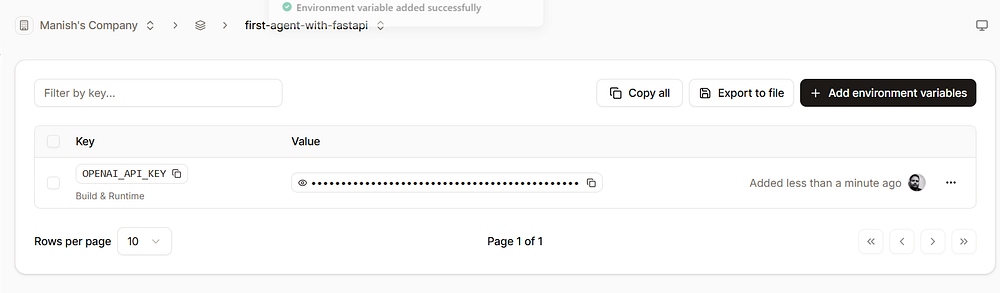
Now, we are ready to deploy our application. Click on “Deployments” and click “Deploy now”. It will take 2–3 minutes for the deployment to complete.

\ Sevalla Deployment
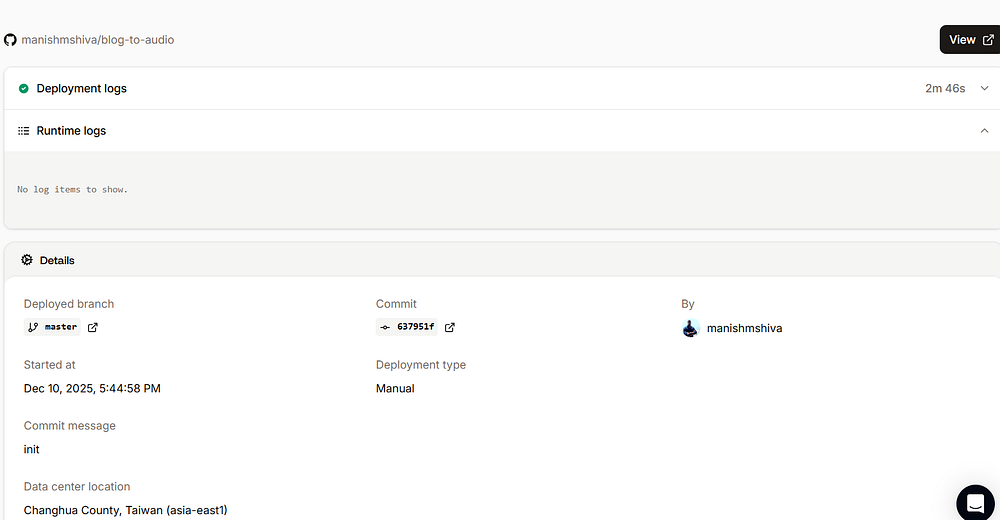
Once done, click on “Visit app”. You will see the application served via a URL ending with sevalla.app . This is your new root URL. You can replace localhost:8000 with this URL and start using it.

Congrats! Your blog-to-audio service is now live. You can extend this by adding other capabilities and pushing your code to GitHub. Sevalla will automatically deploy your application to production.

Conclusion

You now know how to build a full blog-to-audio service using OpenAI. You learned how to fetch blog text, convert it into speech, and serve it with FastAPI. You also learned how to create a simple user interface, allowing people to try it with no setup.

\ With this foundation, you can turn any written content into smooth, natural audio. This can help creators reach a wider audience, enhance accessibility, and provide users with more ways to enjoy content.

\ Hope you enjoyed this article. Sign up for my free newsletter, TuringTalks.ai, for more hands-on tutorials on AI. You can also visit my website.

\

Market Opportunity
Brainedge Logo
Brainedge Price(LEARN)
$0.00904
$0.00904$0.00904
+1.57%
USD
Brainedge (LEARN) Live Price Chart
Disclaimer: The articles reposted on this site are sourced from public platforms and are provided for informational purposes only. They do not necessarily reflect the views of MEXC. All rights remain with the original authors. If you believe any content infringes on third-party rights, please contact service@support.mexc.com for removal. MEXC makes no guarantees regarding the accuracy, completeness, or timeliness of the content and is not responsible for any actions taken based on the information provided. The content does not constitute financial, legal, or other professional advice, nor should it be considered a recommendation or endorsement by MEXC.

You May Also Like

Franklin Templeton CEO Dismisses 50bps Rate Cut Ahead FOMC

Franklin Templeton CEO Dismisses 50bps Rate Cut Ahead FOMC

The post Franklin Templeton CEO Dismisses 50bps Rate Cut Ahead FOMC appeared on BitcoinEthereumNews.com. Franklin Templeton CEO Jenny Johnson has weighed in on whether the Federal Reserve should make a 25 basis points (bps) Fed rate cut or 50 bps cut. This comes ahead of the Fed decision today at today’s FOMC meeting, with the market pricing in a 25 bps cut. Bitcoin and the broader crypto market are currently trading flat ahead of the rate cut decision. Franklin Templeton CEO Weighs In On Potential FOMC Decision In a CNBC interview, Jenny Johnson said that she expects the Fed to make a 25 bps cut today instead of a 50 bps cut. She acknowledged the jobs data, which suggested that the labor market is weakening. However, she noted that this data is backward-looking, indicating that it doesn’t show the current state of the economy. She alluded to the wage growth, which she remarked is an indication of a robust labor market. She added that retail sales are up and that consumers are still spending, despite inflation being sticky at 3%, which makes a case for why the FOMC should opt against a 50-basis-point Fed rate cut. In line with this, the Franklin Templeton CEO said that she would go with a 25 bps rate cut if she were Jerome Powell. She remarked that the Fed still has the October and December FOMC meetings to make further cuts if the incoming data warrants it. Johnson also asserted that the data show a robust economy. However, she noted that there can’t be an argument for no Fed rate cut since Powell already signaled at Jackson Hole that they were likely to lower interest rates at this meeting due to concerns over a weakening labor market. Notably, her comment comes as experts argue for both sides on why the Fed should make a 25 bps cut or…
Share
BitcoinEthereumNews2025/09/18 00:36
Why Is Crypto Up Today? – January 13, 2026

Why Is Crypto Up Today? – January 13, 2026

The crypto market is trading slightly higher today, with total cryptocurrency market capitalization rising by around 1.7% over the past 24 hours to approximately
Share
CryptoNews2026/01/13 22:26
After the interest rate cut, how far can the institutional bull market go?

After the interest rate cut, how far can the institutional bull market go?

The dominant force in this cycle comes from institutions. The four major cryptocurrencies, BTC, ETH, SOL, and BNB, have all hit new highs, but only BTC and BNB have continued to rise by over 40% since breaking through their all-time highs. SOL achieved a breakout earlier this year thanks to Trump's coin launch, while ETH experienced a revaluation mid-year driven by DAT buying, but neither has yet reached a new high. The Federal Reserve cut interest rates last night. How far can this round of institutional-led market trends go? 1. The institutional configuration logic of the three major currencies The positioning of crypto assets directly determines their long-term value, and different positioning corresponds to different institutional configuration logic. Bitcoin: The anti-inflation property of digital gold Positioned as "digital gold," its long-term logic is strongly tied to the fiat currency inflation cycle. Data shows that its market capitalization growth is synchronized with Global M2 and negatively correlated with the US dollar index. Its core value lies in its "inflation resistance" and value preservation and appreciation, making it a fundamental target for institutional investment. Ethereum: The Institutional Narrative Dividend of the World Computer Positioned as the "World Computer," although the foundation's "Layer 2 scaling" narrative has failed to gain traction in the capital market, its stable system, with 10 years of zero downtime, has capitalized on the development of institutional narratives such as US dollar stablecoins, RWAs, and the tokenization of US stocks. It has shrugged off the collapse of the Web3 narrative, and with the crucial push from DAT, has achieved a revaluation of its market capitalization. Ethereum, with its stability and security, will become the settlement network for institutional applications. Solana: The Active Advantage of Online Capital Markets Positioned as an "Internet Capital Market," Solana (ICM) stands for on-chain asset issuance, trading, and clearing. It has experienced a resurgence following the collapse of FTX. Year-to-date, it accounts for 46% of on-chain trading volume, with over 3 million daily active users year-round, making it the most active blockchain network. Solana, with its superior performance and high liquidity, will be the catalyst for the crypto-native on-chain trading ecosystem. The three platforms have distinct positioning, leading to different institutional investment logic. Traditional financial institutions first understand the value of Bitcoin, then consider developing their institutional business based on Ethereum, and finally, perhaps recognize the value of on-chain transactions. This is a typical path: question, understand, and become a part of it. Second, institutional holdings of the three major currencies show gradient differences The institutional holdings data of BTC, ETH, and SOL show obvious gradient differences, which also reflects the degree and rhythm of institutions' recognition of these three projects. Chart by: IOBC Capital From the comparison, we can see that institutional holdings of BTC and ETH account for > 18% of the circulating supply; SOL currently only accounts for 9.5%, and there may be room for replenishment. 3. SOL DAT: New Trends in Crypto Concept Stocks In the past month or so, 18 SOL DAT companies have come onto the scene, directly pushing SOL up by more than 50% from its August low. The louder SOL DAT company: Chart by: IOBC Capital Among the existing SOL DAT companies, Forward Industries, led by Multicoin Capital founder Kyle Samani, may become the SOL DAT leader. Unlike BTC DAT, which simply hoards coins, many SOL DAT companies will build their own Solana Validators, so that this is not limited to the "NAV game". Instead of simply waiting for token appreciation, they will continue to obtain cash flow income through the Validator business. This strategy is equivalent to "hoarding coins + mining", which is both long-term and profitable in the short term. 4. Crypto Concept Stocks: A Mapping of Capital Market Betting Crypto concept stocks are a new bridge between traditional capital and the crypto market. The degree of recognition of various Crypto businesses by the traditional financial market is also reflected in the stock price performance of crypto concept stocks. Chart by: IOBC Capital Looking back at the crypto stocks that have seen significant gains this round, we can see two common characteristics: 1. Only by betting big can a valuation reassessment be achieved. There are 189 publicly listed companies holding BTC, but only 30 hold 70% of their stock market capitalization, and only 12 hold more than 10,000 BTC—and these 12 have seen significant gains. A similar pattern is observed among listed ETH DATs. A superficial DAT strategy can only cause short-term stock price fluctuations and cannot substantially boost stock market capitalization or liquidity. 2. Business synergy can amplify commercial value. Transforming a single-point business into a multifaceted industry chain layout can amplify commercial value. For example, Robinhood, through its expansion into cryptocurrency trading, real-world asset trading (RRE), and participation in the USDG stablecoin, has formed a closed-loop business cycle for capital flow, leading to record highs in its stock price. Conversely, while Trump Media has also invested heavily in crypto (holding BTC, applying for an ETH ETF, and issuing tokens like Trump, Melania, and WLFI), the lack of synergy between its businesses has ultimately led to a lackluster market response to both its stock and its token. Ending The project philosophies of Bitcoin, Ethereum, and Solana correspond to three instincts of human beings when facing the future: survival, order, and flow.
Share
PANews2025/09/18 19:00




