Bitcoin is trying to hold above the $91,000 level as the market searches for support, but demand remains fragile after weeks of volatility. While the recent declineBitcoin is trying to hold above the $91,000 level as the market searches for support, but demand remains fragile after weeks of volatility. While the recent decline

Bitcoin Recovers In January: Funding Divergence Points To A Spot-Driven Market

Bitcoin is trying to hold above the $91,000 level as the market searches for support, but demand remains fragile after weeks of volatility. While the recent decline has pressured sentiment, a CryptoQuant report suggests January is still shaping up as a recovery phase rather than a full breakdown. The analysis points to cautious optimism driven by institutional and whale-level accumulation, while retail participation remains hesitant and risk-averse.

According to Binance-related data, Bitcoin’s spot price action and funding rates have started to diverge in early 2026, signaling a spot-driven market environment. This setup is often viewed as constructive because it implies the latest move is being supported more by real spot buying than by excessive leverage in derivatives. In practice, a spot-led trend tends to reduce the risk of sudden liquidation cascades, which have recently amplified downside moves across the crypto market.

Bitcoin Binance Divergence BTC-USDT and Funding Rate | Source: CryptoQuant

CryptoQuant notes that spot-driven conditions can also create more durable rallies, since they attract organic inflows and allow price to climb without relying on unstable speculative positioning. Historical comparisons to the 2021 and 2024 cycles show similar divergences between spot strength and muted funding rates often preceded extended upside expansions, ranging from 20% to 50%.

Is the Four-Year Bitcoin Cycle Breaking Down?

The CryptoQuant report raises a bigger question that many investors are now debating: is the traditional four-year Bitcoin cycle starting to fade? As the market matures, analysts argue that the old post-halving pattern may no longer apply in the same way. Since 2024, spot Bitcoin ETFs and corporate treasuries have been absorbing a growing share of supply, potentially creating steadier demand and reducing the boom-and-bust dynamics that defined prior cycles.

This argument gained traction in 2025. Despite being a post-halving year, Bitcoin failed to deliver the type of parabolic rally seen in previous cycles, while altcoins also struggled to produce a true “altseason.” That divergence has led some analysts to conclude that halvings are becoming less dominant as a driver, especially now that Bitcoin trades as a $2T+ macro asset.

Instead, market direction may be increasingly shaped by global liquidity conditions, including Federal Reserve policy, M2 growth, geopolitical risk, and large-scale institutional flows. Analysts like Raoul Pal have framed this as a shift toward longer liquidity cycles that could last five years or more, reinforcing the idea that the four-year framework may be outdated.

The report also highlights Binance as a critical reference point. Historically favored by whales, Binance remains a major leading indicator for broader crypto market positioning and flows.

Bitcoin Weekly Chart Signals Fragile Recovery

Bitcoin is attempting to stabilize after weeks of heavy selling pressure, but the weekly structure still reflects a market fighting to reclaim lost ground. BTC is trading near $91,075 after printing a sharp weekly pullback, reinforcing that volatility remains elevated even as price tries to base. The recent rebound from the sub-$85,000 region shows buyers stepping in aggressively, yet the recovery still looks fragile while broader macro uncertainty keeps risk appetite limited across crypto.
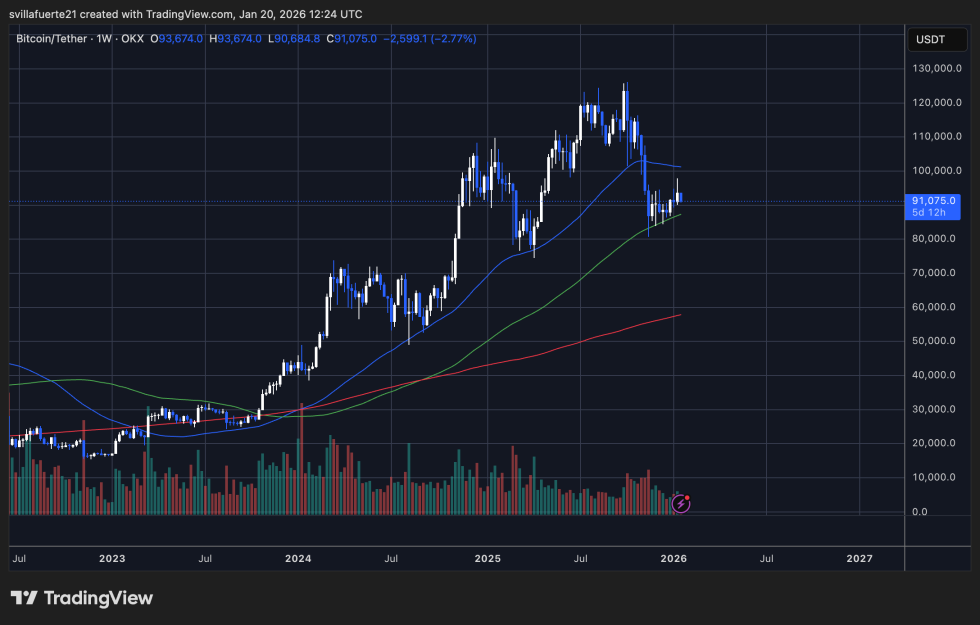
BTC consolidates around key level | Source: BTCUST chart on TradingView

From a technical perspective, Bitcoin is hovering around the zone where previous support has flipped into resistance. Price is currently sitting near the rising 100-week moving average (green), which is acting as a key pivot for bulls. Holding above this level would signal that demand is strong enough to absorb supply during dips. However, the 50-week moving average (blue) has rolled over and remains above price, highlighting that the broader trend has not fully reset bullish momentum.

The 200-week moving average (red) continues to trend higher far below current levels, confirming the long-term uptrend remains intact. For now, the market likely needs a clean weekly reclaim above $95,000 to shift sentiment. Until then, this bounce risks being treated as corrective rather than trend-confirming.

Featured image from ChatGPT, chart from TradingView.com 

Disclaimer: The articles reposted on this site are sourced from public platforms and are provided for informational purposes only. They do not necessarily reflect the views of MEXC. All rights remain with the original authors. If you believe any content infringes on third-party rights, please contact service@support.mexc.com for removal. MEXC makes no guarantees regarding the accuracy, completeness, or timeliness of the content and is not responsible for any actions taken based on the information provided. The content does not constitute financial, legal, or other professional advice, nor should it be considered a recommendation or endorsement by MEXC.

You May Also Like

Microsoft Corp. $MSFT blue box area offers a buying opportunity

Microsoft Corp. $MSFT blue box area offers a buying opportunity

The post Microsoft Corp. $MSFT blue box area offers a buying opportunity appeared on BitcoinEthereumNews.com. In today’s article, we’ll examine the recent performance of Microsoft Corp. ($MSFT) through the lens of Elliott Wave Theory. We’ll review how the rally from the April 07, 2025 low unfolded as a 5-wave impulse followed by a 3-swing correction (ABC) and discuss our forecast for the next move. Let’s dive into the structure and expectations for this stock. Five wave impulse structure + ABC + WXY correction $MSFT 8H Elliott Wave chart 9.04.2025 In the 8-hour Elliott Wave count from Sep 04, 2025, we saw that $MSFT completed a 5-wave impulsive cycle at red III. As expected, this initial wave prompted a pullback. We anticipated this pullback to unfold in 3 swings and find buyers in the equal legs area between $497.02 and $471.06 This setup aligns with a typical Elliott Wave correction pattern (ABC), in which the market pauses briefly before resuming its primary trend. $MSFT 8H Elliott Wave chart 7.14.2025 The update, 10 days later, shows the stock finding support from the equal legs area as predicted allowing traders to get risk free. The stock is expected to bounce towards 525 – 532 before deciding if the bounce is a connector or the next leg higher. A break into new ATHs will confirm the latter and can see it trade higher towards 570 – 593 area. Until then, traders should get risk free and protect their capital in case of a WXY double correction. Conclusion In conclusion, our Elliott Wave analysis of Microsoft Corp. ($MSFT) suggested that it remains supported against April 07, 2025 lows and bounce from the blue box area. In the meantime, keep an eye out for any corrective pullbacks that may offer entry opportunities. By applying Elliott Wave Theory, traders can better anticipate the structure of upcoming moves and enhance risk management in volatile markets. Source: https://www.fxstreet.com/news/microsoft-corp-msft-blue-box-area-offers-a-buying-opportunity-202509171323
Share
BitcoinEthereumNews2025/09/18 03:50
WTI drifts higher above $59.50 on Kazakh supply disruptions

WTI drifts higher above $59.50 on Kazakh supply disruptions

The post WTI drifts higher above $59.50 on Kazakh supply disruptions appeared on BitcoinEthereumNews.com. West Texas Intermediate (WTI), the US crude oil benchmark
Share
BitcoinEthereumNews2026/01/21 11:24
Fed forecasts only one rate cut in 2026, a more conservative outlook than expected

Fed forecasts only one rate cut in 2026, a more conservative outlook than expected

The post Fed forecasts only one rate cut in 2026, a more conservative outlook than expected appeared on BitcoinEthereumNews.com. Federal Reserve Chairman Jerome Powell talks to reporters following the regular Federal Open Market Committee meetings at the Fed on July 30, 2025 in Washington, DC. Chip Somodevilla | Getty Images The Federal Reserve is projecting only one rate cut in 2026, fewer than expected, according to its median projection. The central bank’s so-called dot plot, which shows 19 individual members’ expectations anonymously, indicated a median estimate of 3.4% for the federal funds rate at the end of 2026. That compares to a median estimate of 3.6% for the end of this year following two expected cuts on top of Wednesday’s reduction. A single quarter-point reduction next year is significantly more conservative than current market pricing. Traders are currently pricing in at two to three more rate cuts next year, according to the CME Group’s FedWatch tool, updated shortly after the decision. The gauge uses prices on 30-day fed funds futures contracts to determine market-implied odds for rate moves. Here are the Fed’s latest targets from 19 FOMC members, both voters and nonvoters: Zoom In IconArrows pointing outwards The forecasts, however, showed a large difference of opinion with two voting members seeing as many as four cuts. Three officials penciled in three rate reductions next year. “Next year’s dot plot is a mosaic of different perspectives and is an accurate reflection of a confusing economic outlook, muddied by labor supply shifts, data measurement concerns, and government policy upheaval and uncertainty,” said Seema Shah, chief global strategist at Principal Asset Management. The central bank has two policy meetings left for the year, one in October and one in December. Economic projections from the Fed saw slightly faster economic growth in 2026 than was projected in June, while the outlook for inflation was updated modestly higher for next year. There’s a lot of uncertainty…
Share
BitcoinEthereumNews2025/09/18 02:59