In 2025, Bitcoin mining is no longer just a competition over hashpower and block rewards—it has evolved into a full-scale infrastructure war, where access to energy, geopolitical positioning, and integration with emerging technologies like AI define who survives and who fades out. According to the newly released Bitcoin Mining Market Review and Key Trends authored by Nico Smid, research analyst at GoMining Institutional, and Fakhul Miah, managing director at GoMining Institutional, the industry now finds itself locked in a struggle with one of the world’s fastest-growing tech verticals: artificial intelligence. AI hyperscalers are demanding huge amounts of electricity for model training and deployment, putting them on a direct collision course with Bitcoin miners, who also rely on affordable, high-volume power to remain profitable. This competition has triggered what the report calls a “power crunch,” forcing mining companies to rethink site selection, energy procurement, and geopolitical risk in real time. The competition for electricity is no longer limited to internal mining rivalries—it has gone external. Major players like Riot Platforms have paused a 600 MW expansion, while Iris Energy has shifted away from pure BTC mining to allocate capacity toward AI cloud services. On February 13, Riot Platforms also anno unced that it is actively pursuing potential partnerships within the AI and HPC sectors. 💡 Bitcoin miner @RiotPlatforms eyes AI and HPC as Bitcoin transactions slump. #Bitcoin #AI #Mining https://t.co/9lab9MJy32 — Cryptonews.com (@cryptonews) February 13, 2025 As nations attempt to balance power grids and prioritize forward-looking technologies, miners are being priced out, regulated against, or simply pushed aside, claims the report. Institutional Capital Pours in, but Miners Are Squeezed The report notes that this crunch comes at a time when institutional demand for Bitcoin has never been higher. Wall Street has poured billions into U.S. spot Bitcoin ETFs , and the U.S. government has officially recognized the asset by forming a Strategic Bitcoin Reserve. The result is a paradox: demand for Bitcoin is soaring, but the supply-side infrastructure—mining—is becoming more fragile. While capital floods into ETFs, miners face rising operating costs, compressed fees, and restricted energy access. Hash price has declined sharply post-halving, and transaction fee revenue has collapsed to less than 1% of miner income. Even as Bitcoin becomes more embedded in institutional portfolios and public balance sheets, the ability to mint new coins is under siege. This growing disconnect between Bitcoin’s financialization and the economic sustainability of mining is one of the report’s core warnings. Miners Turn to Financial Engineering to Survive To survive this high-cost, post-halving environment, miners are evolving into financial tacticians. No longer just hardware operators, leading firms are now using Bitcoin-backed loans, convertible notes, and creative equity structures to raise capital without liquidating their BTC reserves. The report identifies this trend as “the rise of the financially engineered miner,” where the ability to model capital stack scenarios is as important as mining efficiency. The shift marks a turning point in how mining companies operate. Access to energy is still paramount, but access to capital markets—and the sophistication to operate within them—is now equally essential. As mining companies adapt to lower margins and greater volatility, their financial survival may hinge on how well they can balance debt, equity, and retained BTC while preparing for further pressure from AI, regulation, and tariffs. Legacy Hardware Feels the Pain The report also shines a light on the economic pressure facing legacy ASIC hardware. The S19 generation of miners, which still accounts for roughly 25% of Bitcoin’s total hashrate, is fast approaching obsolescence. Profitability data shows that S19 units operating at electricity costs above $0.06/kWh are already unprofitable unless the hash price exceeds $60—a rarity in 2025. For operators paying more than $0.05/kWh, even slight hash price drops can push them into the red. While the S19 has been a workhorse since its release five years ago, it is now a liability for many mining farms. The narrowing profit margins are an indicator of how quickly economic viability can shift, particularly in an industry facing both internal halving events and external competition from AI infrastructure players, GoMining Institutional reports. Outlook: More Than Just Block Rewards The report concludes that the first half of 2025 has revealed that Bitcoin mining is no longer a closed system. It’s now a frontline industry operating at the intersection of capital, energy, and compute. As the network seeks equilibrium after April’s halving, miners must make tough decisions about scale, strategy, and survival. The second half of the year promises no less intensity—but the winners will be those who can work within capital markets as well as they can manage hashpower.In 2025, Bitcoin mining is no longer just a competition over hashpower and block rewards—it has evolved into a full-scale infrastructure war, where access to energy, geopolitical positioning, and integration with emerging technologies like AI define who survives and who fades out. According to the newly released Bitcoin Mining Market Review and Key Trends authored by Nico Smid, research analyst at GoMining Institutional, and Fakhul Miah, managing director at GoMining Institutional, the industry now finds itself locked in a struggle with one of the world’s fastest-growing tech verticals: artificial intelligence. AI hyperscalers are demanding huge amounts of electricity for model training and deployment, putting them on a direct collision course with Bitcoin miners, who also rely on affordable, high-volume power to remain profitable. This competition has triggered what the report calls a “power crunch,” forcing mining companies to rethink site selection, energy procurement, and geopolitical risk in real time. The competition for electricity is no longer limited to internal mining rivalries—it has gone external. Major players like Riot Platforms have paused a 600 MW expansion, while Iris Energy has shifted away from pure BTC mining to allocate capacity toward AI cloud services. On February 13, Riot Platforms also anno unced that it is actively pursuing potential partnerships within the AI and HPC sectors. 💡 Bitcoin miner @RiotPlatforms eyes AI and HPC as Bitcoin transactions slump. #Bitcoin #AI #Mining https://t.co/9lab9MJy32 — Cryptonews.com (@cryptonews) February 13, 2025 As nations attempt to balance power grids and prioritize forward-looking technologies, miners are being priced out, regulated against, or simply pushed aside, claims the report. Institutional Capital Pours in, but Miners Are Squeezed The report notes that this crunch comes at a time when institutional demand for Bitcoin has never been higher. Wall Street has poured billions into U.S. spot Bitcoin ETFs , and the U.S. government has officially recognized the asset by forming a Strategic Bitcoin Reserve. The result is a paradox: demand for Bitcoin is soaring, but the supply-side infrastructure—mining—is becoming more fragile. While capital floods into ETFs, miners face rising operating costs, compressed fees, and restricted energy access. Hash price has declined sharply post-halving, and transaction fee revenue has collapsed to less than 1% of miner income. Even as Bitcoin becomes more embedded in institutional portfolios and public balance sheets, the ability to mint new coins is under siege. This growing disconnect between Bitcoin’s financialization and the economic sustainability of mining is one of the report’s core warnings. Miners Turn to Financial Engineering to Survive To survive this high-cost, post-halving environment, miners are evolving into financial tacticians. No longer just hardware operators, leading firms are now using Bitcoin-backed loans, convertible notes, and creative equity structures to raise capital without liquidating their BTC reserves. The report identifies this trend as “the rise of the financially engineered miner,” where the ability to model capital stack scenarios is as important as mining efficiency. The shift marks a turning point in how mining companies operate. Access to energy is still paramount, but access to capital markets—and the sophistication to operate within them—is now equally essential. As mining companies adapt to lower margins and greater volatility, their financial survival may hinge on how well they can balance debt, equity, and retained BTC while preparing for further pressure from AI, regulation, and tariffs. Legacy Hardware Feels the Pain The report also shines a light on the economic pressure facing legacy ASIC hardware. The S19 generation of miners, which still accounts for roughly 25% of Bitcoin’s total hashrate, is fast approaching obsolescence. Profitability data shows that S19 units operating at electricity costs above $0.06/kWh are already unprofitable unless the hash price exceeds $60—a rarity in 2025. For operators paying more than $0.05/kWh, even slight hash price drops can push them into the red. While the S19 has been a workhorse since its release five years ago, it is now a liability for many mining farms. The narrowing profit margins are an indicator of how quickly economic viability can shift, particularly in an industry facing both internal halving events and external competition from AI infrastructure players, GoMining Institutional reports. Outlook: More Than Just Block Rewards The report concludes that the first half of 2025 has revealed that Bitcoin mining is no longer a closed system. It’s now a frontline industry operating at the intersection of capital, energy, and compute. As the network seeks equilibrium after April’s halving, miners must make tough decisions about scale, strategy, and survival. The second half of the year promises no less intensity—but the winners will be those who can work within capital markets as well as they can manage hashpower.

Bitcoin Mining Goes Institutional – But Can It Survive Tariffs, AI Grid Wars, and Fee Collapse?

2025/08/01 00:52
4 min read
For feedback or concerns regarding this content, please contact us at crypto.news@mexc.com

In 2025, Bitcoin mining is no longer just a competition over hashpower and block rewards—it has evolved into a full-scale infrastructure war, where access to energy, geopolitical positioning, and integration with emerging technologies like AI define who survives and who fades out.

According to the newly released Bitcoin Mining Market Review and Key Trends authored by Nico Smid, research analyst at GoMining Institutional, and Fakhul Miah, managing director at GoMining Institutional, the industry now finds itself locked in a struggle with one of the world’s fastest-growing tech verticals: artificial intelligence.

AI hyperscalers are demanding huge amounts of electricity for model training and deployment, putting them on a direct collision course with Bitcoin miners, who also rely on affordable, high-volume power to remain profitable.

This competition has triggered what the report calls a “power crunch,” forcing mining companies to rethink site selection, energy procurement, and geopolitical risk in real time.

The competition for electricity is no longer limited to internal mining rivalries—it has gone external. Major players like Riot Platforms have paused a 600 MW expansion, while Iris Energy has shifted away from pure BTC mining to allocate capacity toward AI cloud services.

On February 13, Riot Platforms also announced that it is actively pursuing potential partnerships within the AI and HPC sectors.

As nations attempt to balance power grids and prioritize forward-looking technologies, miners are being priced out, regulated against, or simply pushed aside, claims the report.

Institutional Capital Pours in, but Miners Are Squeezed

The report notes that this crunch comes at a time when institutional demand for Bitcoin has never been higher. Wall Street has poured billions into U.S. spot Bitcoin ETFs, and the U.S. government has officially recognized the asset by forming a Strategic Bitcoin Reserve.

The result is a paradox: demand for Bitcoin is soaring, but the supply-side infrastructure—mining—is becoming more fragile.

While capital floods into ETFs, miners face rising operating costs, compressed fees, and restricted energy access. Hash price has declined sharply post-halving, and transaction fee revenue has collapsed to less than 1% of miner income.

Even as Bitcoin becomes more embedded in institutional portfolios and public balance sheets, the ability to mint new coins is under siege. This growing disconnect between Bitcoin’s financialization and the economic sustainability of mining is one of the report’s core warnings.

Miners Turn to Financial Engineering to Survive

To survive this high-cost, post-halving environment, miners are evolving into financial tacticians. No longer just hardware operators, leading firms are now using Bitcoin-backed loans, convertible notes, and creative equity structures to raise capital without liquidating their BTC reserves.

The report identifies this trend as “the rise of the financially engineered miner,” where the ability to model capital stack scenarios is as important as mining efficiency.

The shift marks a turning point in how mining companies operate. Access to energy is still paramount, but access to capital markets—and the sophistication to operate within them—is now equally essential.

As mining companies adapt to lower margins and greater volatility, their financial survival may hinge on how well they can balance debt, equity, and retained BTC while preparing for further pressure from AI, regulation, and tariffs.

Legacy Hardware Feels the Pain

The report also shines a light on the economic pressure facing legacy ASIC hardware. The S19 generation of miners, which still accounts for roughly 25% of Bitcoin’s total hashrate, is fast approaching obsolescence.

Profitability data shows that S19 units operating at electricity costs above $0.06/kWh are already unprofitable unless the hash price exceeds $60—a rarity in 2025. For operators paying more than $0.05/kWh, even slight hash price drops can push them into the red.
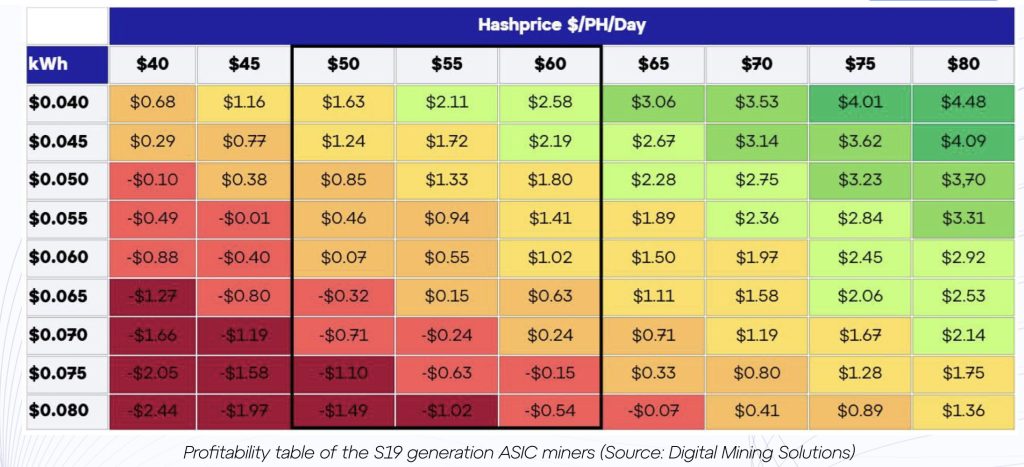
While the S19 has been a workhorse since its release five years ago, it is now a liability for many mining farms. The narrowing profit margins are an indicator of how quickly economic viability can shift, particularly in an industry facing both internal halving events and external competition from AI infrastructure players, GoMining Institutional reports.

Outlook: More Than Just Block Rewards

The report concludes that the first half of 2025 has revealed that Bitcoin mining is no longer a closed system. It’s now a frontline industry operating at the intersection of capital, energy, and compute.

As the network seeks equilibrium after April’s halving, miners must make tough decisions about scale, strategy, and survival.

The second half of the year promises no less intensity—but the winners will be those who can work within capital markets as well as they can manage hashpower.


Market Opportunity
Threshold Logo
Threshold Price(T)
$0.005977
$0.005977$0.005977
-1.19%
USD
Threshold (T) Live Price Chart
Disclaimer: The articles reposted on this site are sourced from public platforms and are provided for informational purposes only. They do not necessarily reflect the views of MEXC. All rights remain with the original authors. If you believe any content infringes on third-party rights, please contact crypto.news@mexc.com for removal. MEXC makes no guarantees regarding the accuracy, completeness, or timeliness of the content and is not responsible for any actions taken based on the information provided. The content does not constitute financial, legal, or other professional advice, nor should it be considered a recommendation or endorsement by MEXC.

You May Also Like

Rachel Maddow spots terrifying trend for GOP as Trump rocked by 'Red State spring'

Rachel Maddow spots terrifying trend for GOP as Trump rocked by 'Red State spring'

MS NOW's Rachel Maddow identified a fascinating trend in this month's No Kings protests against President Donald Trump — and one that should leave the Republican
Share
Rawstory2026/03/31 09:52
China’s NBS Manufacturing and Non-Manufacturing PMIs return to expansion in March

China’s NBS Manufacturing and Non-Manufacturing PMIs return to expansion in March

The post China’s NBS Manufacturing and Non-Manufacturing PMIs return to expansion in March appeared on BitcoinEthereumNews.com. China’s Manufacturing Purchasing
Share
BitcoinEthereumNews2026/03/31 10:11
The Fed Just Changed Everything For Crypto, Says Top Trader

The Fed Just Changed Everything For Crypto, Says Top Trader

The Federal Reserve’s first rate cut of 2025 has landed—25 basis points on September 17—and, in Trader Mayne’s telling, that removes the last macro “X-factor” hanging over the crypto market. In a video analysis posted the same day, the veteran price-action trader argued that with the policy move now in the rear-view mirror, crypto can “just focus on the charts,” sketching a roadmap in which Bitcoin posts one more leg higher into new all-time highs before a pullback ushers in a classic altseason blow-off. “We had FOMC today and the rates got cut finally… It’s 25 basis points,” he said. “Now the market’s going to digest it.” Where Is Bitcoin Price Going Next? The policy backdrop he’s reacting to is straightforward: the FOMC lowered the fed funds target range by a quarter point to 4.00%–4.25% on Sept. 17, with Chair Jerome Powell describing the move as a risk-management response to weakening labor dynamics and leaving the door open to additional easing this year. The decision drew an 11–1 vote, with newly appointed Governor Stephen Miran dissenting in favor of a larger, 50 bps cut—an unusually hawkish dissent in a dovish direction—while the Board’s implementation note reset key administered rates effective Sept. 18. Markets read the statement and projections as signaling scope for further cuts into year-end. Related Reading: Crucial Ten Days Ahead For Crypto: Will They Ignite Mega Altcoin Season? From here, Mayne’s framework is unapologetically technical. He characterizes Bitcoin’s most recent upswing as corrective relative to the prior impulse and expects price to “push above the mid-range” toward a range high around $120,000–$121,000, where he will watch for rejection at a higher-time-frame confluence defined by a weekly swing-failure pattern (SFP) and an H12 breaker. If momentum stalls there, he plans to short into a washout to clear out built-up leverage—“HYPE made another all-time high today. PUMP has tripled in the last two weeks… there’s some leverage in the system”—and then buy the dip for what he calls the last parabolic leg of the cycle. “Any sort of dip on BTC, I want to be looking for a long,” he said, adding that a shallow retest in the $110,000–$111,000 area or a deeper sweep of recent lows would both be acceptable springboards if the rebound is decisive. If, instead, price grinds through the $120,000 s with no signs of exhaustion, Mayne says he has “no problem” flipping to breakout longs above the all-time high once strength is confirmed intraday—an approach that mirrors his playbook from prior expansions (“Once this thing broke out aggressively… you’re looking for longs”). He emphasizes sequence over prediction: the short he’s eyeing is counter-trend—“a pullback in an uptrend”—and the prime objective remains to position for the next impulsive advance. When Will The Crypto Market Top? Timing-wise, he situates the prospective cycle top in Q4 2025 or Q1 2026, describing a pattern in which Bitcoin’s final vertical leg into the $150,000 to $180,000 region is followed by distribution while altcoins reprice higher—the archetypal altseason. “This parabolic leg I think would be the last leg of the bull run,” he said, before outlining notional alt targets consistent with a late-cycle melt-up: Ethereum $5,000–$7,000, Solana $300–$500, Dogecoin $0.50–$0.70. The mechanics, as he narrates them: a last BTC push, a corrective wash, a V-shaped reclaim of the 2024 ATH “very quickly,” then Q4 “mania” with breadth shifting to large-cap alts as Bitcoin distributes. Related Reading: December 2024 Crypto Crash Signal Returns As Altcoins Go Wild The technical scaffolding behind that view leans on concepts familiar to discretionary price-action traders. Weekly SFPs (failed breaks of prior extremes) set the trap line at range edges; H12 breakers and order blocks frame high-probability reaction zones; and fair-value gaps guide where liquidity vacuums might fill during a corrective flush. On structure, he insists the weekly trend remains up, so any short is tactical and any deeper dip must resolve in a swift V-bottom and reclaim of the former highs to keep the cyclical script intact. His invalidation is equally clear: “If we spend any significant time back below [the 2024 all-time high], it’s really bad… I’m probably going to reassess my thoughts.” Macro, in Mayne’s view, now recedes to the background. The rate cut may have helped pull forward some September strength—“you could argue… the up move we’ve seen on Bitcoin… is in anticipation of this rate cut”—but with the decision made and Powell hinting there “could be another one… there could be two,” his emphasis is squarely on execution: wait for price to trade into the $120,000s and signal weakness for the clean counter-trend short; or, absent weakness, wait for the breakout continuation and ride it. Either way, he’s explicit about the north star for the coming weeks: “Focus on Bitcoin… Any sort of dip on BTC, I want to be looking for a long… Then altseason.” At press time, BTC traded at $117,176. Featured image created with DALL.E, chart from TradingView.com
Share
NewsBTC2025/09/18 20:00