While non-fungible token (NFT) sales may not carry the same heat they once did, the NFT arena has still tallied $71.55 billion in lifetime sales since 2017. Metrics also reveal that 64.78% of those sales came from Ethereum-based NFTs. Digital Collectibles Still Command Sales Volume, but the Sector Is Morphing During the 2017 bull run, […]While non-fungible token (NFT) sales may not carry the same heat they once did, the NFT arena has still tallied $71.55 billion in lifetime sales since 2017. Metrics also reveal that 64.78% of those sales came from Ethereum-based NFTs. Digital Collectibles Still Command Sales Volume, but the Sector Is Morphing During the 2017 bull run, […]

NFTs Are Down but Not Out: $3.62B Already Sold in 2025

For feedback or concerns regarding this content, please contact us at crypto.news@mexc.com

While non-fungible token (NFT) sales may not carry the same heat they once did, the NFT arena has still tallied $71.55 billion in lifetime sales since 2017. Metrics also reveal that 64.78% of those sales came from Ethereum-based NFTs.

Digital Collectibles Still Command Sales Volume, but the Sector Is Morphing

During the 2017 bull run, NFTs barely made a dent, with sales totaling just over $143,000, according to cryptoslam.io stats. The following year, 2018, brought $1.5 million. By 2019, sales doubled to $3.75 million, and in 2020 they climbed to a much higher $22.25 million. Then came 2021, when NFTs truly caught fire during the bull run, racking up $15.7 billion in sales volume. In 2022, the sector pushed even higher, reaching $23.77 billion.
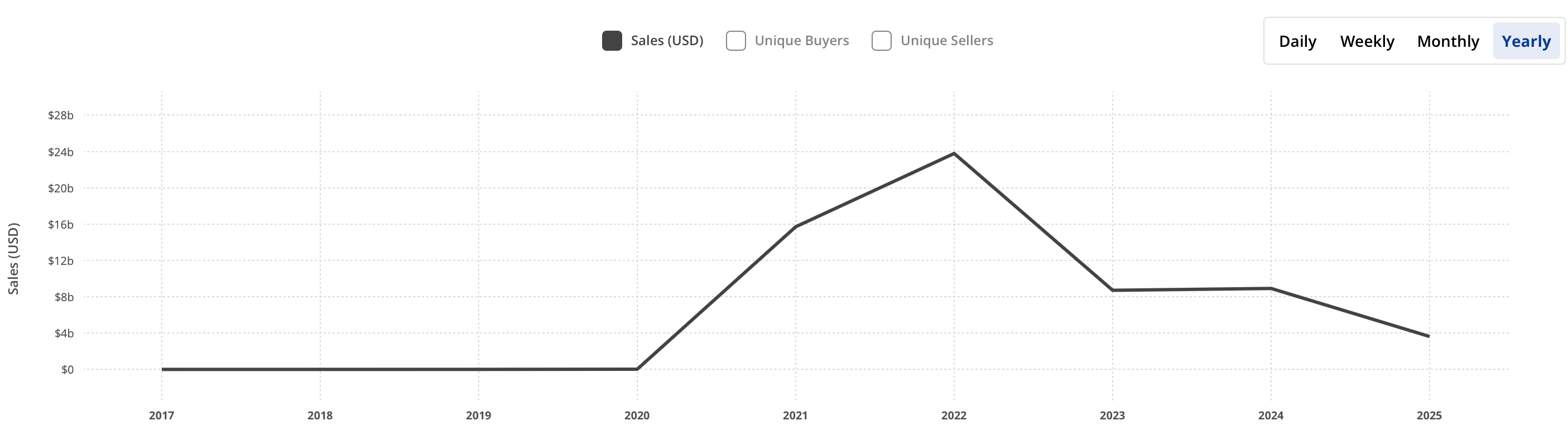
In 2023, the party came to an abrupt end as sales tumbled 63.4% to just $8.7 billion. The next year brought a slight bounce, with totals reaching $8.91 billion in 2024. So far in 2025, the tally stands at $3.62 billion in NFT sales. As of Aug. 19, 2025, total sales have reached $71.55 billion, with $46.35 billion of that tied to Ethereum-based NFTs. In fact, Ethereum recorded $80.95 billion overall, though $34.59 billion of that volume was wash trading NFTs.
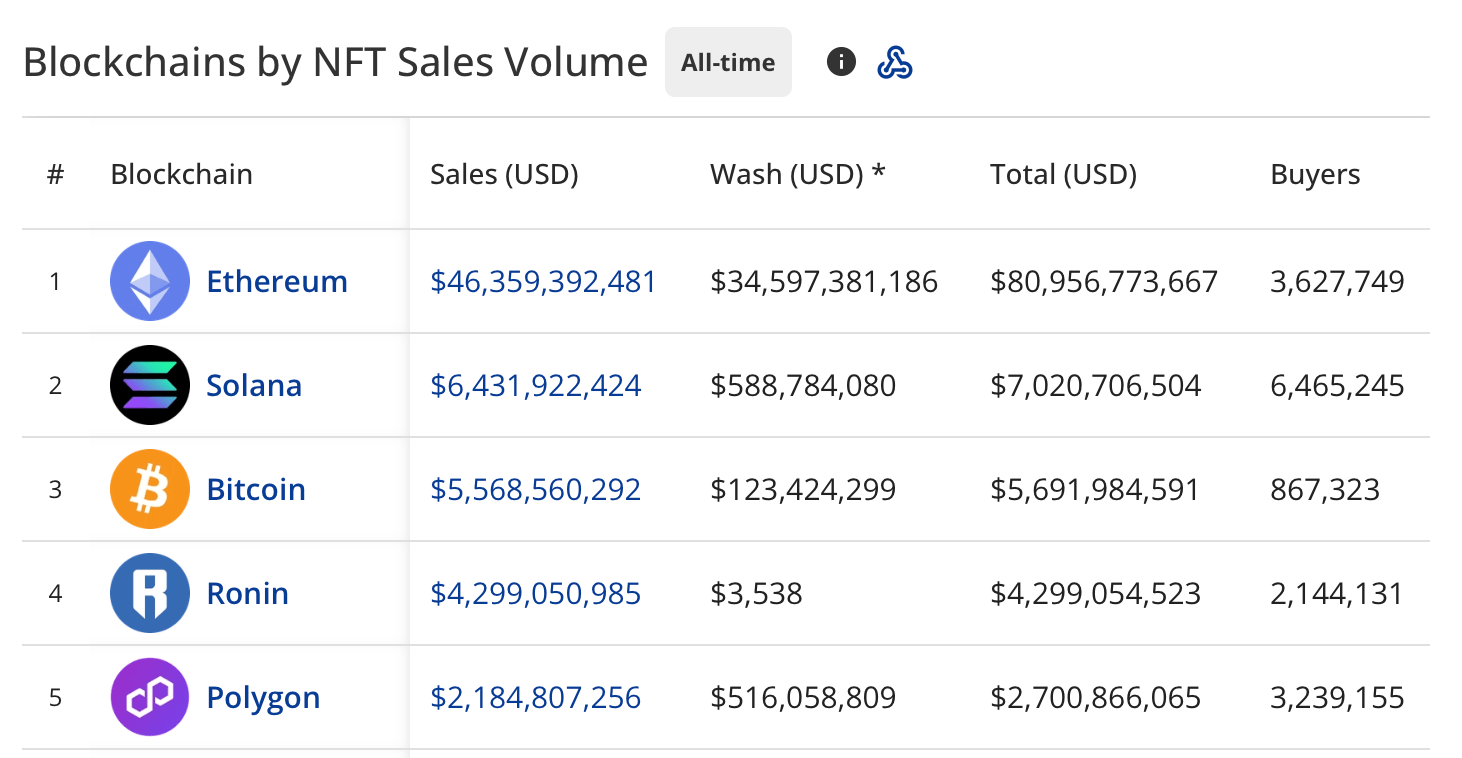
A wash trade is when the same party simultaneously buys and sells an asset or NFT to artificially inflate trading volume or manipulate prices. Solana has logged $7.02 billion in total sales, with $588 million flagged as illegitimate wash trades. That leaves Solana, the second-place contender, with $6.43 billion in legit NFT sales volume. Bitcoin ranks third with $5.69 billion in total sales, $123 million of which were wash trades.

That brings its adjusted total to $5.56 billion—a notable figure given that the bulk of these Bitcoin-based NFT sales have occurred more recently, following the 2021 and 2022 digital collectible sales highs. Ronin holds the fourth spot in overall sales, with the Axie Infinity-linked chain recording $4.29 billion in lifetime NFT sales. Wash trading on Ronin is almost negligible, totaling just $3,538 since inception.

Axie Infinity’s marketplace and in-game NFTs come with design and economic limits that make wash trading and self-dealing strategies hard to pull off. Polygon, meanwhile, has seen $2.7 billion in total NFT sales, with $516 million tied to wash trades, leaving a genuine $2.18 billion. Just below Polygon, in sixth place, is Flow with roughly $1.53 billion in digital collectible sales.

Flow has logged an estimated $18.27 million in wash trades, giving it a final tally of $1.52 billion in legitimate NFT sales. Trailing Flow are Immutable, Mythos, Cardano, and BNB Chain, rounding out the top ten blockchains by NFT sales. While NFTs may not match their euphoric highs, their presence in digital culture still appears durable.

With 134 days left in 2025, the market would need another $5.29 billion in sales—an average of $39.48 million per day—to match 2024’s total of $8.91 billion. Hitting $10 billion this year would require $47.61 million daily, or 1.57× the current pace. To top 2022’s all-time high, however, daily sales would need to jump to more than four times today’s rate.

Sales distribution across multiple chains demonstrates a broader experiment in digital ownership, one that continues to attract interest despite setbacks. As speculative activity fades, the remaining ecosystem could evolve toward more practical applications, morphing and reshaping expectations for what NFTs ultimately represent in global markets.


Disclaimer: The articles reposted on this site are sourced from public platforms and are provided for informational purposes only. They do not necessarily reflect the views of MEXC. All rights remain with the original authors. If you believe any content infringes on third-party rights, please contact crypto.news@mexc.com for removal. MEXC makes no guarantees regarding the accuracy, completeness, or timeliness of the content and is not responsible for any actions taken based on the information provided. The content does not constitute financial, legal, or other professional advice, nor should it be considered a recommendation or endorsement by MEXC.

You May Also Like

Hong Kong Backs Commercial Bank Tokenized Deposits in 2025

Hong Kong Backs Commercial Bank Tokenized Deposits in 2025

The post Hong Kong Backs Commercial Bank Tokenized Deposits in 2025 appeared on BitcoinEthereumNews.com. HKMA to support tokenized deposits and regular issuance of digital bonds. SFC drafting licensing framework for trading, custody, and stablecoin issuers. New rules will cover stablecoin issuers, digital asset trading, and custody services. Hong Kong is stepping up its digital finance ambitions with a policy blueprint that places tokenization at the core of banking innovation.  In the 2025 Policy Address, Chief Executive John Lee outlined measures that will see the Hong Kong Monetary Authority (HKMA) encourage commercial banks to roll out tokenized deposits and expand the city’s live tokenized-asset transactions. Hong Kong’s Project Ensemble to Drive Tokenized Deposits Lee confirmed that the HKMA will “continue to take forward Project Ensemble, including encouraging commercial banks to introduce tokenised deposits, and promoting live transactions of tokenised assets, such as the settlement of tokenised money market funds with tokenised deposits.” The initiative aims to embed tokenized deposits, bank liabilities represented as blockchain-based tokens, into mainstream financial operations. These deposits could facilitate the settlement of money-market funds and other financial instruments more quickly and efficiently. To ensure a controlled rollout, the HKMA will utilize its regulatory sandbox to enable banks to test tokenized products while enhancing risk management. Tokenized Bonds to Become a Regular Feature Beyond deposits, the government intends to make tokenized bond issuance a permanent element of Hong Kong’s financial markets. After successful pilots, including green bonds, the HKMA will help regularize the issuance process to build deep and liquid markets for digital bonds accessible to both local and international investors. Related: Beijing Blocks State-Owned Firms From Stablecoin Businesses in Hong Kong Hong Kong’s Global Financial Role The policy address also set out a comprehensive regulatory framework for digital assets. Hong Kong is implementing a regime for stablecoin issuers and drafting licensing rules for digital asset trading and custody services. The Securities…
Share
BitcoinEthereumNews2025/09/18 07:10
TRX Price Prediction: Testing $0.32-$0.35 Resistance Zone as Technical Momentum Builds

TRX Price Prediction: Testing $0.32-$0.35 Resistance Zone as Technical Momentum Builds

TRON (TRX) consolidates at $0.28 with neutral RSI signals. Technical analysis suggests potential breakout toward $0.32-$0.35 resistance zone amid mixed momentum
Share
BlockChain News2026/03/04 15:57
Pi Network DEX Launch Confirmed for March 12, 2026: A New Chapter for Picoin and Web3 Trading

Pi Network DEX Launch Confirmed for March 12, 2026: A New Chapter for Picoin and Web3 Trading

    Pi Network has officially confirmed the launch date of its decentralized exchange (DEX), scheduled for Marc
Share
Hokanews2026/03/04 15:52