Bitcoin’s near-term path, argues macro commentator Bruce Florian–founder of the Bitcoin Self-Custody Company Schwarzberg and a bestselling author–is being set far from crypto order books and deep inside the US money markets, where a once-enormous pool of excess cash has finally run dry. In a thread on X, Florian frames the Federal Reserve’s overnight reverse repo facility (RRP) as the “surplus pot” that quietly powered asset prices for two years—and now, with that pot empty, he believes markets are about to feel the unfiltered weight of tighter liquidity. Why This Means Pain For Bitcoin Florian starts by locating the inflection point: “The reverse repo facility (RRP) is at its lowest level in four years.” He then walks through the basic plumbing. During the pandemic response, “so much money was printed… there were fewer assets than excess cash,” so banks and money funds “parked [it] with the Fed in the RRP. Safe and earning interest.” As that pool drained, it didn’t disappear—it “was continuously pumped into the market over the last few years. Mainly into government bonds.” In his accounting, “around $2 trillion in excess liquidity from 2020/21 flowed into the market over the last 24 months,” keeping valuations buoyant despite higher policy rates and formal quantitative tightening. Related Reading: Is The Bitcoin Treasury Bubble Popping? Expert Answers The metaphor he uses is deliberate and evocative: “It’s like a tanker traveling at full speed. Even if you turn off the engine, it will continue to drift for many kilometers, solely due to the speed it has built up.” For Florian, that drift—the lagged effect of past liquidity—is ending. “Now the propulsion is gone. The surplus pot is empty, and the tanker comes to a standstill.” He connects that mechanical turn to the looming supply calendar: “There are still trillions in government bonds that need to be purchased in the coming months and years.” With the RRP no longer acting as a buyer of first resort, “we will feel the full brunt of the reduced liquidity since 2022.” The near-term cross-asset message is unambiguous. “This is bad for stocks, bonds, and Bitcoin in the short term,” he writes, adding that “stocks and Bitcoin can afford short respites… bonds cannot.” The constraint, in his view, is structural: “The US bond market is the most important market in the world.” If the RRP isn’t there to absorb cash and recycle it into Treasuries, “bond yields will continue to rise to attract investors.” Related Reading: Bitcoin Bull Run Hinges On Trump’s Pick For Fed Chair: Analyst That dynamic, he warns, collides with political and macro limits: “interest rates are already far too high for the current administration.” His base case is that the central bank ultimately has to step in: “The Fed will likely intervene and rescue the bond market by providing new liquidity.” The path from here is “unclear… in the short term,” but the contours of the pressure are, in his telling, set by the plumbing. Florian repeatedly stresses that any turbulence should not be misread as a Bitcoin-native failure. “The turmoil is once again coming from the fiat system, not from Bitcoin. Bitcoin merely reflects this development with its volatility.” That framing places Bitcoin downstream of dollar liquidity rather than in opposition to it. The market, he cautions, will “do everything it can to drive you out of your position.” His counsel for positioning is psychological as much as financial: “If you know what you own, you can stay relaxed.” The long-term thesis remains intact in his mind—“Remember where Bitcoin is headed as an ideal store of value”—but navigating the next phase requires horizon discipline: “Because if you keep your eyes on the horizon, you won’t get seasick.” At press time, BTC traded at $113,736. Featured image created with DALL.E, chart from TradingView.comBitcoin’s near-term path, argues macro commentator Bruce Florian–founder of the Bitcoin Self-Custody Company Schwarzberg and a bestselling author–is being set far from crypto order books and deep inside the US money markets, where a once-enormous pool of excess cash has finally run dry. In a thread on X, Florian frames the Federal Reserve’s overnight reverse repo facility (RRP) as the “surplus pot” that quietly powered asset prices for two years—and now, with that pot empty, he believes markets are about to feel the unfiltered weight of tighter liquidity. Why This Means Pain For Bitcoin Florian starts by locating the inflection point: “The reverse repo facility (RRP) is at its lowest level in four years.” He then walks through the basic plumbing. During the pandemic response, “so much money was printed… there were fewer assets than excess cash,” so banks and money funds “parked [it] with the Fed in the RRP. Safe and earning interest.” As that pool drained, it didn’t disappear—it “was continuously pumped into the market over the last few years. Mainly into government bonds.” In his accounting, “around $2 trillion in excess liquidity from 2020/21 flowed into the market over the last 24 months,” keeping valuations buoyant despite higher policy rates and formal quantitative tightening. Related Reading: Is The Bitcoin Treasury Bubble Popping? Expert Answers The metaphor he uses is deliberate and evocative: “It’s like a tanker traveling at full speed. Even if you turn off the engine, it will continue to drift for many kilometers, solely due to the speed it has built up.” For Florian, that drift—the lagged effect of past liquidity—is ending. “Now the propulsion is gone. The surplus pot is empty, and the tanker comes to a standstill.” He connects that mechanical turn to the looming supply calendar: “There are still trillions in government bonds that need to be purchased in the coming months and years.” With the RRP no longer acting as a buyer of first resort, “we will feel the full brunt of the reduced liquidity since 2022.” The near-term cross-asset message is unambiguous. “This is bad for stocks, bonds, and Bitcoin in the short term,” he writes, adding that “stocks and Bitcoin can afford short respites… bonds cannot.” The constraint, in his view, is structural: “The US bond market is the most important market in the world.” If the RRP isn’t there to absorb cash and recycle it into Treasuries, “bond yields will continue to rise to attract investors.” Related Reading: Bitcoin Bull Run Hinges On Trump’s Pick For Fed Chair: Analyst That dynamic, he warns, collides with political and macro limits: “interest rates are already far too high for the current administration.” His base case is that the central bank ultimately has to step in: “The Fed will likely intervene and rescue the bond market by providing new liquidity.” The path from here is “unclear… in the short term,” but the contours of the pressure are, in his telling, set by the plumbing. Florian repeatedly stresses that any turbulence should not be misread as a Bitcoin-native failure. “The turmoil is once again coming from the fiat system, not from Bitcoin. Bitcoin merely reflects this development with its volatility.” That framing places Bitcoin downstream of dollar liquidity rather than in opposition to it. The market, he cautions, will “do everything it can to drive you out of your position.” His counsel for positioning is psychological as much as financial: “If you know what you own, you can stay relaxed.” The long-term thesis remains intact in his mind—“Remember where Bitcoin is headed as an ideal store of value”—but navigating the next phase requires horizon discipline: “Because if you keep your eyes on the horizon, you won’t get seasick.” At press time, BTC traded at $113,736. Featured image created with DALL.E, chart from TradingView.com

Bitcoin Braces For Pain As $2 Trillion Liquidity Engine Shuts Off

2025/08/21 18:00

Bitcoin’s near-term path, argues macro commentator Bruce Florian–founder of the Bitcoin Self-Custody Company Schwarzberg and a bestselling author–is being set far from crypto order books and deep inside the US money markets, where a once-enormous pool of excess cash has finally run dry. In a thread on X, Florian frames the Federal Reserve’s overnight reverse repo facility (RRP) as the “surplus pot” that quietly powered asset prices for two years—and now, with that pot empty, he believes markets are about to feel the unfiltered weight of tighter liquidity.

Why This Means Pain For Bitcoin

Florian starts by locating the inflection point: “The reverse repo facility (RRP) is at its lowest level in four years.” He then walks through the basic plumbing. During the pandemic response, “so much money was printed… there were fewer assets than excess cash,” so banks and money funds “parked [it] with the Fed in the RRP. Safe and earning interest.” As that pool drained, it didn’t disappear—it “was continuously pumped into the market over the last few years. Mainly into government bonds.” In his accounting, “around $2 trillion in excess liquidity from 2020/21 flowed into the market over the last 24 months,” keeping valuations buoyant despite higher policy rates and formal quantitative tightening.

The metaphor he uses is deliberate and evocative: “It’s like a tanker traveling at full speed. Even if you turn off the engine, it will continue to drift for many kilometers, solely due to the speed it has built up.” For Florian, that drift—the lagged effect of past liquidity—is ending. “Now the propulsion is gone. The surplus pot is empty, and the tanker comes to a standstill.”

He connects that mechanical turn to the looming supply calendar: “There are still trillions in government bonds that need to be purchased in the coming months and years.” With the RRP no longer acting as a buyer of first resort, “we will feel the full brunt of the reduced liquidity since 2022.”

The near-term cross-asset message is unambiguous. “This is bad for stocks, bonds, and Bitcoin in the short term,” he writes, adding that “stocks and Bitcoin can afford short respites… bonds cannot.” The constraint, in his view, is structural: “The US bond market is the most important market in the world.” If the RRP isn’t there to absorb cash and recycle it into Treasuries, “bond yields will continue to rise to attract investors.”

That dynamic, he warns, collides with political and macro limits: “interest rates are already far too high for the current administration.” His base case is that the central bank ultimately has to step in: “The Fed will likely intervene and rescue the bond market by providing new liquidity.” The path from here is “unclear… in the short term,” but the contours of the pressure are, in his telling, set by the plumbing.

Florian repeatedly stresses that any turbulence should not be misread as a Bitcoin-native failure. “The turmoil is once again coming from the fiat system, not from Bitcoin. Bitcoin merely reflects this development with its volatility.” That framing places Bitcoin downstream of dollar liquidity rather than in opposition to it.

The market, he cautions, will “do everything it can to drive you out of your position.” His counsel for positioning is psychological as much as financial: “If you know what you own, you can stay relaxed.” The long-term thesis remains intact in his mind—“Remember where Bitcoin is headed as an ideal store of value”—but navigating the next phase requires horizon discipline: “Because if you keep your eyes on the horizon, you won’t get seasick.”

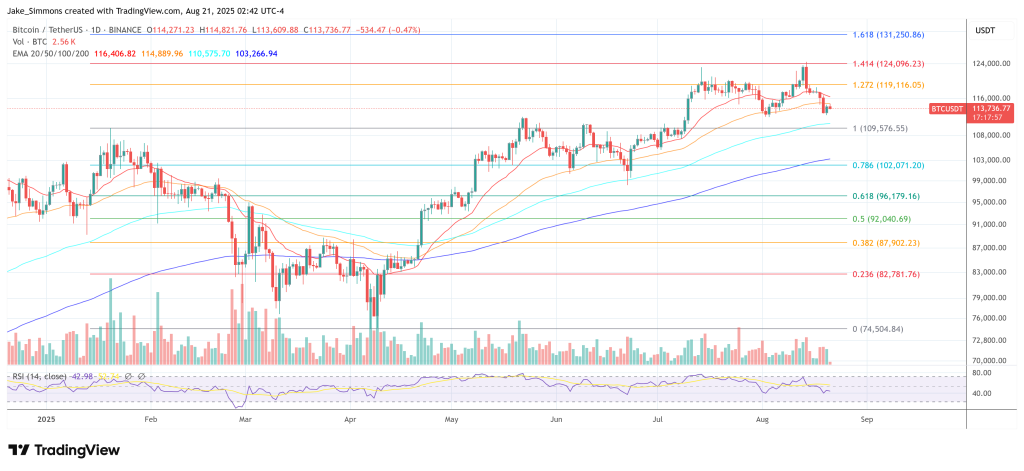
At press time, BTC traded at $113,736.

Bitcoin price
Market Opportunity
NEAR Logo
NEAR Price(NEAR)
$1.887
$1.887$1.887
+4.13%
USD
NEAR (NEAR) Live Price Chart
Disclaimer: The articles reposted on this site are sourced from public platforms and are provided for informational purposes only. They do not necessarily reflect the views of MEXC. All rights remain with the original authors. If you believe any content infringes on third-party rights, please contact service@support.mexc.com for removal. MEXC makes no guarantees regarding the accuracy, completeness, or timeliness of the content and is not responsible for any actions taken based on the information provided. The content does not constitute financial, legal, or other professional advice, nor should it be considered a recommendation or endorsement by MEXC.

You May Also Like

XRP Delivers Impressive ETF Volumes But Digitap ($TAP) is the King of Cross-Border Payments in 2026

XRP Delivers Impressive ETF Volumes But Digitap ($TAP) is the King of Cross-Border Payments in 2026

XRP has dominated crypto headlines recently. Spot XRP ETFs brought over $1 billion in institutional inflows, and total ETF-held assets now sit at $1.47 billion.
Share
Brave Newcoin2026/01/14 03:58
Strive Completes Acquisition of Bitcoin Treasury Firm Semler

Strive Completes Acquisition of Bitcoin Treasury Firm Semler

The post Strive Completes Acquisition of Bitcoin Treasury Firm Semler appeared on BitcoinEthereumNews.com. Strive Inc. (ASST) and Semler scientific (SMLR) were
Share
BitcoinEthereumNews2026/01/14 04:29
Wormhole token soars following tokenomics overhaul, W reserve launch

Wormhole token soars following tokenomics overhaul, W reserve launch

                                                                               Wormhole’s native token has had a tough time since launch, debuting at $1.66 before dropping significantly despite the general crypto market’s bull cycle.                     Wormhole, an interoperability protocol facilitating asset transfers between blockchains, announced updated tokenomics to its native Wormhole (W) token, including a token reserve and more yield for stakers. The changes could affect the protocol’s governance, as staked Wormhole tokens allocate voting power to delegates.According to a Wednesday announcement, three main changes are coming to the Wormhole token: a W reserve funded with protocol fees and revenue, a 4% base yield for staking with higher rewards for active ecosystem participants, and a change from bulk unlocks to biweekly unlocks.“The goal of Wormhole Contributors is to significantly expand the asset transfer and messaging volume that Wormhole facilitates over the next 1-2 years,” the protocol said. According to Wormhole, more tokens will be locked as adoption takes place and revenue filters back to the company.Read more
Share
Coinstats2025/09/18 02:41