On July 18, 2025, the United States signed into law the Guidance and Establishment of National Innovations for U.S. Stablecoins Act (GENIUS). This marked a turning point, pushing retail interest in stablecoins to an entirely new level.   At the same time, the total market capitalization of stablecoins hit a historic peak, surpassing $274 billion […] Сообщение A Synthetic Dollar for Institutions: The Falcon Finance Model появились сначала на INCRYPTED.On July 18, 2025, the United States signed into law the Guidance and Establishment of National Innovations for U.S. Stablecoins Act (GENIUS). This marked a turning point, pushing retail interest in stablecoins to an entirely new level.   At the same time, the total market capitalization of stablecoins hit a historic peak, surpassing $274 billion […] Сообщение A Synthetic Dollar for Institutions: The Falcon Finance Model появились сначала на INCRYPTED.

A Synthetic Dollar for Institutions: The Falcon Finance Model

In this article:

1. Falcon Finance: How It Works

2. Falcon Miles Loyalty Program

3. Funding

4. The Future of Falcon Finance

On July 18, 2025, the United States signed into law the Guidance and Establishment of National Innovations for U.S. Stablecoins Act (GENIUS). This marked a turning point, pushing retail interest in stablecoins to an entirely new level.  

At the same time, the total market capitalization of stablecoins hit a historic peak, surpassing $274 billion at the time of writing. 

Riding this wave of growing demand for “digital dollars,” new solutions are entering the market — one of the most notable being Falcon Finance.In just a few months since launch, Falcon’s synthetic stablecoin, USDf, has already exceeded $1 billion in circulation, placing it among the top ten products in the sector. Behind the project is DWF Labs, one of the most active — and most controversial — investment firms in the crypto industry.

Despite the controversial reputation of its founders — including Andrey Grachev — it’s becoming increasingly difficult to ignore Falcon Finance’s momentum. The company’s recent announcement of a strategic partnership with  World Liberty Financial adds a political dimension to an already intriguing story. 

The Incrypted editorial team took a closer look at what Falcon Finance is building and the opportunities it offers to users.


  • The protocol is built around two key assets: the U.S. dollar–pegged stablecoin USDf and its yield-bearing counterpart sUSDf, which is issued by locking the base token.
  • Falcon Finance allows users to mint stablecoins not only against other “stables” but also by using volatile assets as collateral. The platform supports two minting mechanisms—one traditional and the other “innovative.”
  • Holders of sUSDf earn yield generated by Falcon Finance’s underlying engine, which executes a range of operations such as funding rate arbitrage and staking.
  • Looking ahead, the project’s roadmap envisions building infrastructure that unites cryptocurrencies, real-world assets (RWA), and capital markets into a single system.

Falcon Finance presents itself as a next-generation protocol, aiming to evolve into a full-fledged financial institution that bridges traditional banking, centralized crypto platforms, and decentralized finance. 

DWF Labs co-founder Andrei Grachev first introduced the project in October 2024, describing it as a yield-generating synthetic stablecoin.

At the start of 2025, the Falcon Finance team launched a beta version of the product. 

What Are USDf and sUSDf?

USDf is Falcon Finance’s U.S. dollar–pegged stablecoin, maintained at a 1:1 ratio with the dollar. It is issued by locking supported assets as collateral.
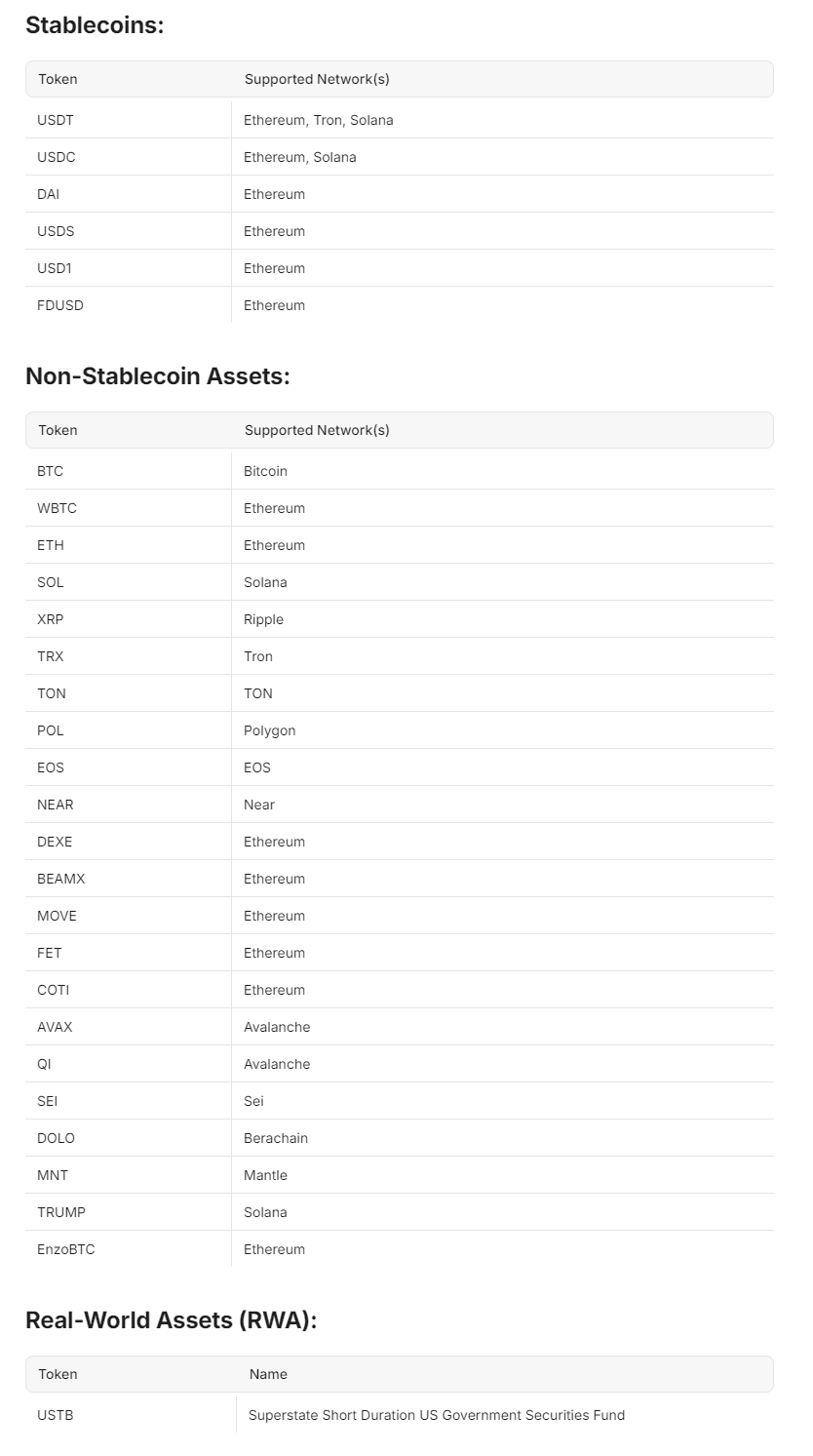
Assets Supported by Falcon Finance. Source: Falcon Finance.

Falcon Finance offers two minting mechanisms: the classic and the “innovative” model.

Classic Mint

The minimum collateral requirement is $10,000 in supported stablecoins or volatile assets.

When using volatile assets, an overcollateralization ratio is applied, varying depending on the risk profile of the asset.

When collateralized with stablecoins, users receive USDf at a 1:1 ratio.

“Innovative” Mint

The minimum collateral requirement is $50,000 in supported volatile assets.

This mechanism provides partial exposure to upside price movement. Funds are locked for a fixed term ranging from 3 to 12 months. During issuance, users must specify parameters such as:

  • lock-up period,
  • capital efficiency level,
  • strike price multiplier.

These parameters determine the amount of USDf issued, the liquidation price, and the strike price.

Collateral is monitored throughout the lock-up period, leading to three possible scenarios:

  1. If the collateral price falls below liquidation at any point: the user forfeits the collateral to protect the protocol, but keeps the issued USDf, which can be redeemed for supported stablecoins like USDT or USDC.
  2. If the collateral price stays between liquidation and strike until maturity: the user can reclaim the original collateral by returning the issued USDf — regaining the asset while still having had access to liquidity in USDf during the lock-up.
  3. If the collateral price rises above the strike before or at maturity: the user forfeits the collateral but receives an additional payout in USDf, calculated as:

(strike price × collateral amount) – issued USDf

sUSDf is a yield-bearing token (ERC-4626 standard) issued when USDf is locked. Its value increases over time as the protocol generates revenue through Falcon Finance’s institutional strategies.

The yield comes from a range of operations managed by the Falcon engine. 

 Revenue Strategies

Positive funding rate arbitrage. Falcon Finance generates income by holding spot positions while simultaneously opening shorts on corresponding perpetual futures. The spot assets are then staked, adding an extra layer of yield.

Negative funding rate arbitrage. In this case, the engine sells spot assets and opens long positions on futures contracts.

Cross-exchange arbitrage. Falcon Finance buys and sells assets across different markets, profiting from price discrepancies.

Altcoin staking. The protocol leverages staking opportunities for supported volatile assets, earning on-chain rewards.

Liquidity pools. A portion of assets is allocated to liquidity pools, generating returns through arbitrage and trading activity on decentralized exchanges.

Roadmap

On July 29, 2025, Falcon Finance unveiled its roadmap for the next 18 months. The plan outlines the creation of an efficient infrastructure that integrates cryptocurrencies, tokenized real-world assets (RWA), and capital markets into a unified system. 

Priorities for 2025

In 2025, the Falcon Finance team is focused on bridging crypto liquidity with traditional financial infrastructure. Key initiatives include:

  • Opening regulated fiat gateways in Latin America, Turkey, the Middle East, North Africa, and the Eurozone to ensure 24/7 liquidity for USDf.
  • Introducing the option for physical gold redemption in the UAE.
  • Expanding collateral options to include fiat currencies, RWA, and gold.

Initiatives for 2026

The 2026 roadmap emphasizes infrastructure expansion for deeper RWA integration and stronger institutional participation. Core initiatives include:

  • Geographic expansion, with support for gold-backed collateral in the MENA region and Hong Kong.
    Launching the Falcon RWA Tokenization Engine, a tool for tokenizing real-world assets.
  • Adding support for tokenized corporate bonds, equities, treasuries, and private credit as eligible collateral.
  • Expanding USDf’s integration with traditional financial platforms.
  • Issuing a securitized version of USDf through an SPV (special purpose vehicle), enabling institutional investors to adopt the asset within regulated infrastructure.
  • Rolling out flexible investment products based on USDf, offering regulated infrastructure and institutional-grade reporting.

The pilot season of Falcon Miles is designed to incentivize key actions within the Falcon app and broader DeFi activity. Users can earn Miles in several ways: 

  • Minting, locking, and holding USDf.
  • Providing USDf liquidity on supported DEXs: Uniswap, Curve, Balancer, PancakeSwap, and Bunni.
  • Depositing USDf, sUSDf, or USDC into Morpho and Euler protocols.
  • Tokenizing yield through Pendle, Spectra, and Napier.
  • Bringing in new users via the referral program.
  • Completing Falcon community social tasks.
  • Trading within designated DEX pools.

Falcon Miles operates on a multiplier system: points are awarded for each of the above actions based on their dollar value — either by the amount of USDf issued or the total collateral locked.

In late July 2025, DeFi project Falcon Finance announced it had secured $10 million in strategic investments from World Liberty Financial. 

That same month, Falcon Finance reported significant growth across its core metrics.

Total USDf Issuance

On June 9, 2025, the total issuance of USDf surpassed $500 million. Just five weeks later, it had climbed to $600 million. And on the eve of announcing its strategic partnership with World Liberty Financial, Falcon Finance reported crossing the $1 billion milestone. 

Total Issuance and Percentage of Locked USDf. Source: Dune Analytics

As shown in the chart, the most significant surge in USDf issuance since the protocol’s launch occurred just before the announcement of the investment from World Liberty Financial.

User Count

As of August 6, 2025, the number of unique addresses interacting with Falcon Finance’s smart contracts surpassed 4,000.

Number of First-Time USDf Addresses. Source: Dune Analytics.

Temporary De-Pegging from the U.S. Dollar and Community Reactions

In the same month that Falcon Finance announced its $10 million investment from World Liberty Financial, another notable event occurred. USDf temporarily lost its peg to the U.S. dollar amid industry concerns over collateral quality.

Data from CoinMarketCap show that on July 8, USDf dropped to $0.9094. This decline sparked heightened attention from the DeFi community, with some industry observers questioning the token’s collateral and governance model. 

The analytics platform Parsec reported on X that on-chain liquidity for USDf had decreased. 

Daily USDf/USD Chart. Source: CoinMarketCap.

A developer using the pseudonym 0xlaw, who runs the yield farming protocol Stream Finance, accused Falcon Finance of “owing tens of millions of dollars” and labeled USDf a “scam.”

According to 0xlaw, USDf is allegedly backed by illiquid assets, including a large amount of MOVE tokens from Movement Network. Coinbase suspended  trading of MOVE in May 2025, citing non-compliance with listing standards. 

A risk assessment by the DeFi analytics group LlamaRisk revealed further red flags. The report notes that “the Falcon team holds unilateral control over the operational management of reserve assets.” It also raises concerns about potential overissuance: 

The synthetic stablecoin USDf combines overcollateralization mechanisms with multi-component revenue strategies. Its substantial liquidity (over $1 billion at the time of writing) and strategic investments from World Liberty Financial indicate strong demand for the instrument. 

However, risks remain. The association with World Liberty Financial, which is directly linked to Donald Trump, and DWF Labs co-founder Andrey Grachev draws additional attention from both media and regulators. 

Other risks include the dependence of yield on the performance and reliability of Falcon Finance’s engine strategies. Algorithm errors or unforeseen market events could result in losses rather than profits.

Moreover, the engine is managed by the project team, introducing a degree of centralization. Users must trust the developers regarding asset management and execution of trading strategies.

While prospects for integration with traditional banking and RWA are promising, they may require significant time and regulatory coordination. Ultimately, the future will reveal whether Falcon Finance can meet expectations and become a unifying, programmable layer in the evolving landscape of digital finance. 

Market Opportunity
The AI Prophecy Logo
The AI Prophecy Price(ACT)
$0.02537
$0.02537$0.02537
+1.31%
USD
The AI Prophecy (ACT) Live Price Chart
Disclaimer: The articles reposted on this site are sourced from public platforms and are provided for informational purposes only. They do not necessarily reflect the views of MEXC. All rights remain with the original authors. If you believe any content infringes on third-party rights, please contact service@support.mexc.com for removal. MEXC makes no guarantees regarding the accuracy, completeness, or timeliness of the content and is not responsible for any actions taken based on the information provided. The content does not constitute financial, legal, or other professional advice, nor should it be considered a recommendation or endorsement by MEXC.

You May Also Like

Ripple inches closer to full MiCA license to expand across EU via Luxembourg

Ripple inches closer to full MiCA license to expand across EU via Luxembourg

The post Ripple inches closer to full MiCA license to expand across EU via Luxembourg  appeared on BitcoinEthereumNews.com. Ripple has been making significant progress
Share
BitcoinEthereumNews2026/01/14 21:52
Best Crypto to Buy as Saylor & Crypto Execs Meet in US Treasury Council

Best Crypto to Buy as Saylor & Crypto Execs Meet in US Treasury Council

The post Best Crypto to Buy as Saylor & Crypto Execs Meet in US Treasury Council appeared on BitcoinEthereumNews.com. Michael Saylor and a group of crypto executives met in Washington, D.C. yesterday to push for the Strategic Bitcoin Reserve Bill (the BITCOIN Act), which would see the U.S. acquire up to 1M $BTC over five years. With Bitcoin being positioned yet again as a cornerstone of national monetary policy, many investors are turning their eyes to projects that lean into this narrative – altcoins, meme coins, and presales that could ride on the same wave. Read on for three of the best crypto projects that seem especially well‐suited to benefit from this macro shift:  Bitcoin Hyper, Best Wallet Token, and Remittix. These projects stand out for having a strong use case and high adoption potential, especially given the push for a U.S. Bitcoin reserve.   Why the Bitcoin Reserve Bill Matters for Crypto Markets The strategic Bitcoin Reserve Bill could mark a turning point for the U.S. approach to digital assets. The proposal would see America build a long-term Bitcoin reserve by acquiring up to one million $BTC over five years. To make this happen, lawmakers are exploring creative funding methods such as revaluing old gold certificates. The plan also leans on confiscated Bitcoin already held by the government, worth an estimated $15–20B. This isn’t just a headline for policy wonks. It signals that Bitcoin is moving from the margins into the core of financial strategy. Industry figures like Michael Saylor, Senator Cynthia Lummis, and Marathon Digital’s Fred Thiel are all backing the bill. They see Bitcoin not just as an investment, but as a hedge against systemic risks. For the wider crypto market, this opens the door for projects tied to Bitcoin and the infrastructure that supports it. 1. Bitcoin Hyper ($HYPER) – Turning Bitcoin Into More Than Just Digital Gold The U.S. may soon treat Bitcoin as…
Share
BitcoinEthereumNews2025/09/18 00:27
XRPL Validator Reveals Why He Just Vetoed New Amendment

XRPL Validator Reveals Why He Just Vetoed New Amendment

Vet has explained that he has decided to veto the Token Escrow amendment to prevent breaking things
Share
Coinstats2025/09/18 00:28