Key Takeaways: Ethereum’s recent outperformance has reignited interest in its role as infrastructure, particularly among structured treasury firms. Republic Technologies’ strategy focuses on yield through validators and derivatives rather than speculative accumulation. CEO Daniel Liu views Ethereum as a functional asset, distinct from Bitcoin’s store-of-value positioning. Ethereum has outperformed major tokens in recent weeks, with its ETH/BTC ratio climbing from 0.025 to nearly 0.04—an over 40% gain. Stablecoin volumes, validator activity, and tokenization pilots are intensifying on the network, while major institutions explore deployment options amid growing regulatory clarity. Ethereum’s position as the base layer for much of the crypto economy appears to be solidifying, even as market volatility persists. In contrast to the speculation-driven spikes of earlier cycles, this phase is influenced by legal frameworks and infrastructure development. The GENIUS Act is paving the way for U.S. institutions, while stablecoin regulations are progressing in Asia. As a result, Ethereum is increasingly perceived not just as a trading asset but as a comprehensive system. Among the firms embracing that view is Republic Technologies, a publicly listed Ethereum treasury company led by CEO and co-founder Daniel Liu. Republic accumulates ETH and deploys it through validator networks and structured yield strategies. Liu, who worked on large-scale energy financing, believes Ethereum is not simply an asset—it’s infrastructure. Ethereum Functions as Digital Fuel in a Financial Engine With years of experience in energy finance, Liu draws parallels between Ethereum’s fee dynamics and traditional power markets. He likens validator incentives and gas pricing to demand-driven energy curves: costlier at peak usage, cheaper when demand drops. “Ethereum is digital fuel,” Liu said. “It’s very similar to how oil powered the industrial age… gas fees, validators, everything in the infrastructure system depends on it.” This analogy isn’t just theoretical. It shapes how Liu explains Ethereum’s utility to investors and institutions. “When I go talk to some of my old directors or colleagues from the energy industry, they really understand that it makes sense,” he said. In Liu’s view, Ethereum is not trying to be digital gold like Bitcoin. It powers applications, including stablecoins, tokenization platforms, and DeFi protocols, similar to how energy supports industrial functions. That underlying utility, he argues, is what gives ETH long-term relevance. Regulatory Clarity Is Catalyzing Ethereum’s Institutional Phase Liu believes recent policy developments are unlocking Ethereum’s next growth phase. Chief among them is the GENIUS Act, a U.S. legislative effort that has introduced new clarity around stablecoins and digital assets. “The GENIUS Act really removed [regulatory] blockers… it unlocked the floodgates for all this capital to come in,” he said. He compares Ethereum’s current moment to Bitcoin’s breakout in 2017, when Wall Street began viewing BTC as a treasury asset, even if most institutions stayed on the sidelines. For Ethereum, Liu argues, the difference is that its use cases are already operational. Stablecoins are built on it. Tokenized equities are testing it. Internal banking assets are being issued on it. Though ETH and BTC still move in tandem, Liu argues Ethereum’s differentiated role is starting to matter. While Bitcoin remains a passive holding, Ethereum is being integrated into active systems—payment rails, liquidity networks, and validator infrastructure. Republic Technologies Adopts a Yield-Focused ETH Strategy Republic Technologies has structured itself around a simple principle: accumulate ETH and make it productive. The company acquires ETH through structured derivative strategies and runs it through validator networks operated by third-party partners. The approach is modeled on Metaplanet, the Japanese company that took a similar path with Bitcoin. “We hope to have a very similar performance,” Liu said. But he emphasized the company’s risk ceiling when it comes to native yield generation, saying, “We are not chasing double-digit on-chain yields.” Without taking “unnecessary risks,” the company is targeting a 6-8% annual return. He believes that Ethereum treasuries, like public companies, will ultimately be judged on operational performance—how efficiently they accumulate ETH, how they manage validator returns, and how they protect downside exposure. “Anyone looking at these treasuries long term will look toward those metrics,” Liu said. Republic recently completed a restructuring and rebrand, and while Liu declined to preview future moves, he said partnerships and fundraising activity are in progress. “We want to protect our investors’ assets and our assets as much as possible,” he added. Frequently Asked Questions (FAQs) How do Ethereum treasuries differ from corporate BTC holdings like MicroStrategy’s? ETH treasuries often involve active staking, validator operations, and derivatives, whereas BTC holdings are typically passive, held in cold storage. Are validator partnerships a point of centralization risk for ETH treasuries? Potentially. If too few third-party validators control large amounts of staked ETH, it could raise security and governance concerns for corporate treasuries. How liquid are ETH treasury assets compared to traditional holdings? ETH can be liquid but may face slippage or protocol-level constraints when staked or used in derivatives, unlike fiat or short-term bonds. Key Takeaways: Ethereum’s recent outperformance has reignited interest in its role as infrastructure, particularly among structured treasury firms. Republic Technologies’ strategy focuses on yield through validators and derivatives rather than speculative accumulation. CEO Daniel Liu views Ethereum as a functional asset, distinct from Bitcoin’s store-of-value positioning. Ethereum has outperformed major tokens in recent weeks, with its ETH/BTC ratio climbing from 0.025 to nearly 0.04—an over 40% gain. Stablecoin volumes, validator activity, and tokenization pilots are intensifying on the network, while major institutions explore deployment options amid growing regulatory clarity. Ethereum’s position as the base layer for much of the crypto economy appears to be solidifying, even as market volatility persists. In contrast to the speculation-driven spikes of earlier cycles, this phase is influenced by legal frameworks and infrastructure development. The GENIUS Act is paving the way for U.S. institutions, while stablecoin regulations are progressing in Asia. As a result, Ethereum is increasingly perceived not just as a trading asset but as a comprehensive system. Among the firms embracing that view is Republic Technologies, a publicly listed Ethereum treasury company led by CEO and co-founder Daniel Liu. Republic accumulates ETH and deploys it through validator networks and structured yield strategies. Liu, who worked on large-scale energy financing, believes Ethereum is not simply an asset—it’s infrastructure. Ethereum Functions as Digital Fuel in a Financial Engine With years of experience in energy finance, Liu draws parallels between Ethereum’s fee dynamics and traditional power markets. He likens validator incentives and gas pricing to demand-driven energy curves: costlier at peak usage, cheaper when demand drops. “Ethereum is digital fuel,” Liu said. “It’s very similar to how oil powered the industrial age… gas fees, validators, everything in the infrastructure system depends on it.” This analogy isn’t just theoretical. It shapes how Liu explains Ethereum’s utility to investors and institutions. “When I go talk to some of my old directors or colleagues from the energy industry, they really understand that it makes sense,” he said. In Liu’s view, Ethereum is not trying to be digital gold like Bitcoin. It powers applications, including stablecoins, tokenization platforms, and DeFi protocols, similar to how energy supports industrial functions. That underlying utility, he argues, is what gives ETH long-term relevance. Regulatory Clarity Is Catalyzing Ethereum’s Institutional Phase Liu believes recent policy developments are unlocking Ethereum’s next growth phase. Chief among them is the GENIUS Act, a U.S. legislative effort that has introduced new clarity around stablecoins and digital assets. “The GENIUS Act really removed [regulatory] blockers… it unlocked the floodgates for all this capital to come in,” he said. He compares Ethereum’s current moment to Bitcoin’s breakout in 2017, when Wall Street began viewing BTC as a treasury asset, even if most institutions stayed on the sidelines. For Ethereum, Liu argues, the difference is that its use cases are already operational. Stablecoins are built on it. Tokenized equities are testing it. Internal banking assets are being issued on it. Though ETH and BTC still move in tandem, Liu argues Ethereum’s differentiated role is starting to matter. While Bitcoin remains a passive holding, Ethereum is being integrated into active systems—payment rails, liquidity networks, and validator infrastructure. Republic Technologies Adopts a Yield-Focused ETH Strategy Republic Technologies has structured itself around a simple principle: accumulate ETH and make it productive. The company acquires ETH through structured derivative strategies and runs it through validator networks operated by third-party partners. The approach is modeled on Metaplanet, the Japanese company that took a similar path with Bitcoin. “We hope to have a very similar performance,” Liu said. But he emphasized the company’s risk ceiling when it comes to native yield generation, saying, “We are not chasing double-digit on-chain yields.” Without taking “unnecessary risks,” the company is targeting a 6-8% annual return. He believes that Ethereum treasuries, like public companies, will ultimately be judged on operational performance—how efficiently they accumulate ETH, how they manage validator returns, and how they protect downside exposure. “Anyone looking at these treasuries long term will look toward those metrics,” Liu said. Republic recently completed a restructuring and rebrand, and while Liu declined to preview future moves, he said partnerships and fundraising activity are in progress. “We want to protect our investors’ assets and our assets as much as possible,” he added. Frequently Asked Questions (FAQs) How do Ethereum treasuries differ from corporate BTC holdings like MicroStrategy’s? ETH treasuries often involve active staking, validator operations, and derivatives, whereas BTC holdings are typically passive, held in cold storage. Are validator partnerships a point of centralization risk for ETH treasuries? Potentially. If too few third-party validators control large amounts of staked ETH, it could raise security and governance concerns for corporate treasuries. How liquid are ETH treasury assets compared to traditional holdings? ETH can be liquid but may face slippage or protocol-level constraints when staked or used in derivatives, unlike fiat or short-term bonds.

Ethereum Is Digital Fuel Powering the Next Financial Era, Says Crypto Treasury CEO

Key Takeaways:

  • Ethereum’s recent outperformance has reignited interest in its role as infrastructure, particularly among structured treasury firms.
  • Republic Technologies’ strategy focuses on yield through validators and derivatives rather than speculative accumulation.
  • CEO Daniel Liu views Ethereum as a functional asset, distinct from Bitcoin’s store-of-value positioning.

Ethereum has outperformed major tokens in recent weeks, with its ETH/BTC ratio climbing from 0.025 to nearly 0.04—an over 40% gain. Stablecoin volumes, validator activity, and tokenization pilots are intensifying on the network, while major institutions explore deployment options amid growing regulatory clarity.

Ethereum’s position as the base layer for much of the crypto economy appears to be solidifying, even as market volatility persists.

In contrast to the speculation-driven spikes of earlier cycles, this phase is influenced by legal frameworks and infrastructure development. The GENIUS Act is paving the way for U.S. institutions, while stablecoin regulations are progressing in Asia. As a result, Ethereum is increasingly perceived not just as a trading asset but as a comprehensive system.

Among the firms embracing that view is Republic Technologies, a publicly listed Ethereum treasury company led by CEO and co-founder Daniel Liu. Republic accumulates ETH and deploys it through validator networks and structured yield strategies. Liu, who worked on large-scale energy financing, believes Ethereum is not simply an asset—it’s infrastructure.

Ethereum Functions as Digital Fuel in a Financial Engine

With years of experience in energy finance, Liu draws parallels between Ethereum’s fee dynamics and traditional power markets. He likens validator incentives and gas pricing to demand-driven energy curves: costlier at peak usage, cheaper when demand drops.

“Ethereum is digital fuel,” Liu said. “It’s very similar to how oil powered the industrial age… gas fees, validators, everything in the infrastructure system depends on it.”
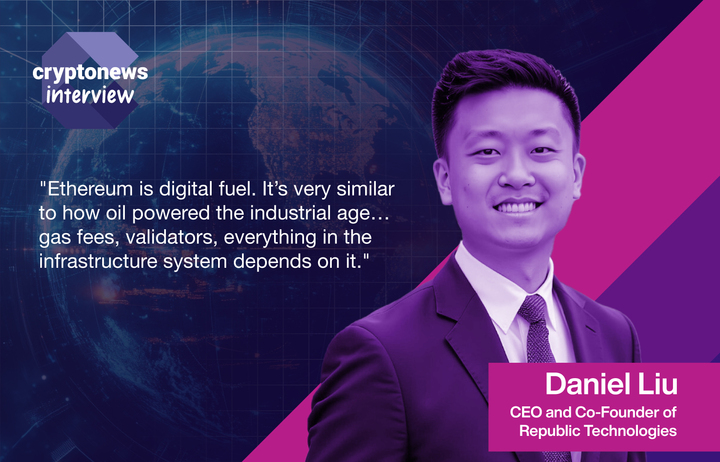
This analogy isn’t just theoretical. It shapes how Liu explains Ethereum’s utility to investors and institutions. “When I go talk to some of my old directors or colleagues from the energy industry, they really understand that it makes sense,” he said.

In Liu’s view, Ethereum is not trying to be digital gold like Bitcoin. It powers applications, including stablecoins, tokenization platforms, and DeFi protocols, similar to how energy supports industrial functions. That underlying utility, he argues, is what gives ETH long-term relevance.

Regulatory Clarity Is Catalyzing Ethereum’s Institutional Phase

Liu believes recent policy developments are unlocking Ethereum’s next growth phase. Chief among them is the GENIUS Act, a U.S. legislative effort that has introduced new clarity around stablecoins and digital assets.

“The GENIUS Act really removed [regulatory] blockers… it unlocked the floodgates for all this capital to come in,” he said.

He compares Ethereum’s current moment to Bitcoin’s breakout in 2017, when Wall Street began viewing BTC as a treasury asset, even if most institutions stayed on the sidelines.

For Ethereum, Liu argues, the difference is that its use cases are already operational. Stablecoins are built on it. Tokenized equities are testing it. Internal banking assets are being issued on it.

Though ETH and BTC still move in tandem, Liu argues Ethereum’s differentiated role is starting to matter. While Bitcoin remains a passive holding, Ethereum is being integrated into active systems—payment rails, liquidity networks, and validator infrastructure.

Republic Technologies Adopts a Yield-Focused ETH Strategy

Republic Technologies has structured itself around a simple principle: accumulate ETH and make it productive. The company acquires ETH through structured derivative strategies and runs it through validator networks operated by third-party partners.

The approach is modeled on Metaplanet, the Japanese company that took a similar path with Bitcoin. “We hope to have a very similar performance,” Liu said.

But he emphasized the company’s risk ceiling when it comes to native yield generation, saying, “We are not chasing double-digit on-chain yields.” Without taking “unnecessary risks,” the company is targeting a 6-8% annual return.

He believes that Ethereum treasuries, like public companies, will ultimately be judged on operational performance—how efficiently they accumulate ETH, how they manage validator returns, and how they protect downside exposure.

“Anyone looking at these treasuries long term will look toward those metrics,” Liu said.

Republic recently completed a restructuring and rebrand, and while Liu declined to preview future moves, he said partnerships and fundraising activity are in progress. “We want to protect our investors’ assets and our assets as much as possible,” he added.

Frequently Asked Questions (FAQs)

How do Ethereum treasuries differ from corporate BTC holdings like MicroStrategy’s?

ETH treasuries often involve active staking, validator operations, and derivatives, whereas BTC holdings are typically passive, held in cold storage.

Are validator partnerships a point of centralization risk for ETH treasuries?

Potentially. If too few third-party validators control large amounts of staked ETH, it could raise security and governance concerns for corporate treasuries.

How liquid are ETH treasury assets compared to traditional holdings?

ETH can be liquid but may face slippage or protocol-level constraints when staked or used in derivatives, unlike fiat or short-term bonds.


Market Opportunity
Fuel Logo
Fuel Price(FUEL)
$0.00174
$0.00174$0.00174
+2.95%
USD
Fuel (FUEL) Live Price Chart
Disclaimer: The articles reposted on this site are sourced from public platforms and are provided for informational purposes only. They do not necessarily reflect the views of MEXC. All rights remain with the original authors. If you believe any content infringes on third-party rights, please contact service@support.mexc.com for removal. MEXC makes no guarantees regarding the accuracy, completeness, or timeliness of the content and is not responsible for any actions taken based on the information provided. The content does not constitute financial, legal, or other professional advice, nor should it be considered a recommendation or endorsement by MEXC.

You May Also Like

Fed rate decision September 2025

Fed rate decision September 2025

The post Fed rate decision September 2025 appeared on BitcoinEthereumNews.com. WASHINGTON – The Federal Reserve on Wednesday approved a widely anticipated rate cut and signaled that two more are on the way before the end of the year as concerns intensified over the U.S. labor market. In an 11-to-1 vote signaling less dissent than Wall Street had anticipated, the Federal Open Market Committee lowered its benchmark overnight lending rate by a quarter percentage point. The decision puts the overnight funds rate in a range between 4.00%-4.25%. Newly-installed Governor Stephen Miran was the only policymaker voting against the quarter-point move, instead advocating for a half-point cut. Governors Michelle Bowman and Christopher Waller, looked at for possible additional dissents, both voted for the 25-basis point reduction. All were appointed by President Donald Trump, who has badgered the Fed all summer to cut not merely in its traditional quarter-point moves but to lower the fed funds rate quickly and aggressively. In the post-meeting statement, the committee again characterized economic activity as having “moderated” but added language saying that “job gains have slowed” and noted that inflation “has moved up and remains somewhat elevated.” Lower job growth and higher inflation are in conflict with the Fed’s twin goals of stable prices and full employment.  “Uncertainty about the economic outlook remains elevated” the Fed statement said. “The Committee is attentive to the risks to both sides of its dual mandate and judges that downside risks to employment have risen.” Markets showed mixed reaction to the developments, with the Dow Jones Industrial Average up more than 300 points but the S&P 500 and Nasdaq Composite posting losses. Treasury yields were modestly lower. At his post-meeting news conference, Fed Chair Jerome Powell echoed the concerns about the labor market. “The marked slowing in both the supply of and demand for workers is unusual in this less dynamic…
Share
BitcoinEthereumNews2025/09/18 02:44
GBP/USD rallies as Fed independence threats hammer US Dollar

GBP/USD rallies as Fed independence threats hammer US Dollar

The post GBP/USD rallies as Fed independence threats hammer US Dollar appeared on BitcoinEthereumNews.com. The British Pound (GBP) extends its gains on Wednesday
Share
BitcoinEthereumNews2026/01/15 00:19
Why The Green Bay Packers Must Take The Cleveland Browns Seriously — As Hard As That Might Be

Why The Green Bay Packers Must Take The Cleveland Browns Seriously — As Hard As That Might Be

The post Why The Green Bay Packers Must Take The Cleveland Browns Seriously — As Hard As That Might Be appeared on BitcoinEthereumNews.com. Jordan Love and the Green Bay Packers are off to a 2-0 start. Getty Images The Green Bay Packers are, once again, one of the NFL’s better teams. The Cleveland Browns are, once again, one of the league’s doormats. It’s why unbeaten Green Bay (2-0) is a 8-point favorite at winless Cleveland (0-2) Sunday according to betmgm.com. The money line is also Green Bay -500. Most expect this to be a Packers’ rout, and it very well could be. But Green Bay knows taking anyone in this league for granted can prove costly. “I think if you look at their roster, the paper, who they have on that team, what they can do, they got a lot of talent and things can turn around quickly for them,” Packers safety Xavier McKinney said. “We just got to kind of keep that in mind and know we not just walking into something and they just going to lay down. That’s not what they going to do.” The Browns certainly haven’t laid down on defense. Far from. Cleveland is allowing an NFL-best 191.5 yards per game. The Browns gave up 141 yards to Cincinnati in Week 1, including just seven in the second half, but still lost, 17-16. Cleveland has given up an NFL-best 45.5 rushing yards per game and just 2.1 rushing yards per attempt. “The biggest thing is our defensive line is much, much improved over last year and I think we’ve got back to our personality,” defensive coordinator Jim Schwartz said recently. “When we play our best, our D-line leads us there as our engine.” The Browns rank third in the league in passing defense, allowing just 146.0 yards per game. Cleveland has also gone 30 straight games without allowing a 300-yard passer, the longest active streak in the NFL.…
Share
BitcoinEthereumNews2025/09/18 00:41