Ethereum (ETH) has a history of defying expectations. In the 2020–2021 bull run, ETH skyrocketed more than 3,900%, climbing from under $100 to nearly $4,900 at its peak. Related Reading: Solana Extends Streak, Outshines Ethereum in DEX Volume – Details That surge was fueled by the rise of decentralized finance (DeFi), NFTs, and a wave of institutional interest. Now, as Ethereum enters a new cycle backed by stronger fundamentals and wider adoption, investors are bracing for a potential repeat. This time, the story goes beyond retail speculation. Institutional demand is accelerating at record pace, with Ethereum ETFs, staking yields, and corporate treasury allocations reshaping the market dynamics. Institutional Demand Redefines Ethereum’s Market Position In 2025, Ethereum-based ETFs have far outpaced their Bitcoin counterparts, attracting over $12.1 billion in assets under management. BlackRock’s iShares Ethereum Trust (ETHA) alone saw nearly $300 million in inflows in August, underscoring Wall Street’s growing appetite for ETH exposure. Meanwhile, Bitcoin ETFs faced over $1.1 billion in outflows, signaling a dramatic shift in capital allocation. Beyond ETFs, public companies now hold 3.4% of Ethereum’s total supply, with more than 3.5 million ETH staked in corporate treasuries. Household names like Ferrari and Deutsche Bank are integrating Ethereum into payments, tokenization platforms, and settlement systems. Unlike Bitcoin, which remains a non-yielding store of value, Ethereum offers corporations yield-generating opportunities through 3–5% staking rewards, making it both a treasury asset and a productive instrument. ETH's price records some losses on the daily chart. Source: ETHUSD on Tradingview Why ETH Could Outperform Again Ethereum’s long-term bull case rests on three pillars: Deflationary mechanics: Post-Merge upgrades and token burns have reduced ETH supply by 0.1% quarter-over-quarter, reinforcing scarcity. Yield generation: With nearly 30% of ETH staked, institutions enjoy consistent returns absent in Bitcoin’s model. Regulatory clarity: The SEC and Europe’s MiCA framework have reclassified Ethereum as a utility token, giving the green light for ETFs and large-scale adoption. Ethereum now powers 53% of real-world asset tokenization, strengthening its role as the backbone of decentralized finance and digital settlements. Analysts at Standard Chartered and other firms are forecasting ETH could reach $7,500 by year-end 2025, with potential long-term targets of $12,000–$18,000 as adoption accelerates. Final Takeaway Ethereum is no longer just Bitcoin’s “little brother.” Its hybrid profile, a deflationary, yield-bearing, utility-driven asset, makes it a compelling choice for institutional and retail investors alike. Related Reading: This Week In XRP: Ripple CTO Set To Announce Important Update If the last cycle’s 3,900% rally was a preview, the next phase could reimagine how Ethereum is valued, not just as a cryptocurrency, but as the infrastructure layer in  global finance. Cover image from ChatGPT, ETHUSD chart from TradingviewEthereum (ETH) has a history of defying expectations. In the 2020–2021 bull run, ETH skyrocketed more than 3,900%, climbing from under $100 to nearly $4,900 at its peak. Related Reading: Solana Extends Streak, Outshines Ethereum in DEX Volume – Details That surge was fueled by the rise of decentralized finance (DeFi), NFTs, and a wave of institutional interest. Now, as Ethereum enters a new cycle backed by stronger fundamentals and wider adoption, investors are bracing for a potential repeat. This time, the story goes beyond retail speculation. Institutional demand is accelerating at record pace, with Ethereum ETFs, staking yields, and corporate treasury allocations reshaping the market dynamics. Institutional Demand Redefines Ethereum’s Market Position In 2025, Ethereum-based ETFs have far outpaced their Bitcoin counterparts, attracting over $12.1 billion in assets under management. BlackRock’s iShares Ethereum Trust (ETHA) alone saw nearly $300 million in inflows in August, underscoring Wall Street’s growing appetite for ETH exposure. Meanwhile, Bitcoin ETFs faced over $1.1 billion in outflows, signaling a dramatic shift in capital allocation. Beyond ETFs, public companies now hold 3.4% of Ethereum’s total supply, with more than 3.5 million ETH staked in corporate treasuries. Household names like Ferrari and Deutsche Bank are integrating Ethereum into payments, tokenization platforms, and settlement systems. Unlike Bitcoin, which remains a non-yielding store of value, Ethereum offers corporations yield-generating opportunities through 3–5% staking rewards, making it both a treasury asset and a productive instrument. ETH's price records some losses on the daily chart. Source: ETHUSD on Tradingview Why ETH Could Outperform Again Ethereum’s long-term bull case rests on three pillars: Deflationary mechanics: Post-Merge upgrades and token burns have reduced ETH supply by 0.1% quarter-over-quarter, reinforcing scarcity. Yield generation: With nearly 30% of ETH staked, institutions enjoy consistent returns absent in Bitcoin’s model. Regulatory clarity: The SEC and Europe’s MiCA framework have reclassified Ethereum as a utility token, giving the green light for ETFs and large-scale adoption. Ethereum now powers 53% of real-world asset tokenization, strengthening its role as the backbone of decentralized finance and digital settlements. Analysts at Standard Chartered and other firms are forecasting ETH could reach $7,500 by year-end 2025, with potential long-term targets of $12,000–$18,000 as adoption accelerates. Final Takeaway Ethereum is no longer just Bitcoin’s “little brother.” Its hybrid profile, a deflationary, yield-bearing, utility-driven asset, makes it a compelling choice for institutional and retail investors alike. Related Reading: This Week In XRP: Ripple CTO Set To Announce Important Update If the last cycle’s 3,900% rally was a preview, the next phase could reimagine how Ethereum is valued, not just as a cryptocurrency, but as the infrastructure layer in  global finance. Cover image from ChatGPT, ETHUSD chart from Tradingview

ETH Rallied 3,900% Last Cycle: With Institutional Demand Rising, Could History Repeat Itself?

2025/08/26 08:00

Ethereum (ETH) has a history of defying expectations. In the 2020–2021 bull run, ETH skyrocketed more than 3,900%, climbing from under $100 to nearly $4,900 at its peak.

That surge was fueled by the rise of decentralized finance (DeFi), NFTs, and a wave of institutional interest. Now, as Ethereum enters a new cycle backed by stronger fundamentals and wider adoption, investors are bracing for a potential repeat.

This time, the story goes beyond retail speculation. Institutional demand is accelerating at record pace, with Ethereum ETFs, staking yields, and corporate treasury allocations reshaping the market dynamics.

Institutional Demand Redefines Ethereum’s Market Position

In 2025, Ethereum-based ETFs have far outpaced their Bitcoin counterparts, attracting over $12.1 billion in assets under management.

BlackRock’s iShares Ethereum Trust (ETHA) alone saw nearly $300 million in inflows in August, underscoring Wall Street’s growing appetite for ETH exposure. Meanwhile, Bitcoin ETFs faced over $1.1 billion in outflows, signaling a dramatic shift in capital allocation.

Beyond ETFs, public companies now hold 3.4% of Ethereum’s total supply, with more than 3.5 million ETH staked in corporate treasuries. Household names like Ferrari and Deutsche Bank are integrating Ethereum into payments, tokenization platforms, and settlement systems.

Unlike Bitcoin, which remains a non-yielding store of value, Ethereum offers corporations yield-generating opportunities through 3–5% staking rewards, making it both a treasury asset and a productive instrument.
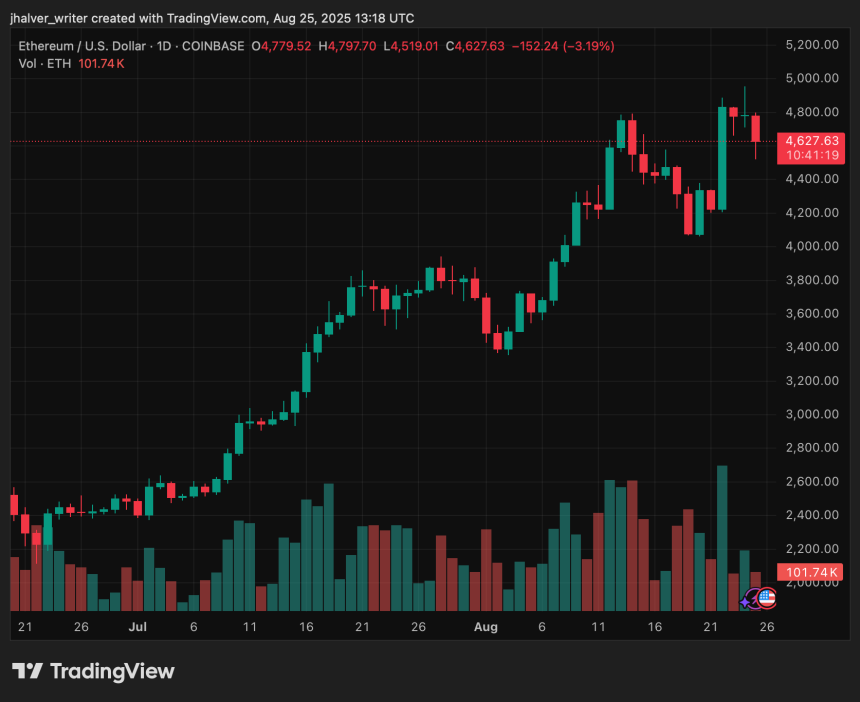
Ethereum ETH ETHUSD

Why ETH Could Outperform Again

Ethereum’s long-term bull case rests on three pillars:

  • Deflationary mechanics: Post-Merge upgrades and token burns have reduced ETH supply by 0.1% quarter-over-quarter, reinforcing scarcity.
  • Yield generation: With nearly 30% of ETH staked, institutions enjoy consistent returns absent in Bitcoin’s model.
  • Regulatory clarity: The SEC and Europe’s MiCA framework have reclassified Ethereum as a utility token, giving the green light for ETFs and large-scale adoption.

Ethereum now powers 53% of real-world asset tokenization, strengthening its role as the backbone of decentralized finance and digital settlements.

Analysts at Standard Chartered and other firms are forecasting ETH could reach $7,500 by year-end 2025, with potential long-term targets of $12,000–$18,000 as adoption accelerates.

Final Takeaway

Ethereum is no longer just Bitcoin’s “little brother.” Its hybrid profile, a deflationary, yield-bearing, utility-driven asset, makes it a compelling choice for institutional and retail investors alike.

If the last cycle’s 3,900% rally was a preview, the next phase could reimagine how Ethereum is valued, not just as a cryptocurrency, but as the infrastructure layer in  global finance.

Cover image from ChatGPT, ETHUSD chart from Tradingview

Market Opportunity
RealLink Logo
RealLink Price(REAL)
$0.08045
$0.08045$0.08045
+0.19%
USD
RealLink (REAL) Live Price Chart
Disclaimer: The articles reposted on this site are sourced from public platforms and are provided for informational purposes only. They do not necessarily reflect the views of MEXC. All rights remain with the original authors. If you believe any content infringes on third-party rights, please contact service@support.mexc.com for removal. MEXC makes no guarantees regarding the accuracy, completeness, or timeliness of the content and is not responsible for any actions taken based on the information provided. The content does not constitute financial, legal, or other professional advice, nor should it be considered a recommendation or endorsement by MEXC.

You May Also Like

The Federal Reserve cut interest rates by 25 basis points, and Powell said this was a risk management cut

The Federal Reserve cut interest rates by 25 basis points, and Powell said this was a risk management cut

PANews reported on September 18th, according to the Securities Times, that at 2:00 AM Beijing time on September 18th, the Federal Reserve announced a 25 basis point interest rate cut, lowering the federal funds rate from 4.25%-4.50% to 4.00%-4.25%, in line with market expectations. The Fed's interest rate announcement triggered a sharp market reaction, with the three major US stock indices rising briefly before quickly plunging. The US dollar index plummeted, briefly hitting a new low since 2025, before rebounding sharply, turning a decline into an upward trend. The sharp market volatility was closely tied to the subsequent monetary policy press conference held by Federal Reserve Chairman Powell. He stated that the 50 basis point rate cut lacked broad support and that there was no need for a swift adjustment. Today's move could be viewed as a risk-management cut, suggesting the Fed will not enter a sustained cycle of rate cuts. Powell reiterated the Fed's unwavering commitment to maintaining its independence. Market participants are currently unaware of the risks to the Fed's independence. The latest published interest rate dot plot shows that the median expectation of Fed officials is to cut interest rates twice more this year (by 25 basis points each), one more than predicted in June this year. At the same time, Fed officials expect that after three rate cuts this year, there will be another 25 basis point cut in 2026 and 2027.
Share
PANews2025/09/18 06:54
Zero Knowledge Proof Kicks Off 2026 With Presale Auction Plus $5M Reward – Could This Spark Major Movement?

Zero Knowledge Proof Kicks Off 2026 With Presale Auction Plus $5M Reward – Could This Spark Major Movement?

Most crypto markets concentrate on popular names bouncing back from the latest drops, yet one presale auction grabs focus for completely different reasons. Zero
Share
LiveBitcoinNews2026/01/15 05:00
Uphold’s Massive 1.59 Billion XRP Holdings Shocks Community, CEO Reveals The Real Owners

Uphold’s Massive 1.59 Billion XRP Holdings Shocks Community, CEO Reveals The Real Owners

Uphold, a cloud-based digital financial service platform, has come under the spotlight after on-chain data confirmed that it safeguards approximately 1.59 billion XRP. According to Uphold’s Chief Executive Officer (CEO), Simon McLoughlin, these tokens are fully owned by customers, not the exchange itself.  Uphold Clarifies Massive XRP Holdings The crypto community was taken by surprise […]
Share
Bitcoinist2025/09/18 00:30