

How Symbiotic AI Can Find Your Paper's Next Great Citation
:::info Authors:
(1) Karan Goyal, IIIT Delhi, India (karang@iiitd.ac.in);
(2) Mayank Goel, NSUT Delhi, India (mayank.co19@nsut.ac.in);
(3) Vikram Goyal, IIIT Delhi, India (vikram@iiitd.ac.in);
(4) Mukesh Mohania, IIIT Delhi, India (mukesh@iiitd.ac.in).
:::
Table of Links
Abstract and 1. Introduction
-
Related Work
-
Proposed Dataset
-
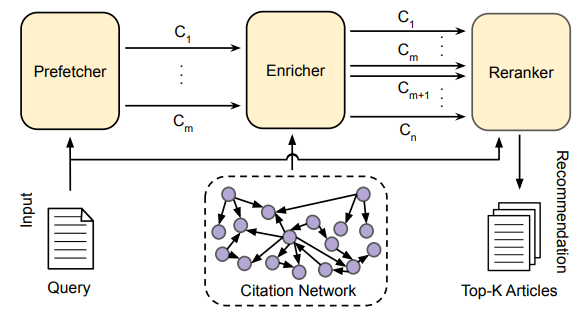
SymTax Model
4.1 Prefetcher
4.2 Enricher
4.3 Reranker
-
Experiments and Results
-
Analysis
6.1 Ablation Study
6.2 Quantitative Analysis and 6.3 Qualitative Analysis
-
Conclusion
-
Limitations
-
Ethics Statement and References
Appendix
Abstract
Citing pertinent literature is pivotal to writing and reviewing a scientific document. Existing techniques mainly focus on the local context or the global context for recommending citations but fail to consider the actual human citation behaviour. We propose SymTax[1], a three-stage recommendation architecture that considers both the local and the global context, and additionally the taxonomical representations of query-candidate tuples and the Symbiosis prevailing amongst them. SymTax learns to embed the infused taxonomies in the hyperbolic space and uses hyperbolic separation as a latent feature to compute query-candidate similarity. We build a novel and large dataset ArSyTa, containing 8.27 million citation contexts and describe the creation process in detail. We conduct extensive experiments and ablation studies to demonstrate the effectiveness and design choice of each module in our framework. Also, combinatorial analysis from our experiments shed light on the choice of language models (LMs) and fusion embedding, and the inclusion of section headings as a signal. Our proposed module that captures the symbiotic relationship solely leads to performance gains of 26.66% and 39.25% in Recall@5 w.r.t. SOTA on ACL-200 and RefSeer datasets, respectively. The complete framework yields a gain of 22.56% in Recall@5 wrt SOTA on our proposed dataset. The code and dataset are available at https://github.com/goyalkaraniit/SymTax.
\
1 Introduction
Citing has always been the backbone of scientific research. It enables trust and supports the claims made in the scientific document. The ever-growing increase in the amount of scientific literature makes it imperative to ease out the author’s task of finding a list of suitable papers to follow and cite (Johnson et al., 2018; Bornmann et al., 2021; Nane et al., 2023). Citation recommendation is such a process that helps researchers to be aware of the relevant research in respective domains. There are two different approaches to recommend citations: local (Dai et al., 2019; Ebesu and Fang, 2017; Huang et al., 2012; He et al., 2010), and global (Xie et al., 2021; Ali et al., 2021; Bhagavatula et al., 2018; Guo et al., 2017). Local citation recommendation is the task of finding and recommending the most relevant prior work, mainly corresponding to a specific text passage (also known as citation context), making it context-aware. On the other hand, global citation recommendation recommends a list of suitable prior art for the entire document, mainly given the title and abstract or the whole document. In this paper, we solve the task of local citation recommendation, which is more fine-grained and provides a solution to the actual challenge the author faces.
\ 
\ For example, consider the below citation excerpt:[2]
\ This can have extreme consequences in real-life scenarios such as autonomous cars CitX.
\ Examining the above context in isolation makes it challenging to predict the specific article cited at CitX. However, leveraging global information such as title, abstract, and taxonomy narrows down the search space while at the same time utilizing symbiotic relationship provides the model with an enriched pool of the most suitable candidates. Unlike ACL-200 and RefSeer datasets with curated contexts of fixed size, we curate richer contexts by incorporating complete information of adjoining sentences with respect to the citation sentence. To summarise, we make the following contributions:
\ • Dataset: We have constructed a dataset ArSyTa comprising 8.27 million comprehensive citation contexts across diverse domains, featuring richer density and relevant features, including taxonomy concepts, to facilitate the task of citation recommendation.
\ • Conceptual: We explore the concept of Symbiosis from Biology and draw its analogy with human citation behaviour in the scientific research ecosystem and select a better pool of candidates.
\ • Methodological: We propose a novel taxonomy fused reranker that subsequently learns projections of fused taxonomies in hyperbolic space and utilises hyperbolic separation as a latent feature.
\ • Empirical: We perform extensive experiments, ablations, and analysis on five datasets and six metrics, demonstrating SymTax consistently outperforms SOTA by huge margins.
\
:::info This paper is available on arxiv under CC by-SA 4.0 Deed (Attribution-Sharealike 4.0 International) license.
:::
[1] Accepted in ACL 2024
\ [2] Excerpt is borrowed from Towards Consistency in Adversarial Classification of (Meunier et al., 2022). The cited article is An analysis of adversarial attacks and defenses on autonomous driving models of (Deng et al., 2020).


You May Also Like

Agentshub.AI Launches true Agentic AI Platform to Build Autonomous AI Workforces in Minutes
Turnkey PCB Assembly: The Complete Guide for Hardware Engineers and Product Teams




