This paper focuses on federated learning for user authentication. We show that it is difficult to achieve both privacy preservation and high accuracy with existing methods. We propose Identity Protected Federated Learning (IPFed) as a solution to this problem.This paper focuses on federated learning for user authentication. We show that it is difficult to achieve both privacy preservation and high accuracy with existing methods. We propose Identity Protected Federated Learning (IPFed) as a solution to this problem.

Struggling with GDPR-Compliant AI? IPFed Delivers Accuracy and Privacy

:::info Authors:

(1) Yosuke Kaga, Hitachi, Ltd., Japan;

(2) Yusei Suzuki, Hitachi, Ltd., Japan;

(3) Kenta Takahashi, Hitachi, Ltd., Japan.

:::

Abstract and I. Introduction

II. Related Work

III. IPFED

IV. Experiments

[V. Conclusion and References]()

\ Abstract—With the development of laws and regulations related to privacy preservation, it has become difficult to collect personal data to perform machine learning. In this context, federated learning, which is distributed learning without sharing personal data, has been proposed. In this paper, we focus on federated learning for user authentication. We show that it is difficult to achieve both privacy preservation and high accuracy with existing methods. To address these challenges, we propose IPFed which is privacy-preserving federated learning using random projection for class embedding. Furthermore, we prove that IPFed is capable of learning equivalent to the state-of-the-art method. Experiments on face image datasets show that IPFed can protect the privacy of personal data while maintaining the accuracy of the state-of-the-art method.

I. INTRODUCTION

User authentication, such as face recognition, has recently achieved dramatic improvements in accuracy through the application of deep learning, and one of the reasons for this is that large numbers of images have been collected through web crawling and used as training data [1]. However, in recent years, GDPR [2] and other privacy-related regulations have made it more difficult to collect personal data. In order to continue to improve the accuracy of user authentication, Privacy-Preserving Machine Learning (PPML) [3] is needed, which performs machine learning without directly collecting personal data. One of the most popular methods in PPML is federated learning [4], which can perform privacy-preserving distributed learning using personal data on the client, and it has attracted attention. Federated learning has been applied to user authentication [5]–[8]. However, these methods face the challenges of privacy of training data [5], [6] and model accuracy [7], [8]. We propose Identity Protected Federated Learning (IPFed) as a solution to this problem. The main contributions of our work are as follows.

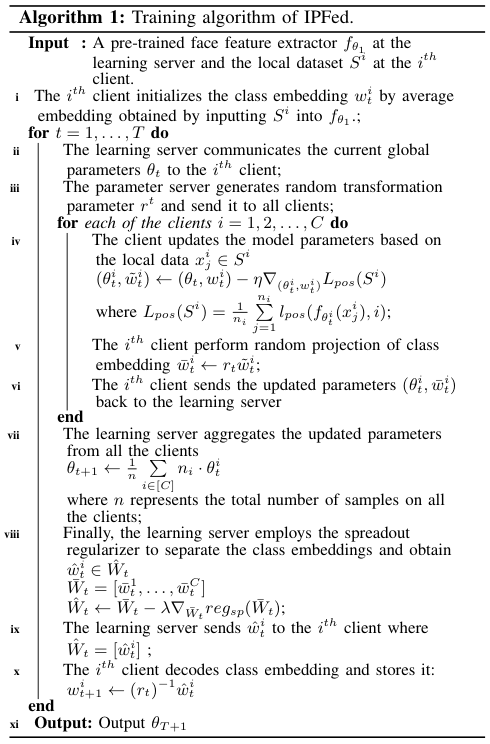
\ • We develop IPFed, which is a method to perform federated learning for user authentication while preserving the privacy of personal data using random projection for class embeddings.

\ • We prove mathematically that IPFed can perform equivalent learning to the state-of-the-art method while preserving the privacy of the training data.

\ • Experiments on face image datasets show that the proposed method can learn models with equivalent accuracy to the state-of-the-art method.

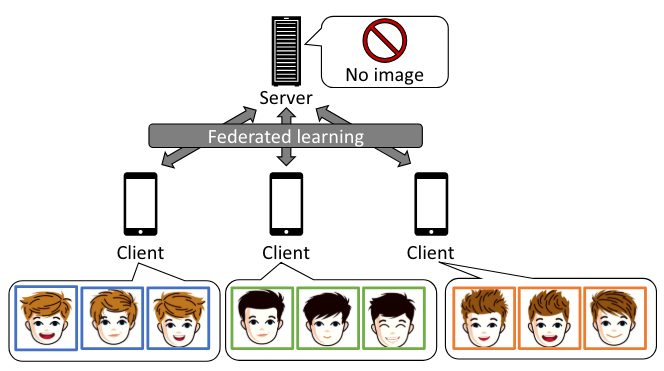
\ Fig. 1. Federated learning for user authentication.
II. RELATED WORKS

A. Federated learning

\ Federated learning is a method of machine learning in which training data is not shared but distributed across multiple devices. A typical federated learning algorithm is federated averaging (FedAvg) [4]. In this method, machine learning is performed while the personal data is kept in the clients, thus the privacy of training data can be preserved.

\ B. Federated learning for user authentication

\ Federated learning for user authentication is a method of learning a discriminator based on personal data such as fingerprints, faces, veins, etc., to determine a person’s identity. An overview of federated learning for user authentication is shown in Fig.1. Since a client is often occupied by a single person in user authentication, it is natural for a single client to contain the personal data of only one user. Under this assumption, it is difficult to train a model that can discriminate between others because it is not possible for the client to refer to the personal data of others.

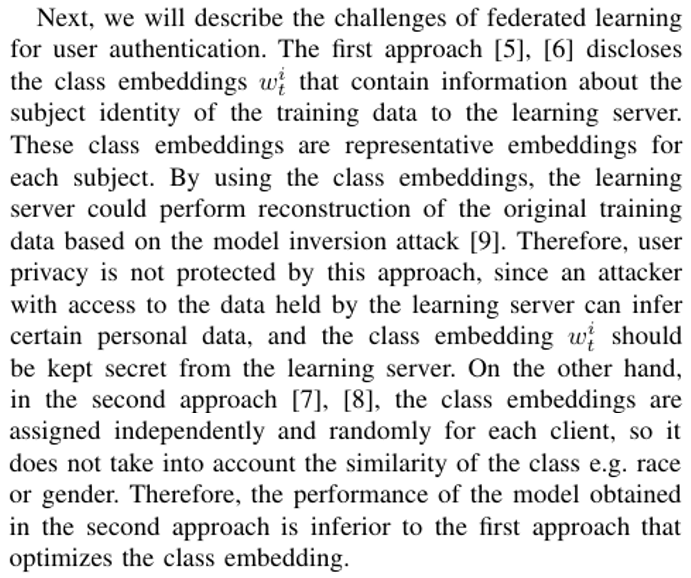
\ Two main approaches have been proposed to solve this problem. The first one is [5], [6], a method where the learning server performs the learning to increase the distance between the embeddings of the others, and the second is [7], [8], a method where the clients randomly assign representative embeddings for each class (called class embedding). In the following, we will give an overview of each method.

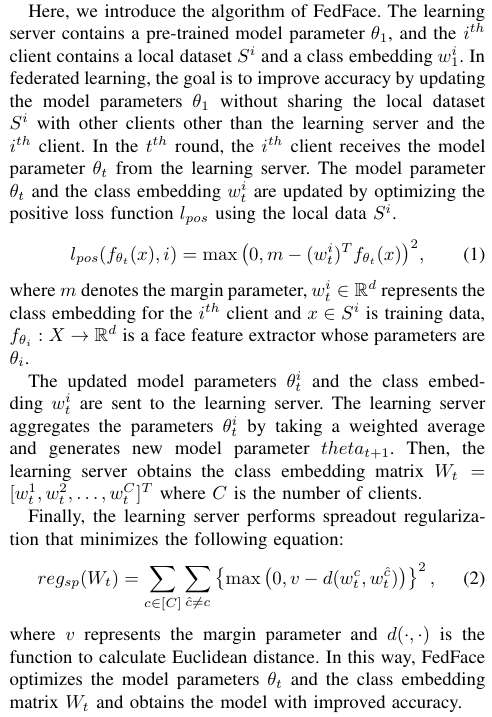
\ FedAwS [5], FedFace [6]: Federated Averaging with Spreadout (FedAwS) [5] is the algorithm to realize federated learning for user authentication by learning to increase the distance between each other’s embeddings on the learning server side. Furthermore, Aggarwal et.al. introduce FedFace, which applies FedAwS to face recognition[6].
Hosseini at.el. [7], [8]: Next, we outline the second approach [7], [8]. In this method, class embeddings are randomly initialized and frozen on the client side, and are not shared with the learning server in order to preserve the privacy of the training data. The clients use the fixed class embedding to train the model, and the learning server aggregates the training results and updates the model parameter

\ C. Challenging of related work
From the above discussion, as far as we know, there is no method that can perform federated learning for user authentication with both high accuracy and privacy preservation of training data. Satisfying these two requirements is an important problem to be solved in the field of federated learning for user authentication.

\

:::info This paper is available on arxiv under CC by 4.0 Deed (Attribution 4.0 International) license.

:::

\

Market Opportunity
null Logo
null Price(null)
--
----
USD
null (null) Live Price Chart
Disclaimer: The articles reposted on this site are sourced from public platforms and are provided for informational purposes only. They do not necessarily reflect the views of MEXC. All rights remain with the original authors. If you believe any content infringes on third-party rights, please contact service@support.mexc.com for removal. MEXC makes no guarantees regarding the accuracy, completeness, or timeliness of the content and is not responsible for any actions taken based on the information provided. The content does not constitute financial, legal, or other professional advice, nor should it be considered a recommendation or endorsement by MEXC.

You May Also Like

TD Cowen cuts Strategy price target to $440, cites lower bitcoin yield outlook

TD Cowen cuts Strategy price target to $440, cites lower bitcoin yield outlook

Despite the target cut, TD Cowen said Strategy remains an attractive vehicle for investors seeking bitcoin exposure.
Share
Coinstats2026/01/15 07:29
How to earn from cloud mining: IeByte’s upgraded auto-cloud mining platform unlocks genuine passive earnings

How to earn from cloud mining: IeByte’s upgraded auto-cloud mining platform unlocks genuine passive earnings

The post How to earn from cloud mining: IeByte’s upgraded auto-cloud mining platform unlocks genuine passive earnings appeared on BitcoinEthereumNews.com. contributor Posted: September 17, 2025 As digital assets continue to reshape global finance, cloud mining has become one of the most effective ways for investors to generate stable passive income. Addressing the growing demand for simplicity, security, and profitability, IeByte has officially upgraded its fully automated cloud mining platform, empowering both beginners and experienced investors to earn Bitcoin, Dogecoin, and other mainstream cryptocurrencies without the need for hardware or technical expertise. Why cloud mining in 2025? Traditional crypto mining requires expensive hardware, high electricity costs, and constant maintenance. In 2025, with blockchain networks becoming more competitive, these barriers have grown even higher. Cloud mining solves this by allowing users to lease professional mining power remotely, eliminating the upfront costs and complexity. IeByte stands at the forefront of this transformation, offering investors a transparent and seamless path to daily earnings. IeByte’s upgraded auto-cloud mining platform With its latest upgrade, IeByte introduces: Full Automation: Mining contracts can be activated in just one click, with all processes handled by IeByte’s servers. Enhanced Security: Bank-grade encryption, cold wallets, and real-time monitoring protect every transaction. Scalable Options: From starter packages to high-level investment contracts, investors can choose the plan that matches their goals. Global Reach: Already trusted by users in over 100 countries. Mining contracts for 2025 IeByte offers a wide range of contracts tailored for every investor level. From entry-level plans with daily returns to premium high-yield packages, the platform ensures maximum accessibility. Contract Type Duration Price Daily Reward Total Earnings (Principal + Profit) Starter Contract 1 Day $200 $6 $200 + $6 + $10 bonus Bronze Basic Contract 2 Days $500 $13.5 $500 + $27 Bronze Basic Contract 3 Days $1,200 $36 $1,200 + $108 Silver Advanced Contract 1 Day $5,000 $175 $5,000 + $175 Silver Advanced Contract 2 Days $8,000 $320 $8,000 + $640 Silver…
Share
BitcoinEthereumNews2025/09/17 23:48
BlackRock boosts AI and US equity exposure in $185 billion models

BlackRock boosts AI and US equity exposure in $185 billion models

The post BlackRock boosts AI and US equity exposure in $185 billion models appeared on BitcoinEthereumNews.com. BlackRock is steering $185 billion worth of model portfolios deeper into US stocks and artificial intelligence. The decision came this week as the asset manager adjusted its entire model suite, increasing its equity allocation and dumping exposure to international developed markets. The firm now sits 2% overweight on stocks, after money moved between several of its biggest exchange-traded funds. This wasn’t a slow shuffle. Billions flowed across multiple ETFs on Tuesday as BlackRock executed the realignment. The iShares S&P 100 ETF (OEF) alone brought in $3.4 billion, the largest single-day haul in its history. The iShares Core S&P 500 ETF (IVV) collected $2.3 billion, while the iShares US Equity Factor Rotation Active ETF (DYNF) added nearly $2 billion. The rebalancing triggered swift inflows and outflows that realigned investor exposure on the back of performance data and macroeconomic outlooks. BlackRock raises equities on strong US earnings The model updates come as BlackRock backs the rally in American stocks, fueled by strong earnings and optimism around rate cuts. In an investment letter obtained by Bloomberg, the firm said US companies have delivered 11% earnings growth since the third quarter of 2024. Meanwhile, earnings across other developed markets barely touched 2%. That gap helped push the decision to drop international holdings in favor of American ones. Michael Gates, lead portfolio manager for BlackRock’s Target Allocation ETF model portfolio suite, said the US market is the only one showing consistency in sales growth, profit delivery, and revisions in analyst forecasts. “The US equity market continues to stand alone in terms of earnings delivery, sales growth and sustainable trends in analyst estimates and revisions,” Michael wrote. He added that non-US developed markets lagged far behind, especially when it came to sales. This week’s changes reflect that position. The move was made ahead of the Federal…
Share
BitcoinEthereumNews2025/09/18 01:44