Why Bitcoin Won’t Save You From Tyranny, Inflation, or Market Collapse
Table of Links
- Introduction/Abstract
- The Blockchain
- Vulnerability of Revenue-Free Bubbles
- Success in Wrong Places
- Principles for a Currency
- The Difficult with Inflation Hedges
- Some Additional Fallacies
- Conclusion and References
SOME ADDITIONAL FALLACIES
1) Fallacy of libertarianism: The belief that bitcoin is an offshoot of libertarian and Austrian economics has no solid backing — it has the same lack of rigor as the one behind the belief that cryptos represent a "hedge for inflation". Spitznagel [20] had already, in 2017, debunked the notion that bitcoin can be a safe haven (as discussed next) or that the principles of Austrian economics can be invoked in support of cryptocurrencies.
\ 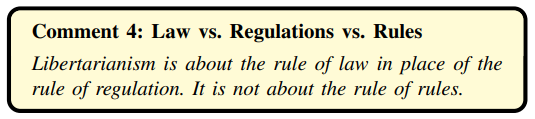
\ Libertarianism is fundamentally about the rule of law in place of the rule of regulation. It is not about the rule of rules — mechanistic, automated rules with irreversible outcomes. The real world is fraught with ambiguities and even Napoleonic law (far less mechanistic than crypto rules) cannot keep up — to wit, as a risk management directive, most commercial contracts traditionally prefer forums of dispute resolution to be under the more flexible Anglo Saxon common law (London, NY, Hong Kong) that rules on balance, intent, and symmetry in contracts. This applies of course to quantitative finance products such as complex derivatives contracts for which one needs to minimize the legal risk.
\ Nor is libertarianism about total distrust.
\ 2) Fallacy of safe haven, I (protection for financial tail risk): The experience of March 2020, during the market panic upon the onset of the pandemic, when bitcoin dropped farther than the stock market —and subsequently recovered with it upon the massive injection of liquidity is sufficient evidence that it cannot remotely be used as a tail hedge against systemic risk. Furthermore, bitcoin appears to respond to liquidity, exactly like other bubble items.
\ It is also uncertain what could happen should the internet experience a general, or an even a regional, outage — particularly if it takes place during a financial collapse.
\ 3) Fallacy of safe haven, II (protection from tyrannical regimes): To many paranoid antigovernment individuals and of others distrustful of institutions, bitcoin has been marketed as a safe haven — also with an open invitation to fall for the fallacy that a volatile electronic token in a public setting is a place for your hidden treasure.
\ By its very nature, bitcoin is open for all to see. The belief in one’s ability to hide one’s assets from the government with a public blockchain easily triangularizable at endpoints, and not just read by the FBI but also by people in their living rooms, requires a certain lack of financial seasoning and statistical understanding — perhaps even a lack of minimal common sense. For instance a Wolfram Research specialist was able to statistically detect and triangularize "anonymous" ransom payments made by Colonial Pipeline on May 8 in 2021 [21] — and it did not take long for the FBI to restore the funds.
\ We can safely assume that government structures and computational power will remain stronger than those of distributed operators who, while distrusting one another, can fall prey to simple hoaxes.
\ In the cyber world, connections are with people one has never met in real life; infiltration by government agents has proven to be extremely easy[18]. By comparison, the mafia required a Sicilian lineage for "friends of ours" for security clearance. One never knows the degree of governmental surveillance and its real capabilities.
\ The slogan "Escape government tyranny hence bitcoin" is similar to advertisements in the 1960s extolling the health benefits of cigarettes.
\ 4) Fallacy of the Agency problem: One might have the impression that, by being distributed, Bitcoin would be democratic and reduce the agency problem perceived to be present among civil servants and bankers. Unfortunately, there appears to be a worse agency problem: a concentration of insiders hoarding what they think will be the world currency, so others would have to go to them later on for supply. They would be cumulatively earning trillions, with many billionaire "Hodlers" — in comparison the "evil civil servants" behind fiat money make, at best, lower middle class wages. This situation represents a wealth transfer to the cartel of early bitcoin accumulators.
\
CONCLUSION
We have presented the attributes of the blockchain in general and bitcoin in particular. Few assets in financial history have been more fragile than bitcoin.
\ The customary standard argument is that "bitcoin has its flaws but we are getting a great technology; we will do wonders with the blockchain". No, there is no evidence that we are getting a great technology — unless "great technology" doesn’t mean "useful". And at the time of writing —in spite of all the fanfare — we have done still close to nothing with the blockchain.
\ So we close with a Damascus joke. One vendor was selling the exact same variety of cucumbers at two different prices. "Why is this one twice the price?", the merchant was asked. "They came on higher quality mules" was the answer.
\ We only judge a technology by how it solves problems, not by what technological attributes it has.
REFERENCES
[1] S. Nakamoto, “Bitcoin: A peer-to-peer electronic cash system,” Tech. Rep., 2008.
\ [2] J. Von Neumann, “Various techniques used in connection with random digits,” Appl. Math Ser, vol. 12, no. 36-38, p. 3, 1951.
\ [3] A. Narayanan and J. Clark, “Bitcoin’s academic pedigree,” Communications of the ACM, vol. 60, no. 12, pp. 36–45, 2017.
\ [4] O. J. Blanchard and M. W. Watson, “Bubbles, rational expectations and financial markets,” NBER working paper, no. w0945, 1982.
\ [5] M. K. Brunnermeier, “Bubbles,” in Banking Crises. Springer, 2016, pp. 28–36.
\ [6] D. Graeber, Debt: The first 5000 years. Penguin UK, 2012.
\ [7] N. N. Taleb, Antifragile: things that gain from disorder. Random House and Penguin, 2012.
\ [8] D. Ricardo, Reply to Mr. Bosanquet’s practical observations on the report of the Bullion Committee. J. Murray, 1811, vol. 10.
\ [9] ——, Proposals for an economical and secure currency, 1816.
\ [10] W. S. Jevons, A Serious Fall in the Value of Gold Ascertained: And Its Social Effects Set Forth. E. Stanford, 1863.
\ [11] F. R. Velde and W. E. Weber, “A model of bimetallism,” Journal of Political Economy, vol. 108, no. 6, pp. 1210–1234, 2000.
\ [12] T. J. Sargent and M. Wallace, “A model of commodity money,” Journal of Monetary Economics, vol. 12, no. 1, pp. 163–187, 1983.
\ [13] P. Krugman, M. Obstfeld, and M. Melitz, “International economics: Theory and policy,” 2017.
\ [14] M. McLeay, A. Radia, and R. Thomas, “Money creation in the modern economy,” Bank of England Quarterly Bulletin, p. Q1, 2014.
\ [15] S. A. Ross, Neoclassical finance. Princeton University Press, 2009, vol. 4.
\ [16] L. Campiglio, “Un’analisi comparata del sistema dei prezzi nei venti comuni capoluogo di regione,” Rivista Internazionale di Scienze Sociali, vol. 94, no. 3, pp. 329–377, 1986.
\ [17] M. Nair and R. Emozozo, “Electronic currency in africa: M-pesa as private inside money,” Economic Affairs, vol. 38, no. 2, pp. 197–206, 2018.
\ [18] K. Colucci and C. Moiso, “Il fenomeno delle monete virtuali: opportunità per telecom italia,” Notiziaro Tecnico /Telecom Italia, vol. 1, pp. 76–89, 2014.
\ [19] J. Murphy-O’Connor, “Jesus and the money changers (mark 11: 15-17; john 2: 13-17),” Revue Biblique (1946-), pp. 42–55, 2000.
\ [20] M. W. Spitznagel, “Why cryptocurrencies will never be safe havens,” Von Mises Institute, 2017.
\ [21] D. Porechna, “Darkside update: The fbi hacks the hackers?” Wolfram Research, June 2021.
\
:::info Author:
(1) Nassim Nicholas Taleb, Universa Investments, Tandon School of Engineering, New York University Forthcoming, Quantitative Finance.
:::
:::info This paper is available on arxiv under CC BY 4.0 DEED license.
:::
[18] This is one of the weaknesses of total decentralization.


You May Also Like

How Stablecoins Are Changing Business Payments

Lowe’s (LOW) Stock Falls After Earnings Beat Gets Overshadowed by Weak Guidance