This article explores how different embedding approaches perform in medical image retrieval tasks. Self-supervised models slightly edge out supervised ones, though the performance gap across architectures is narrow. Surprisingly, pretraining on natural images (ImageNet) outperforms domain-specific sets (RadImageNet), while fractal-based embeddings achieve unexpectedly strong results given their synthetic origins. DreamSim, an ensemble of ViT embeddings fine-tuned with synthetic data, delivers the best recall overall, making it the current leader in embedding generation. Isolated anomalies—like poor recall for certain anatomies—remain unexplained, pointing to fertile ground for future research.This article explores how different embedding approaches perform in medical image retrieval tasks. Self-supervised models slightly edge out supervised ones, though the performance gap across architectures is narrow. Surprisingly, pretraining on natural images (ImageNet) outperforms domain-specific sets (RadImageNet), while fractal-based embeddings achieve unexpectedly strong results given their synthetic origins. DreamSim, an ensemble of ViT embeddings fine-tuned with synthetic data, delivers the best recall overall, making it the current leader in embedding generation. Isolated anomalies—like poor recall for certain anatomies—remain unexplained, pointing to fertile ground for future research.

DreamSim and the Future of Embedding Models in Radiology AI

Abstract and 1. Introduction

  1. Materials and Methods

    2.1 Vector Database and Indexing

    2.2 Feature Extractors

    2.3 Dataset and Pre-processing

    2.4 Search and Retrieval

    2.5 Re-ranking retrieval and evaluation

  2. Evaluation and 3.1 Search and Retrieval

    3.2 Re-ranking

  3. Discussion

    4.1 Dataset and 4.2 Re-ranking

    4.3 Embeddings

    4.4 Volume-based, Region-based and Localized Retrieval and 4.5 Localization-ratio

  4. Conclusion, Acknowledgement, and References

4.3 Embeddings

It was shown that embeddings generated from self-supervised models are slightly better for image retrieval tasks than those derived from regular supervised models. This is true for coarse anatomical regions with 29 labels (see Table 20) as well as fine-granular anatomical regions with 104 regions (see Table 21). This is roughly preserved for all modes of retrieval (i.e. slice-wise, volume-based, region-based, and localized retrieval). More generally, the differences in recall across differently pre-trained models (except pre-trained from fractal image) are very small. Practically, the exact choice of the feature extractor should not be noticeable to a potential user in a downstream application. Further, it can be

\
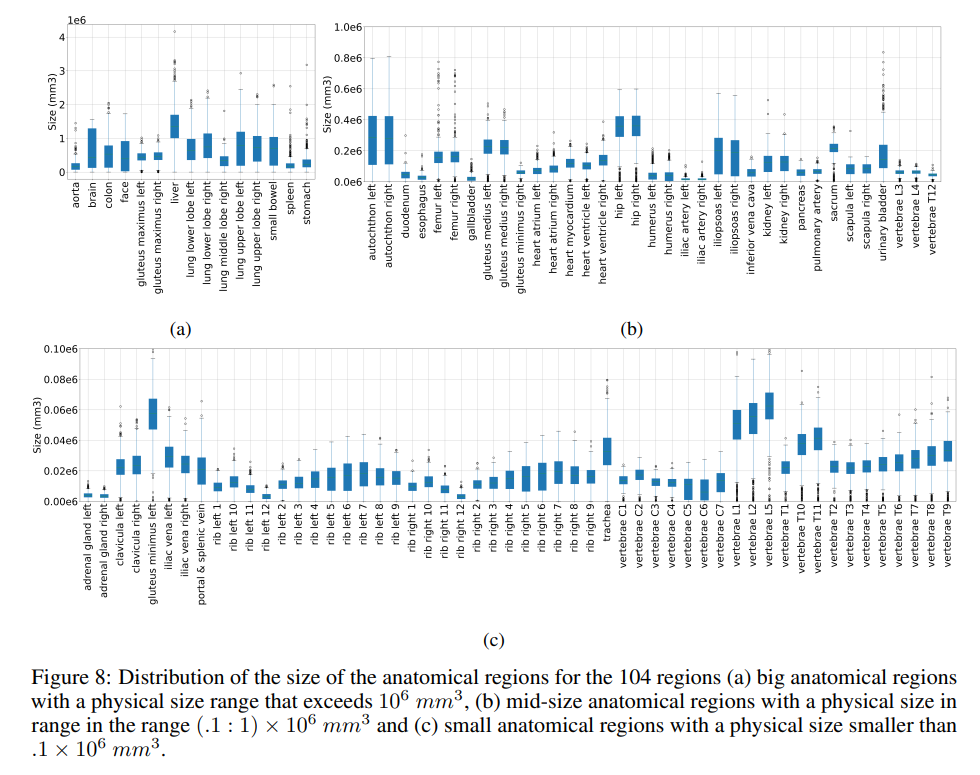
\ concluded that pre-training on general natural images (i.e. ImageNet) resulted in slightly more performant embedding vectors than domain-specific images (i.e. RadImageNet). This is unexpected and subject to further research.

\ Although, the model pre-trained of formula-derived synthetic images of fractals (i.e. Fractaldb) showed the lowest recall accuracy the absolute values are surprisingly high considering that the model learned visual primitives out of rendered fractals. This is very encouraging as the Formular-Driven Supervised Learning (FDSL) can easily be extended to very high number of data points per class and also several virtual classes within one family of formulas [Kataoka et al., 2022]. Additionally, the mathematical space of formulas for producing visual primitives is virtually infinite and thus it is the subject of further research whether radiology-specific visual primitives can be created that outperform natural image-based pre-training. Again, FDSL does not require the effort of data collection, curation, and annotation. It can scale to a large number of samples and classes which potentially results in a very smooth and evenly covered latent space.

\ Embeddings derived from DreamSim architecture showed the highest overall retrieval recall in region-based and localized evaluations. DreamSim is an ensemble architecture that uses multiple ViT embeddings with additional finetuning using synthetic images. It is plausible that an ensemble approach outperforms single-architecture embeddings (i.e. DINOv1, DINOv2, SwinTransformer, and ResNet50). Therefore, the usage of DreamSim is currently the preferred method of embedding generation.

\ Worth discussing is an observation that can be found in all tables presenting recall values. Across all model architectures (column) there are usually a few anatomies or regions (i.e. row) that show lower recall on average (see "Average" column). For example, in Table 2 "gallbladder" showed poor retrieval accuracy, whereas in Table Table 4 "brain" and "face" showed lower recall. The observation of isolated low-recall patterns can be seen across all modes of retrieval and aggregation. The authors of this paper cannot provide an explanation, as to why certain anatomies perform worse in certain retrieval configurations but gain high recall in many other retrieval configurations. This will be subject to future research.

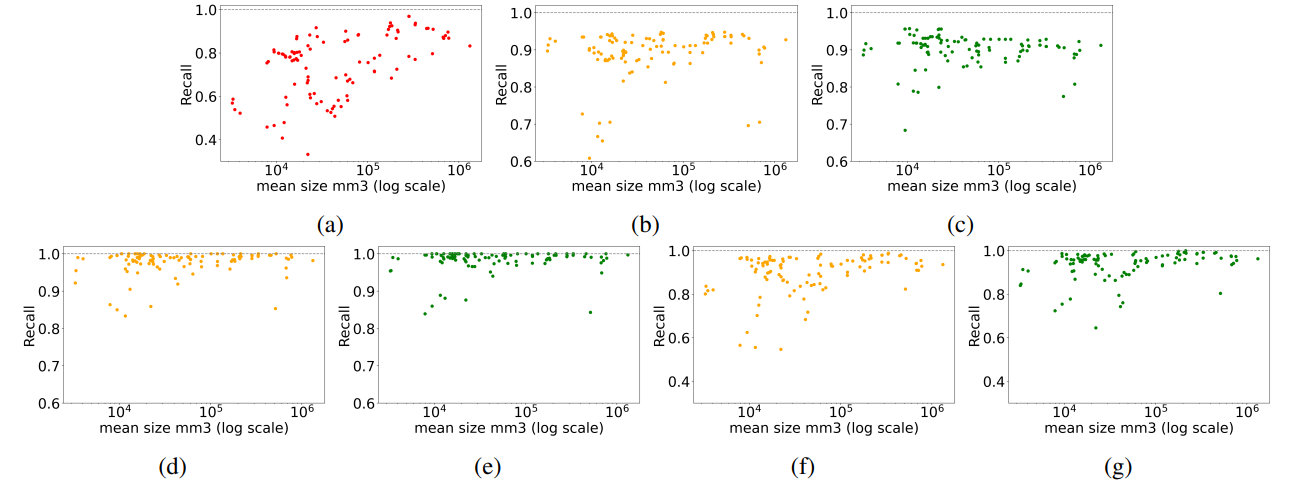
\ Figure 9: Overview of average recall vs. mean anatomical region size for 29 anatomical regions for (a) slice-wise, (b) volume-based, (c) volume-based and re-ranking, (d) region-based, (e) region-based and re-ranking, (f) localized, (g) localized and re-ranking retrieval.
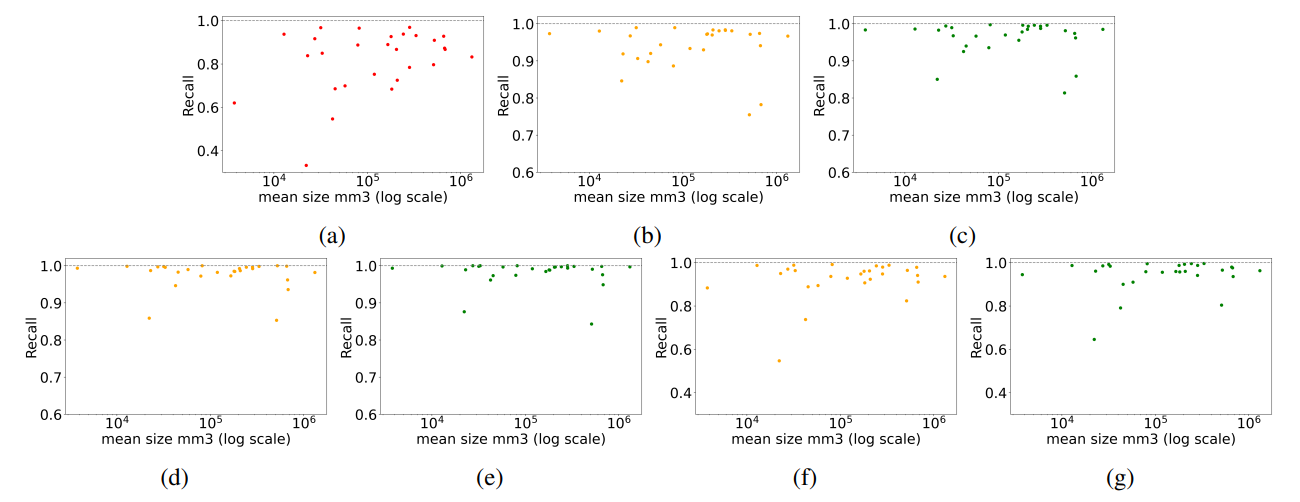
\ Figure 10: Overview of average recall vs. mean anatomical region size for 104 anatomical regions for (a) slice-wise, (b) volume-based, (c) volume-based and re-ranking, (d) region-based, (e) region-based and re-ranking, (f) localized, (g) localized and re-ranking retrieval.

\

:::info Authors:

(1) Farnaz Khun Jush, Bayer AG, Berlin, Germany (farnaz.khunjush@bayer.com);

(2) Steffen Vogler, Bayer AG, Berlin, Germany (steffen.vogler@bayer.com);

(3) Tuan Truong, Bayer AG, Berlin, Germany (tuan.truong@bayer.com);

(4) Matthias Lenga, Bayer AG, Berlin, Germany (matthias.lenga@bayer.com).

:::


:::info This paper is available on arxiv under CC BY 4.0 DEED license.

:::

\

Market Opportunity
Edge Logo
Edge Price(EDGE)
$0.14609
$0.14609$0.14609
+0.87%
USD
Edge (EDGE) Live Price Chart
Disclaimer: The articles reposted on this site are sourced from public platforms and are provided for informational purposes only. They do not necessarily reflect the views of MEXC. All rights remain with the original authors. If you believe any content infringes on third-party rights, please contact service@support.mexc.com for removal. MEXC makes no guarantees regarding the accuracy, completeness, or timeliness of the content and is not responsible for any actions taken based on the information provided. The content does not constitute financial, legal, or other professional advice, nor should it be considered a recommendation or endorsement by MEXC.

You May Also Like

The Economics of Self-Isolation: A Game-Theoretic Analysis of Contagion in a Free Economy

The Economics of Self-Isolation: A Game-Theoretic Analysis of Contagion in a Free Economy

Exploring how the costs of a pandemic can lead to a self-enforcing lockdown in a networked economy, analyzing the resulting changes in network structure and the existence of stable equilibria.
Share
Hackernoon2025/09/17 23:00
One Of Frank Sinatra’s Most Famous Albums Is Back In The Spotlight

One Of Frank Sinatra’s Most Famous Albums Is Back In The Spotlight

The post One Of Frank Sinatra’s Most Famous Albums Is Back In The Spotlight appeared on BitcoinEthereumNews.com. Frank Sinatra’s The World We Knew returns to the Jazz Albums and Traditional Jazz Albums charts, showing continued demand for his timeless music. Frank Sinatra performs on his TV special Frank Sinatra: A Man and his Music Bettmann Archive These days on the Billboard charts, Frank Sinatra’s music can always be found on the jazz-specific rankings. While the art he created when he was still working was pop at the time, and later classified as traditional pop, there is no such list for the latter format in America, and so his throwback projects and cuts appear on jazz lists instead. It’s on those charts where Sinatra rebounds this week, and one of his popular projects returns not to one, but two tallies at the same time, helping him increase the total amount of real estate he owns at the moment. Frank Sinatra’s The World We Knew Returns Sinatra’s The World We Knew is a top performer again, if only on the jazz lists. That set rebounds to No. 15 on the Traditional Jazz Albums chart and comes in at No. 20 on the all-encompassing Jazz Albums ranking after not appearing on either roster just last frame. The World We Knew’s All-Time Highs The World We Knew returns close to its all-time peak on both of those rosters. Sinatra’s classic has peaked at No. 11 on the Traditional Jazz Albums chart, just missing out on becoming another top 10 for the crooner. The set climbed all the way to No. 15 on the Jazz Albums tally and has now spent just under two months on the rosters. Frank Sinatra’s Album With Classic Hits Sinatra released The World We Knew in the summer of 1967. The title track, which on the album is actually known as “The World We Knew (Over and…
Share
BitcoinEthereumNews2025/09/18 00:02
The U.S. Department of Justice files civil forfeiture lawsuit for over $225 million in crypto fraud funds

The U.S. Department of Justice files civil forfeiture lawsuit for over $225 million in crypto fraud funds

PANews reported on June 18 that according to an official announcement, the U.S. Department of Justice filed a civil forfeiture lawsuit in the U.S. District Court for the District of
Share
PANews2025/06/18 23:59