Source: Alea Research Daily Newsletter Compiled by: Zhou, ChainCatcher Synthetic derivatives, decentralized oracles, and composable liquidity protocols enable traders to access everything from Bitcoin and ETH to gold and FX using stablecoin collateral. Since Avantis launched on the mainnet in February 2024, it has become the largest derivatives exchange on Base and the largest DEX in the RWA trading and market making field. The protocol has processed over $18 billion in cumulative trading volume and executed over 2 million trades for over 38,500 traders. With $23 million in TVL across 25,000+ LPs and over 80 markets, Avantis is solidifying its position as a hub for perps. This article will explore Universal Leverage, Avantis's architecture, and the launch of $AVNT. About Avantis Avantis is a perps DEX that allows users to trade cryptocurrencies, forex, commodities, and indices using stablecoin collateral. The protocol abstracts away individual order books and instead builds a “universal leverage layer” where any asset with a reliable price feed can be listed. Synthetic leverage is achieved through a USDC-based liquidity vault that acts as the counterparty for all trades, enabling capital-efficient exposure to multiple markets. Traders can choose up to 500x leverage, allowing them to express directional views with minimal capital, while liquidity providers (LPs) earn a yield by providing USDC to support their positions. Avantis distinguishes itself from other perpetual swap exchanges in that users can trade non-crypto markets like the Japanese Yen, gold, and US stock indices alongside BTC or ETH. The protocol's design also supports features like zero trading fees, loss rebates, and positive slippage, aligning incentives between traders and limited partners by returning a portion of fees or profits to users when they improve the protocol's risk profile. Avantis Architecture At its core, Avantis is a capital-efficient synthetic engine. Traders use the protocol's interface to open positions on supported assets. Instead of matching orders in an order book, Avantis pairs each trader with a USDC vault that takes the other side of the trade. This vault aggregates deposits from thousands of limited partners and acts as a single counterparty. This structure allows the protocol to offer deep liquidity across many markets without requiring separate liquidity pools for each pair, enabling Avantis to list over 80 markets, including 22 RWA assets. Avantis introduces risk tranches and time-lock parameters so that LPs can choose their preferred exposure. LPs can passively deposit in the senior tranche or take more risk in the junior tranche, which has higher return potential but also absorbs a greater share of losses. Additionally, LPs can choose a time lock (e.g., 30 or 90 days) to control the duration of their capital commitment, with longer locks incurring more fees. This design mimics the centralized liquidity model of Uniswap v3 while applying it to the risk management of perps exchanges. Trader <> LP Alignment Avantis' innovative mechanism further aligns the interests of traders and LPs. Loss Rebates: Traders who take the opposite side of open interest (helping balance the platform’s long/short skew) can receive up to 20% loss rebates. This encourages traders to arbitrage open interest and stabilize LP exposure. Positive Slippage: When a trader's order reduces the vault's risk (e.g., closing out a heavily long position), Avantis offers an entry price above the Mark Price. This "better-than-market" execution rewards traders for helping to balance flows. Zero Trading Fees: Avantis pioneered a product where traders pay no fees to open, close, or borrow positions. Instead, they pay only a portion of their profits when closing a winning trade. Available for $BTC, $SOL, and $ETH, with leverage up to 250x, this tool is popular with scalpers and high-frequency traders. Advanced Risk Management: LPs can act as passive lenders or active market makers by selecting risk tranches and time locks. Each tranche has its own share of fees and potential losses, enabling LPs to control risk and return. $AVNT: Token Issuance and Token Economics To facilitate its next phase of growth, Avantis has launched $AVNT, a utility and governance token. $AVNT has multiple functions: Security and Staking: Holders can stake $AVNT in the Avantis Security Module to support the USDC vault during periods of extreme market volatility. Stakers receive $AVNT rewards and discounted trading fees. Community Rewards: 50.1% of the total 1 billion token supply is reserved for traders, liquidity providers, referrers, and builders who contribute to Avantis. Airdrops (12.5% of the supply) will reward protocol activity starting in February 2024, while on-chain incentives (28.6%) will fund future XP seasons and community contributions. Builder and ecosystem grants (9%) will support the creation of new front-ends and trading tools, such as AI agents and Telegram bots. Governance: Token holders will be able to propose and vote on protocol decisions, ranging from asset listings and fee structures to buyback programs and cross-chain deployments. The remaining 49.9% of the supply is distributed as follows: Team (13.3%) Investors (26.61%) Avantis Foundation (4%) Liquidity reserve (6%)Source: Alea Research Daily Newsletter Compiled by: Zhou, ChainCatcher Synthetic derivatives, decentralized oracles, and composable liquidity protocols enable traders to access everything from Bitcoin and ETH to gold and FX using stablecoin collateral. Since Avantis launched on the mainnet in February 2024, it has become the largest derivatives exchange on Base and the largest DEX in the RWA trading and market making field. The protocol has processed over $18 billion in cumulative trading volume and executed over 2 million trades for over 38,500 traders. With $23 million in TVL across 25,000+ LPs and over 80 markets, Avantis is solidifying its position as a hub for perps. This article will explore Universal Leverage, Avantis's architecture, and the launch of $AVNT. About Avantis Avantis is a perps DEX that allows users to trade cryptocurrencies, forex, commodities, and indices using stablecoin collateral. The protocol abstracts away individual order books and instead builds a “universal leverage layer” where any asset with a reliable price feed can be listed. Synthetic leverage is achieved through a USDC-based liquidity vault that acts as the counterparty for all trades, enabling capital-efficient exposure to multiple markets. Traders can choose up to 500x leverage, allowing them to express directional views with minimal capital, while liquidity providers (LPs) earn a yield by providing USDC to support their positions. Avantis distinguishes itself from other perpetual swap exchanges in that users can trade non-crypto markets like the Japanese Yen, gold, and US stock indices alongside BTC or ETH. The protocol's design also supports features like zero trading fees, loss rebates, and positive slippage, aligning incentives between traders and limited partners by returning a portion of fees or profits to users when they improve the protocol's risk profile. Avantis Architecture At its core, Avantis is a capital-efficient synthetic engine. Traders use the protocol's interface to open positions on supported assets. Instead of matching orders in an order book, Avantis pairs each trader with a USDC vault that takes the other side of the trade. This vault aggregates deposits from thousands of limited partners and acts as a single counterparty. This structure allows the protocol to offer deep liquidity across many markets without requiring separate liquidity pools for each pair, enabling Avantis to list over 80 markets, including 22 RWA assets. Avantis introduces risk tranches and time-lock parameters so that LPs can choose their preferred exposure. LPs can passively deposit in the senior tranche or take more risk in the junior tranche, which has higher return potential but also absorbs a greater share of losses. Additionally, LPs can choose a time lock (e.g., 30 or 90 days) to control the duration of their capital commitment, with longer locks incurring more fees. This design mimics the centralized liquidity model of Uniswap v3 while applying it to the risk management of perps exchanges. Trader <> LP Alignment Avantis' innovative mechanism further aligns the interests of traders and LPs. Loss Rebates: Traders who take the opposite side of open interest (helping balance the platform’s long/short skew) can receive up to 20% loss rebates. This encourages traders to arbitrage open interest and stabilize LP exposure. Positive Slippage: When a trader's order reduces the vault's risk (e.g., closing out a heavily long position), Avantis offers an entry price above the Mark Price. This "better-than-market" execution rewards traders for helping to balance flows. Zero Trading Fees: Avantis pioneered a product where traders pay no fees to open, close, or borrow positions. Instead, they pay only a portion of their profits when closing a winning trade. Available for $BTC, $SOL, and $ETH, with leverage up to 250x, this tool is popular with scalpers and high-frequency traders. Advanced Risk Management: LPs can act as passive lenders or active market makers by selecting risk tranches and time locks. Each tranche has its own share of fees and potential losses, enabling LPs to control risk and return. $AVNT: Token Issuance and Token Economics To facilitate its next phase of growth, Avantis has launched $AVNT, a utility and governance token. $AVNT has multiple functions: Security and Staking: Holders can stake $AVNT in the Avantis Security Module to support the USDC vault during periods of extreme market volatility. Stakers receive $AVNT rewards and discounted trading fees. Community Rewards: 50.1% of the total 1 billion token supply is reserved for traders, liquidity providers, referrers, and builders who contribute to Avantis. Airdrops (12.5% of the supply) will reward protocol activity starting in February 2024, while on-chain incentives (28.6%) will fund future XP seasons and community contributions. Builder and ecosystem grants (9%) will support the creation of new front-ends and trading tools, such as AI agents and Telegram bots. Governance: Token holders will be able to propose and vote on protocol decisions, ranging from asset listings and fee structures to buyback programs and cross-chain deployments. The remaining 49.9% of the supply is distributed as follows: Team (13.3%) Investors (26.61%) Avantis Foundation (4%) Liquidity reserve (6%)

Zero Fees + 500x Leverage: Understanding Avantis, the Largest Derivatives Exchange on Base

2025/09/04 08:00

Source: Alea Research Daily Newsletter

Compiled by: Zhou, ChainCatcher

Synthetic derivatives, decentralized oracles, and composable liquidity protocols enable traders to access everything from Bitcoin and ETH to gold and FX using stablecoin collateral.

Since Avantis launched on the mainnet in February 2024, it has become the largest derivatives exchange on Base and the largest DEX in the RWA trading and market making field.

The protocol has processed over $18 billion in cumulative trading volume and executed over 2 million trades for over 38,500 traders. With $23 million in TVL across 25,000+ LPs and over 80 markets, Avantis is solidifying its position as a hub for perps.

This article will explore Universal Leverage, Avantis's architecture, and the launch of $AVNT.

About Avantis

Avantis is a perps DEX that allows users to trade cryptocurrencies, forex, commodities, and indices using stablecoin collateral. The protocol abstracts away individual order books and instead builds a “universal leverage layer” where any asset with a reliable price feed can be listed.

Synthetic leverage is achieved through a USDC-based liquidity vault that acts as the counterparty for all trades, enabling capital-efficient exposure to multiple markets. Traders can choose up to 500x leverage, allowing them to express directional views with minimal capital, while liquidity providers (LPs) earn a yield by providing USDC to support their positions.

Avantis distinguishes itself from other perpetual swap exchanges in that users can trade non-crypto markets like the Japanese Yen, gold, and US stock indices alongside BTC or ETH. The protocol's design also supports features like zero trading fees, loss rebates, and positive slippage, aligning incentives between traders and limited partners by returning a portion of fees or profits to users when they improve the protocol's risk profile.

Avantis Architecture

At its core, Avantis is a capital-efficient synthetic engine. Traders use the protocol's interface to open positions on supported assets. Instead of matching orders in an order book, Avantis pairs each trader with a USDC vault that takes the other side of the trade. This vault aggregates deposits from thousands of limited partners and acts as a single counterparty. This structure allows the protocol to offer deep liquidity across many markets without requiring separate liquidity pools for each pair, enabling Avantis to list over 80 markets, including 22 RWA assets.
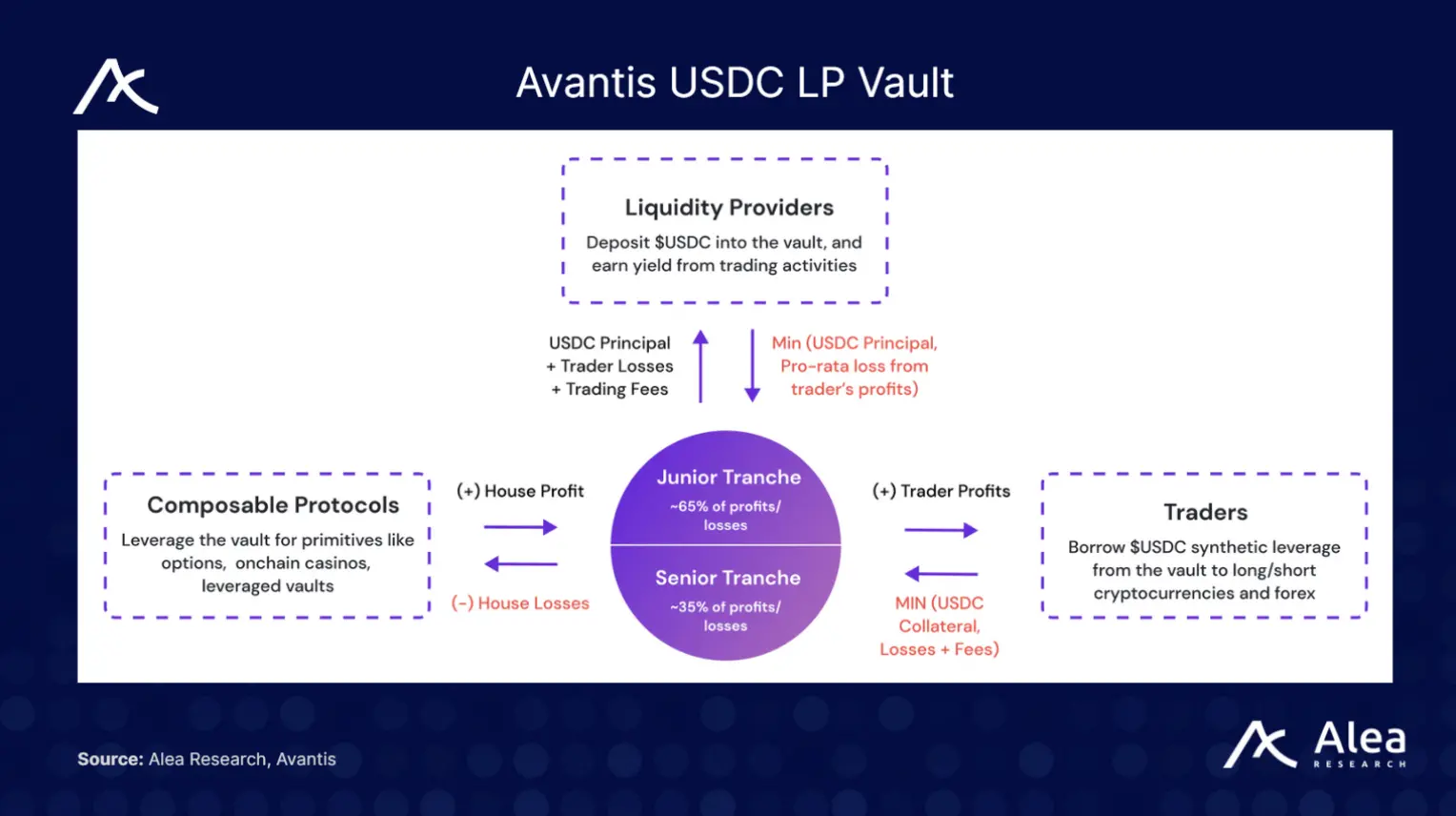
Avantis introduces risk tranches and time-lock parameters so that LPs can choose their preferred exposure. LPs can passively deposit in the senior tranche or take more risk in the junior tranche, which has higher return potential but also absorbs a greater share of losses.
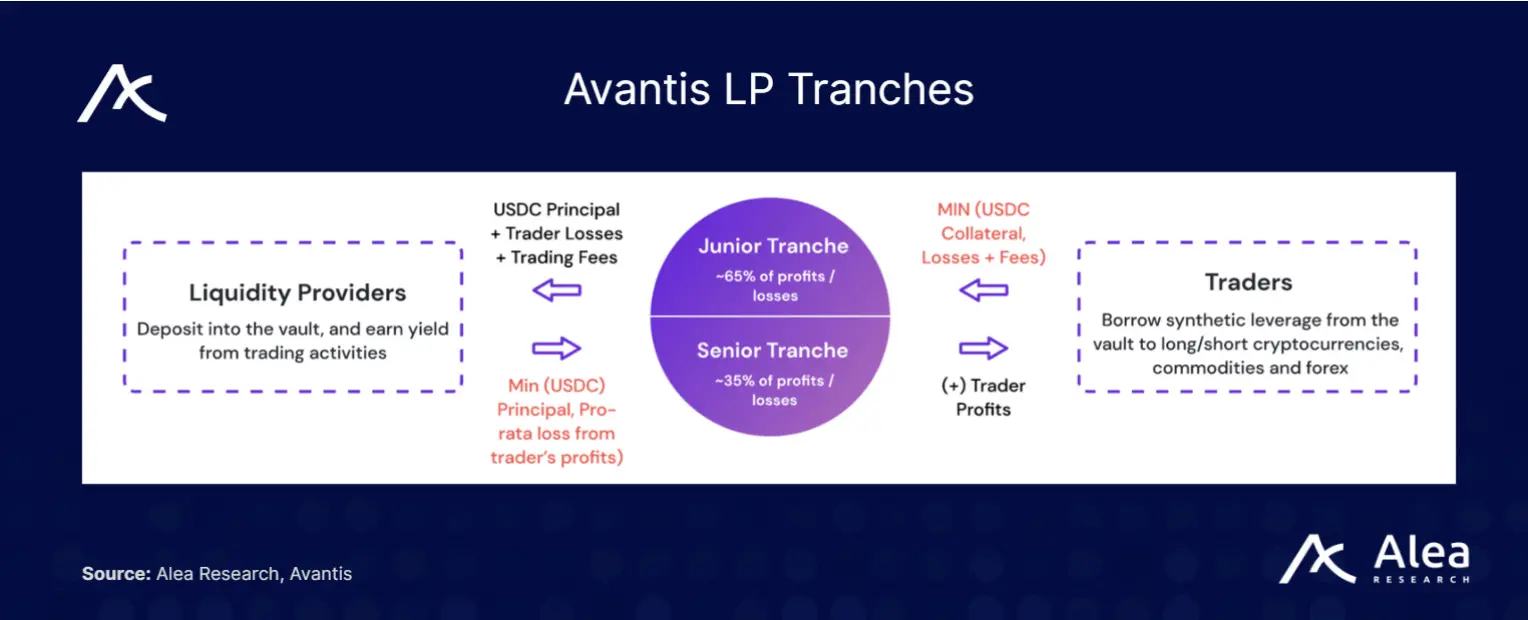
Additionally, LPs can choose a time lock (e.g., 30 or 90 days) to control the duration of their capital commitment, with longer locks incurring more fees. This design mimics the centralized liquidity model of Uniswap v3 while applying it to the risk management of perps exchanges.

Trader <> LP Alignment

Avantis' innovative mechanism further aligns the interests of traders and LPs.

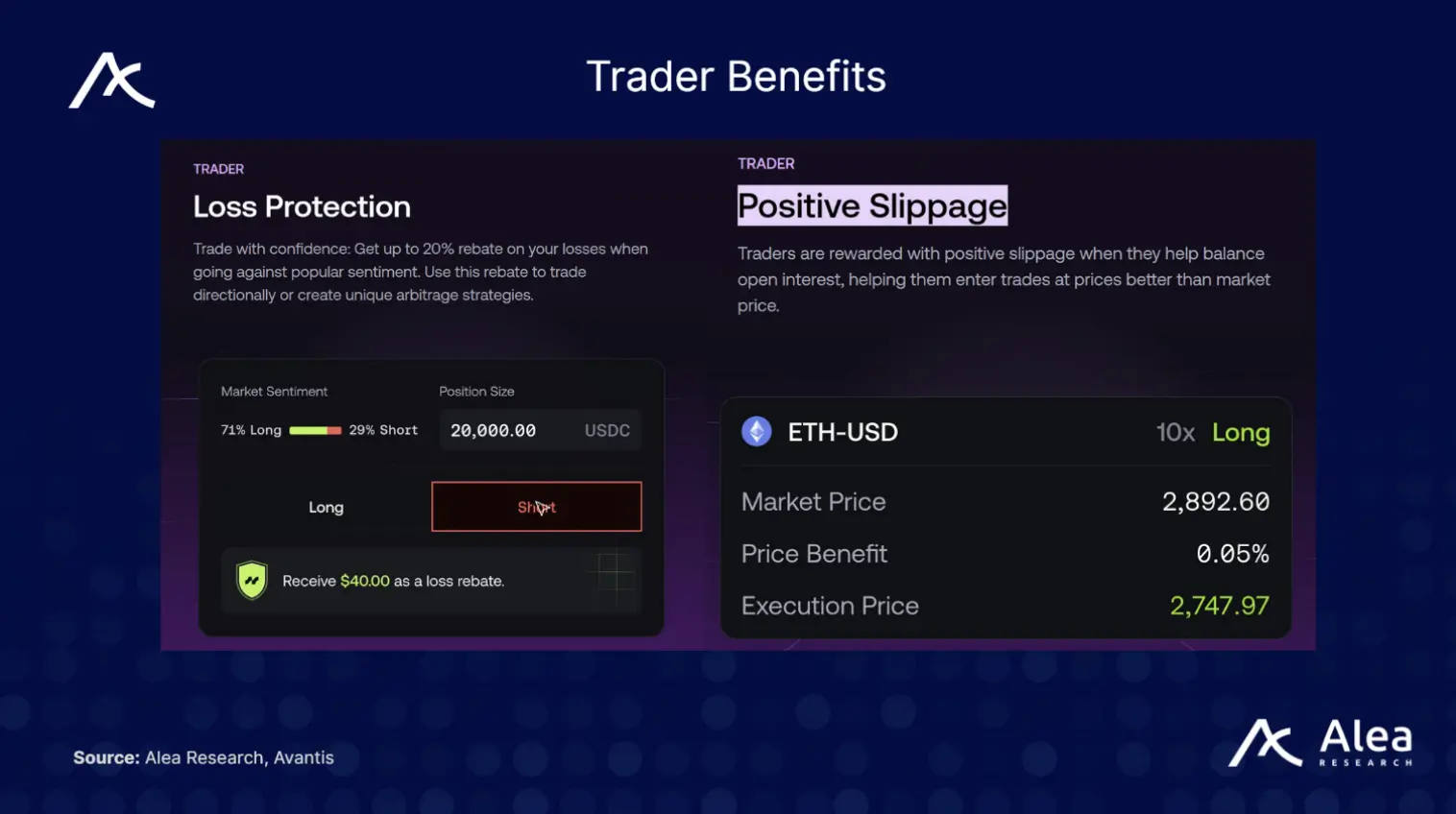
Loss Rebates: Traders who take the opposite side of open interest (helping balance the platform’s long/short skew) can receive up to 20% loss rebates. This encourages traders to arbitrage open interest and stabilize LP exposure.

Positive Slippage: When a trader's order reduces the vault's risk (e.g., closing out a heavily long position), Avantis offers an entry price above the Mark Price. This "better-than-market" execution rewards traders for helping to balance flows.
Zero Trading Fees: Avantis pioneered a product where traders pay no fees to open, close, or borrow positions. Instead, they pay only a portion of their profits when closing a winning trade. Available for $BTC, $SOL, and $ETH, with leverage up to 250x, this tool is popular with scalpers and high-frequency traders.

Advanced Risk Management: LPs can act as passive lenders or active market makers by selecting risk tranches and time locks. Each tranche has its own share of fees and potential losses, enabling LPs to control risk and return.

$AVNT: Token Issuance and Token Economics

To facilitate its next phase of growth, Avantis has launched $AVNT, a utility and governance token.

$AVNT has multiple functions:

Security and Staking: Holders can stake $AVNT in the Avantis Security Module to support the USDC vault during periods of extreme market volatility. Stakers receive $AVNT rewards and discounted trading fees.

Community Rewards: 50.1% of the total 1 billion token supply is reserved for traders, liquidity providers, referrers, and builders who contribute to Avantis. Airdrops (12.5% of the supply) will reward protocol activity starting in February 2024, while on-chain incentives (28.6%) will fund future XP seasons and community contributions. Builder and ecosystem grants (9%) will support the creation of new front-ends and trading tools, such as AI agents and Telegram bots.

Governance: Token holders will be able to propose and vote on protocol decisions, ranging from asset listings and fee structures to buyback programs and cross-chain deployments.

The remaining 49.9% of the supply is distributed as follows:

  • Team (13.3%)
  • Investors (26.61%)
  • Avantis Foundation (4%)
  • Liquidity reserve (6%)
Disclaimer: The articles reposted on this site are sourced from public platforms and are provided for informational purposes only. They do not necessarily reflect the views of MEXC. All rights remain with the original authors. If you believe any content infringes on third-party rights, please contact service@support.mexc.com for removal. MEXC makes no guarantees regarding the accuracy, completeness, or timeliness of the content and is not responsible for any actions taken based on the information provided. The content does not constitute financial, legal, or other professional advice, nor should it be considered a recommendation or endorsement by MEXC.

You May Also Like

Holywater Raises Additional $22 Million To Expand AI Vertical Video Platform

Holywater Raises Additional $22 Million To Expand AI Vertical Video Platform

The post Holywater Raises Additional $22 Million To Expand AI Vertical Video Platform appeared on BitcoinEthereumNews.com. Holywater is positioning itself as “the
Share
BitcoinEthereumNews2026/01/17 01:18
OpenVPP accused of falsely advertising cooperation with the US government; SEC commissioner clarifies no involvement

OpenVPP accused of falsely advertising cooperation with the US government; SEC commissioner clarifies no involvement

PANews reported on September 17th that on-chain sleuth ZachXBT tweeted that OpenVPP ( $OVPP ) announced this week that it was collaborating with the US government to advance energy tokenization. SEC Commissioner Hester Peirce subsequently responded, stating that the company does not collaborate with or endorse any private crypto projects. The OpenVPP team subsequently hid the response. Several crypto influencers have participated in promoting the project, and the accounts involved have been questioned as typical influencer accounts.
Share
PANews2025/09/17 23:58
Best Crypto to Buy as Saylor & Crypto Execs Meet in US Treasury Council

Best Crypto to Buy as Saylor & Crypto Execs Meet in US Treasury Council

The post Best Crypto to Buy as Saylor & Crypto Execs Meet in US Treasury Council appeared on BitcoinEthereumNews.com. Michael Saylor and a group of crypto executives met in Washington, D.C. yesterday to push for the Strategic Bitcoin Reserve Bill (the BITCOIN Act), which would see the U.S. acquire up to 1M $BTC over five years. With Bitcoin being positioned yet again as a cornerstone of national monetary policy, many investors are turning their eyes to projects that lean into this narrative – altcoins, meme coins, and presales that could ride on the same wave. Read on for three of the best crypto projects that seem especially well‐suited to benefit from this macro shift:  Bitcoin Hyper, Best Wallet Token, and Remittix. These projects stand out for having a strong use case and high adoption potential, especially given the push for a U.S. Bitcoin reserve.   Why the Bitcoin Reserve Bill Matters for Crypto Markets The strategic Bitcoin Reserve Bill could mark a turning point for the U.S. approach to digital assets. The proposal would see America build a long-term Bitcoin reserve by acquiring up to one million $BTC over five years. To make this happen, lawmakers are exploring creative funding methods such as revaluing old gold certificates. The plan also leans on confiscated Bitcoin already held by the government, worth an estimated $15–20B. This isn’t just a headline for policy wonks. It signals that Bitcoin is moving from the margins into the core of financial strategy. Industry figures like Michael Saylor, Senator Cynthia Lummis, and Marathon Digital’s Fred Thiel are all backing the bill. They see Bitcoin not just as an investment, but as a hedge against systemic risks. For the wider crypto market, this opens the door for projects tied to Bitcoin and the infrastructure that supports it. 1. Bitcoin Hyper ($HYPER) – Turning Bitcoin Into More Than Just Digital Gold The U.S. may soon treat Bitcoin as…
Share
BitcoinEthereumNews2025/09/18 00:27