Bitcoin’s mining math hit a fresh high this week as the network’s difficulty climbed to a new all-time peak of 135 trillion. Miners now need more computing work than ever to win a block, while the overall hashpower available to the network has slipped from its summer peak. Related Reading: MemeCore Explodes 3,800% For ATH — But Is A Collapse Around The Corner? Mining Difficulty Reaches New High According to on-chain data, network hashrate fell to 967 billion hashes per second after topping 1 trillion hashes per second on August 4. That gap — rising difficulty paired with a lower hashrate — tightens margins for miners. Reports have disclosed that higher difficulty makes mining more costly, and the pressure is felt most by smaller operations that run on narrow profit margins. Big miners have room to scale. Smaller teams do not. Costs for electricity, machines and maintenance add up fast. The situation raises concern about concentration. As the cost to operate rises, larger pools and firms are better positioned to absorb the pain and keep hashing. Solo Miners Still Score Big Despite those headwinds, Three solo miners managed to land blocks in July and August, proving the system still hands out rewards to individuals now and then. Reports show the block subsidy is 3.125 BTC per block. On July three, a solo miner found block 903,883 and took home just under $350,000 in subsidy plus fees. Another solo miner added block 907,283 on July 26, claiming over $373,000 when prices at the time were used to value the reward. On August 17, block 910,440 was mined by a solo operator, yielding roughly $373,000 in subsidy and fees. Those payouts highlight two facts. First, solo success is rare but possible. Second, occasional large rewards do not erase the steady advantage of scale. Pools still smooth earnings for participants, and many miners use them to avoid long dry spells. Seasonality And Market Patterns Meanwhile, September has a poor historical record for Bitcoin, with an average return of -3.77% across 12 years beginning in 2013, researchers say. Bitcoin endured six straight losing Septembers from 2017 through 2022. The streak reversed in 2023, and 2024 closed out as the best September on record at +7.29%. Related Reading: Trump-Tied Thumzup Raises $50M, Merges Dogecoin Mining With XRP Plans What This Means Now In short, the network’s math is becoming tougher at the same time mining capacity dipped slightly. That creates tighter margins and fuels debate over centralization as scale matters more. Yet the ecosystem still shows variety: solo miners can and do win blocks, and market history gives investors a mixed picture where seasonal trends matter but do not guarantee outcomes. For now, miners and market watchers alike will be tracking difficulty, hashrate and price swings as the fall unfolds. Featured image from Unsplash, chart from TradingViewBitcoin’s mining math hit a fresh high this week as the network’s difficulty climbed to a new all-time peak of 135 trillion. Miners now need more computing work than ever to win a block, while the overall hashpower available to the network has slipped from its summer peak. Related Reading: MemeCore Explodes 3,800% For ATH — But Is A Collapse Around The Corner? Mining Difficulty Reaches New High According to on-chain data, network hashrate fell to 967 billion hashes per second after topping 1 trillion hashes per second on August 4. That gap — rising difficulty paired with a lower hashrate — tightens margins for miners. Reports have disclosed that higher difficulty makes mining more costly, and the pressure is felt most by smaller operations that run on narrow profit margins. Big miners have room to scale. Smaller teams do not. Costs for electricity, machines and maintenance add up fast. The situation raises concern about concentration. As the cost to operate rises, larger pools and firms are better positioned to absorb the pain and keep hashing. Solo Miners Still Score Big Despite those headwinds, Three solo miners managed to land blocks in July and August, proving the system still hands out rewards to individuals now and then. Reports show the block subsidy is 3.125 BTC per block. On July three, a solo miner found block 903,883 and took home just under $350,000 in subsidy plus fees. Another solo miner added block 907,283 on July 26, claiming over $373,000 when prices at the time were used to value the reward. On August 17, block 910,440 was mined by a solo operator, yielding roughly $373,000 in subsidy and fees. Those payouts highlight two facts. First, solo success is rare but possible. Second, occasional large rewards do not erase the steady advantage of scale. Pools still smooth earnings for participants, and many miners use them to avoid long dry spells. Seasonality And Market Patterns Meanwhile, September has a poor historical record for Bitcoin, with an average return of -3.77% across 12 years beginning in 2013, researchers say. Bitcoin endured six straight losing Septembers from 2017 through 2022. The streak reversed in 2023, and 2024 closed out as the best September on record at +7.29%. Related Reading: Trump-Tied Thumzup Raises $50M, Merges Dogecoin Mining With XRP Plans What This Means Now In short, the network’s math is becoming tougher at the same time mining capacity dipped slightly. That creates tighter margins and fuels debate over centralization as scale matters more. Yet the ecosystem still shows variety: solo miners can and do win blocks, and market history gives investors a mixed picture where seasonal trends matter but do not guarantee outcomes. For now, miners and market watchers alike will be tracking difficulty, hashrate and price swings as the fall unfolds. Featured image from Unsplash, chart from TradingView

New Peak: Bitcoin Mining Difficulty Soars To 135 Trillion

2025/09/07 17:00

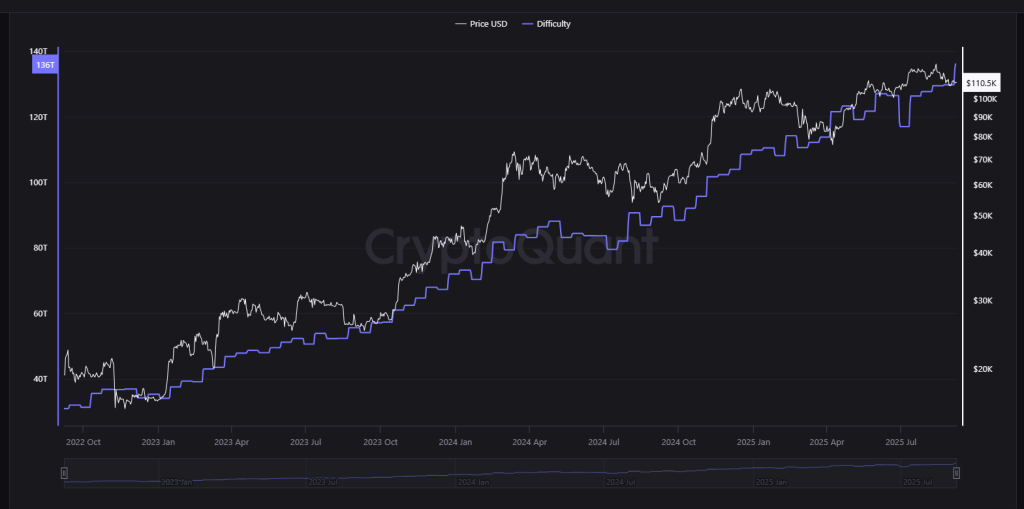
Bitcoin’s mining math hit a fresh high this week as the network’s difficulty climbed to a new all-time peak of 135 trillion. Miners now need more computing work than ever to win a block, while the overall hashpower available to the network has slipped from its summer peak.

Mining Difficulty Reaches New High

According to on-chain data, network hashrate fell to 967 billion hashes per second after topping 1 trillion hashes per second on August 4. That gap — rising difficulty paired with a lower hashrate — tightens margins for miners.

Reports have disclosed that higher difficulty makes mining more costly, and the pressure is felt most by smaller operations that run on narrow profit margins.

Big miners have room to scale. Smaller teams do not. Costs for electricity, machines and maintenance add up fast. The situation raises concern about concentration. As the cost to operate rises, larger pools and firms are better positioned to absorb the pain and keep hashing.
Solo Miners Still Score Big

Despite those headwinds, Three solo miners managed to land blocks in July and August, proving the system still hands out rewards to individuals now and then. Reports show the block subsidy is 3.125 BTC per block. On July three, a solo miner found block 903,883 and took home just under $350,000 in subsidy plus fees.

Another solo miner added block 907,283 on July 26, claiming over $373,000 when prices at the time were used to value the reward. On August 17, block 910,440 was mined by a solo operator, yielding roughly $373,000 in subsidy and fees.

Those payouts highlight two facts. First, solo success is rare but possible. Second, occasional large rewards do not erase the steady advantage of scale. Pools still smooth earnings for participants, and many miners use them to avoid long dry spells.

Seasonality And Market Patterns

Meanwhile, September has a poor historical record for Bitcoin, with an average return of -3.77% across 12 years beginning in 2013, researchers say.

Bitcoin endured six straight losing Septembers from 2017 through 2022. The streak reversed in 2023, and 2024 closed out as the best September on record at +7.29%.

What This Means Now

In short, the network’s math is becoming tougher at the same time mining capacity dipped slightly. That creates tighter margins and fuels debate over centralization as scale matters more.

Yet the ecosystem still shows variety: solo miners can and do win blocks, and market history gives investors a mixed picture where seasonal trends matter but do not guarantee outcomes.

For now, miners and market watchers alike will be tracking difficulty, hashrate and price swings as the fall unfolds.

Featured image from Unsplash, chart from TradingView

Market Opportunity
SIX Logo
SIX Price(SIX)
$0.0121
$0.0121$0.0121
-1.78%
USD
SIX (SIX) Live Price Chart
Disclaimer: The articles reposted on this site are sourced from public platforms and are provided for informational purposes only. They do not necessarily reflect the views of MEXC. All rights remain with the original authors. If you believe any content infringes on third-party rights, please contact service@support.mexc.com for removal. MEXC makes no guarantees regarding the accuracy, completeness, or timeliness of the content and is not responsible for any actions taken based on the information provided. The content does not constitute financial, legal, or other professional advice, nor should it be considered a recommendation or endorsement by MEXC.

You May Also Like

Franklin Templeton CEO Dismisses 50bps Rate Cut Ahead FOMC

Franklin Templeton CEO Dismisses 50bps Rate Cut Ahead FOMC

The post Franklin Templeton CEO Dismisses 50bps Rate Cut Ahead FOMC appeared on BitcoinEthereumNews.com. Franklin Templeton CEO Jenny Johnson has weighed in on whether the Federal Reserve should make a 25 basis points (bps) Fed rate cut or 50 bps cut. This comes ahead of the Fed decision today at today’s FOMC meeting, with the market pricing in a 25 bps cut. Bitcoin and the broader crypto market are currently trading flat ahead of the rate cut decision. Franklin Templeton CEO Weighs In On Potential FOMC Decision In a CNBC interview, Jenny Johnson said that she expects the Fed to make a 25 bps cut today instead of a 50 bps cut. She acknowledged the jobs data, which suggested that the labor market is weakening. However, she noted that this data is backward-looking, indicating that it doesn’t show the current state of the economy. She alluded to the wage growth, which she remarked is an indication of a robust labor market. She added that retail sales are up and that consumers are still spending, despite inflation being sticky at 3%, which makes a case for why the FOMC should opt against a 50-basis-point Fed rate cut. In line with this, the Franklin Templeton CEO said that she would go with a 25 bps rate cut if she were Jerome Powell. She remarked that the Fed still has the October and December FOMC meetings to make further cuts if the incoming data warrants it. Johnson also asserted that the data show a robust economy. However, she noted that there can’t be an argument for no Fed rate cut since Powell already signaled at Jackson Hole that they were likely to lower interest rates at this meeting due to concerns over a weakening labor market. Notably, her comment comes as experts argue for both sides on why the Fed should make a 25 bps cut or…
Share
BitcoinEthereumNews2025/09/18 00:36
XRP Treasury Firm Evernorth Prepares Public Listing to Boost Institutional Exposure

XRP Treasury Firm Evernorth Prepares Public Listing to Boost Institutional Exposure

Evernorth is working toward a Q1 Nasdaq listing through a SPAC merger, giving XRP exposure to Wall Street investors. Funds raised will be used to back DeFi products
Share
Crypto News Flash2026/01/17 20:01
XRP Treasury Firm Evernorth Prepares Public Listing

XRP Treasury Firm Evernorth Prepares Public Listing

The post XRP Treasury Firm Evernorth Prepares Public Listing appeared on BitcoinEthereumNews.com. Kelvin is a crypto journalist/editor with over six years of experience
Share
BitcoinEthereumNews2026/01/17 20:13