A Conditional Diffusion Approach to Multidimensional Unfolding Across Physics Processes
:::info Authors:
(1) Camila Pazos, Department of Physics and Astronomy, Tufts University, Medford, Massachusetts;
(2) Shuchin Aeron, Department of Electrical and Computer Engineering, Tufts University, Medford, Massachusetts and The NSF AI Institute for Artificial Intelligence and Fundamental Interactions;
(3) Pierre-Hugues Beauchemin, Department of Physics and Astronomy, Tufts University, Medford, Massachusetts and The NSF AI Institute for Artificial Intelligence and Fundamental Interactions;
(4) Vincent Croft, Leiden Institute for Advanced Computer Science LIACS, Leiden University, The Netherlands;
(5) Martin Klassen, Department of Physics and Astronomy, Tufts University, Medford, Massachusetts;
(6) Taritree Wongjirad, Department of Physics and Astronomy, Tufts University, Medford, Massachusetts and The NSF AI Institute for Artificial Intelligence and Fundamental Interactions.
:::
Table of Links
Abstract and 1. Introduction
-
Unfolding
2.1 Posing the Unfolding Problem
2.2 Our Unfolding Approach
-
Denoising Diffusion Probabilistic Models
3.1 Conditional DDPM
-
Unfolding with cDDPMs
-
Results
5.1 Toy models
5.2 Physics Results
-
Discussion, Acknowledgments, and References
\ Appendices
A. Conditional DDPM Loss Derivation
B. Physics Simulations
C. Detector Simulation and Jet Matching
D. Toy Model Results
E. Complete Physics Results
Abstract
The unfolding of detector effects in experimental data is critical for enabling precision measurements in high-energy physics. However, traditional unfolding methods face challenges in scalability, flexibility, and dependence on simulations. We introduce a novel unfolding approach using conditional Denoising Diffusion Probabilistic Models (cDDPM). Our method utilizes the cDDPM for a non-iterative, flexible posterior sampling approach, which exhibits a strong inductive bias that allows it to generalize to unseen physics processes without explicitly assuming the underlying distribution. We test our approach by training a single cDDPM to perform multidimensional particle-wise unfolding for a variety of physics processes, including those not seen during training. Our results highlight the potential of this method as a step towards a “universal” unfolding tool that reduces dependence on truth-level assumptions.
\
1 Introduction
Unfolding detector effects in high-energy physics (HEP) events is a critical challenge with significant implications for both theoretical and experimental physics. Experimental data in HEP presents a distorted picture of the true physics processes due to detector effects. Unfolding is an inverse-problem solved through statistical inference that aims to correct the detector distortions of the observed data to recover the true distribution of particle properties. This process is essential for the validation of theories, new discoveries, precision measurements, and comparison of experimental results between different experiments. Since there are flaws in any possible solution to such a problem, the quality of the statistical inference directly impacts the reliability of scientific conclusions, making unfolding a cornerstone in high-energy physics research.
\ Traditional unfolding methods [5] are based on the linearization of the problem, reducing it to the resolution of a set of linear equations. Such approaches often suffer from limitations such as the requirement for data to be binned into histograms, the inability to unfold multiple observables simultaneously, and the lack of utilization of all features that control the detector response. These limitations necessitate a more robust and comprehensive approach to unfolding that would increase the usefulness of a dataset, for example by providing more information about the underlying physics process that led to the observed data.
\ Machine learning methods for unfolding have recently emerged as a powerful tool for this purpose. The ability of machine learning algorithms to learn patterns and relationships from large datasets makes them well-suited to analyzing the vast amounts of data generated by modern particle experiments. The OmniFold method, for instance, mitigates many of the challenges faced by traditional approaches by allowing us to utilize a multidimensional representation of the particles, which can include both the full phase space information and high-dimensional features [1]. Along with OmniFold, a variety of machine learning approaches for unfolding have been presented in recent years, including generative adversarial networks [9], conditional invertible neural networks [2], latent variational diffusion models [16], Schrodinger bridges and diffusion models [11], and others, see [15] for a recent survey. Each new method has made further strides in unfolding and shown the advantages in machine learning based approaches compared to traditional techniques. However, these methods all rely on an explicit description of the expected underlying distribution resulting from the unfolding process.
\ In this work, we introduce a novel approach based on Denoising Diffusion Probabilistic Models (DDPM) to unfold detector effects in HEP data without requiring an explicit assumption about the underlying distribution. We demonstrate how a single conditional DDPM can be trained to perform multidimensional particle-wise unfolding for a variety of physics processes. This flexibility is a step towards a “universal” unfolding tool, providing unfolded estimates while reducing the dependence on truth-level assumptions that could bias the results. This study serves as a benchmark for improving unfolding methods for the LHC and future colliders.
\
2 Unfolding
2.1 Posing the Unfolding Problem
\ 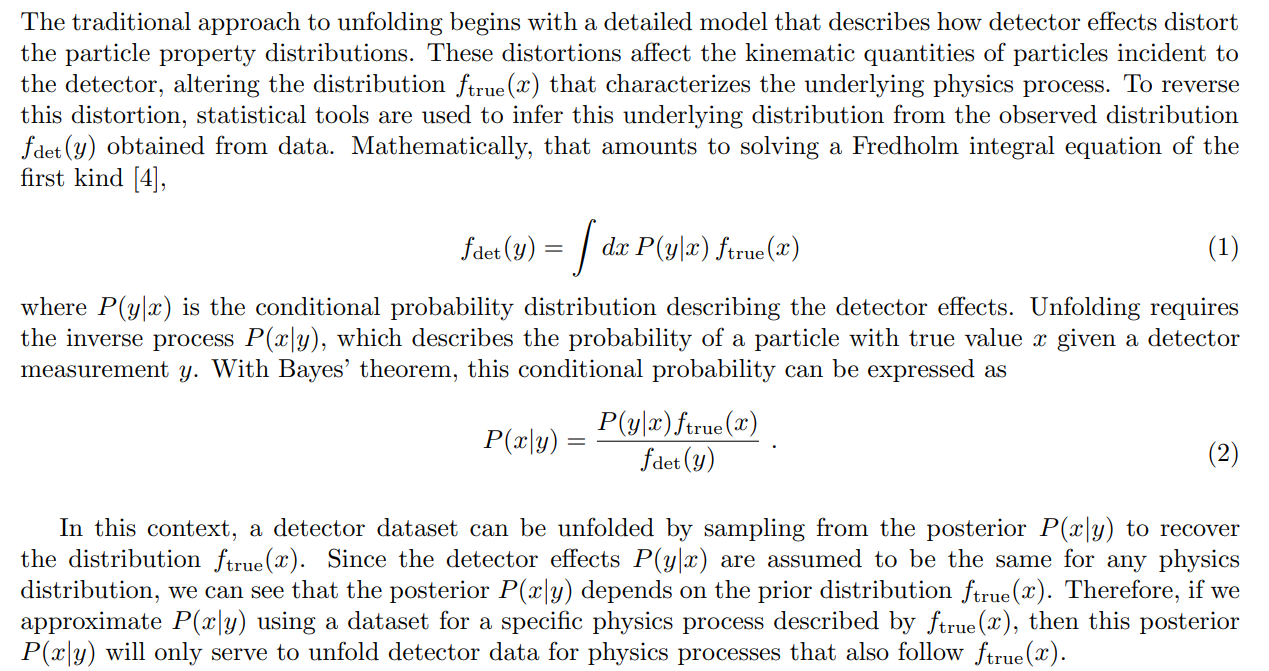
\ \ This reveals one of the main challenges in developing a universal unfolder, which can be applied to unfold detector data for any physics process. Instead of developing a method able to learn a posterior P(x|y) to unfold detector data pertaining to a specific true underlying distribution, a universal unfolder aims to remove detector effects from any set of measured data agnostic of the process of interest, ideally with no bias towards any prior distribution.
\
2.2 Our Unfolding Approach
Although we cannot achieve an ideal universal unfolder, we can seek an approach that will enhance the inductive bias of the unfolding method to improve generalization to cover various posteriors pertaining to different physics data distributions. From eq. (2) we can see that the posteriors for two different physics processes i and j are related by a ratio of the probability density functions of each process,
\ \ 
\ \ Assuming we can learn the posterior for a given physics process, we note that we could extrapolate to unseen posteriors if the priors ftrue(x) and detector distributions fdet(y) can be approximated or written in a closed form. Although these functions have no analytical form, we can approximate key features using the first moments of these distributions. By making use of these moments, we can have a more flexible unfolder that is not strictly tied to a selected prior distribution, and enables it to interpolate and extrapolate to unseen posteriors based on the provided moments. Consequently, this unfolding tool gains the ability to handle a wider range of physics processes and enhances the generalization capabilities, making it a more versatile tool for unfolding in various high energy physics applications.
\ In practice, one can use a training dataset of pairs {x, y} to train a machine learning model to learn a posterior P(x|y). To implement our approach and improve the inductive bias, we define a training dataset consisting of multiple prior distributions and incorporate the moments of these distributions to the data pairs. The moments are therefore included in the conditioning and generative aspects of the machine learning model such that it may be able to model multiple posteriors. As a result, we establish an unfolding tool as a posterior sampler that, when trained with sufficient priors within a family of distributions, is “universal” in the sense that it has a strong inductive bias to allow generalization towards estimating the prior distribution of unseen datasets. Further details and a technical description of this method are provided in section 4.
\ Our proposed approach calls for a flexible generative model, and denoising diffusion probabilistic models (DDPMs) [13] lend themselves naturally to this task. DDPMs learn via a reversible generative process that can be conditioned directly on the moments of the distribution fdet(y) and on the detector values themselves, providing a natural way to model P(x|y) for unfolding. In particular, the various conditioning methods available for DDPMs offer the flexibility to construct a model that can adapt to different detector data distributions and physics processes. Further details on DDPMs are provided in section 3.
\
:::info This paper is available on arxiv under CC BY 4.0 DEED license.
:::
\


You May Also Like

Super Micro Computer (SMCI) Stock Jumps 6% as Traders Bet Big on Calls

Solana soaks up $10.5b USDC as stablecoin rails go multi‑chain