Original author: Geek Original translation: Luffy, Foresight News I wouldn't be surprised if we've reached the end of the InfoFi era, or are approaching it. Since the rise of InfoFi, many people have made considerable profits from it, some have accumulated 5 figures, and some have even made 6 figures. But now, there are some signals that deserve our high attention. Threshold rule changes Strictly speaking, I don’t think this upgrade of Kaito is a completely bad thing. It may effectively prevent a large number of accounts from using AI to generate low-quality content to “brush up” the volume, while improving the quality of the content. However, after the upgrade, not only small accounts were affected, but many large accounts were also not spared. This led to a large number of users who relied on Kaito to choose to leave, because after the upgrade, they had almost no chance of making money through the platform. In response to this, some project owners have chosen to remove the threshold to attract small trumpeters to join. This just shows that in most cases, the small trumpet group is crucial. My opinion is that Kaito seems confused about the direction of this upgrade, and many project parties clearly don’t like this “threshold restriction.” However, it is undeniable that Kaito has performed quite well in the past few months. The token distribution plan is poor For content creators (yappers), today’s typical 0.5%-1% token distribution ratio is far from enough, as these tokens are often valued very low when they are launched. In the early days, some accounts could earn 4-5 figures through 1-2 months of promotional activities; but now, even if they participate in 3-6 months of activities, they can only earn 3-4 figures, which makes many people feel discouraged. Even top accounts, even if they produce high-quality content, find it difficult to earn substantial four-digit income. Why is this bad news for creators who rely on InfoFi? Before InfoFi's rise, many creators earned a healthy income by promoting their content as brand ambassadors or influencers. However, the compensation offered by projects on Kaito now simply cannot compare to external partnerships. Given this fact, it's no surprise that more and more creators are choosing to leave the InfoFi platform. Capital Launchpad’s dominance is evident On July 22, Kaito's "Capital Launchpad" was officially launched. The first project to be launched was Espresso, and more projects subsequently joined. This is undoubtedly a great product for Kaito, but I do have a few concerns: None of the projects that went through Kaito’s initial coin offering have yet been listed on the public market; None of these projects have announced a launch date; Most projects have overvalued valuations and token unlocking plans that are not investor-friendly. My additional perspective: Kaito was originally built as a platform specifically for InfoFi, and later decided to add additional platform features (such as Launchpad), which is a great initiative in itself. However, recently, more and more projects have chosen to join the "Capital Launchpad" rather than participate in the "Creator Leaderboard." For an InfoFi platform, this trend is clearly not optimistic. However, this is just an obvious phenomenon that I have observed, and it seems that not many people question it. Project owners prefer to work directly with KOLs rather than through the Kaito platform. It is clear that the project parties are no longer so keen to participate in InfoFi cooperation. Recently, Zachxbt published a Google Sheet listing a number of accounts that received compensation from a project. I mention this not because I’m surprised, but because the amounts paid are quite substantial, especially compared to the projects on Kaito’s “Creator Leaderboard.” I believe this has made many people realize that there are many ways to make money besides InfoFi. Since human nature is to "find ways to make more money," I believe this poses direct competition to Kaito.Original author: Geek Original translation: Luffy, Foresight News I wouldn't be surprised if we've reached the end of the InfoFi era, or are approaching it. Since the rise of InfoFi, many people have made considerable profits from it, some have accumulated 5 figures, and some have even made 6 figures. But now, there are some signals that deserve our high attention. Threshold rule changes Strictly speaking, I don’t think this upgrade of Kaito is a completely bad thing. It may effectively prevent a large number of accounts from using AI to generate low-quality content to “brush up” the volume, while improving the quality of the content. However, after the upgrade, not only small accounts were affected, but many large accounts were also not spared. This led to a large number of users who relied on Kaito to choose to leave, because after the upgrade, they had almost no chance of making money through the platform. In response to this, some project owners have chosen to remove the threshold to attract small trumpeters to join. This just shows that in most cases, the small trumpet group is crucial. My opinion is that Kaito seems confused about the direction of this upgrade, and many project parties clearly don’t like this “threshold restriction.” However, it is undeniable that Kaito has performed quite well in the past few months. The token distribution plan is poor For content creators (yappers), today’s typical 0.5%-1% token distribution ratio is far from enough, as these tokens are often valued very low when they are launched. In the early days, some accounts could earn 4-5 figures through 1-2 months of promotional activities; but now, even if they participate in 3-6 months of activities, they can only earn 3-4 figures, which makes many people feel discouraged. Even top accounts, even if they produce high-quality content, find it difficult to earn substantial four-digit income. Why is this bad news for creators who rely on InfoFi? Before InfoFi's rise, many creators earned a healthy income by promoting their content as brand ambassadors or influencers. However, the compensation offered by projects on Kaito now simply cannot compare to external partnerships. Given this fact, it's no surprise that more and more creators are choosing to leave the InfoFi platform. Capital Launchpad’s dominance is evident On July 22, Kaito's "Capital Launchpad" was officially launched. The first project to be launched was Espresso, and more projects subsequently joined. This is undoubtedly a great product for Kaito, but I do have a few concerns: None of the projects that went through Kaito’s initial coin offering have yet been listed on the public market; None of these projects have announced a launch date; Most projects have overvalued valuations and token unlocking plans that are not investor-friendly. My additional perspective: Kaito was originally built as a platform specifically for InfoFi, and later decided to add additional platform features (such as Launchpad), which is a great initiative in itself. However, recently, more and more projects have chosen to join the "Capital Launchpad" rather than participate in the "Creator Leaderboard." For an InfoFi platform, this trend is clearly not optimistic. However, this is just an obvious phenomenon that I have observed, and it seems that not many people question it. Project owners prefer to work directly with KOLs rather than through the Kaito platform. It is clear that the project parties are no longer so keen to participate in InfoFi cooperation. Recently, Zachxbt published a Google Sheet listing a number of accounts that received compensation from a project. I mention this not because I’m surprised, but because the amounts paid are quite substantial, especially compared to the projects on Kaito’s “Creator Leaderboard.” I believe this has made many people realize that there are many ways to make money besides InfoFi. Since human nature is to "find ways to make more money," I believe this poses direct competition to Kaito.

InfoFi faces a cold reception: regulatory upgrades, shrinking revenue, and platform transformation dilemmas

2025/09/09 08:00

Original author: Geek

Original translation: Luffy, Foresight News

I wouldn't be surprised if we've reached the end of the InfoFi era, or are approaching it.

Since the rise of InfoFi, many people have made considerable profits from it, some have accumulated 5 figures, and some have even made 6 figures. But now, there are some signals that deserve our high attention.

Threshold rule changes

Strictly speaking, I don’t think this upgrade of Kaito is a completely bad thing. It may effectively prevent a large number of accounts from using AI to generate low-quality content to “brush up” the volume, while improving the quality of the content.

However, after the upgrade, not only small accounts were affected, but many large accounts were also not spared. This led to a large number of users who relied on Kaito to choose to leave, because after the upgrade, they had almost no chance of making money through the platform.
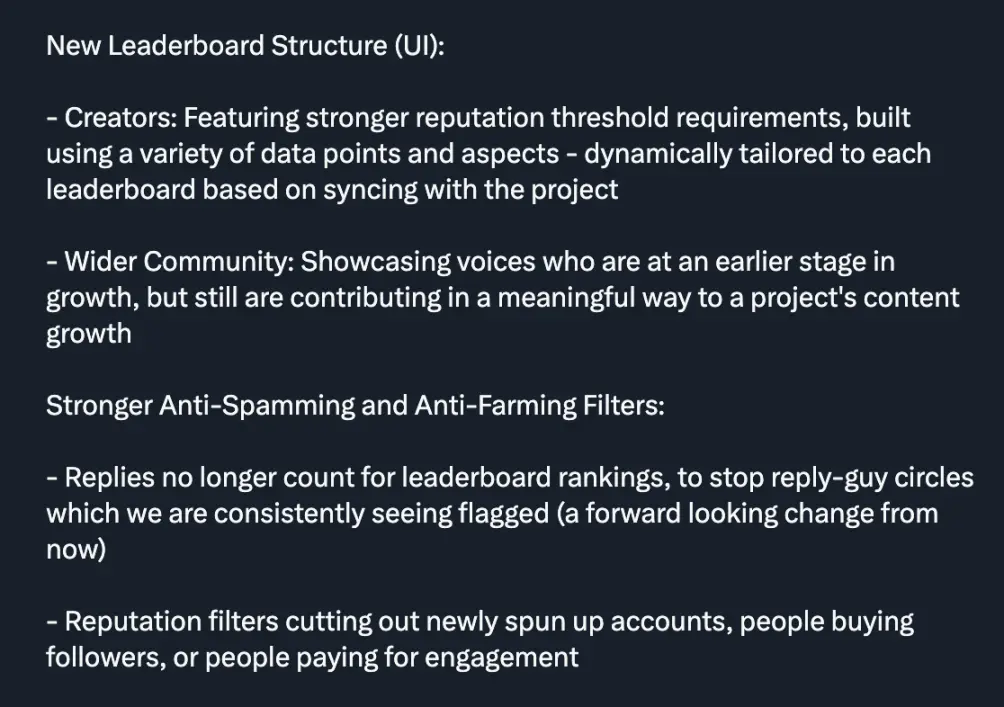
In response to this, some project owners have chosen to remove the threshold to attract small trumpeters to join. This just shows that in most cases, the small trumpet group is crucial.

My opinion is that Kaito seems confused about the direction of this upgrade, and many project parties clearly don’t like this “threshold restriction.” However, it is undeniable that Kaito has performed quite well in the past few months.

The token distribution plan is poor

For content creators (yappers), today’s typical 0.5%-1% token distribution ratio is far from enough, as these tokens are often valued very low when they are launched.

In the early days, some accounts could earn 4-5 figures through 1-2 months of promotional activities; but now, even if they participate in 3-6 months of activities, they can only earn 3-4 figures, which makes many people feel discouraged.

Even top accounts, even if they produce high-quality content, find it difficult to earn substantial four-digit income.

Why is this bad news for creators who rely on InfoFi? Before InfoFi's rise, many creators earned a healthy income by promoting their content as brand ambassadors or influencers. However, the compensation offered by projects on Kaito now simply cannot compare to external partnerships. Given this fact, it's no surprise that more and more creators are choosing to leave the InfoFi platform.

Capital Launchpad’s dominance is evident

On July 22, Kaito's "Capital Launchpad" was officially launched. The first project to be launched was Espresso, and more projects subsequently joined.

This is undoubtedly a great product for Kaito, but I do have a few concerns:

  • None of the projects that went through Kaito’s initial coin offering have yet been listed on the public market;
  • None of these projects have announced a launch date;
  • Most projects have overvalued valuations and token unlocking plans that are not investor-friendly.

My additional perspective: Kaito was originally built as a platform specifically for InfoFi, and later decided to add additional platform features (such as Launchpad), which is a great initiative in itself. However, recently, more and more projects have chosen to join the "Capital Launchpad" rather than participate in the "Creator Leaderboard." For an InfoFi platform, this trend is clearly not optimistic.

However, this is just an obvious phenomenon that I have observed, and it seems that not many people question it.

Project owners prefer to work directly with KOLs rather than through the Kaito platform.

It is clear that the project parties are no longer so keen to participate in InfoFi cooperation.

Recently, Zachxbt published a Google Sheet listing a number of accounts that received compensation from a project. I mention this not because I’m surprised, but because the amounts paid are quite substantial, especially compared to the projects on Kaito’s “Creator Leaderboard.”

I believe this has made many people realize that there are many ways to make money besides InfoFi. Since human nature is to "find ways to make more money," I believe this poses direct competition to Kaito.


Market Opportunity
MemeCore Logo
MemeCore Price(M)
$1,57264
$1,57264$1,57264
-%4,04
USD
MemeCore (M) Live Price Chart
Disclaimer: The articles reposted on this site are sourced from public platforms and are provided for informational purposes only. They do not necessarily reflect the views of MEXC. All rights remain with the original authors. If you believe any content infringes on third-party rights, please contact service@support.mexc.com for removal. MEXC makes no guarantees regarding the accuracy, completeness, or timeliness of the content and is not responsible for any actions taken based on the information provided. The content does not constitute financial, legal, or other professional advice, nor should it be considered a recommendation or endorsement by MEXC.

You May Also Like

American Bitcoin’s $5B Nasdaq Debut Puts Trump-Backed Miner in Crypto Spotlight

American Bitcoin’s $5B Nasdaq Debut Puts Trump-Backed Miner in Crypto Spotlight

The post American Bitcoin’s $5B Nasdaq Debut Puts Trump-Backed Miner in Crypto Spotlight appeared on BitcoinEthereumNews.com. Key Takeaways: American Bitcoin (ABTC) surged nearly 85% on its Nasdaq debut, briefly reaching a $5B valuation. The Trump family, alongside Hut 8 Mining, controls 98% of the newly merged crypto-mining entity. Eric Trump called Bitcoin “modern-day gold,” predicting it could reach $1 million per coin. American Bitcoin, a fast-rising crypto mining firm with strong political and institutional backing, has officially entered Wall Street. After merging with Gryphon Digital Mining, the company made its Nasdaq debut under the ticker ABTC, instantly drawing global attention to both its stock performance and its bold vision for Bitcoin’s future. Read More: Trump-Backed Crypto Firm Eyes Asia for Bold Bitcoin Expansion Nasdaq Debut: An Explosive First Day ABTC’s first day of trading proved as dramatic as expected. Shares surged almost 85% at the open, touching a peak of $14 before settling at lower levels by the close. That initial spike valued the company around $5 billion, positioning it as one of 2025’s most-watched listings. At the last session, ABTC has been trading at $7.28 per share, which is a small positive 2.97% per day. Although the price has decelerated since opening highs, analysts note that the company has been off to a strong start and early investor activity is a hard-to-find feat in a newly-launched crypto mining business. According to market watchers, the listing comes at a time of new momentum in the digital asset markets. With Bitcoin trading above $110,000 this quarter, American Bitcoin’s entry comes at a time when both institutional investors and retail traders are showing heightened interest in exposure to Bitcoin-linked equities. Ownership Structure: Trump Family and Hut 8 at the Helm Its management and ownership set up has increased the visibility of the company. The Trump family and the Canadian mining giant Hut 8 Mining jointly own 98 percent…
Share
BitcoinEthereumNews2025/09/18 01:33
White House AI and Crypto Czar: CLARITY Act Markup Coming in January

White House AI and Crypto Czar: CLARITY Act Markup Coming in January

The White House AI and Crypto Czar has announced that markup procedures for the CLARITY Act will begin in January. This news marks significant progress in U.S. cryptocurrency regulatory framework legislation.
Share
MEXC NEWS2025/12/19 09:40
Bloomberg Strategist Mike McGlone Warns Bitcoin Could Plunge to $10,000 in 2026

Bloomberg Strategist Mike McGlone Warns Bitcoin Could Plunge to $10,000 in 2026

Bloomberg Intelligence commodities strategist Mike McGlone has issued a stark warning for Bitcoin investors, predicting that the leading cryptocurrency could fall to $10,000 in 2026. In an interview with CoinDesk, McGlone cautioned that sharp corrections often follow periods of intense wealth creation.
Share
MEXC NEWS2025/12/19 10:23