This article explores how low-rank approximations streamline two complex domains: portfolio optimization in financial analytics and machine learning with restricted Boltzmann machines (RBMs). By leveraging Spatial Photonic Ising Machines (SPIMs), investors can compute optimal portfolios in microseconds, crucial for high-frequency trading. Meanwhile, low-rank RBMs reduce computational complexity in AI, making training faster and more efficient compared to unrestricted Boltzmann machines. Together, these innovations highlight how optical hardware and low-rank modeling drive performance gains across finance and artificial intelligence.This article explores how low-rank approximations streamline two complex domains: portfolio optimization in financial analytics and machine learning with restricted Boltzmann machines (RBMs). By leveraging Spatial Photonic Ising Machines (SPIMs), investors can compute optimal portfolios in microseconds, crucial for high-frequency trading. Meanwhile, low-rank RBMs reduce computational complexity in AI, making training faster and more efficient compared to unrestricted Boltzmann machines. Together, these innovations highlight how optical hardware and low-rank modeling drive performance gains across finance and artificial intelligence.

What Investors and AI Researchers Can Learn from Low-Rank Optimization

I. Introduction

II. Spim Performance, Advantages and Generality

III. Inherently Low Rank Problems

A. Properties of Low Rank Graphs

B. Weakly NP-Complete Problems and Hardware Precision Limitation

C. Limitation of Low Rank Matrix Mapping

IV. Low Rank Approximation

A. Decomposition of Target Coupling Matrix

B. How Fields Influence Ran

C. Low Rank Approximation of Coupling Matrices

D. Low-Rank Approximation of Random Coupling Matrices

E. Low Rank Approximation for Portfolio Optimization

F. Low-Rank Matrices in Restricted Boltzmann Machines

V. Constrained Number Partitioning Problem

A. Definition and Characteristics of the Constrained Number Partitioning Problem

B. Computational Hardness of Random CNP Instances

VI. Translation Invariant Problems

A. “Realistic” Spin Glass

B. Circulant Graphs

VII. Conclusions, Acknowledgements, and References

E. Low Rank Approximation for Portfolio Optimization

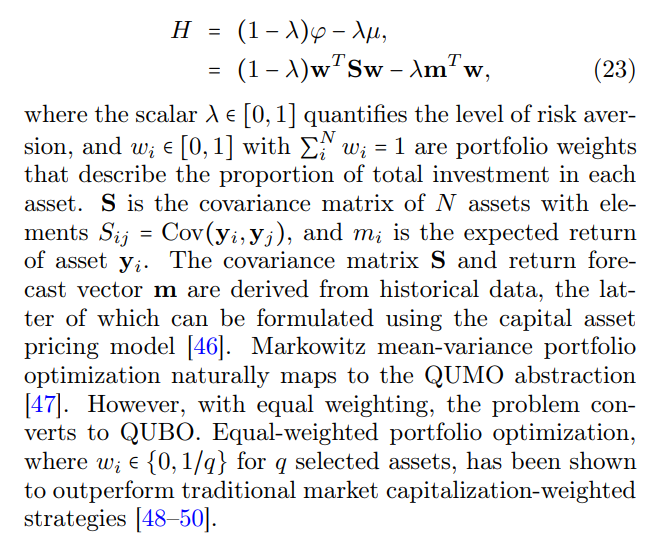
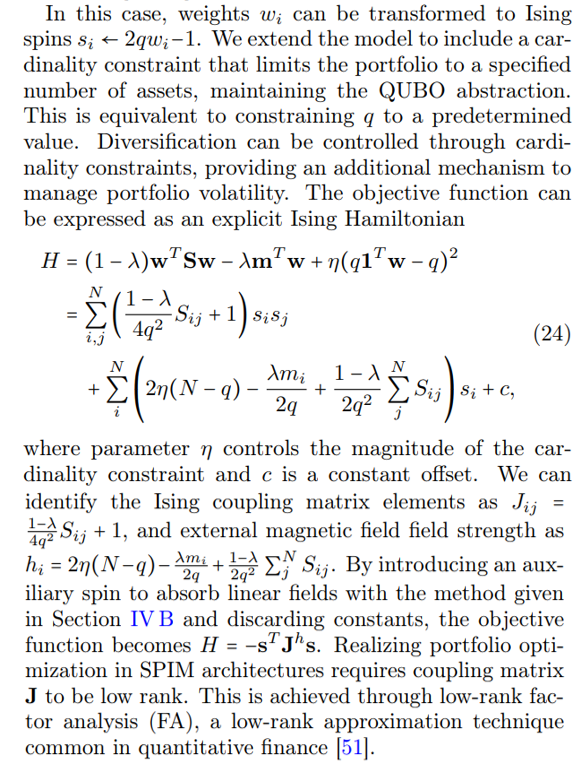
Low-rank matrices can arise during the construction of securities portfolios in financial analytics. Specifically, the optimal portfolio is the solution to a model-dependent quadratic unconstrained mixed optimization (QUMO) problem. Under an equal-weighting constraint, which we will explain below, this transforms into a quadratic unconstrained binary optimization (QUBO) problem that SPIMs can solve. Portfolio optimization involves creating an investment portfolio that balances risk and return. The objective is to allocate assets yi optimally to maximize expected returns µ while minimizing risk φ. In modern portfolio theory, this problem is formulated in the Markowitz mean-variance optimization model [43– 45] with the objective function:

\
\
\
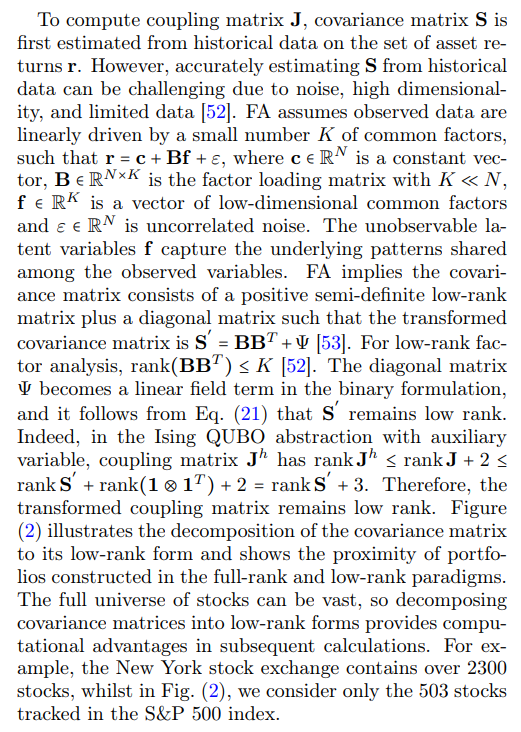
\ For a quadratic unconstrained continuous optimization problem, if the coupling matrix is positive semi-definite as the covariance matrix is, then the problem is convex for any linear field term. However, for QUBO problems, even if S and hence J is positive semi-definitive, the problem is not necessarily easy to solve. The reason is that the binary constraint makes the feasible region discrete, not convex, which is why QUBO problems are generally NP-hard. SPIMs derive a temporal advantage over classical computing due to optical hardware implementing fast and energy-efficient computation. This is particularly crucial in high-frequency trading, where optimal portfolios must be calculated over microseconds to minimize latency in placing orders [54, 55].

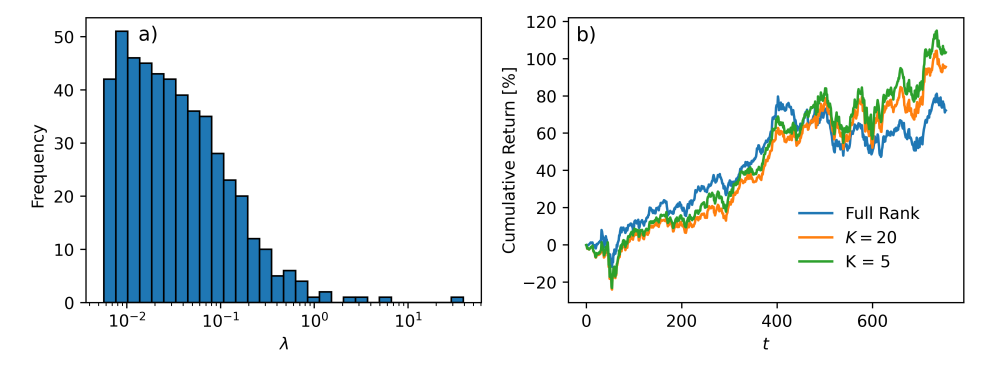
\ Figure 2. (a) Frequency histogram of eigenvalues obtained from the covariance matrix of S&P 500 stock data. There are only a few dominating eigenvalues, and most eigenvalues are orders of magnitude smaller than the dominant ones. (b) Equal-weighted cardinality-constrained portfolios constructed from the full rank covariance matrix S (blue), K = 20 low rank matrix S′ (orange), and K = 5 low rank matrix (green). Here, λ = 0.5, η = 1, and q = 20. The portfolios were built by minimizing Eq. (24) using commercial solver Gurobi.
\

F. Low-Rank Matrices in Restricted Boltzmann Machines

In Section III A, we mentioned that the minimum rank of a weighted complete bipartite graph is 2. The restricted Boltzmann machine (RBM) [56, 57] is a computational model naturally defined on complete bipartite graphs. Thus, it is sensible to consider encoding low-rank approximations of RBMs within the SPIM paradigm.

\ Previous studies have shown that RBMs can provide good results when trained with low-rank approximations for collaborative filtering [58]. Recent advancements have explored low-rank approximations in unrestricted Boltzmann machines (UBMs). Notably, UBMs trained on Spatial Photonic Ising Machine (SPIM) based optical hardware have demonstrated promising results. This novel approach leverages the computational power of optical systems for machine learning tasks, offering significant performance improvements [25].

\ Although UBMs might offer greater modeling flexibility due to their unrestricted connectivity, they suffer significant computational downsides. Each step in the UBM training algorithm involves navigating a complex energy landscape, leading to inefficient convergence. This inefficiency is particularly problematic for large-dimensional datasets, where training time and computational resources can become prohibitively high [25].

\ In contrast, RBMs can be framed as minimal rank problems. Their bipartite nature simplifies the training process and reduces computational complexity, making them more practical for SPIM applications. The training efficiency of RBMs was significantly enhanced by Hinton’s method of minimizing contrastive divergence, which simplified the optimization of these models [57]. This minimal rank framework suggests that RBMs can be trained more efficiently, so they are often preferred for collaborative filtering and feature learning tasks. The theoretical foundations of harmony theory, laid out by Smolensky in 1986 [56], underpin the information processing capabilities of both RBMs and UBMs.

\ In general, RBMs, exhibiting lower computational demands, are valuable tools in machine learning. Recent research demonstrating the efficacy of low-rank UBMs on SPIM hardware [25] indicates that low-rank RBMs could be a promising direction for future applications of SPIM devices.

\

:::info Authors:

(1) Richard Zhipeng Wang, Department of Applied Mathematics and Theoretical Physics, University of Cambridge, Wilberforce Road, Cambridge CB3 0WA, United Kingdom;

(2) James S. Cummins, Department of Applied Mathematics and Theoretical Physics, University of Cambridge, Wilberforce Road, Cambridge CB3 0WA, United Kingdom;

(3) Marvin Syed, Department of Applied Mathematics and Theoretical Physics, University of Cambridge, Wilberforce Road, Cambridge CB3 0WA, United Kingdom;

(4) Nikita Stroev, Department of Physics of Complex Systems, Weizmann Institute of Science, Rehovot 76100, Israel;

(5) George Pastras, QUBITECH, Thessalias 8, Chalandri, GR 15231 Athens, Greece;

(6) Jason Sakellariou, QUBITECH, Thessalias 8, Chalandri, GR 15231 Athens, Greece;

(7) Symeon Tsintzos, QUBITECH, Thessalias 8, Chalandri, GR 15231 Athens, Greece and UBITECH ltd, 95B Archiepiskopou Makariou, CY 3020 Limassol, Cyprus;

(8) Alexis Askitopoulos, QUBITECH, Thessalias 8, Chalandri, GR 15231 Athens, Greece and UBITECH ltd, 95B Archiepiskopou Makariou, CY 3020 Limassol, Cyprus;

(9) Daniele Veraldi, Department of Physics, University Sapienza, Piazzale Aldo Moro 5, Rome 00185, Italy;

(10) Marcello Calvanese Strinati, Research Center Enrico Fermi, Via Panisperna 89A, 00185 Rome, Italy;

(11) Silvia Gentilini, Institute for Complex Systems, National Research Council (ISC-CNR), Via dei Taurini 19, 00185 Rome, Italy;

(12) Calvanese Strinati, Research Center Enrico Fermi, Via Panisperna 89A, 00185 Rome, Italy

(13) Davide Pierangeli, Institute for Complex Systems, National Research Council (ISC-CNR), Via dei Taurini 19, 00185 Rome, Italy;

(14) Claudio Conti, Department of Physics, University Sapienza, Piazzale Aldo Moro 5, Rome 00185, Italy;

(15) Natalia G. Berlof, Department of Applied Mathematics and Theoretical Physics, University of Cambridge, Wilberforce Road, Cambridge CB3 0WA, United Kingdom (N.G.Berloff@damtp.cam.ac.uk).

:::


:::info This paper is available on arxiv under CC BY 4.0 DEED license.

:::

x

Market Opportunity
Brainedge Logo
Brainedge Price(LEARN)
$0.00967
$0.00967$0.00967
+4.31%
USD
Brainedge (LEARN) Live Price Chart
Disclaimer: The articles reposted on this site are sourced from public platforms and are provided for informational purposes only. They do not necessarily reflect the views of MEXC. All rights remain with the original authors. If you believe any content infringes on third-party rights, please contact service@support.mexc.com for removal. MEXC makes no guarantees regarding the accuracy, completeness, or timeliness of the content and is not responsible for any actions taken based on the information provided. The content does not constitute financial, legal, or other professional advice, nor should it be considered a recommendation or endorsement by MEXC.

You May Also Like

IP Hits $11.75, HYPE Climbs to $55, BlockDAG Surpasses Both with $407M Presale Surge!

IP Hits $11.75, HYPE Climbs to $55, BlockDAG Surpasses Both with $407M Presale Surge!

The post IP Hits $11.75, HYPE Climbs to $55, BlockDAG Surpasses Both with $407M Presale Surge! appeared on BitcoinEthereumNews.com. Crypto News 17 September 2025 | 18:00 Discover why BlockDAG’s upcoming Awakening Testnet launch makes it the best crypto to buy today as Story (IP) price jumps to $11.75 and Hyperliquid hits new highs. Recent crypto market numbers show strength but also some limits. The Story (IP) price jump has been sharp, fueled by big buybacks and speculation, yet critics point out that revenue still lags far behind its valuation. The Hyperliquid (HYPE) price looks solid around the mid-$50s after a new all-time high, but questions remain about sustainability once the hype around USDH proposals cools down. So the obvious question is: why chase coins that are either stretched thin or at risk of retracing when you could back a network that’s already proving itself on the ground? That’s where BlockDAG comes in. While other chains are stuck dealing with validator congestion or outages, BlockDAG’s upcoming Awakening Testnet will be stress-testing its EVM-compatible smart chain with real miners before listing. For anyone looking for the best crypto coin to buy, the choice between waiting on fixes or joining live progress feels like an easy one. BlockDAG: Smart Chain Running Before Launch Ethereum continues to wrestle with gas congestion, and Solana is still known for network freezes, yet BlockDAG is already showing a different picture. Its upcoming Awakening Testnet, set to launch on September 25, isn’t just a demo; it’s a live rollout where the chain’s base protocols are being stress-tested with miners connected globally. EVM compatibility is active, account abstraction is built in, and tools like updated vesting contracts and Stratum integration are already functional. Instead of waiting for fixes like other networks, BlockDAG is proving its infrastructure in real time. What makes this even more important is that the technology is operational before the coin even hits exchanges. That…
Share
BitcoinEthereumNews2025/09/18 00:32
Edges higher ahead of BoC-Fed policy outcome

Edges higher ahead of BoC-Fed policy outcome

The post Edges higher ahead of BoC-Fed policy outcome appeared on BitcoinEthereumNews.com. USD/CAD gains marginally to near 1.3760 ahead of monetary policy announcements by the Fed and the BoC. Both the Fed and the BoC are expected to lower interest rates. USD/CAD forms a Head and Shoulder chart pattern. The USD/CAD pair ticks up to near 1.3760 during the late European session on Wednesday. The Loonie pair gains marginally ahead of monetary policy outcomes by the Bank of Canada (BoC) and the Federal Reserve (Fed) during New York trading hours. Both the BoC and the Fed are expected to cut interest rates amid mounting labor market conditions in their respective economies. Inflationary pressures in the Canadian economy have cooled down, emerging as another reason behind the BoC’s dovish expectations. However, the Fed is expected to start the monetary-easing campaign despite the United States (US) inflation remaining higher. Investors will closely monitor press conferences from both Fed Chair Jerome Powell and BoC Governor Tiff Macklem to get cues about whether there will be more interest rate cuts in the remainder of the year. According to analysts from Barclays, the Fed’s latest median projections for interest rates are likely to call for three interest rate cuts by 2025. Ahead of the Fed’s monetary policy, the US Dollar Index (DXY), which tracks the Greenback’s value against six major currencies, holds onto Tuesday’s losses near 96.60. USD/CAD forms a Head and Shoulder chart pattern, which indicates a bearish reversal. The neckline of the above-mentioned chart pattern is plotted near 1.3715. The near-term trend of the pair remains bearish as it stays below the 20-day Exponential Moving Average (EMA), which trades around 1.3800. The 14-day Relative Strength Index (RSI) slides to near 40.00. A fresh bearish momentum would emerge if the RSI falls below that level. Going forward, the asset could slide towards the round level of…
Share
BitcoinEthereumNews2025/09/18 01:23
Zero Knowledge Proof Sparks 300x Growth Discussion! Bitcoin Cash & Ethereum Cool Off

Zero Knowledge Proof Sparks 300x Growth Discussion! Bitcoin Cash & Ethereum Cool Off

Explore how Bitcoin Cash and Ethereum move sideways while Zero Knowledge Proof (ZKP) gains notice with a live presale auction, working infra, shipping Proof Pods
Share
CoinLive2026/01/18 07:00