Benchmarks span MRPC→GQA; text splits follow prior work, images downsampled to a 7×7 grid, visual encoder is frozen for fair param counts.Benchmarks span MRPC→GQA; text splits follow prior work, images downsampled to a 7×7 grid, visual encoder is frozen for fair param counts.

Dataset Splits, Vision Encoder, and Hyper-PELT Implementation Details

Abstract and 1. Introduction

  1. Related Work

  2. Preliminaries

  3. Proposed Method

  4. Experimental Setup

  5. Results and Analysis

  6. Discussion and Conclusion, and References

    \

A. The Connection Between Prefix-tuning and Hypernetwork

B. Number of Tunable Parameters

C. Input-output formats

5. Experimental Setup

5.1. Datasets

Our framework is evaluated on the GLUE benchmark (Wang et al., 2019b) in terms of natural language understanding.

\ This benchmark covers multiple tasks of paraphrase detection (MRPC, QQP), sentiment classification (SST-2), natural language inference (MNLI, RTE, QNLI), and linguistic acceptability (CoLA). The original test sets are not publicly available, and following Zhang et al. (2021), for datasets fewer than 10K samples (RTE, MRPC, STS-B, CoLA), we split the original validation set into two halves, one for validation and the other for testing. For other larger datasets, we randomly split 1K samples from the training set as our validation data and test on the original validation set.

\ In addition, we evaluate the few-shot domain transfer performance on four tasks and datasets: 1) the natural language inference (NLI) datasets CB and 2) the question answering (QA) dataset BoolQ from SuperGLUE (Wang et al., 2019a); 3) the sentiment analysis datasets IMDB (Maas et al., 2011); and 4) the paraphrase detection dataset PAWS (Zhang et al., 2019). For CB and BoolQ, since the test set is not available, we split the validation set into two halves, one for validation and the other for testing. For IMDB, since the validation set is not available, we similarly split the test set to form validation. For PAWS, we report on the original test set.

\ To evaluate our framework on V&L tasks, we experiment on four datasets COCO (Lin et al., 2014), VQA (Goyal et al., 2017), VG-QA (Krishna et al., 2017) and GQA (Hudson & Manning, 2019). We further evaluate our framework on three datasets for multi-modal few-shot transfer learning: OKVQA (Marino et al., 2019); SNLI-VE (Xie et al., 2018).

5.2. Implementation Details
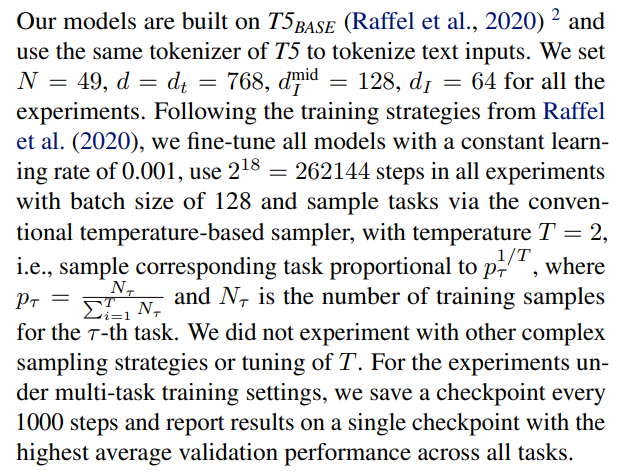
\ For evaluating our framework on vision-language scenarios, we follow Cho et al. (2021) to convert V&L tasks to a text generation format. We use ResNet101 as our vision encoder, and initialize it with CLIP (Radford et al., 2021) [3] pretrained weights. Input images are resized to 224 × 224

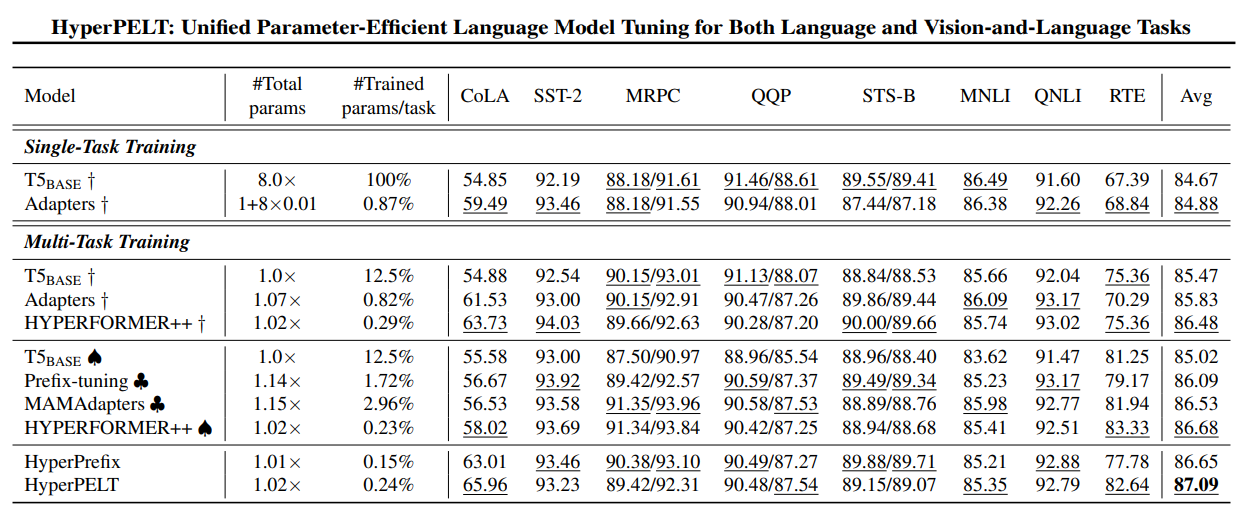
\ Table 1. Performance of all models on the GLUE tasks. For each method, we report the total number of parameters across all tasks and the number of parameters that are trained for each task as a multiple and proportion respectively of the baseline single-task T5 model. For MNLI, we report accuracy on the matched validation set. For MRPC and QQP, we report accuracy and F1. For STS-B, we report Pearson and Spearman correlation coefficients. For CoLA, we report Matthews correlation. For all other tasks, we report accuracy. †: Results from nthe implementation of Mahabadi et al. (2021), ♠: Our re-implementation of (Mahabadi et al., 2021), ♣: We implement the methods of Li & Liang (2021) and He et al. (2021) on top of T5.
\ for the memory efficiency. We extract the 7 × 7 grid features produced by the last convolutional layer. The percentage of updated parameters is also reported as one metric for approach efficiency, and we do not take visual encoder into computation since it is frozen in our experiments. We count the number of tunable parameters and list the input-output formats of each task in the Appendix B and C.

\

:::info Authors:

(1) Zhengkun Zhang, with Equal contribution from Work is done at the internship of Noah’s Ark Lab, Huawei Technologies

(2) Wenya Guo and TKLNDST, CS, Nankai University, China (yangzl@nankai.edu.cn);

(3) Xiaojun Meng, with Equal contribution from Noah’s Ark Lab, Huawei Technologies;

(4) Yasheng Wang, Noah’s Ark Lab, Huawei Technologies;

(5) Yadao Wang, Noah’s Ark Lab, Huawei Technologies;

(6) Xin Jiang, Noah’s Ark Lab, Huawei Technologies;

(7) Qun Liu, Noah’s Ark Lab, Huawei Technologies;

(8) Zhenglu Yang, TKLNDST, CS, Nankai University, China.

:::


:::info This paper is available on arxiv under CC BY 4.0 DEED license.

:::

[2] https://huggingface.co/t5-base

\ [3] https://github.com/openai/CLIP

Market Opportunity
Hyperlane Logo
Hyperlane Price(HYPER)
$0.13413
$0.13413$0.13413
-1.77%
USD
Hyperlane (HYPER) Live Price Chart
Disclaimer: The articles reposted on this site are sourced from public platforms and are provided for informational purposes only. They do not necessarily reflect the views of MEXC. All rights remain with the original authors. If you believe any content infringes on third-party rights, please contact service@support.mexc.com for removal. MEXC makes no guarantees regarding the accuracy, completeness, or timeliness of the content and is not responsible for any actions taken based on the information provided. The content does not constitute financial, legal, or other professional advice, nor should it be considered a recommendation or endorsement by MEXC.

You May Also Like

IP Hits $11.75, HYPE Climbs to $55, BlockDAG Surpasses Both with $407M Presale Surge!

IP Hits $11.75, HYPE Climbs to $55, BlockDAG Surpasses Both with $407M Presale Surge!

The post IP Hits $11.75, HYPE Climbs to $55, BlockDAG Surpasses Both with $407M Presale Surge! appeared on BitcoinEthereumNews.com. Crypto News 17 September 2025 | 18:00 Discover why BlockDAG’s upcoming Awakening Testnet launch makes it the best crypto to buy today as Story (IP) price jumps to $11.75 and Hyperliquid hits new highs. Recent crypto market numbers show strength but also some limits. The Story (IP) price jump has been sharp, fueled by big buybacks and speculation, yet critics point out that revenue still lags far behind its valuation. The Hyperliquid (HYPE) price looks solid around the mid-$50s after a new all-time high, but questions remain about sustainability once the hype around USDH proposals cools down. So the obvious question is: why chase coins that are either stretched thin or at risk of retracing when you could back a network that’s already proving itself on the ground? That’s where BlockDAG comes in. While other chains are stuck dealing with validator congestion or outages, BlockDAG’s upcoming Awakening Testnet will be stress-testing its EVM-compatible smart chain with real miners before listing. For anyone looking for the best crypto coin to buy, the choice between waiting on fixes or joining live progress feels like an easy one. BlockDAG: Smart Chain Running Before Launch Ethereum continues to wrestle with gas congestion, and Solana is still known for network freezes, yet BlockDAG is already showing a different picture. Its upcoming Awakening Testnet, set to launch on September 25, isn’t just a demo; it’s a live rollout where the chain’s base protocols are being stress-tested with miners connected globally. EVM compatibility is active, account abstraction is built in, and tools like updated vesting contracts and Stratum integration are already functional. Instead of waiting for fixes like other networks, BlockDAG is proving its infrastructure in real time. What makes this even more important is that the technology is operational before the coin even hits exchanges. That…
Share
BitcoinEthereumNews2025/09/18 00:32
Edges higher ahead of BoC-Fed policy outcome

Edges higher ahead of BoC-Fed policy outcome

The post Edges higher ahead of BoC-Fed policy outcome appeared on BitcoinEthereumNews.com. USD/CAD gains marginally to near 1.3760 ahead of monetary policy announcements by the Fed and the BoC. Both the Fed and the BoC are expected to lower interest rates. USD/CAD forms a Head and Shoulder chart pattern. The USD/CAD pair ticks up to near 1.3760 during the late European session on Wednesday. The Loonie pair gains marginally ahead of monetary policy outcomes by the Bank of Canada (BoC) and the Federal Reserve (Fed) during New York trading hours. Both the BoC and the Fed are expected to cut interest rates amid mounting labor market conditions in their respective economies. Inflationary pressures in the Canadian economy have cooled down, emerging as another reason behind the BoC’s dovish expectations. However, the Fed is expected to start the monetary-easing campaign despite the United States (US) inflation remaining higher. Investors will closely monitor press conferences from both Fed Chair Jerome Powell and BoC Governor Tiff Macklem to get cues about whether there will be more interest rate cuts in the remainder of the year. According to analysts from Barclays, the Fed’s latest median projections for interest rates are likely to call for three interest rate cuts by 2025. Ahead of the Fed’s monetary policy, the US Dollar Index (DXY), which tracks the Greenback’s value against six major currencies, holds onto Tuesday’s losses near 96.60. USD/CAD forms a Head and Shoulder chart pattern, which indicates a bearish reversal. The neckline of the above-mentioned chart pattern is plotted near 1.3715. The near-term trend of the pair remains bearish as it stays below the 20-day Exponential Moving Average (EMA), which trades around 1.3800. The 14-day Relative Strength Index (RSI) slides to near 40.00. A fresh bearish momentum would emerge if the RSI falls below that level. Going forward, the asset could slide towards the round level of…
Share
BitcoinEthereumNews2025/09/18 01:23
Zero Knowledge Proof Sparks 300x Growth Discussion! Bitcoin Cash & Ethereum Cool Off

Zero Knowledge Proof Sparks 300x Growth Discussion! Bitcoin Cash & Ethereum Cool Off

Explore how Bitcoin Cash and Ethereum move sideways while Zero Knowledge Proof (ZKP) gains notice with a live presale auction, working infra, shipping Proof Pods
Share
CoinLive2026/01/18 07:00