Personal Finance App Industry Statistics 2026: Smart Money Apps Now

Imagine a world where managing your finances is as simple as scrolling through your favorite social media app. Just a decade ago, budgeting and investing required spreadsheets and constant financial oversight. Today, personal finance apps have transformed how we manage our money, putting the power of budgeting, investing, and financial planning right in our pockets.
With growing adoption rates and a constantly evolving tech landscape, the personal finance app industry is more vibrant and expansive than ever. These apps will not only help individuals track expenses but also integrate with broader financial services, providing users with tailored insights and automated wealth management options.
Editor’s Choice
- Digital personal finance apps are expected to grow at about 12.6% CAGR from 2026 to 2033, driven by rising smartphone adoption.
- Global user growth is forecast to rise by roughly 14% annually, reaching around 1.8 billion personal finance app users by mid‑decade.
- North America holds about 35% of the digital personal finance apps market share, followed by Europe with around 25%.
- Asia‑Pacific is projected to capture about 30% of the digital personal finance app share as the fastest‑growing region.
- Subscription and premium models contribute roughly 48% of total personal finance app revenue worldwide.
- Gen Z and Millennials account for over 70% of personal finance app users, underscoring strong adoption among younger cohorts.
- Around 57% of Gen Z primarily use mobile banking apps, reinforcing mobile‑first behavior for personal finance management.
Recent Developments
- Apple Pay is expected to launch in the Philippines in 2026, following BSP approval for its operation as a payment technology service provider.
- Plaid Transfer now supports instant pay-ins via Request for Payment on the RTP network, alongside instant payouts via RTP and FedNow for real-time multirail settlements.
- Zelle reported about $1.2 trillion sent in 2025, with nearly 30% of all dollars flowing to or from small businesses and $357 billion in small-business payments.
- Zelle small-business transactions reached 647.6 million, up 23.5%, with 7.7 million enrolled small businesses, up 15% year over year.
- Zelle processed over 2 billion payments totaling nearly $600 billion in the first half of 2025, with small-business payments up 31% to 180 million transactions.
- Apple Pay’s planned entry in 2026 is expected to follow Google Pay’s rollout, expanding contactless and mobile wallet options for Philippine consumers and merchants.
Personal Finance Apps Market Size Growth
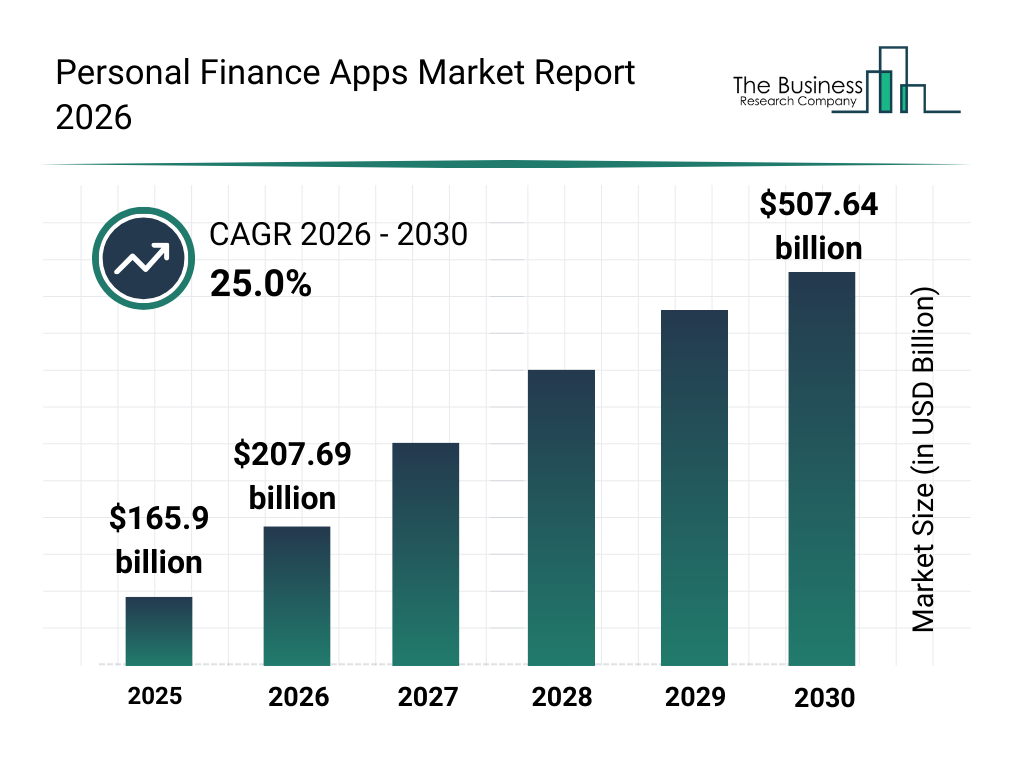
- The personal finance apps market reached $165.9 billion in 2025, showing strong global adoption of digital money management tools.
- The market will grow to around $207.69 billion in 2026 as more users rely on apps for budgeting, saving, and investing.
- The industry will grow at a 25.0% CAGR from 2026 to 2030, reflecting rapid expansion in mobile financial services.
- Increasing smartphone penetration and fintech innovation will push the market to about $259.6 billion in 2027.
- AI-powered financial insights and automation will drive the market to nearly $324.5 billion in 2028.
- Growing demand for digital banking and finance tools will expand the market to around $405.6 billion in 2029.
- The personal finance apps market will reach approximately $507.64 billion by 2030, more than tripling its 2025 size within five years.
 (Reference: The Business Research Company)
User Demographics
- Millennials remain the largest personal finance app user group at around 45%, followed by Gen Z at 25% and Gen X at 20%.
- The average U.S. personal finance app user income is about $70,000, with roughly 60% in the mid- to high-income bracket.
- Men represent about 55% of global personal finance app users, while women account for 45%, rising to 48% in Europe.
- Urban consumers make up roughly 75% of personal finance app users worldwide, compared with 25% from suburban and rural areas combined.
- In the U.S., Hispanic and African American personal finance app users have grown by approximately 18% and 15%, respectively.
- About 89% of Gen Z use digital banking tools and mostly prefer managing finances through mobile apps rather than branches.
- Around 57% of Gen Z primarily rely on mobile banking apps for daily financial activities.
- Roughly 84% of Gen Z and 79% of Millennials are familiar with generative AI and increasingly use AI tools for budgeting and investing.
Key Growth Areas for Finance Apps
- Around 40% of leading personal finance apps now include wealth management or robo-advisory features as users seek integrated investing tools.
- Roughly 42% of consumer finance apps offer cryptocurrency tracking, trading, or payment integrations.
- More than 30% of finance and budgeting apps now use gamification features such as badges, streaks, and milestones to increase engagement.
- BNPL and flexible payment integrations in finance and shopping apps have grown by over 60% year over year.
- Financial education-focused apps have seen download growth of roughly 15%, largely driven by younger first-time investors and savers.
Average Cost per Tap in Apple Ads for Finance Apps
- The global average cost per tap for finance apps reached $6.06.
- In the U.S., finance apps saw high CPT as part of North America’s top-cost markets.
- The U.K. finance CPT aligns with elevated EMEA costs around $2.60 median.
- France recorded a lower CPT at approximately $3.06 for competitive campaigns.
- Germany’s average CPT for finance stood near $3.66.
- Korea’s finance apps averaged $3.99 CPT amid APAC trends.
- Overall, Apple Ads CPT across categories averaged $2.25, with finance being higher.
- Finance maintained premium positioning after sports at $6.06 CPT.
Top Finance Apps Ranking
- Mint leads budgeting apps with 32 million active users.
- Acorns expanded to 16.2 million customers and $28 billion invested.
- Cash App holds 59 million monthly active users.
- YNAB grew its user base by 20% among Gen Z users.
- Robinhood reports 26.8 million funded customers.
- Chime neobank reaches 19.5 million active users.
- Honeydue maintains 1.2 million couples managing joint finances.
Finance App Retention and Engagement
- AI recommendation apps boosted retention by 42% over standard apps.
- Average session length increased to 6.8 minutes per user.
- Weekly logins averaged 5.2 times per active user.
- Personalized notifications tripled weekly engagement to 13.5 sessions.
- Gamified goals improved retention by 32% with frequent milestone checks.
- Tax season Q1 engagement surged by 52% year-over-year.
- Personalized dashboards lifted daily active usage by 27%.
Personal Finance Investment Portfolio Allocation
- 34% of investments are allocated to retirement funds like 401k and IRA.
- 26% directed to high-yield savings accounts for secure returns.
- 22% invested in individual stocks for growth opportunities.
- 18% placed in CDs and mutual funds, prioritizing stability.
- ETFs captured 15% of portfolios amid diversification trends.
- Real estate investments accounted for 12% of total allocations.
- Cryptocurrency holdings reached 8% across investor portfolios.
- Bonds comprised 10%, reflecting risk-averse strategies.
- ESG funds gained 14% allocation driven by a sustainability focus.
- Alternative investments like commodities took 5% of portfolios.
Technological Advancements in Personal Finance Apps
- AI powers 68% of finance apps for budgeting and investment advice.
- Biometric verification cuts fraud by 70% in adopting apps.
- Open banking APIs connect 58% of apps to real-time bank data.
- Voice commands are supported in 22% of apps for quick transactions.
- Wearable integration reaches 37% of apps for on-the-go tracking.
- Blockchain security is adopted by 25% of high-end finance apps.
Frequently Asked Questions (FAQs)
The broader financial app market is expected to increase from about $3.45 billion in 2025 to approximately $3.98 billion in 2026.
The global neobanking market, a key driver of app-based personal finance, is projected to grow from about $310.15 billion in 2026 to $7,661.57 billion by 2034 at a 49.30% CAGR.
Within neobanking services, savings and checking accounts represent around 50.23% of the global market share in 2026.
Conclusion
The personal finance app industry is booming, with rapid growth driven by technological innovations, expanding user demographics, and increased focus on financial literacy. As users demand more integrated and personalized tools, finance apps are adapting with advanced AI, blockchain integration, and seamless banking services. The industry’s leaders continue to evolve while emerging players carve niches with specialized offerings.
This year marks a pivotal moment for finance apps, as they transition from basic budgeting tools to comprehensive financial management platforms, paving the way for an empowered, financially literate global population.
The post Personal Finance App Industry Statistics 2026: Smart Money Apps Now appeared first on CoinLaw.
You May Also Like

Unlimit Appoints Irene Skrynova as CEO, Global Payments

Economic policies are chasing investors away from US – Mercer