Grupo Santander’s Digital Bank Launches Crypto Trading in Europe Openbank, the fully digital subsidiary of Grupo Santander, is expanding its footprint across Europe with a new cryptocurrency trading service tailored for German clients. This move comes in response to increasing demand for digital assets and aims to provide a seamless experience for buying, selling, and [...]Grupo Santander’s Digital Bank Launches Crypto Trading in Europe Openbank, the fully digital subsidiary of Grupo Santander, is expanding its footprint across Europe with a new cryptocurrency trading service tailored for German clients. This move comes in response to increasing demand for digital assets and aims to provide a seamless experience for buying, selling, and [...]

Santander’s Openbank Launches Crypto Trading in Germany, Targets Spain
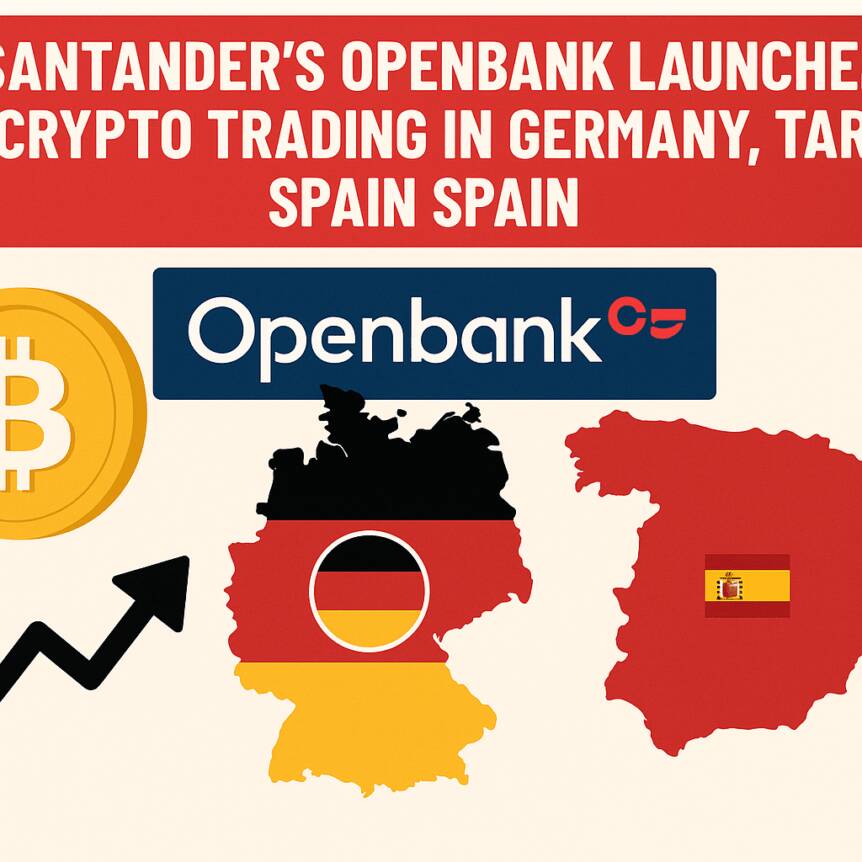
Santander’s Openbank Launches Crypto Trading In Germany, Targets Spain

Grupo Santander’s Digital Bank Launches Crypto Trading in Europe

Openbank, the fully digital subsidiary of Grupo Santander, is expanding its footprint across Europe with a new cryptocurrency trading service tailored for German clients. This move comes in response to increasing demand for digital assets and aims to provide a seamless experience for buying, selling, and holding major cryptocurrencies.

Starting this week, users in Germany can trade Bitcoin (BTC), Ether (ETH), Litecoin (LTC), Polygon (MATIC), and Cardano (ADA) directly on the Openbank platform. The new service integrates cryptocurrencies into its established suite of investment products, offering a streamlined alternative to third-party platforms while operating under the comprehensive European Markets in Crypto-Assets (MiCA) regulation framework.

Santander has outlined plans to introduce similar crypto trading features in Spain shortly, with additional functionalities such as crypto-to-crypto conversions and more token options expected soon. According to Coty de Monteverde, head of crypto at Grupo Santander, the move responds to clear customer demand for digital assets within traditional banking services.

Santander's Openbank expands crypto services in Europe

While Openbank’s entry into crypto trading is a recent development, Santander has historically explored blockchain applications, including the launch of Ripple-powered cross-border payment solutions in 2018. The bank has also expressed interest in stablecoins, contemplating issuing its own or participating in existing projects, aiming to stay at the forefront of crypto innovation.

Crypto Adoption Grows Among Germany’s Leading Banks

The expansion of Santander’s crypto offerings is part of a broader movement among Germany’s largest banks preparing to incorporate crypto assets into their services. Notably, DZ Bank launched a crypto pilot program across 700 cooperative banks in September 2024, leveraging Börse Stuttgart Digital’s infrastructure. Similarly, Deutsche Bank announced plans to establish a digital asset custody service in 2026, partnering with Austrian startup Bitpanda and Swiss firm Taurus.

Deutsche Bank’s executives have also indicated interest in stablecoin markets, exploring the issuance of their own tokens or participating in existing initiatives to facilitate crypto payments and settlements.

In addition, Sparkassen-Finanzgruppe plans to roll out retail crypto trading to its nearly 50 million German customers by mid-2026, supported by DekaBank and Börse Stuttgart Digital.

These developments highlight a significant shift in Europe’s traditional banking landscape, driven by regulatory clarity through frameworks like MiCA, which is fostering increased participation in the fast-growing crypto markets. U.S. banks are also ramping up their crypto initiatives, with major institutions exploring stablecoin creation and digital asset services following recent legislative advances.

This article was originally published as Santander’s Openbank Launches Crypto Trading in Germany, Targets Spain on Crypto Breaking News – your trusted source for crypto news, Bitcoin news, and blockchain updates.


Market Opportunity
Movement Logo
Movement Price(MOVE)
$0.03434
$0.03434$0.03434
-5.24%
USD
Movement (MOVE) Live Price Chart
Disclaimer: The articles reposted on this site are sourced from public platforms and are provided for informational purposes only. They do not necessarily reflect the views of MEXC. All rights remain with the original authors. If you believe any content infringes on third-party rights, please contact service@support.mexc.com for removal. MEXC makes no guarantees regarding the accuracy, completeness, or timeliness of the content and is not responsible for any actions taken based on the information provided. The content does not constitute financial, legal, or other professional advice, nor should it be considered a recommendation or endorsement by MEXC.

You May Also Like

The Channel Factories We’ve Been Waiting For

The Channel Factories We’ve Been Waiting For

The post The Channel Factories We’ve Been Waiting For appeared on BitcoinEthereumNews.com. Visions of future technology are often prescient about the broad strokes while flubbing the details. The tablets in “2001: A Space Odyssey” do indeed look like iPads, but you never see the astronauts paying for subscriptions or wasting hours on Candy Crush.  Channel factories are one vision that arose early in the history of the Lightning Network to address some challenges that Lightning has faced from the beginning. Despite having grown to become Bitcoin’s most successful layer-2 scaling solution, with instant and low-fee payments, Lightning’s scale is limited by its reliance on payment channels. Although Lightning shifts most transactions off-chain, each payment channel still requires an on-chain transaction to open and (usually) another to close. As adoption grows, pressure on the blockchain grows with it. The need for a more scalable approach to managing channels is clear. Channel factories were supposed to meet this need, but where are they? In 2025, subnetworks are emerging that revive the impetus of channel factories with some new details that vastly increase their potential. They are natively interoperable with Lightning and achieve greater scale by allowing a group of participants to open a shared multisig UTXO and create multiple bilateral channels, which reduces the number of on-chain transactions and improves capital efficiency. Achieving greater scale by reducing complexity, Ark and Spark perform the same function as traditional channel factories with new designs and additional capabilities based on shared UTXOs.  Channel Factories 101 Channel factories have been around since the inception of Lightning. A factory is a multiparty contract where multiple users (not just two, as in a Dryja-Poon channel) cooperatively lock funds in a single multisig UTXO. They can open, close and update channels off-chain without updating the blockchain for each operation. Only when participants leave or the factory dissolves is an on-chain transaction…
Share
BitcoinEthereumNews2025/09/18 00:09
Franklin Templeton CEO Dismisses 50bps Rate Cut Ahead FOMC

Franklin Templeton CEO Dismisses 50bps Rate Cut Ahead FOMC

The post Franklin Templeton CEO Dismisses 50bps Rate Cut Ahead FOMC appeared on BitcoinEthereumNews.com. Franklin Templeton CEO Jenny Johnson has weighed in on whether the Federal Reserve should make a 25 basis points (bps) Fed rate cut or 50 bps cut. This comes ahead of the Fed decision today at today’s FOMC meeting, with the market pricing in a 25 bps cut. Bitcoin and the broader crypto market are currently trading flat ahead of the rate cut decision. Franklin Templeton CEO Weighs In On Potential FOMC Decision In a CNBC interview, Jenny Johnson said that she expects the Fed to make a 25 bps cut today instead of a 50 bps cut. She acknowledged the jobs data, which suggested that the labor market is weakening. However, she noted that this data is backward-looking, indicating that it doesn’t show the current state of the economy. She alluded to the wage growth, which she remarked is an indication of a robust labor market. She added that retail sales are up and that consumers are still spending, despite inflation being sticky at 3%, which makes a case for why the FOMC should opt against a 50-basis-point Fed rate cut. In line with this, the Franklin Templeton CEO said that she would go with a 25 bps rate cut if she were Jerome Powell. She remarked that the Fed still has the October and December FOMC meetings to make further cuts if the incoming data warrants it. Johnson also asserted that the data show a robust economy. However, she noted that there can’t be an argument for no Fed rate cut since Powell already signaled at Jackson Hole that they were likely to lower interest rates at this meeting due to concerns over a weakening labor market. Notably, her comment comes as experts argue for both sides on why the Fed should make a 25 bps cut or…
Share
BitcoinEthereumNews2025/09/18 00:36
Tom Lee’s Bitmine Scoops Up 3.4% of Ethereum, Triggering a Supply Squeeze

Tom Lee’s Bitmine Scoops Up 3.4% of Ethereum, Triggering a Supply Squeeze

Bitmine Immersion now controls 3.4% of Ethereum amid shrinking exchange supply and rising institutional accumulation.
Share
Crypto Breaking News2026/01/20 16:27