BitcoinWorld Anti-CBDC Act: U.S. House Debates Crucial Inclusion in Crypto Bill A significant discussion is currently unfolding within the U.S. House of Representatives. Lawmakers are actively considering a proposal to integrate the Anti-CBDC act into a broader, comprehensive digital asset market structure bill. This move could have profound implications for the future of digital currencies in America. This development, initially reported by Cointelegraph, signals a critical juncture for cryptocurrency regulation. If this measure passes, the combined legislation would then advance to the Senate for further deliberation. What is the Anti-CBDC Act and Why is it Crucial? At its core, the Anti-CBDC act aims to prevent the U.S. government from issuing a central bank digital currency (CBDC). A CBDC is essentially a digital form of a country’s fiat currency, issued and backed by its central bank. Proponents of the Anti-CBDC act express significant concerns. They often highlight issues related to privacy, potential government surveillance, and the risk of increased financial control over citizens. The act seeks to safeguard individual financial freedom and limit government overreach in digital transactions. Many believe that a government-issued digital currency could pave the way for a ‘surveillance state,’ where every transaction is monitored. This perspective drives the urgent push for this protective legislation. A Pivotal Moment for Crypto Market Structure The proposed inclusion of the Anti-CBDC act is not happening in isolation. It is being considered as part of a larger digital asset market structure bill. This overarching legislation aims to provide a clear regulatory framework for the entire cryptocurrency industry. Establishing clear rules is vital for the growth and stability of the crypto market. Without proper guidelines, businesses and investors face uncertainty, which can hinder innovation and adoption. The market structure bill intends to address these regulatory gaps. Integrating the Anti-CBDC act into this bill means that the debate over central bank digital currencies is now firmly linked to the broader conversation about how digital assets will be regulated in the U.S. This connection elevates the importance of both legislative efforts. Past Battles and Future Prospects for the Anti-CBDC Act This isn’t the first time Republican lawmakers have attempted to ban the issuance of a central bank digital currency. Previously, they sought to include an anti-CBDC measure during a vote on the GENIUS Act, a stablecoin regulation bill. While that specific attempt did not succeed within the stablecoin bill, the commitment to the cause remained strong. Subsequently, the Anti-CBDC act successfully passed the House as a standalone bill. This earlier success demonstrates significant support for the measure. Now, by attempting to attach it to a broader digital asset bill, lawmakers are looking for a more direct path to enactment. This strategy could increase its chances of becoming law, as it would be part of a larger package deemed essential for the crypto industry. What are the Core Concerns Surrounding CBDCs? The opposition to CBDCs stems from several key concerns: Privacy: Critics fear that a CBDC could eliminate financial privacy, allowing governments to track every transaction. Surveillance: There’s a worry that a CBDC could enable a ‘surveillance state,’ giving authorities unprecedented insight into citizens’ spending habits. Control: Some argue that a CBDC could give governments the power to freeze funds, implement negative interest rates, or even program spending, limiting individual economic freedom. Disintermediation: There are concerns that CBDCs could bypass commercial banks, fundamentally altering the financial system. These points form the bedrock of the arguments in favor of the Anti-CBDC act, emphasizing the need for safeguards against potential governmental overreach. The Road Ahead: From House to Senate If the U.S. House of Representatives successfully incorporates the Anti-CBDC act into the digital asset market structure bill, the journey is far from over. The comprehensive legislation would then be sent to the Senate for its own round of deliberations, debates, and votes. The Senate process can be complex and time-consuming, with potential amendments and further negotiations. The outcome in the Senate is not guaranteed, and strong advocacy from both sides of the CBDC debate is expected. Ultimately, for the Anti-CBDC act to become law as part of this broader bill, it must pass both chambers of Congress and receive presidential assent. This legislative path highlights the critical nature of the current discussions in the House. The ongoing debate in the U.S. House over the inclusion of the Anti-CBDC act in the digital asset market structure bill marks a truly pivotal moment for the future of finance and individual liberties. This legislative effort underscores a growing concern among lawmakers about the potential implications of central bank digital currencies. The outcome of these discussions will not only shape the regulatory landscape for cryptocurrencies but also determine the extent of government involvement in digital money. It’s a debate that touches upon fundamental questions of privacy, control, and the very nature of money in the digital age. Keeping an eye on these developments is essential for anyone interested in the evolving world of digital assets. Frequently Asked Questions (FAQs) Q1: What is a Central Bank Digital Currency (CBDC)? A1: A CBDC is a digital form of a country’s fiat currency, issued and backed by its central bank. Unlike cryptocurrencies like Bitcoin, which are decentralized, a CBDC is centralized and controlled by the government. Q2: What is the primary goal of the Anti-CBDC act? A2: The primary goal of the Anti-CBDC act is to prevent the U.S. government from issuing a central bank digital currency, citing concerns about privacy, surveillance, and potential government control over individual finances. Q3: How does the Anti-CBDC act relate to the broader crypto market structure bill? A3: The Anti-CBDC act is being considered for inclusion in a larger bill designed to establish a comprehensive regulatory framework for digital assets in the U.S. This means the debate over CBDCs is now tied to the overall regulation of the crypto industry. Q4: What are the main concerns opponents have about CBDCs? A4: Opponents primarily worry about the erosion of financial privacy, the potential for government surveillance of transactions, and the risk of governments gaining excessive control over citizens’ spending and financial activities. Q5: What happens if the Anti-CBDC act is included in the market structure bill and passes the House? A5: If included and passed by the House, the combined legislation, including the Anti-CBDC act, would then proceed to the Senate for further deliberation, debate, and a vote before potentially becoming law. Q6: Has the Anti-CBDC act been debated before? A6: Yes, Republican lawmakers previously attempted to include an anti-CBDC measure in a stablecoin regulation bill. The Anti-CBDC act also passed the House as a standalone bill prior to this current consideration. If you found this article informative and believe in the importance of understanding legislative actions impacting digital currencies, please share it with your friends and on your social media platforms. Your support helps spread awareness and encourages a broader conversation about the future of finance. To learn more about the latest crypto market trends, explore our article on key developments shaping digital asset institutional adoption. This post Anti-CBDC Act: U.S. House Debates Crucial Inclusion in Crypto Bill first appeared on BitcoinWorld.BitcoinWorld Anti-CBDC Act: U.S. House Debates Crucial Inclusion in Crypto Bill A significant discussion is currently unfolding within the U.S. House of Representatives. Lawmakers are actively considering a proposal to integrate the Anti-CBDC act into a broader, comprehensive digital asset market structure bill. This move could have profound implications for the future of digital currencies in America. This development, initially reported by Cointelegraph, signals a critical juncture for cryptocurrency regulation. If this measure passes, the combined legislation would then advance to the Senate for further deliberation. What is the Anti-CBDC Act and Why is it Crucial? At its core, the Anti-CBDC act aims to prevent the U.S. government from issuing a central bank digital currency (CBDC). A CBDC is essentially a digital form of a country’s fiat currency, issued and backed by its central bank. Proponents of the Anti-CBDC act express significant concerns. They often highlight issues related to privacy, potential government surveillance, and the risk of increased financial control over citizens. The act seeks to safeguard individual financial freedom and limit government overreach in digital transactions. Many believe that a government-issued digital currency could pave the way for a ‘surveillance state,’ where every transaction is monitored. This perspective drives the urgent push for this protective legislation. A Pivotal Moment for Crypto Market Structure The proposed inclusion of the Anti-CBDC act is not happening in isolation. It is being considered as part of a larger digital asset market structure bill. This overarching legislation aims to provide a clear regulatory framework for the entire cryptocurrency industry. Establishing clear rules is vital for the growth and stability of the crypto market. Without proper guidelines, businesses and investors face uncertainty, which can hinder innovation and adoption. The market structure bill intends to address these regulatory gaps. Integrating the Anti-CBDC act into this bill means that the debate over central bank digital currencies is now firmly linked to the broader conversation about how digital assets will be regulated in the U.S. This connection elevates the importance of both legislative efforts. Past Battles and Future Prospects for the Anti-CBDC Act This isn’t the first time Republican lawmakers have attempted to ban the issuance of a central bank digital currency. Previously, they sought to include an anti-CBDC measure during a vote on the GENIUS Act, a stablecoin regulation bill. While that specific attempt did not succeed within the stablecoin bill, the commitment to the cause remained strong. Subsequently, the Anti-CBDC act successfully passed the House as a standalone bill. This earlier success demonstrates significant support for the measure. Now, by attempting to attach it to a broader digital asset bill, lawmakers are looking for a more direct path to enactment. This strategy could increase its chances of becoming law, as it would be part of a larger package deemed essential for the crypto industry. What are the Core Concerns Surrounding CBDCs? The opposition to CBDCs stems from several key concerns: Privacy: Critics fear that a CBDC could eliminate financial privacy, allowing governments to track every transaction. Surveillance: There’s a worry that a CBDC could enable a ‘surveillance state,’ giving authorities unprecedented insight into citizens’ spending habits. Control: Some argue that a CBDC could give governments the power to freeze funds, implement negative interest rates, or even program spending, limiting individual economic freedom. Disintermediation: There are concerns that CBDCs could bypass commercial banks, fundamentally altering the financial system. These points form the bedrock of the arguments in favor of the Anti-CBDC act, emphasizing the need for safeguards against potential governmental overreach. The Road Ahead: From House to Senate If the U.S. House of Representatives successfully incorporates the Anti-CBDC act into the digital asset market structure bill, the journey is far from over. The comprehensive legislation would then be sent to the Senate for its own round of deliberations, debates, and votes. The Senate process can be complex and time-consuming, with potential amendments and further negotiations. The outcome in the Senate is not guaranteed, and strong advocacy from both sides of the CBDC debate is expected. Ultimately, for the Anti-CBDC act to become law as part of this broader bill, it must pass both chambers of Congress and receive presidential assent. This legislative path highlights the critical nature of the current discussions in the House. The ongoing debate in the U.S. House over the inclusion of the Anti-CBDC act in the digital asset market structure bill marks a truly pivotal moment for the future of finance and individual liberties. This legislative effort underscores a growing concern among lawmakers about the potential implications of central bank digital currencies. The outcome of these discussions will not only shape the regulatory landscape for cryptocurrencies but also determine the extent of government involvement in digital money. It’s a debate that touches upon fundamental questions of privacy, control, and the very nature of money in the digital age. Keeping an eye on these developments is essential for anyone interested in the evolving world of digital assets. Frequently Asked Questions (FAQs) Q1: What is a Central Bank Digital Currency (CBDC)? A1: A CBDC is a digital form of a country’s fiat currency, issued and backed by its central bank. Unlike cryptocurrencies like Bitcoin, which are decentralized, a CBDC is centralized and controlled by the government. Q2: What is the primary goal of the Anti-CBDC act? A2: The primary goal of the Anti-CBDC act is to prevent the U.S. government from issuing a central bank digital currency, citing concerns about privacy, surveillance, and potential government control over individual finances. Q3: How does the Anti-CBDC act relate to the broader crypto market structure bill? A3: The Anti-CBDC act is being considered for inclusion in a larger bill designed to establish a comprehensive regulatory framework for digital assets in the U.S. This means the debate over CBDCs is now tied to the overall regulation of the crypto industry. Q4: What are the main concerns opponents have about CBDCs? A4: Opponents primarily worry about the erosion of financial privacy, the potential for government surveillance of transactions, and the risk of governments gaining excessive control over citizens’ spending and financial activities. Q5: What happens if the Anti-CBDC act is included in the market structure bill and passes the House? A5: If included and passed by the House, the combined legislation, including the Anti-CBDC act, would then proceed to the Senate for further deliberation, debate, and a vote before potentially becoming law. Q6: Has the Anti-CBDC act been debated before? A6: Yes, Republican lawmakers previously attempted to include an anti-CBDC measure in a stablecoin regulation bill. The Anti-CBDC act also passed the House as a standalone bill prior to this current consideration. If you found this article informative and believe in the importance of understanding legislative actions impacting digital currencies, please share it with your friends and on your social media platforms. Your support helps spread awareness and encourages a broader conversation about the future of finance. To learn more about the latest crypto market trends, explore our article on key developments shaping digital asset institutional adoption. This post Anti-CBDC Act: U.S. House Debates Crucial Inclusion in Crypto Bill first appeared on BitcoinWorld.

Anti-CBDC Act: U.S. House Debates Crucial Inclusion in Crypto Bill

BitcoinWorld
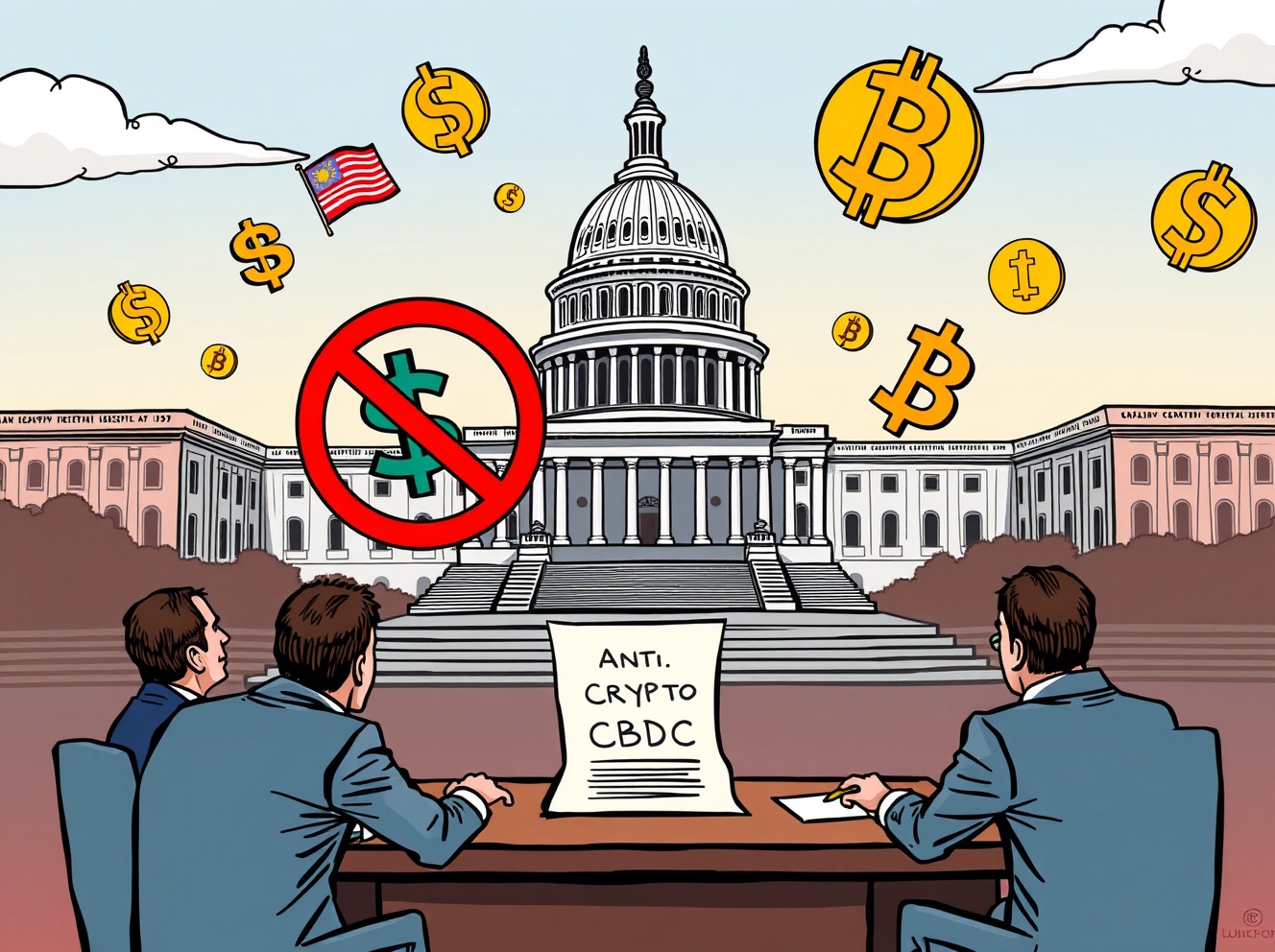
Anti-CBDC Act: U.S. House Debates Crucial Inclusion in Crypto Bill

A significant discussion is currently unfolding within the U.S. House of Representatives. Lawmakers are actively considering a proposal to integrate the Anti-CBDC act into a broader, comprehensive digital asset market structure bill. This move could have profound implications for the future of digital currencies in America.

This development, initially reported by Cointelegraph, signals a critical juncture for cryptocurrency regulation. If this measure passes, the combined legislation would then advance to the Senate for further deliberation.

What is the Anti-CBDC Act and Why is it Crucial?

At its core, the Anti-CBDC act aims to prevent the U.S. government from issuing a central bank digital currency (CBDC). A CBDC is essentially a digital form of a country’s fiat currency, issued and backed by its central bank.

Proponents of the Anti-CBDC act express significant concerns. They often highlight issues related to privacy, potential government surveillance, and the risk of increased financial control over citizens. The act seeks to safeguard individual financial freedom and limit government overreach in digital transactions.

Many believe that a government-issued digital currency could pave the way for a ‘surveillance state,’ where every transaction is monitored. This perspective drives the urgent push for this protective legislation.

A Pivotal Moment for Crypto Market Structure

The proposed inclusion of the Anti-CBDC act is not happening in isolation. It is being considered as part of a larger digital asset market structure bill. This overarching legislation aims to provide a clear regulatory framework for the entire cryptocurrency industry.

Establishing clear rules is vital for the growth and stability of the crypto market. Without proper guidelines, businesses and investors face uncertainty, which can hinder innovation and adoption. The market structure bill intends to address these regulatory gaps.

Integrating the Anti-CBDC act into this bill means that the debate over central bank digital currencies is now firmly linked to the broader conversation about how digital assets will be regulated in the U.S. This connection elevates the importance of both legislative efforts.

Past Battles and Future Prospects for the Anti-CBDC Act

This isn’t the first time Republican lawmakers have attempted to ban the issuance of a central bank digital currency. Previously, they sought to include an anti-CBDC measure during a vote on the GENIUS Act, a stablecoin regulation bill.

While that specific attempt did not succeed within the stablecoin bill, the commitment to the cause remained strong. Subsequently, the Anti-CBDC act successfully passed the House as a standalone bill. This earlier success demonstrates significant support for the measure.

Now, by attempting to attach it to a broader digital asset bill, lawmakers are looking for a more direct path to enactment. This strategy could increase its chances of becoming law, as it would be part of a larger package deemed essential for the crypto industry.

What are the Core Concerns Surrounding CBDCs?

The opposition to CBDCs stems from several key concerns:

  • Privacy: Critics fear that a CBDC could eliminate financial privacy, allowing governments to track every transaction.
  • Surveillance: There’s a worry that a CBDC could enable a ‘surveillance state,’ giving authorities unprecedented insight into citizens’ spending habits.
  • Control: Some argue that a CBDC could give governments the power to freeze funds, implement negative interest rates, or even program spending, limiting individual economic freedom.
  • Disintermediation: There are concerns that CBDCs could bypass commercial banks, fundamentally altering the financial system.

These points form the bedrock of the arguments in favor of the Anti-CBDC act, emphasizing the need for safeguards against potential governmental overreach.

The Road Ahead: From House to Senate

If the U.S. House of Representatives successfully incorporates the Anti-CBDC act into the digital asset market structure bill, the journey is far from over. The comprehensive legislation would then be sent to the Senate for its own round of deliberations, debates, and votes.

The Senate process can be complex and time-consuming, with potential amendments and further negotiations. The outcome in the Senate is not guaranteed, and strong advocacy from both sides of the CBDC debate is expected.

Ultimately, for the Anti-CBDC act to become law as part of this broader bill, it must pass both chambers of Congress and receive presidential assent. This legislative path highlights the critical nature of the current discussions in the House.

The ongoing debate in the U.S. House over the inclusion of the Anti-CBDC act in the digital asset market structure bill marks a truly pivotal moment for the future of finance and individual liberties. This legislative effort underscores a growing concern among lawmakers about the potential implications of central bank digital currencies.

The outcome of these discussions will not only shape the regulatory landscape for cryptocurrencies but also determine the extent of government involvement in digital money. It’s a debate that touches upon fundamental questions of privacy, control, and the very nature of money in the digital age. Keeping an eye on these developments is essential for anyone interested in the evolving world of digital assets.

Frequently Asked Questions (FAQs)

Q1: What is a Central Bank Digital Currency (CBDC)?
A1: A CBDC is a digital form of a country’s fiat currency, issued and backed by its central bank. Unlike cryptocurrencies like Bitcoin, which are decentralized, a CBDC is centralized and controlled by the government.

Q2: What is the primary goal of the Anti-CBDC act?
A2: The primary goal of the Anti-CBDC act is to prevent the U.S. government from issuing a central bank digital currency, citing concerns about privacy, surveillance, and potential government control over individual finances.

Q3: How does the Anti-CBDC act relate to the broader crypto market structure bill?
A3: The Anti-CBDC act is being considered for inclusion in a larger bill designed to establish a comprehensive regulatory framework for digital assets in the U.S. This means the debate over CBDCs is now tied to the overall regulation of the crypto industry.

Q4: What are the main concerns opponents have about CBDCs?
A4: Opponents primarily worry about the erosion of financial privacy, the potential for government surveillance of transactions, and the risk of governments gaining excessive control over citizens’ spending and financial activities.

Q5: What happens if the Anti-CBDC act is included in the market structure bill and passes the House?
A5: If included and passed by the House, the combined legislation, including the Anti-CBDC act, would then proceed to the Senate for further deliberation, debate, and a vote before potentially becoming law.

Q6: Has the Anti-CBDC act been debated before?
A6: Yes, Republican lawmakers previously attempted to include an anti-CBDC measure in a stablecoin regulation bill. The Anti-CBDC act also passed the House as a standalone bill prior to this current consideration.

If you found this article informative and believe in the importance of understanding legislative actions impacting digital currencies, please share it with your friends and on your social media platforms. Your support helps spread awareness and encourages a broader conversation about the future of finance.

To learn more about the latest crypto market trends, explore our article on key developments shaping digital asset institutional adoption.

This post Anti-CBDC Act: U.S. House Debates Crucial Inclusion in Crypto Bill first appeared on BitcoinWorld.


Market Opportunity
Threshold Logo
Threshold Price(T)
$0.009707
$0.009707$0.009707
+1.07%
USD
Threshold (T) Live Price Chart
Disclaimer: The articles reposted on this site are sourced from public platforms and are provided for informational purposes only. They do not necessarily reflect the views of MEXC. All rights remain with the original authors. If you believe any content infringes on third-party rights, please contact service@support.mexc.com for removal. MEXC makes no guarantees regarding the accuracy, completeness, or timeliness of the content and is not responsible for any actions taken based on the information provided. The content does not constitute financial, legal, or other professional advice, nor should it be considered a recommendation or endorsement by MEXC.

You May Also Like

In 2025, global cryptocurrency investors will rush to purchase Pioneer Hash smart cloud mining contracts, allowing you to earn a daily incomethatneverstops!

In 2025, global cryptocurrency investors will rush to purchase Pioneer Hash smart cloud mining contracts, allowing you to earn a daily incomethatneverstops!

The post In 2025, global cryptocurrency investors will rush to purchase Pioneer Hash smart cloud mining contracts, allowing you to earn a daily incomethatneverstops! appeared on BitcoinEthereumNews.com. In recent years, as digital assets have further entered the mainstream, Pioneer Hash has grown into a top global cloud mining service provider, serving over 6 million users in over 180 countries. The platform allows users to mine cryptocurrencies such as Bitcoin (BTC), Ethereum (ETH), Solana (SOL), Ripple (XRP), and Dogecoin (DOGE) without purchasing expensive hardware or paying for electricity. Pioneer Hash’s contracts, which transform idle assets into high-yield mining schemes, have attracted numerous cryptocurrency holders, with some advanced users reporting daily returns of up to $8,999 or more. This model is particularly suitable for both novice and professional investors, and cloud mining is rapidly becoming one of the most convenient ways for individuals to earn passive crypto income. Bitcoin mining is often associated with expensive hardware, high electricity costs, and technical know-how. But in 2025, cloud mining allows anyone to start mining, no experience required. Instead of setting up a mining rig at home, a simple contract gives remote access to an industrial-scale mining farm. These services allow beginners to earn Bitcoin securely, transparently, and efficiently, using only their phone or computer. How to join Pioneer Hash and start earning a stable daily income? 1. Visit the official website. Register an account at pioneerhash.com to quickly begin your cloud mining journey. 2. Complete registration and receive a $15 welcome bonus. Fill in your basic information and, upon successful registration, receive a $15 trial bonus from the platform. Try cloud mining at no cost. 3. Choose a contract. Choose the appropriate cloud computing power contract. No technical knowledge is required. The platform automatically schedules mining pools and computing power, and mining and generating revenue will begin within 24 hours. 4. Referral Rewards: Invite friends and earn commissions easily. Level 1 referral: Receive a 3% bonus. Level 2 referral: Receive a…
Share
BitcoinEthereumNews2025/09/22 20:51
MakinaFi suffered an attack that resulted in the loss of approximately 1299 ETH, with some funds being preemptively processed by MEV.

MakinaFi suffered an attack that resulted in the loss of approximately 1299 ETH, with some funds being preemptively processed by MEV.

PANews reported on January 20th that, according to PeckShieldAlert, the MakinaFi platform was attacked, with hackers stealing approximately 1,299 ETH, worth about
Share
PANews2026/01/20 12:32
Magic Eden co-founder sees 'speculation supercycle' ahead

Magic Eden co-founder sees 'speculation supercycle' ahead

Trading volumes in prediction markets are higher than ever, with Monday seeing a record $814.2 million worth of trades placed on Kalshi, Polymarket, and other platforms
Share
Coinstats2026/01/20 12:12