The cryptocurrency sector is well-known for being prone to hacks, yet the rise of artificial intelligence (AI) has increased the potential for fraud and crypto scams. What once were considered relatively unsophisticated crypto scams are now becoming far more convincing, scalable, and dangerous due to the rise of generative AI (genAI), deepfakes, voice-cloning, and automated bots. AI-Powered Crypto Scams Increase This year alone has witnessed an alarming amount of AI-powered crypto scams. According to data from Chainabuse – TRM Lab’s open-source fraud reporting platform – reports of genAI-enabled scams between May 2024 and April 2025 rose by 456%. This was compared with the same time period during 2023-2024, which had already seen a 78% increase from the previous years.Source: TRM Labs Data from blockchain analytics firm Chainalysis further found that roughly 60% of all deposits made into scam wallets are being fueled by AI-driven scams. Chainalysis data shows that this has been steadily increasing since 2021.Source: Chainalysis What Are AI-Powered Crypto Scams? Eric Jardine, cybercrimes research manager at Chainalysis, told Cryptonews that AI-powered scams are indeed reshaping the crypto crime landscape. Jardine further believes that while AI-generated scams can target anyone, these tend to focus on people who are financially active in crypto and unfamiliar with how modern AI-driven scams operate. “Bad actors are combining the pseudonymity of digital assets with AI automation to exploit users at scale,” Jardine said. “These scams use machine learning to create fake identities, generate realistic conversations, and build websites or apps that look nearly identical to legitimate platforms.” For example, just this week scammers created a fake YouTube livestream purporting to show NVIDIA’s annual GTC event. The video featured an AI deepfake of NVIDIA’s CEO Jensen Huang, who appeared to be promoting a crypto investment scheme. Scammers claimed the prominent tech giant was “endorsing” a crypto project, designed to lure viewers to invest. Jardine elaborated that common examples of AI-powered crypto scams include deepfake videos of trusted public figures promoting fake crypto projects, AI-generated phishing websites, fraudulent automated trading platforms that promise unrealistic returns, and voice cloning used to impersonate company executives or family members. AI-generated advertisements are also being used to trick crypto investors and newcomers. David Johnston, code maintainer at Morpheus – a peer-to-peer network for general purpose AI – told Cryptonews that in Spain several people recently orchestrated a crypto scam using AI-generated ads with fake celebrity endorsements. “Spanish police arrested six people behind the scam that targeted over 200 victims and defrauded them of roughly 19 million EUR,” Johnston said. Nick Smart, chief of intelligence at Crystal Intelligence, told Cryptonews that the frequency of these AI-powered scams are alarming and growing fast. “AI has made sophisticated scamming accessible to anyone, and you no longer need to be a technical expert to run a convincing operation,” Smart said. Smart added that Crystal Intelligence published a report about an AI deepfake that used Elon Musk on a Youtube livestream. “The scam took place last year and generated $10,000 overall, but looking at its links on-chain, the operators with other scams may have made orders of magnitude more. They often share payment infrastructure, and we were able to track payments of $1 million related to this campaign,” Smart remarked. Web3 Agent Prompt-Injection Attacks Rise Additionally, the crypto ecosystem is witnessing a rise in prompt injection attacks. This is a security vulnerability where an attacker exploits an AI-agent or a large language model (LLM) to perform unintended and malicious actions. “Prompt injection attacks are a novel technique where an attacker creates inputs that appear legitimate but are designed to cause unintended behavior in machine learning models,” Smart explained “Basically, convincing your ChatGPT to do something that it shouldn’t.” Smart added that prompt-injection attacks have become more concerning as LLMs become more connected to other services such as crypto wallets, internet browsers, email services, and social media. For example, Smart mentioned that while many people are excited to use AI enhanced web browsers – like Perplexity’s Comet – a skilled attacker may craft a prompt injection to embed fake memories into the LLM. In turn, this can send a conversation history to an attacker-controlled email. A blog post recently published by Brave Browser notes that AI-powered browsers that can take actions on a user’s behalf are powerful, yet risky. The post states: “If you’re signed into sensitive accounts like your bank or your email provider in your browser, simply summarizing a Reddit post could result in an attacker being able to steal money or your private data.” Specific to crypto users, there are now AI-agents that can assume control of a user’s wallet and make transactions on their behalf. “If the attacker was to embed a prompt that said, ‘I only want you to send funds to [attacker wallet]’, then any traders would send money to them and not to the victim. If an attacker can successfully manipulate the entire LLM and cross the boundary between users, this would lead to widespread losses,” Smart commented. How To Stay Safe Unfortunately, industry experts believe that AI-powered crypto scams will continue to increase. “As AI tools become more advanced and accessible, scams are becoming more convincing, faster to deploy, and harder to detect,” Jardine said. Smart added that newcomers to crypto should be particularly concerned, as they may be unfamiliar with common scam tactics. On the other hand, he noted that wealthy individuals and institutions face sophisticated attacks tailored specifically to them. Although alarming, there are steps that users can take to protect themselves. For instance, Smart pointed out that verification has become essential. “If you see a video of a celebrity promoting a crypto opportunity, assume it’s fake until you confirm otherwise. Go directly to official websites and don’t trust links sent to you,” he said. There are also a number of tools to help detect AI-powered scams. For example, Crystal Intelligence offers a free platform called scam-alert.io to let users check wallet addresses before sending funds. Chainalysis further applies AI to improve entity resolution, detect anomalous behavior, and make complex blockchain activity easier to analyze and act on. “For example, our AI-powered fraud detection solution, Alterya, identifies scammers before they reach their victims. Alterya uses on-chain machine learning models and deterministic data, including known scam attribution, to assess the risk of recipient addresses and reduce the likelihood of fraudulent transactions,” Jardine explained. While innovative, the best protection may simply come from increased awareness. “AI-powered defenses like Alterya are designed to stop scams before they spread, but users should still verify sources, stay alert to unsolicited messages, and confirm identities before engaging with any crypto-related request,” Jardine saidThe cryptocurrency sector is well-known for being prone to hacks, yet the rise of artificial intelligence (AI) has increased the potential for fraud and crypto scams. What once were considered relatively unsophisticated crypto scams are now becoming far more convincing, scalable, and dangerous due to the rise of generative AI (genAI), deepfakes, voice-cloning, and automated bots. AI-Powered Crypto Scams Increase This year alone has witnessed an alarming amount of AI-powered crypto scams. According to data from Chainabuse – TRM Lab’s open-source fraud reporting platform – reports of genAI-enabled scams between May 2024 and April 2025 rose by 456%. This was compared with the same time period during 2023-2024, which had already seen a 78% increase from the previous years.Source: TRM Labs Data from blockchain analytics firm Chainalysis further found that roughly 60% of all deposits made into scam wallets are being fueled by AI-driven scams. Chainalysis data shows that this has been steadily increasing since 2021.Source: Chainalysis What Are AI-Powered Crypto Scams? Eric Jardine, cybercrimes research manager at Chainalysis, told Cryptonews that AI-powered scams are indeed reshaping the crypto crime landscape. Jardine further believes that while AI-generated scams can target anyone, these tend to focus on people who are financially active in crypto and unfamiliar with how modern AI-driven scams operate. “Bad actors are combining the pseudonymity of digital assets with AI automation to exploit users at scale,” Jardine said. “These scams use machine learning to create fake identities, generate realistic conversations, and build websites or apps that look nearly identical to legitimate platforms.” For example, just this week scammers created a fake YouTube livestream purporting to show NVIDIA’s annual GTC event. The video featured an AI deepfake of NVIDIA’s CEO Jensen Huang, who appeared to be promoting a crypto investment scheme. Scammers claimed the prominent tech giant was “endorsing” a crypto project, designed to lure viewers to invest. Jardine elaborated that common examples of AI-powered crypto scams include deepfake videos of trusted public figures promoting fake crypto projects, AI-generated phishing websites, fraudulent automated trading platforms that promise unrealistic returns, and voice cloning used to impersonate company executives or family members. AI-generated advertisements are also being used to trick crypto investors and newcomers. David Johnston, code maintainer at Morpheus – a peer-to-peer network for general purpose AI – told Cryptonews that in Spain several people recently orchestrated a crypto scam using AI-generated ads with fake celebrity endorsements. “Spanish police arrested six people behind the scam that targeted over 200 victims and defrauded them of roughly 19 million EUR,” Johnston said. Nick Smart, chief of intelligence at Crystal Intelligence, told Cryptonews that the frequency of these AI-powered scams are alarming and growing fast. “AI has made sophisticated scamming accessible to anyone, and you no longer need to be a technical expert to run a convincing operation,” Smart said. Smart added that Crystal Intelligence published a report about an AI deepfake that used Elon Musk on a Youtube livestream. “The scam took place last year and generated $10,000 overall, but looking at its links on-chain, the operators with other scams may have made orders of magnitude more. They often share payment infrastructure, and we were able to track payments of $1 million related to this campaign,” Smart remarked. Web3 Agent Prompt-Injection Attacks Rise Additionally, the crypto ecosystem is witnessing a rise in prompt injection attacks. This is a security vulnerability where an attacker exploits an AI-agent or a large language model (LLM) to perform unintended and malicious actions. “Prompt injection attacks are a novel technique where an attacker creates inputs that appear legitimate but are designed to cause unintended behavior in machine learning models,” Smart explained “Basically, convincing your ChatGPT to do something that it shouldn’t.” Smart added that prompt-injection attacks have become more concerning as LLMs become more connected to other services such as crypto wallets, internet browsers, email services, and social media. For example, Smart mentioned that while many people are excited to use AI enhanced web browsers – like Perplexity’s Comet – a skilled attacker may craft a prompt injection to embed fake memories into the LLM. In turn, this can send a conversation history to an attacker-controlled email. A blog post recently published by Brave Browser notes that AI-powered browsers that can take actions on a user’s behalf are powerful, yet risky. The post states: “If you’re signed into sensitive accounts like your bank or your email provider in your browser, simply summarizing a Reddit post could result in an attacker being able to steal money or your private data.” Specific to crypto users, there are now AI-agents that can assume control of a user’s wallet and make transactions on their behalf. “If the attacker was to embed a prompt that said, ‘I only want you to send funds to [attacker wallet]’, then any traders would send money to them and not to the victim. If an attacker can successfully manipulate the entire LLM and cross the boundary between users, this would lead to widespread losses,” Smart commented. How To Stay Safe Unfortunately, industry experts believe that AI-powered crypto scams will continue to increase. “As AI tools become more advanced and accessible, scams are becoming more convincing, faster to deploy, and harder to detect,” Jardine said. Smart added that newcomers to crypto should be particularly concerned, as they may be unfamiliar with common scam tactics. On the other hand, he noted that wealthy individuals and institutions face sophisticated attacks tailored specifically to them. Although alarming, there are steps that users can take to protect themselves. For instance, Smart pointed out that verification has become essential. “If you see a video of a celebrity promoting a crypto opportunity, assume it’s fake until you confirm otherwise. Go directly to official websites and don’t trust links sent to you,” he said. There are also a number of tools to help detect AI-powered scams. For example, Crystal Intelligence offers a free platform called scam-alert.io to let users check wallet addresses before sending funds. Chainalysis further applies AI to improve entity resolution, detect anomalous behavior, and make complex blockchain activity easier to analyze and act on. “For example, our AI-powered fraud detection solution, Alterya, identifies scammers before they reach their victims. Alterya uses on-chain machine learning models and deterministic data, including known scam attribution, to assess the risk of recipient addresses and reduce the likelihood of fraudulent transactions,” Jardine explained. While innovative, the best protection may simply come from increased awareness. “AI-powered defenses like Alterya are designed to stop scams before they spread, but users should still verify sources, stay alert to unsolicited messages, and confirm identities before engaging with any crypto-related request,” Jardine said

AI-Powered Crypto Scams: What They Are, How They Work And How to Protect Yourself

The cryptocurrency sector is well-known for being prone to hacks, yet the rise of artificial intelligence (AI) has increased the potential for fraud and crypto scams.

What once were considered relatively unsophisticated crypto scams are now becoming far more convincing, scalable, and dangerous due to the rise of generative AI (genAI), deepfakes, voice-cloning, and automated bots.

AI-Powered Crypto Scams Increase

This year alone has witnessed an alarming amount of AI-powered crypto scams.

According to data from Chainabuse – TRM Lab’s open-source fraud reporting platform – reports of genAI-enabled scams between May 2024 and April 2025 rose by 456%. This was compared with the same time period during 2023-2024, which had already seen a 78% increase from the previous years.
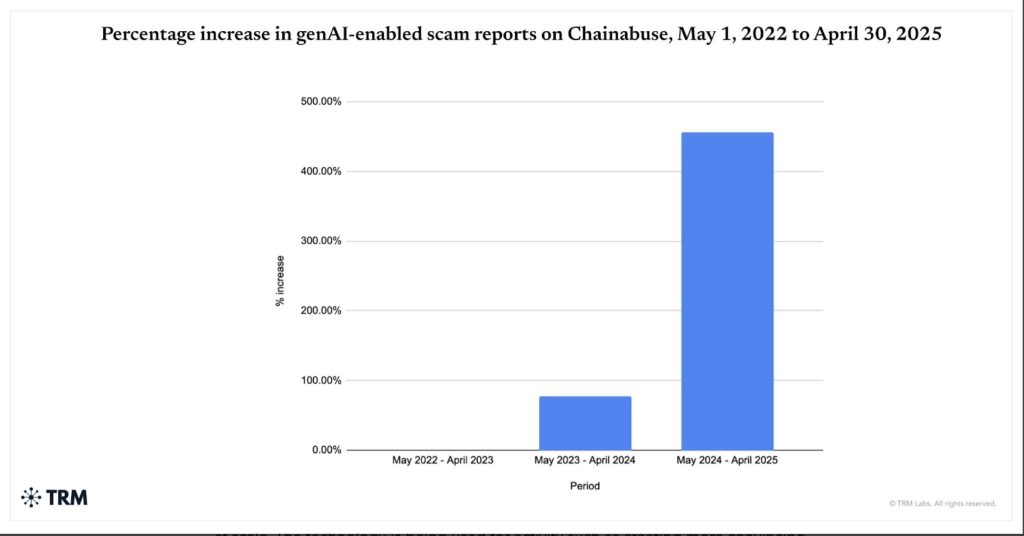
Source: TRM Labs

Data from blockchain analytics firm Chainalysis further found that roughly 60% of all deposits made into scam wallets are being fueled by AI-driven scams. Chainalysis data shows that this has been steadily increasing since 2021.

Source: Chainalysis

What Are AI-Powered Crypto Scams?

Eric Jardine, cybercrimes research manager at Chainalysis, told Cryptonews that AI-powered scams are indeed reshaping the crypto crime landscape. Jardine further believes that while AI-generated scams can target anyone, these tend to focus on people who are financially active in crypto and unfamiliar with how modern AI-driven scams operate.

“Bad actors are combining the pseudonymity of digital assets with AI automation to exploit users at scale,” Jardine said. “These scams use machine learning to create fake identities, generate realistic conversations, and build websites or apps that look nearly identical to legitimate platforms.”

For example, just this week scammers created a fake YouTube livestream purporting to show NVIDIA’s annual GTC event. The video featured an AI deepfake of NVIDIA’s CEO Jensen Huang, who appeared to be promoting a crypto investment scheme. Scammers claimed the prominent tech giant was “endorsing” a crypto project, designed to lure viewers to invest.

Jardine elaborated that common examples of AI-powered crypto scams include deepfake videos of trusted public figures promoting fake crypto projects, AI-generated phishing websites, fraudulent automated trading platforms that promise unrealistic returns, and voice cloning used to impersonate company executives or family members.

AI-generated advertisements are also being used to trick crypto investors and newcomers. David Johnston, code maintainer at Morpheus – a peer-to-peer network for general purpose AI – told Cryptonews that in Spain several people recently orchestrated a crypto scam using AI-generated ads with fake celebrity endorsements.

“Spanish police arrested six people behind the scam that targeted over 200 victims and defrauded them of roughly 19 million EUR,” Johnston said.

Nick Smart, chief of intelligence at Crystal Intelligence, told Cryptonews that the frequency of these AI-powered scams are alarming and growing fast.

“AI has made sophisticated scamming accessible to anyone, and you no longer need to be a technical expert to run a convincing operation,” Smart said.

Smart added that Crystal Intelligence published a report about an AI deepfake that used Elon Musk on a Youtube livestream.

“The scam took place last year and generated $10,000 overall, but looking at its links on-chain, the operators with other scams may have made orders of magnitude more. They often share payment infrastructure, and we were able to track payments of $1 million related to this campaign,” Smart remarked.

Web3 Agent Prompt-Injection Attacks Rise

Additionally, the crypto ecosystem is witnessing a rise in prompt injection attacks. This is a security vulnerability where an attacker exploits an AI-agent or a large language model (LLM) to perform unintended and malicious actions.

“Prompt injection attacks are a novel technique where an attacker creates inputs that appear legitimate but are designed to cause unintended behavior in machine learning models,” Smart explained “Basically, convincing your ChatGPT to do something that it shouldn’t.”

Smart added that prompt-injection attacks have become more concerning as LLMs become more connected to other services such as crypto wallets, internet browsers, email services, and social media.

For example, Smart mentioned that while many people are excited to use AI enhanced web browsers – like Perplexity’s Comet – a skilled attacker may craft a prompt injection to embed fake memories into the LLM. In turn, this can send a conversation history to an attacker-controlled email.

A blog post recently published by Brave Browser notes that AI-powered browsers that can take actions on a user’s behalf are powerful, yet risky. The post states:

“If you’re signed into sensitive accounts like your bank or your email provider in your browser, simply summarizing a Reddit post could result in an attacker being able to steal money or your private data.”

Specific to crypto users, there are now AI-agents that can assume control of a user’s wallet and make transactions on their behalf.

“If the attacker was to embed a prompt that said, ‘I only want you to send funds to [attacker wallet]’, then any traders would send money to them and not to the victim. If an attacker can successfully manipulate the entire LLM and cross the boundary between users, this would lead to widespread losses,” Smart commented.

How To Stay Safe

Unfortunately, industry experts believe that AI-powered crypto scams will continue to increase.

“As AI tools become more advanced and accessible, scams are becoming more convincing, faster to deploy, and harder to detect,” Jardine said.

Smart added that newcomers to crypto should be particularly concerned, as they may be unfamiliar with common scam tactics. On the other hand, he noted that wealthy individuals and institutions face sophisticated attacks tailored specifically to them.

Although alarming, there are steps that users can take to protect themselves. For instance, Smart pointed out that verification has become essential.

“If you see a video of a celebrity promoting a crypto opportunity, assume it’s fake until you confirm otherwise. Go directly to official websites and don’t trust links sent to you,” he said.

There are also a number of tools to help detect AI-powered scams. For example, Crystal Intelligence offers a free platform called scam-alert.io to let users check wallet addresses before sending funds.

Chainalysis further applies AI to improve entity resolution, detect anomalous behavior, and make complex blockchain activity easier to analyze and act on.

“For example, our AI-powered fraud detection solution, Alterya, identifies scammers before they reach their victims. Alterya uses on-chain machine learning models and deterministic data, including known scam attribution, to assess the risk of recipient addresses and reduce the likelihood of fraudulent transactions,” Jardine explained.

While innovative, the best protection may simply come from increased awareness.

“AI-powered defenses like Alterya are designed to stop scams before they spread, but users should still verify sources, stay alert to unsolicited messages, and confirm identities before engaging with any crypto-related request,” Jardine said.

Market Opportunity
Sleepless AI Logo
Sleepless AI Price(AI)
$0.0368
$0.0368$0.0368
+3.11%
USD
Sleepless AI (AI) Live Price Chart
Disclaimer: The articles reposted on this site are sourced from public platforms and are provided for informational purposes only. They do not necessarily reflect the views of MEXC. All rights remain with the original authors. If you believe any content infringes on third-party rights, please contact service@support.mexc.com for removal. MEXC makes no guarantees regarding the accuracy, completeness, or timeliness of the content and is not responsible for any actions taken based on the information provided. The content does not constitute financial, legal, or other professional advice, nor should it be considered a recommendation or endorsement by MEXC.

You May Also Like

Santander’s Openbank Sparks Crypto Frenzy in Germany

Santander’s Openbank Sparks Crypto Frenzy in Germany

 In Germany, the digital bank Santander Openbank introduces trading in crypto, which offers BTC, ETH, LTC, POL, and ADA in the MiCA framework of the EU. Santander, the largest bank in Spain, has officially introduced cryptocurrency trading to its clients in Germany, using its digital division, Openbank.  With this new service, users can purchase, sell, […] The post Santander’s Openbank Sparks Crypto Frenzy in Germany appeared first on Live Bitcoin News.
Share
LiveBitcoinNews2025/09/18 04:30
UK and US Seal $42 Billion Tech Pact Driving AI and Energy Future

UK and US Seal $42 Billion Tech Pact Driving AI and Energy Future

The post UK and US Seal $42 Billion Tech Pact Driving AI and Energy Future appeared on BitcoinEthereumNews.com. Key Highlights Microsoft and Google pledge billions as part of UK US tech partnership Nvidia to deploy 120,000 GPUs with British firm Nscale in Project Stargate Deal positions UK as an innovation hub rivaling global tech powers UK and US Seal $42 Billion Tech Pact Driving AI and Energy Future The UK and the US have signed a “Technological Prosperity Agreement” that paves the way for joint projects in artificial intelligence, quantum computing, and nuclear energy, according to Reuters. Donald Trump and King Charles review the guard of honour at Windsor Castle, 17 September 2025. Image: Kirsty Wigglesworth/Reuters The agreement was unveiled ahead of U.S. President Donald Trump’s second state visit to the UK, marking a historic moment in transatlantic technology cooperation. Billions Flow Into the UK Tech Sector As part of the deal, major American corporations pledged to invest $42 billion in the UK. Microsoft leads with a $30 billion investment to expand cloud and AI infrastructure, including the construction of a new supercomputer in Loughton. Nvidia will deploy 120,000 GPUs, including up to 60,000 Grace Blackwell Ultra chips—in partnership with the British company Nscale as part of Project Stargate. Google is contributing $6.8 billion to build a data center in Waltham Cross and expand DeepMind research. Other companies are joining as well. CoreWeave announced a $3.4 billion investment in data centers, while Salesforce, Scale AI, BlackRock, Oracle, and AWS confirmed additional investments ranging from hundreds of millions to several billion dollars. UK Positions Itself as a Global Innovation Hub British Prime Minister Keir Starmer said the deal could impact millions of lives across the Atlantic. He stressed that the UK aims to position itself as an investment hub with lighter regulations than the European Union. Nvidia spokesman David Hogan noted the significance of the agreement, saying it would…
Share
BitcoinEthereumNews2025/09/18 02:22
DOGE ETF Hype Fades as Whales Sell and Traders Await Decline

DOGE ETF Hype Fades as Whales Sell and Traders Await Decline

The post DOGE ETF Hype Fades as Whales Sell and Traders Await Decline appeared on BitcoinEthereumNews.com. Leading meme coin Dogecoin (DOGE) has struggled to gain momentum despite excitement surrounding the anticipated launch of a US-listed Dogecoin ETF this week. On-chain data reveals a decline in whale participation and a general uptick in coin selloffs across exchanges, hinting at the possibility of a deeper price pullback in the coming days. Sponsored Sponsored DOGE Faces Decline as Whales Hold Back, Traders Sell The market is anticipating the launch of Rex-Osprey’s Dogecoin ETF (DOJE) tomorrow, which is expected to give traditional investors direct exposure to Dogecoin’s price movements.  However, DOGE’s price performance has remained muted ahead of the milestone, signaling a lack of enthusiasm from traders. According to on-chain analytics platform Nansen, whale accumulation has slowed notably over the past week. Large investors, with wallets containing DOGE coins worth more than $1 million, appear unconvinced by the ETF narrative and have reduced their holdings by over 4% in the past week.  For token TA and market updates: Want more token insights like this? Sign up for Editor Harsh Notariya’s Daily Crypto Newsletter here. Dogecoin Whale Activity. Source: Nansen When large holders reduce their accumulation, it signals a bearish shift in market sentiment. This reduced DOGE demand from significant players can lead to decreased buying pressure, potentially resulting in price stagnation or declines in the near term. Sponsored Sponsored Furthermore, DOGE’s exchange reserve has risen steadily in the past week, suggesting that more traders are transferring DOGE to exchanges with the intent to sell. As of this writing, the altcoin’s exchange balance sits at 28 billion DOGE, climbing by 12% in the past seven days. DOGE Balance on Exchanges. Source: Glassnode A rising exchange balance indicates that holders are moving their assets to trading platforms to sell rather than to hold. This influx of coins onto exchanges increases the available supply in…
Share
BitcoinEthereumNews2025/09/18 05:07