Bitcoin has triggered a new Death Cross, a rare chart signal that occurs when the 50-day moving average slips below the 200-day moving average. This pattern has been a turning point in earlier cycles, and traders now wonder whether the latest event marks another local bottom or signals deeper weakness ahead. Historical data shows that […]Bitcoin has triggered a new Death Cross, a rare chart signal that occurs when the 50-day moving average slips below the 200-day moving average. This pattern has been a turning point in earlier cycles, and traders now wonder whether the latest event marks another local bottom or signals deeper weakness ahead. Historical data shows that […]

Bitcoin (BTC) Death Cross Flashes Again: Is a 130K Target Still Possible?

Bitcoin
  • Bitcoin’s latest Death Cross has appeared at a major inflection point in the market cycle.
  • A 35% rise from current levels could place Bitcoin near $130,000 in 2026.
  • Analysts warn that losing the 2025 opening price and the $92,000 level could end the bull cycle.

Bitcoin has triggered a new Death Cross, a rare chart signal that occurs when the 50-day moving average slips below the 200-day moving average. This pattern has been a turning point in earlier cycles, and traders now wonder whether the latest event marks another local bottom or signals deeper weakness ahead.

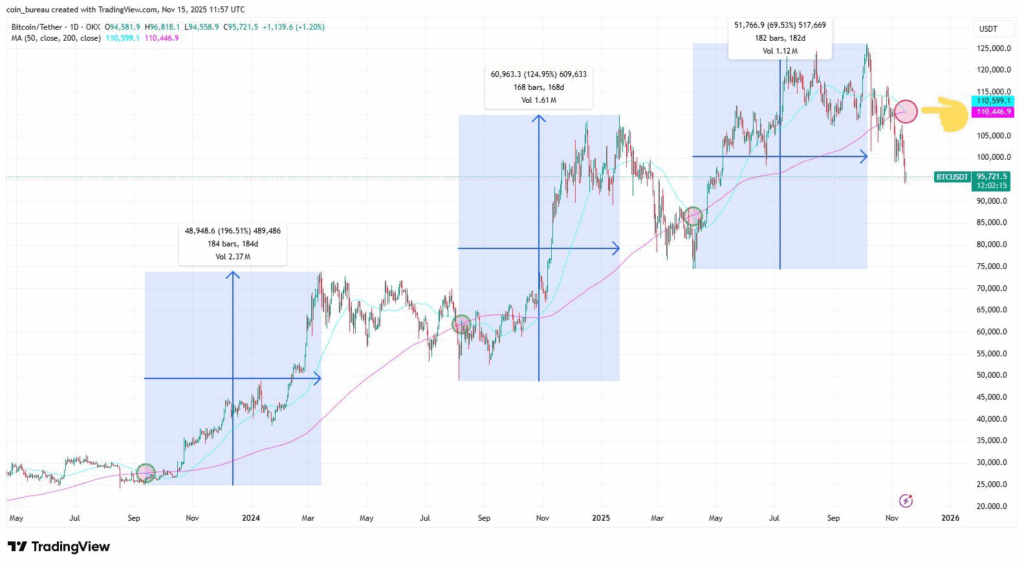
Historical data shows that similar crosses in September 2023, August 2024, and April 2025 were followed by strong recoveries. Those rallies measured 195%, 125%, and 70%.
Source: X

If the market repeats even part of this pattern, a move of around 35% from current levels could carry Bitcoin toward the $130,000 region by May 2026.

Another factor adding interest to the timing is the Federal Reserve’s plan to end quantitative tightening on December 1. Market watchers believe this shift could ease financial conditions and create a more supportive backdrop for risk assets, including Bitcoin.

With several macro signals aligning, investors are closely assessing whether the latest cross will once again lead to a major trend reversal.

Analysts Track the Battle Around the 50-Week Moving Average

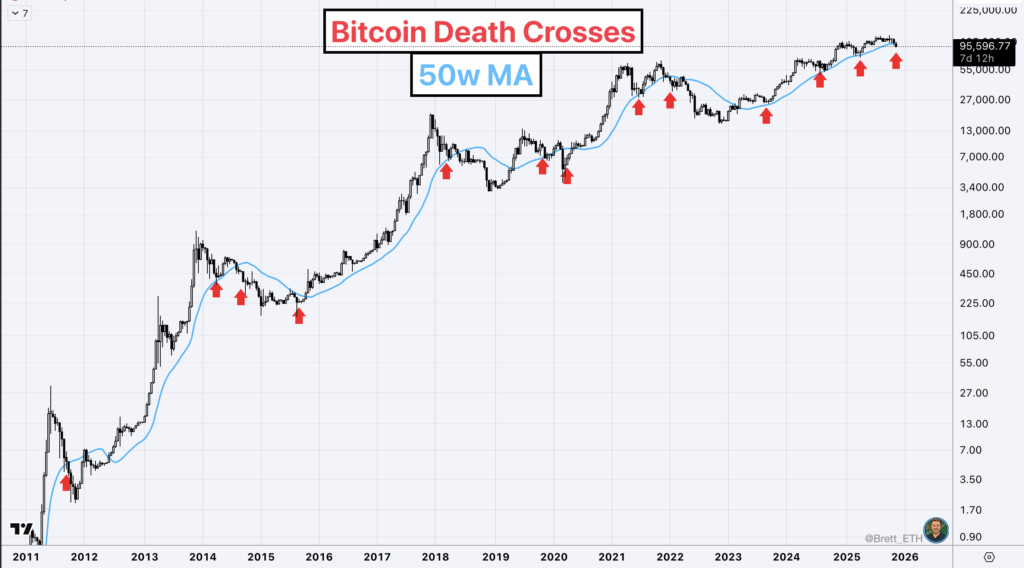
Market analyst Brett observed that Bitcoin is now facing resistance close to its 50-week moving average, which is more significant than the Death Cross. He added that unless a short-term close is achieved above $103,000, a break below this long-term level is most likely.

The previous cycles have indicated that when there were two weekly closes below this level, the top of this cycle was already established. Evidently, Brett also indicated that death crosses within up-market formations have previously led to new highs.
Source: X

The next level he expects is a possible return to the $103,000 area to retest on a weekly basis. A similar scenario emerged in 2022, where Bitcoin temporarily rose to the 50-week line after breaching it but could not hold on to the trend.

Bitcoin Key Support at $92K Seen as Market Turning Point

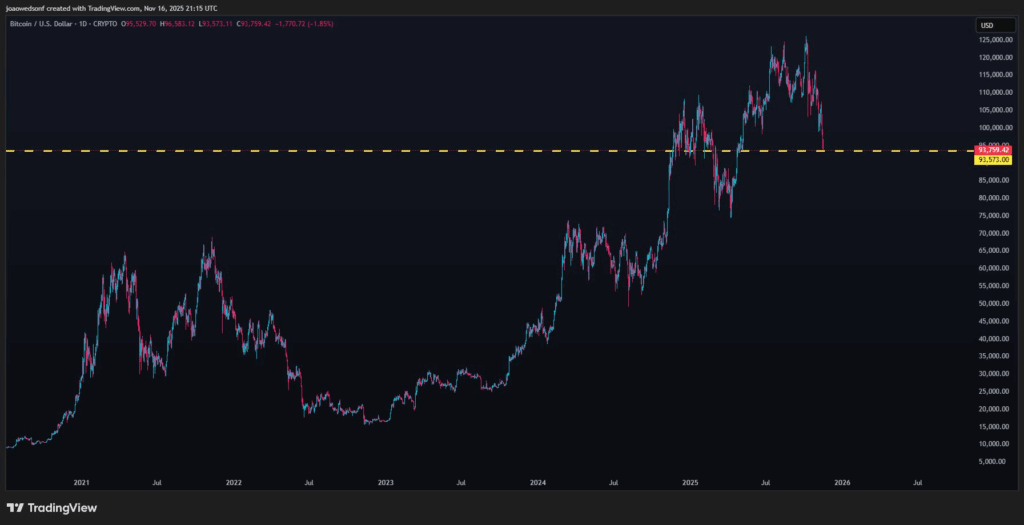
Joao Wedson, Founder & CEO at Alphracta, noticed that Bitcoin is currently back to its starting value in 2025. Joao Wedson added that if this level is broken to the downside, resulting in a breach beneath $92,000, most charts will turn bearish.
Source: X

It is generally agreed that this is the last opportunity available to market bulls to stabilize markets. Failure to do so could trigger a protracted bear market because on-chain analytics and market risk factors could gradually shift towards bearish markets.

Also Read: Bitcoin Enters Bear Territory With Price Falling Over 20% From ATH

Market Opportunity
Bitcoin Logo
Bitcoin Price(BTC)
$88,669.38
$88,669.38$88,669.38
+0.37%
USD
Bitcoin (BTC) Live Price Chart
Disclaimer: The articles reposted on this site are sourced from public platforms and are provided for informational purposes only. They do not necessarily reflect the views of MEXC. All rights remain with the original authors. If you believe any content infringes on third-party rights, please contact service@support.mexc.com for removal. MEXC makes no guarantees regarding the accuracy, completeness, or timeliness of the content and is not responsible for any actions taken based on the information provided. The content does not constitute financial, legal, or other professional advice, nor should it be considered a recommendation or endorsement by MEXC.

You May Also Like

Trust Wallet’s Decisive Move: Full Compensation for $7M Hack Victims

Trust Wallet’s Decisive Move: Full Compensation for $7M Hack Victims

BitcoinWorld Trust Wallet’s Decisive Move: Full Compensation for $7M Hack Victims In a significant move for cryptocurrency security, Trust Wallet has committed
Share
bitcoinworld2025/12/26 17:40
Cashing In On University Patents Means Giving Up On Our Innovation Future

Cashing In On University Patents Means Giving Up On Our Innovation Future

The post Cashing In On University Patents Means Giving Up On Our Innovation Future appeared on BitcoinEthereumNews.com. “It’s a raid on American innovation that would deliver pennies to the Treasury while kneecapping the very engine of our economic and medical progress,” writes Pipes. Getty Images Washington is addicted to taxing success. Now, Commerce Secretary Howard Lutnick is floating a plan to skim half the patent earnings from inventions developed at universities with federal funding. It’s being sold as a way to shore up programs like Social Security. In reality, it’s a raid on American innovation that would deliver pennies to the Treasury while kneecapping the very engine of our economic and medical progress. Yes, taxpayer dollars support early-stage research. But the real payoff comes later—in the jobs created, cures discovered, and industries launched when universities and private industry turn those discoveries into real products. By comparison, the sums at stake in patent licensing are trivial. Universities collectively earn only about $3.6 billion annually in patent income—less than the federal government spends on Social Security in a single day. Even confiscating half would barely register against a $6 trillion federal budget. And yet the damage from such a policy would be anything but trivial. The true return on taxpayer investment isn’t in licensing checks sent to Washington, but in the downstream economic activity that federally supported research unleashes. Thanks to the bipartisan Bayh-Dole Act of 1980, universities and private industry have powerful incentives to translate early-stage discoveries into real-world products. Before Bayh-Dole, the government hoarded patents from federally funded research, and fewer than 5% were ever licensed. Once universities could own and license their own inventions, innovation exploded. The result has been one of the best returns on investment in government history. Since 1996, university research has added nearly $2 trillion to U.S. industrial output, supported 6.5 million jobs, and launched more than 19,000 startups. Those companies pay…
Share
BitcoinEthereumNews2025/09/18 03:26
Trust Wallet Hack Hits $7M: CZ Hints at Possible Insider Role

Trust Wallet Hack Hits $7M: CZ Hints at Possible Insider Role

CZ hinted at possible insider involvement in the Trust Wallet incident while assuring users that their funds would be reimbursed.
Share
CryptoPotato2025/12/26 16:48