Dogecoin’s early November bounce appears weak, despite the modest 1.2% gain. DOGE price is still down 5.9% over the past week and nearly 27% this month. And now, on-chain data signals a deepening sell trend. The key question now: can Dogecoin’s $0.17 floor— which has held strong since October 11, even during the last bearish crossover — survive as long-term holders start to exit? Cost Basis Heatmap Marks The Last Line Of Defense On-chain cost basis data highlights Dogecoin’s strongest short-term support cluster between $0.177 and $0.179, where nearly 3.78 billion DOGE were last accumulated. First Cluster Protecting The Floor: Glassnode This range represents the heaviest long-term holder supply, acting as a key buffer during past sell-offs. Want more token insights like this? Sign up for Editor Harsh Notariya’s Daily Crypto Newsletter here. The cost basis heatmap shows where most investors last bought their tokens. It highlights the price zones with heavy long-term holder concentration that act as support or resistance. Bigger Dogecoin Support Cluster: Glassnode That buffer is weakening fast. According to Glassnode, Hodler Net Position Change — which tracks whether long-term wallets are adding or selling — flipped sharply negative on October 31. It dropped from an inflow of +8.2 million DOGE to an outflow of –22 million DOGE in just 24 hours. That’s a 367% reversal in holder behavior. Long-Term DOGE Holders Keep Selling: Glassnode This swing confirms that even older wallets are offloading their holdings. If this continues, it could thin out the $0.177–$0.179 cluster and expose Dogecoin’s strongest base since early October to further downside risk. Below $0.17, the next significant cost-basis cluster doesn’t appear until $0.14, leaving a wide gap for potential losses. But more on that in the next section. Looming Death Cross Could Accelerate the DOGE Price Breakdown The DOGE price structure now reinforces the bearish on-chain story. After the 50-day exponential moving average (EMA) crossed below the 200-day EMA in late October, Dogecoin extended its decline — marking the first leg of its current downtrend. The EMA is a trend indicator that smooths out price data to show market direction. Now, a second, stronger death cross is forming as the 100-day EMA approaches a drop below the 200-day EMA. Unlike the earlier crossover, this one carries more weight because both averages represent longer timeframes, reflecting sustained weakness rather than short-term volatility. If this crossover confirms, it would signal deepening downside momentum and strengthen the bearish structure already in place. In that case, Dogecoin’s strongest support zone near $0.17, highlighted by its cost basis heatmap, could finally give way — opening the door to a fall toward $0.14. That would be a near 6% dip. DOGE Price Analysis: TradingView Currently, DOGE trades near $0.18, capped by immediate resistances at $0.20 and $0.21. A daily close above $0.21, which hasn’t been tested since October 13, would be needed to invalidate this bearish bias.Dogecoin’s early November bounce appears weak, despite the modest 1.2% gain. DOGE price is still down 5.9% over the past week and nearly 27% this month. And now, on-chain data signals a deepening sell trend. The key question now: can Dogecoin’s $0.17 floor— which has held strong since October 11, even during the last bearish crossover — survive as long-term holders start to exit? Cost Basis Heatmap Marks The Last Line Of Defense On-chain cost basis data highlights Dogecoin’s strongest short-term support cluster between $0.177 and $0.179, where nearly 3.78 billion DOGE were last accumulated. First Cluster Protecting The Floor: Glassnode This range represents the heaviest long-term holder supply, acting as a key buffer during past sell-offs. Want more token insights like this? Sign up for Editor Harsh Notariya’s Daily Crypto Newsletter here. The cost basis heatmap shows where most investors last bought their tokens. It highlights the price zones with heavy long-term holder concentration that act as support or resistance. Bigger Dogecoin Support Cluster: Glassnode That buffer is weakening fast. According to Glassnode, Hodler Net Position Change — which tracks whether long-term wallets are adding or selling — flipped sharply negative on October 31. It dropped from an inflow of +8.2 million DOGE to an outflow of –22 million DOGE in just 24 hours. That’s a 367% reversal in holder behavior. Long-Term DOGE Holders Keep Selling: Glassnode This swing confirms that even older wallets are offloading their holdings. If this continues, it could thin out the $0.177–$0.179 cluster and expose Dogecoin’s strongest base since early October to further downside risk. Below $0.17, the next significant cost-basis cluster doesn’t appear until $0.14, leaving a wide gap for potential losses. But more on that in the next section. Looming Death Cross Could Accelerate the DOGE Price Breakdown The DOGE price structure now reinforces the bearish on-chain story. After the 50-day exponential moving average (EMA) crossed below the 200-day EMA in late October, Dogecoin extended its decline — marking the first leg of its current downtrend. The EMA is a trend indicator that smooths out price data to show market direction. Now, a second, stronger death cross is forming as the 100-day EMA approaches a drop below the 200-day EMA. Unlike the earlier crossover, this one carries more weight because both averages represent longer timeframes, reflecting sustained weakness rather than short-term volatility. If this crossover confirms, it would signal deepening downside momentum and strengthen the bearish structure already in place. In that case, Dogecoin’s strongest support zone near $0.17, highlighted by its cost basis heatmap, could finally give way — opening the door to a fall toward $0.14. That would be a near 6% dip. DOGE Price Analysis: TradingView Currently, DOGE trades near $0.18, capped by immediate resistances at $0.20 and $0.21. A daily close above $0.21, which hasn’t been tested since October 13, would be needed to invalidate this bearish bias.

DOGE Price On Thin Ice As Long-Term Holders Continue to Sell

Dogecoin’s early November bounce appears weak, despite the modest 1.2% gain. DOGE price is still down 5.9% over the past week and nearly 27% this month. And now, on-chain data signals a deepening sell trend.

The key question now: can Dogecoin’s $0.17 floor— which has held strong since October 11, even during the last bearish crossover — survive as long-term holders start to exit?

Cost Basis Heatmap Marks The Last Line Of Defense

On-chain cost basis data highlights Dogecoin’s strongest short-term support cluster between $0.177 and $0.179, where nearly 3.78 billion DOGE were last accumulated.
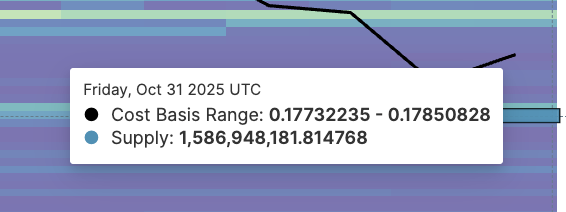
First Cluster Protecting The FloorFirst Cluster Protecting The Floor: Glassnode

This range represents the heaviest long-term holder supply, acting as a key buffer during past sell-offs.

Want more token insights like this? Sign up for Editor Harsh Notariya’s Daily Crypto Newsletter here.

The cost basis heatmap shows where most investors last bought their tokens. It highlights the price zones with heavy long-term holder concentration that act as support or resistance.
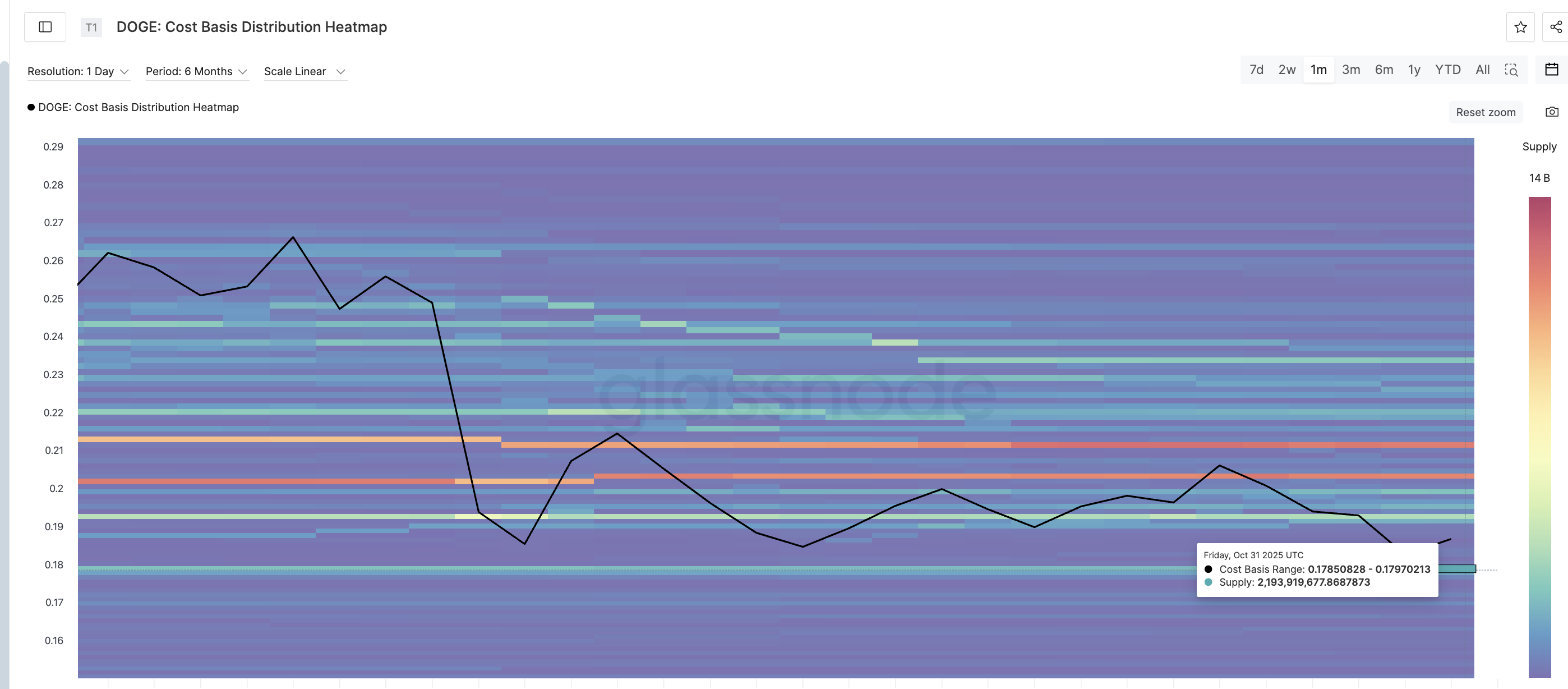
Bigger Dogecoin Support ClusterBigger Dogecoin Support Cluster: Glassnode

That buffer is weakening fast. According to Glassnode, Hodler Net Position Change — which tracks whether long-term wallets are adding or selling — flipped sharply negative on October 31. It dropped from an inflow of +8.2 million DOGE to an outflow of –22 million DOGE in just 24 hours. That’s a 367% reversal in holder behavior.
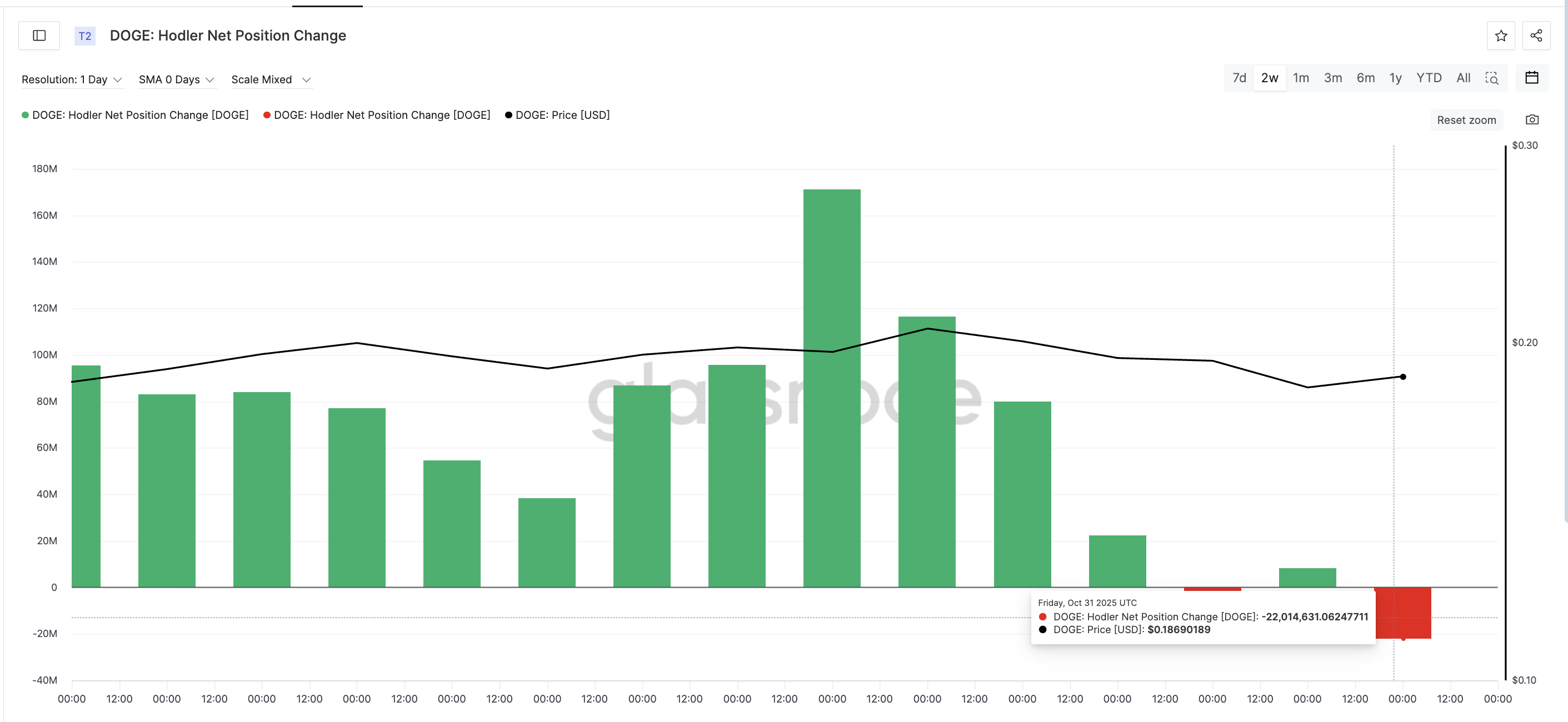
Long-Term DOGE Holders Keep SellingLong-Term DOGE Holders Keep Selling: Glassnode

This swing confirms that even older wallets are offloading their holdings. If this continues, it could thin out the $0.177–$0.179 cluster and expose Dogecoin’s strongest base since early October to further downside risk.

Below $0.17, the next significant cost-basis cluster doesn’t appear until $0.14, leaving a wide gap for potential losses. But more on that in the next section.

Looming Death Cross Could Accelerate the DOGE Price Breakdown

The DOGE price structure now reinforces the bearish on-chain story. After the 50-day exponential moving average (EMA) crossed below the 200-day EMA in late October, Dogecoin extended its decline — marking the first leg of its current downtrend. The EMA is a trend indicator that smooths out price data to show market direction.

Now, a second, stronger death cross is forming as the 100-day EMA approaches a drop below the 200-day EMA. Unlike the earlier crossover, this one carries more weight because both averages represent longer timeframes, reflecting sustained weakness rather than short-term volatility.

If this crossover confirms, it would signal deepening downside momentum and strengthen the bearish structure already in place. In that case, Dogecoin’s strongest support zone near $0.17, highlighted by its cost basis heatmap, could finally give way — opening the door to a fall toward $0.14. That would be a near 6% dip.
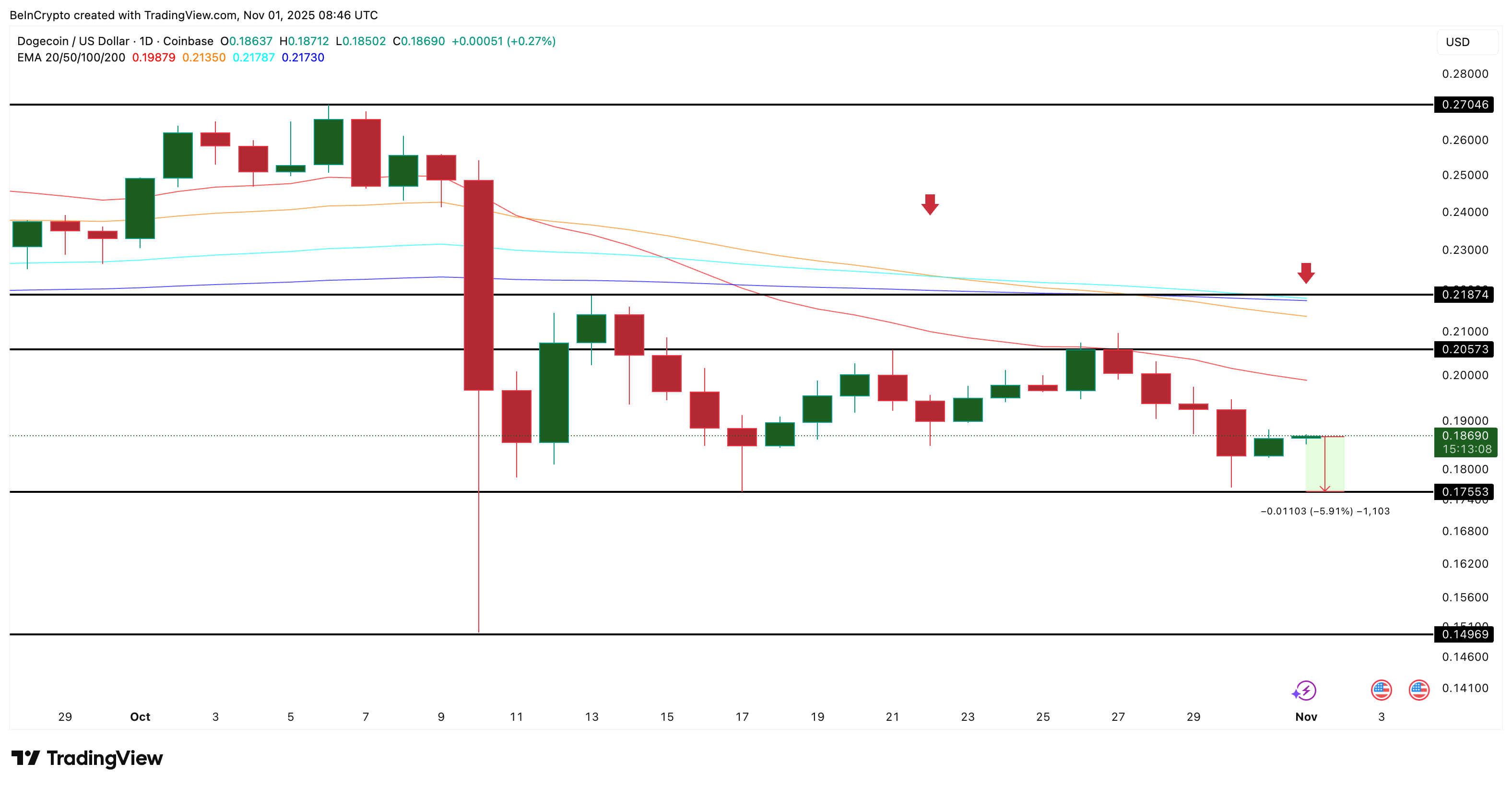
DOGE Price AnalysisDOGE Price Analysis: TradingView

Currently, DOGE trades near $0.18, capped by immediate resistances at $0.20 and $0.21. A daily close above $0.21, which hasn’t been tested since October 13, would be needed to invalidate this bearish bias.

Market Opportunity
DOGE Logo
DOGE Price(DOGE)
$0.13753
$0.13753$0.13753
-0.70%
USD
DOGE (DOGE) Live Price Chart
Disclaimer: The articles reposted on this site are sourced from public platforms and are provided for informational purposes only. They do not necessarily reflect the views of MEXC. All rights remain with the original authors. If you believe any content infringes on third-party rights, please contact service@support.mexc.com for removal. MEXC makes no guarantees regarding the accuracy, completeness, or timeliness of the content and is not responsible for any actions taken based on the information provided. The content does not constitute financial, legal, or other professional advice, nor should it be considered a recommendation or endorsement by MEXC.

You May Also Like

Washington Faces New Dilemma Over Venezuela’s Alleged BTC Reserves

Washington Faces New Dilemma Over Venezuela’s Alleged BTC Reserves

The issue surfaced after the dramatic removal of Venezuela’s longtime leader, Nicolás Maduro, who was captured by U.S. forces and […] The post Washington Faces
Share
Coindoo2026/01/13 10:14
We’re not being as forward-looking as normal

We’re not being as forward-looking as normal

The post We’re not being as forward-looking as normal appeared on BitcoinEthereumNews.com. Bank of Canada (BoC) Governor Tiff Macklem addressed reporters’ questions, offering insights into the central bank’s monetary policy outlook. His remarks came after the BoC lowered its interest rate by 25 basis points to 2.50%, a move that markets had broadly anticipated. BoC press conference key highlights Wage growth continued to ease. The preferred core inflation measures have been around 3.0%. Underlying inflation is running around 2.5%. Consensus to cut rates was clear. Attention now shifts to how exports perform. There are still some mixed signals on inflation. The Inflation picture hasn’t changed much since January. We’re not being as forward-looking as normal. The Bank of Canada considered holding the overnight rate steady. I have more comfort looking at the upward pressure on CPI. We will be assessing the impact of government announcements on targeted support and support for big projects. Inflationary pressures look somewhat more contained. If risks tilt further we are prepared to take more action. Will take it one meeting at a time. This section below was published at 13:45 GMT to cover the Bank of Canada’s policy announcements and the initial market reaction. In line with market analysts’ expectations, the Bank of Canada (BoC) trimmed its policy rate by 25 basis points, taking it to 2.50% on Wednesday. Investors’ attention will now shift to the usual press conference by Governor Tiff Macklem at 14:30 GMT. BoC policy statement key highlights Rate cut was appropriate given the weaker economy and less upside risk to inflation. On a monthly basis, upward momentum in core inflation seen earlier this year has dissipated. Disruption linked to trade shifts will continue to add costs even as they weigh on economic uncertainties. BoC says it will continue to support economic growth while ensuring inflation remains well controlled. Ottawa’s decision to scrap tariffs…
Share
BitcoinEthereumNews2025/09/18 05:17
US Senate Prepares For Crypto Market Structure Bill Markup This Week — Here’s What to Expect

US Senate Prepares For Crypto Market Structure Bill Markup This Week — Here’s What to Expect

After months of intense negotiations involving both political parties, as well as representatives from the crypto industry and traditional banking sectors, the
Share
Bitcoinist2026/01/13 10:00

