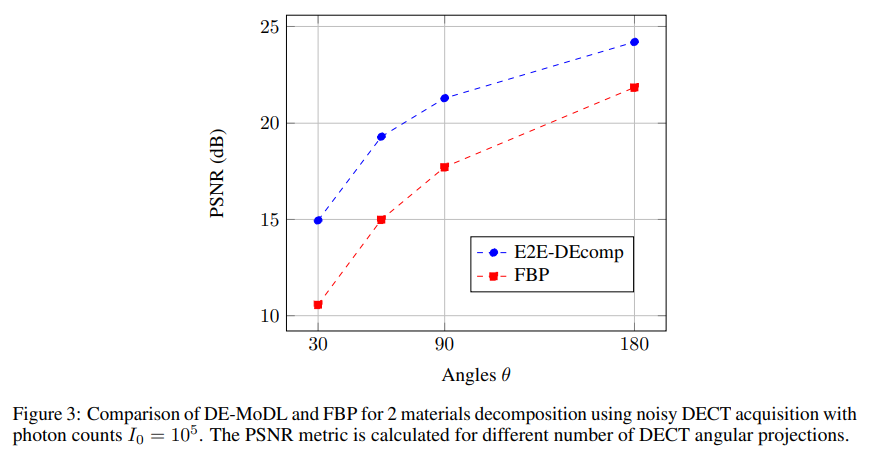
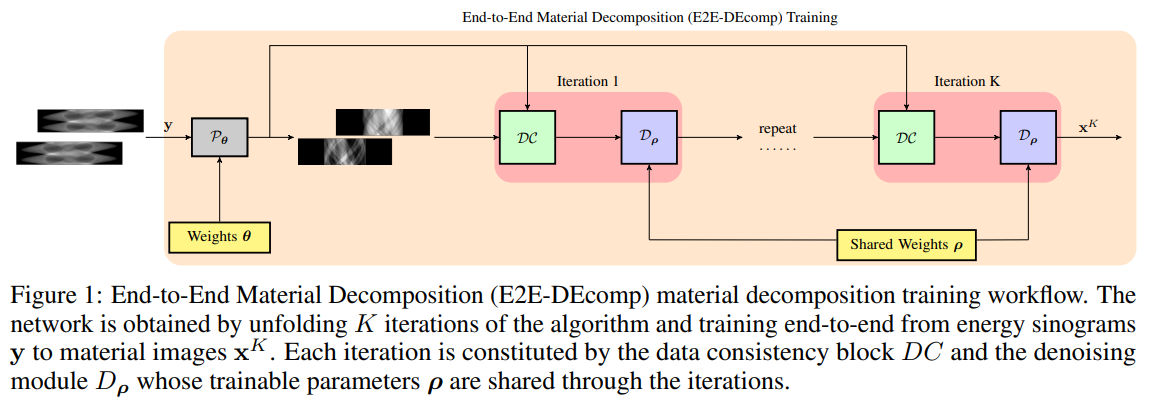
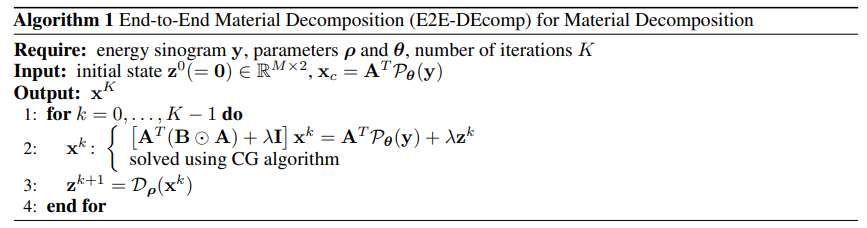
The workflow of the E2E-DEcomp algorithm at inference is shown in Fig. 1, and the structure of E2EDEcomp algorithm for inference is reported in Table 1. In Fig. 2 it is shown the qualitative comparison on a test material image of the adipose tissue using filtered back projection (FBP) and E2 E-DE Comp. Infig. 3 is is reported the PSNR error for a set of 10 testing images for the 2 material decomposition.The workflow of the E2E-DEcomp algorithm at inference is shown in Fig. 1, and the structure of E2EDEcomp algorithm for inference is reported in Table 1. In Fig. 2 it is shown the qualitative comparison on a test material image of the adipose tissue using filtered back projection (FBP) and E2 E-DE Comp. Infig. 3 is is reported the PSNR error for a set of 10 testing images for the 2 material decomposition.

End-to-End Deep Learning Improves CT Material Decomposition

2025/10/01 20:00

Abstract and 1 Introduction

  1. Dual-Energy CT Forward Model
  2. [Model-based Optimization Problem]()
  3. End-to-End Model-based Deep Learning for Material Decomposition (E2E-Decomp)
  4. Numerical Results
  5. Conclusion
  6. Compliance with Ethical Standards and References

4 End-to-End Model-based Deep Learning for Material Decomposition (E2E-Decomp)
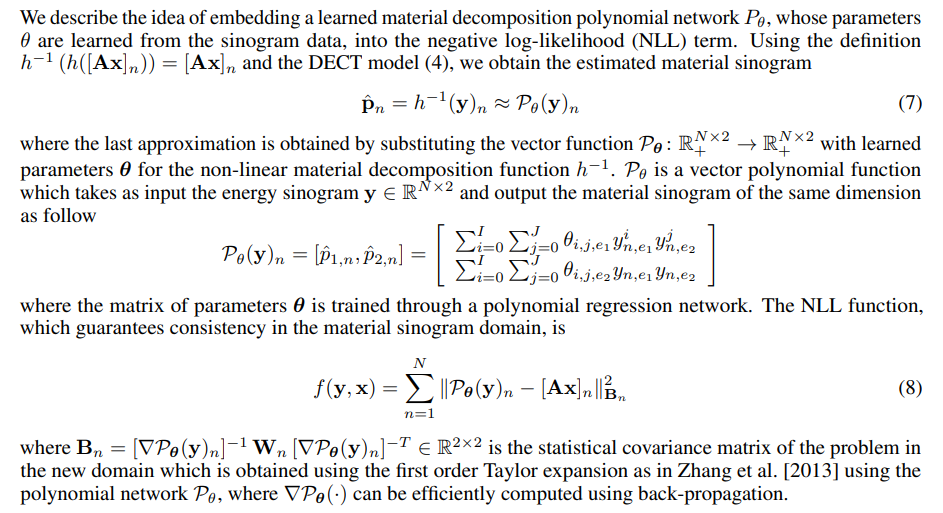
\
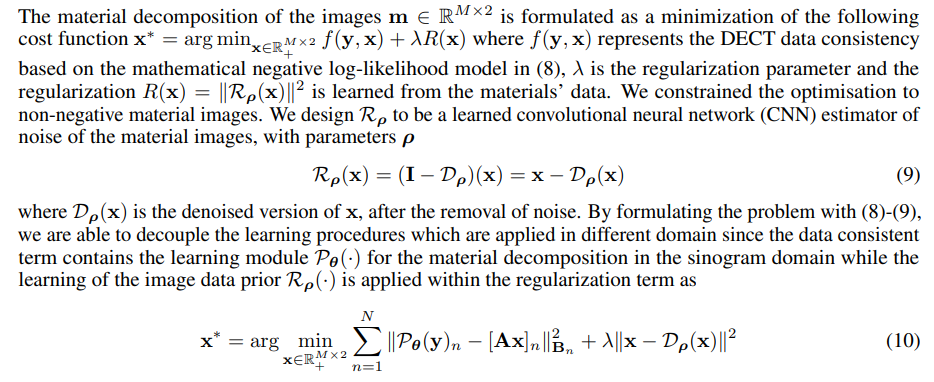
\
\
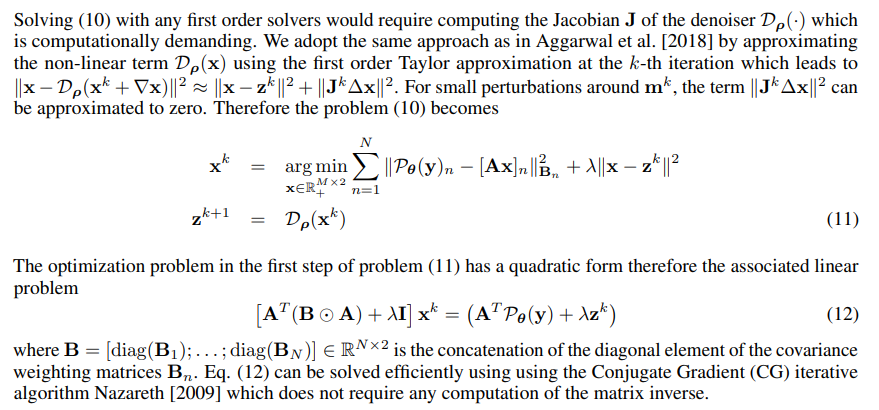
\ The workflow of the E2E-DEcomp algorithm at inference is shown in Fig. 1, and the structure of the E2EDEcomp algorithm for inference is reported in Table 1.

\
5 Numerical Results

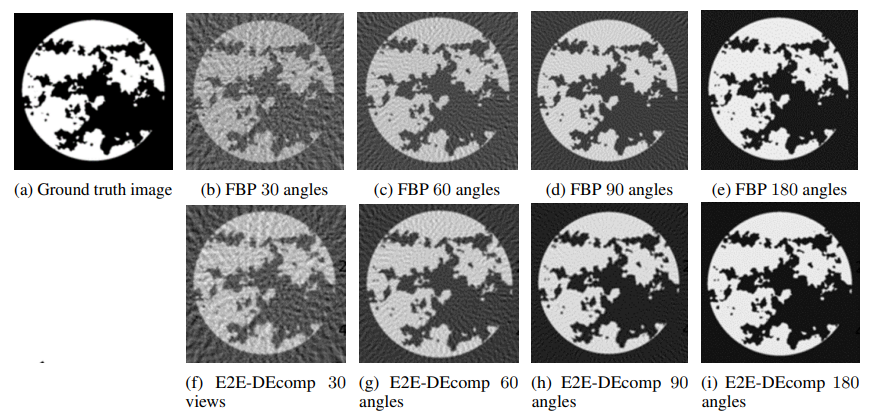
\ In order to reduce the number of learnable parameters we utilise the same architecture for the denoising module D at each iteration k with shared parameters ρ. In Fig. 2 it is shown the qualitative comparison on a test material image of the adipose tissue using filtered back projection (FBP) and E2E-DEcomp while in Fig. 3 is is reported the PSNR error for a set of 10 testing images for the 2 material decomposition.

\ Figure 2: Qualitative comparison between the material decomposition for adipose using E2E-DEcomp and FBP using different number of angular projections.
\

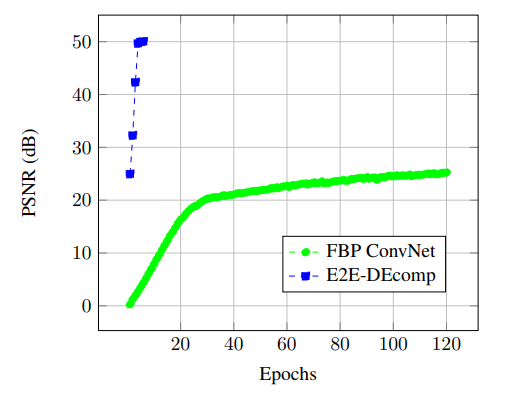
\ It is worth noting that the improvement in the decomposition accuracy are consistent, around 5 dB, across different levels of dose, i.e. from sparse views to higher number of projections. We have also compared the E2E-DEcomp framework with the FBP ConvNet method Jin et al. [2017] and Fig. 4 shows how E2E-DEcomp can achieve a faster convergence in training using fewer epochs.

6 Conclusion

This work proposed a direct method for DECT material decomposition using a model-based optimization able to decouple the learning in the measurement and image domain. Numerical results show the effectiveness

\ Figure 4: Comparison of the PSNR training error between the FBP ConvNet and the E2E-DEcomp algorithms.
\ of the proposed E2E-DEcomp compared to other supervised approaches since it has fast convergence and excellent performance on low-dose DECT which can lead to further study with clinical dataset.

\

7 Compliance with Ethical Standards

This is a numerical simulation study for which no ethical approval was required.

References

Hemant K Aggarwal, Merry P Mani, and Mathews Jacob. Modl: Model-based deep learning architecture for inverse problems. IEEE transactions on medical imaging, 38(2):394–405, 2018.

\ Robert E Alvarez and Albert Macovski. Energy-selective reconstructions in x-ray computerised tomography. Physics in Medicine & Biology, 21(5):733, 1976.

\ Caifang Cai, Thomas Rodet, Samuel Legoupil, and Ali Mohammad-Djafari. A full-spectral bayesian reconstruction approach based on the material decomposition model applied in dual-energy computed tomography. Medical physics, 40(11):111916, 2013.

\ A. Eguizabal, O. Öktem, and M. Persson. A deep learning one-step solution to material image reconstruction in photon counting spectral CT. In Wei Zhao and Lifeng Yu, editors, Medical Imaging 2022: Physics of Medical Imaging, volume 12031, page 120310Y. International Society for Optics and Photonics, 2022. doi:10.1117/12.2612426.

\ W. Fang, D. Wu, K. Kim, M.K. Kalra, R. Singh, L. Li, and Q. Li. Iterative material decomposition for spectral CT using self-supervised Noise2Noise prior. Phys Med Biol, 66(15):155013, July 2021. doi:10.1088/1361- 6560/ac0afd.

\ Kyong Hwan Jin, Michael T McCann, Emmanuel Froustey, and Michael Unser. Deep convolutional neural network for inverse problems in imaging. IEEE transactions on image processing, 26(9):4509–4522, 2017.

\ Thorsten RC Johnson, Bernhard Krauss, Martin Sedlmair, Michael Grasruck, Herbert Bruder, Dominik Morhard, Christian Fink, Sabine Weckbach, Miriam Lenhard, Bernhard Schmidt, et al. Material differentiation by dual energy ct: initial experience. European radiology, 17:1510–1517, 2007.

\ Yong Long and Jeffrey A Fessler. Multi-material decomposition using statistical image reconstruction for spectral ct. IEEE transactions on medical imaging, 33(8):1614–1626, 2014.

\ Clemens Maaß, Matthias Baer, and Marc Kachelrieß. Image-based dual energy ct using optimized precorrection functions: A practical new approach of material decomposition in image domain. Medical physics, 36(8): 3818–3829, 2009.

\ Korbinian Mechlem, Thorsten Sellerer, Sebastian Ehn, Daniela Münzel, Eva Braig, Julia Herzen, Peter B Noël, and Franz Pfeiffer. Spectral angiography material decomposition using an empirical forward model and a dictionary-based regularization. IEEE transactions on medical imaging, 37(10):2298–2309, 2018.

\ Paulo RS Mendonça, Peter Lamb, and Dushyant V Sahani. A flexible method for multi-material decomposition of dual-energy ct images. IEEE transactions on medical imaging, 33(1):99–116, 2013.

\ Rohan Nadkarni, Alex Allphin, Darin P Clark, and Cristian T Badea. Material decomposition from photoncounting ct using a convolutional neural network and energy-integrating ct training labels. Physics in Medicine & Biology, 67(15):155003, 2022.

\ John L Nazareth. Conjugate gradient method. Wiley Interdisciplinary Reviews: Computational Statistics, 1(3): 348–353, 2009.

\ A. Perelli and M.S. Andersen. Regularization by denoising sub-sampled newton method for spectral CT multi-material decomposition. Philosophical Transactions of the Royal Society A: Mathematical, Physical and Engineering Sciences, 379(2200):20200191, 2021. doi:10.1098/rsta.2020.0191.

\ Zaifeng Shi, Huilong Li, Qingjie Cao, Zhongqi Wang, and Ming Cheng. A material decomposition method for dual-energy ct via dual interactive wasserstein generative adversarial networks. Medical Physics, 48(6): 2891–2905, 2021.

\ Emil Y Sidky and Xiaochuan Pan. Report on the AAPM deep-learning spectral CT grand challenge. Medical Physics, 2023.

\ Wim Van Aarle, Willem Jan Palenstijn, Jeroen Cant, Eline Janssens, Folkert Bleichrodt, Andrei Dabravolski, Jan De Beenhouwer, K Joost Batenburg, and Jan Sijbers. Fast and flexible x-ray tomography using the astra toolbox. Optics express, 24(22):25129–25147, 2016.

\ Ruoqiao Zhang, Jean-Baptiste Thibault, Charles A Bouman, Ken D Sauer, and Jiang Hsieh. Model-based iterative reconstruction for dual-energy x-ray ct using a joint quadratic likelihood model. IEEE transactions on medical imaging, 33(1):117–134, 2013.

\

:::info Authors:

(1) Jiandong Wang, Shenzhen Xilaiheng Medical Electronics, (HORRON), China and Centre for Medical Engineering and Technology, University of Dundee, DD1 4HN, UK (jack@horron.com);

(2) Alessandro Perelli, Centre for Medical Engineering and Technology, University of Dundee, DD1 4HN, UK (aperelli001@dundee.ac.uk).

:::


:::info This paper is available on arxiv under CC BY 4.0 DEED license.

:::

\

Disclaimer: The articles reposted on this site are sourced from public platforms and are provided for informational purposes only. They do not necessarily reflect the views of MEXC. All rights remain with the original authors. If you believe any content infringes on third-party rights, please contact service@support.mexc.com for removal. MEXC makes no guarantees regarding the accuracy, completeness, or timeliness of the content and is not responsible for any actions taken based on the information provided. The content does not constitute financial, legal, or other professional advice, nor should it be considered a recommendation or endorsement by MEXC.

You May Also Like

SEC urges caution on crypto wallets in latest investor guide

SEC urges caution on crypto wallets in latest investor guide

The SEC’s Office of Investor Education and Assistance issued a bulletin warning retail investors about crypto asset custody risks. The guidance covers how investors
Share
Crypto.news2025/12/15 01:45
Crucial Fed Rate Cut: October Probability Surges to 94%

Crucial Fed Rate Cut: October Probability Surges to 94%

BitcoinWorld Crucial Fed Rate Cut: October Probability Surges to 94% The financial world is buzzing with a significant development: the probability of a Fed rate cut in October has just seen a dramatic increase. This isn’t just a minor shift; it’s a monumental change that could ripple through global markets, including the dynamic cryptocurrency space. For anyone tracking economic indicators and their impact on investments, this update from the U.S. interest rate futures market is absolutely crucial. What Just Happened? Unpacking the FOMC Statement’s Impact Following the latest Federal Open Market Committee (FOMC) statement, market sentiment has decisively shifted. Before the announcement, the U.S. interest rate futures market had priced in a 71.6% chance of an October rate cut. However, after the statement, this figure surged to an astounding 94%. This jump indicates that traders and analysts are now overwhelmingly confident that the Federal Reserve will lower interest rates next month. Such a high probability suggests a strong consensus emerging from the Fed’s latest communications and economic outlook. A Fed rate cut typically means cheaper borrowing costs for businesses and consumers, which can stimulate economic activity. But what does this really signify for investors, especially those in the digital asset realm? Why is a Fed Rate Cut So Significant for Markets? When the Federal Reserve adjusts interest rates, it sends powerful signals across the entire financial ecosystem. A rate cut generally implies a more accommodative monetary policy, often enacted to boost economic growth or combat deflationary pressures. Impact on Traditional Markets: Stocks: Lower interest rates can make borrowing cheaper for companies, potentially boosting earnings and making stocks more attractive compared to bonds. Bonds: Existing bonds with higher yields might become more valuable, but new bonds will likely offer lower returns. Dollar Strength: A rate cut can weaken the U.S. dollar, making exports cheaper and potentially benefiting multinational corporations. Potential for Cryptocurrency Markets: The cryptocurrency market, while often seen as uncorrelated, can still react significantly to macro-economic shifts. A Fed rate cut could be interpreted as: Increased Risk Appetite: With traditional investments offering lower returns, investors might seek higher-yielding or more volatile assets like cryptocurrencies. Inflation Hedge Narrative: If rate cuts are perceived as a precursor to inflation, assets like Bitcoin, often dubbed “digital gold,” could gain traction as an inflation hedge. Liquidity Influx: A more accommodative monetary environment generally means more liquidity in the financial system, some of which could flow into digital assets. Looking Ahead: What Could This Mean for Your Portfolio? While the 94% probability for a Fed rate cut in October is compelling, it’s essential to consider the nuances. Market probabilities can shift, and the Fed’s ultimate decision will depend on incoming economic data. Actionable Insights: Stay Informed: Continue to monitor economic reports, inflation data, and future Fed statements. Diversify: A diversified portfolio can help mitigate risks associated with sudden market shifts. Assess Risk Tolerance: Understand how a potential rate cut might affect your specific investments and adjust your strategy accordingly. This increased likelihood of a Fed rate cut presents both opportunities and challenges. It underscores the interconnectedness of traditional finance and the emerging digital asset space. Investors should remain vigilant and prepared for potential volatility. The financial landscape is always evolving, and the significant surge in the probability of an October Fed rate cut is a clear signal of impending change. From stimulating economic growth to potentially fueling interest in digital assets, the implications are vast. Staying informed and strategically positioned will be key as we approach this crucial decision point. The market is now almost certain of a rate cut, and understanding its potential ripple effects is paramount for every investor. Frequently Asked Questions (FAQs) Q1: What is the Federal Open Market Committee (FOMC)? A1: The FOMC is the monetary policymaking body of the Federal Reserve System. It sets the federal funds rate, which influences other interest rates and economic conditions. Q2: How does a Fed rate cut impact the U.S. dollar? A2: A rate cut typically makes the U.S. dollar less attractive to foreign investors seeking higher returns, potentially leading to a weakening of the dollar against other currencies. Q3: Why might a Fed rate cut be good for cryptocurrency? A3: Lower interest rates can reduce the appeal of traditional investments, encouraging investors to seek higher returns in alternative assets like cryptocurrencies. It can also be seen as a sign of increased liquidity or potential inflation, benefiting assets like Bitcoin. Q4: Is a 94% probability a guarantee of a rate cut? A4: While a 94% probability is very high, it is not a guarantee. Market probabilities reflect current sentiment and data, but the Federal Reserve’s final decision will depend on all available economic information leading up to their meeting. Q5: What should investors do in response to this news? A5: Investors should stay informed about economic developments, review their portfolio diversification, and assess their risk tolerance. Consider how potential changes in interest rates might affect different asset classes and adjust strategies as needed. Did you find this analysis helpful? Share this article with your network to keep others informed about the potential impact of the upcoming Fed rate cut and its implications for the financial markets! To learn more about the latest crypto market trends, explore our article on key developments shaping Bitcoin price action. This post Crucial Fed Rate Cut: October Probability Surges to 94% first appeared on BitcoinWorld.
Share
Coinstats2025/09/18 02:25
Bitcoin’s Battle with Market Pressures Sparks Concerns

Bitcoin’s Battle with Market Pressures Sparks Concerns

Throughout the weekend, Bitcoin exhibited a degree of stability. Yet, it is once again challenging the critical support level of $88,000.Continue Reading:Bitcoin
Share
Coinstats2025/12/15 01:35