The asset's price has fallen by nearly 50% from its local peak.The asset's price has fallen by nearly 50% from its local peak.

Internet Computer (ICP) Tanks 32% Weekly: Time to Panic or Time to Accumulate?

2025/11/17 21:36

Internet Computer (ICP) experienced a strong rally earlier this month, but the bears have recently regained control.

Over the past week, the asset’s price has collapsed by approximately 32%, raising the question of whether this is a perfect buying opportunity or the beginning of a more significant crash.

What’s Next?

ICP stole the show at the start of the month, with its valuation exploding to almost $9.50 on November 8, the highest mark witnessed since January this year. Its market capitalization briefly exceeded $5 billion, and it seemed like a further pump was on the way.

However, the major correction of the broader cryptocurrency market poured cold water on those expectations. ICP is among the biggest losers in the past week, tumbling by more than 30% and currently trading at less than $5.
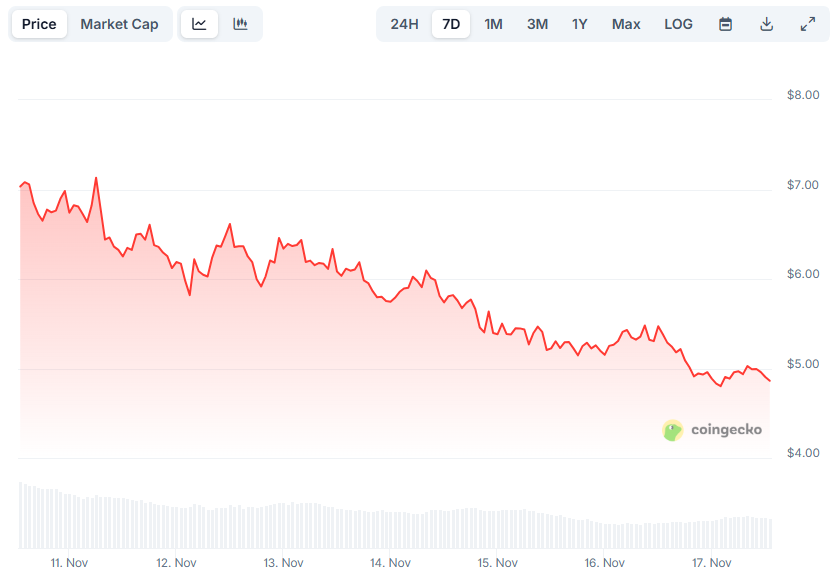
ICP PriceICP Price, Source: CoinGecko

Despite the retreat, many analysts believe the token has not yet said its final word for this cycle. X user WIZZ told their more than 800,000 followers that ICP is approaching a bounce area, predicting that the next push could stretch to as high as $20.

Rushi was even more optimistic. The analyst claimed that a potential price explosion for Bitcoin (BTC) to $220,000 in the next 45 days might trigger an overall altcoin resurgence, with ICP “going straight” for $100.

It is important to note that the primary cryptocurrency has seen better days, and reaching that level seems unlikely (at least for now). As of this writing, BTC trades at just over $95,000, representing a 10% decline over the past week.

This Metric Flashes the Buy Signal

According to ICP’s Relative Strength Index (RSI), the valuation could indeed rebound in the short term. The technical analysis tool measures the speed and magnitude of recent price changes to estimate whether the asset is about to undergo a reversal.

It ranges from 0 to 100, and ratios around 30 signal that the token is oversold, indicating a potential surge may be incoming. On the other hand, anything above 70 is seen as bearish territory. ICP’s RSI plummeted below 30 a few hours ago, while currently it is set just north of that mark.

ICP RSIICP RSI, Source: CryptoWaves

The post Internet Computer (ICP) Tanks 32% Weekly: Time to Panic or Time to Accumulate? appeared first on CryptoPotato.

Disclaimer: The articles reposted on this site are sourced from public platforms and are provided for informational purposes only. They do not necessarily reflect the views of MEXC. All rights remain with the original authors. If you believe any content infringes on third-party rights, please contact service@support.mexc.com for removal. MEXC makes no guarantees regarding the accuracy, completeness, or timeliness of the content and is not responsible for any actions taken based on the information provided. The content does not constitute financial, legal, or other professional advice, nor should it be considered a recommendation or endorsement by MEXC.

You May Also Like

Aave DAO to Shut Down 50% of L2s While Doubling Down on GHO

Aave DAO to Shut Down 50% of L2s While Doubling Down on GHO

The post Aave DAO to Shut Down 50% of L2s While Doubling Down on GHO appeared on BitcoinEthereumNews.com. Aave DAO is gearing up for a significant overhaul by shutting down over 50% of underperforming L2 instances. It is also restructuring its governance framework and deploying over $100 million to boost GHO. This could be a pivotal moment that propels Aave back to the forefront of on-chain lending or sparks unprecedented controversy within the DeFi community. Sponsored Sponsored ACI Proposes Shutting Down 50% of L2s The “State of the Union” report by the Aave Chan Initiative (ACI) paints a candid picture. After a turbulent period in the DeFi market and internal challenges, Aave (AAVE) now leads in key metrics: TVL, revenue, market share, and borrowing volume. Aave’s annual revenue of $130 million surpasses the combined cash reserves of its competitors. Tokenomics improvements and the AAVE token buyback program have also contributed to the ecosystem’s growth. Aave global metrics. Source: Aave However, the ACI’s report also highlights several pain points. First, regarding the Layer-2 (L2) strategy. While Aave’s L2 strategy was once a key driver of success, it is no longer fit for purpose. Over half of Aave’s instances on L2s and alt-L1s are not economically viable. Based on year-to-date data, over 86.6% of Aave’s revenue comes from the mainnet, indicating that everything else is a side quest. On this basis, ACI proposes closing underperforming networks. The DAO should invest in key networks with significant differentiators. Second, ACI is pushing for a complete overhaul of the “friendly fork” framework, as most have been unimpressive regarding TVL and revenue. In some cases, attackers have exploited them to Aave’s detriment, as seen with Spark. Sponsored Sponsored “The friendly fork model had a good intention but bad execution where the DAO was too friendly towards these forks, allowing the DAO only little upside,” the report states. Third, the instance model, once a smart…
Share
BitcoinEthereumNews2025/09/18 02:28
Shytoshi Kusama Addresses $2.4 Million Shibarium Bridge Exploit

Shytoshi Kusama Addresses $2.4 Million Shibarium Bridge Exploit

The post Shytoshi Kusama Addresses $2.4 Million Shibarium Bridge Exploit appeared on BitcoinEthereumNews.com. The lead developer of Shiba Inu, Shytoshi Kusama, has publicly addressed the Shibarium bridge exploit that occurred recently, draining $2.4 million from the network. After days of speculation about his involvement in managing the crisis, the project leader broke his silence. Kusama emphasized that a special “war room” has been set up to restore stolen finances and enhance network security. The statement is his first official words since the bridge compromise occurred. “Although I am focusing on AI initiatives to benefit all our tokens, I remain with the developers and leadership in the war room,” Kusama posted on social media platform X. He dismissed claims that he had distanced himself from the project as “utterly preposterous.” The developer said that the reason behind his silence at first was strategic. Before he could make any statements publicly, he must have taken time to evaluate what he termed a complex and deep situation properly. Kusama also vowed to provide further updates in the official Shiba Inu channels as the team comes up with long-term solutions. As highlighted in our previous article, targeted Shibarium’s bridge infrastructure through a sophisticated attack vector. Hackers gained unauthorized access to validator signing keys, compromising the network’s security framework. The hackers executed a flash loan to acquire 4.6 million BONE ShibaSwap tokens. The validator power on the network was majority held by them after this purchase. They were able to transfer assets out of Shibarium with this control. The response of Shibarium developers was timely to limit the breach. They instantly halted all validator functions in order to avoid additional exploitation. The team proceeded to deposit the assets under staking in a multisig hardware wallet that is secure. External security companies were involved in the investigation effort. Hexens, Seal 911, and PeckShield are collaborating with internal developers to…
Share
BitcoinEthereumNews2025/09/18 03:46
