A New York bankruptcy court has granted provisional relief to Singapore-based liquidators overseeing the collapse of Multichain Foundation Ltd., directing stablecoin issuer Circle to keep wallets holding millions of dollars in stolen USD Coin (USDC) frozen. Judge David S. Jones of the U.S. Bankruptcy Court for the Southern District of New York issued the order on Thursday, extending the freeze on three Ethereum wallets tied to the July 2023 Multichain hack. The ruling requires Circle to maintain the addresses on its blacklist, effectively blocking any movement of the roughly $63 million in stolen USDC until further notice. The court’s decision marks a major step in the cross-border effort to recover assets drained from Multichain’s cross-chain bridge protocol, which lost more than $210 million in one of 2023’s largest DeFi exploits. Inside the Multichain Case: How Liquidators Win by Freezing USDC The order, issued under Section 1519 of the U.S. Bankruptcy Code, allows temporary relief before a foreign case receives formal recognition under Chapter 15, the framework that governs cooperation between U.S. courts and foreign insolvency proceedings.Source: Cornell Law School Liquidators appointed in Singapore, from KPMG Services Pte. Ltd., filed for provisional relief on October 23, arguing that lifting Circle’s freeze could cause “immediate and irreparable harm” by allowing stolen assets to move beyond recovery. The request sought to preserve the funds until the U.S. court determines whether to recognize the Singapore case as a “foreign main proceeding,” a designation that would allow the liquidators to pursue recovery efforts across jurisdictions. Circle, which issues the U.S. dollar–pegged USDC stablecoin, typically enforces freezes by blacklisting addresses directly through the token’s smart contract, a feature that blocks any transfers involving those wallets. The company first froze the three hacker-linked addresses in October 2023 at the direction of the U.S. Department of Justice (DOJ), which obtained a seizure warrant shortly after the exploit. The DOJ later lifted the warrant after failing to identify the hackers, leaving Circle without a legal basis to keep the wallets locked. The latest order restores that authority. According to the court filing, the freeze is necessary to prevent competing claims over the same funds. A group of U.S. investors had filed a separate class action lawsuit against Circle in New York State court, seeking control of the stolen USDC. That case has now been paused following the federal court’s ruling. Circle moved the matter to the Southern District of New York under the Class Action Fairness Act, which allows large, multi-jurisdictional class actions to be heard in federal court. After the $125M Hack, Multichain Faces Its Final Chapter in Court The Multichain collapse, one of the most high-profile failures in the decentralized finance sector, stemmed from an exploit discovered in July 2023. Unidentified attackers drained over $125 million from Multichain’s bridge contracts on Fantom, Moonriver, and Dogechain, transferring funds to unknown addresses. Multichain, formerly known as Anyswap, operated as one of the largest cross-chain bridge protocols, allowing users to move assets across blockchains like Ethereum, BNB Chain, Avalanche, and Polygon. The platform had a total value locked of about $9.2 billion in early 2022, according to data from DeFiLlama, before its troubles began in mid-2023. Reports later surfaced that the company’s CEO, known as Zhaojun, had been detained in China, leaving the project in disarray. Following the hack, affected projects, including the Fantom Foundation, launched legal actions in Singapore. In March 2024, the High Court of Singapore issued a default judgment in Fantom’s favor, finding that Multichain had breached contractual obligations. By May 2025, the same court approved a winding-up order against Multichain Foundation Ltd., appointing KPMG’s Bob Yap Cheng Ghee, Toh Ai Ling, and Tan Yen Chiaw as joint liquidators to oversee asset recovery and dissolution. The frozen $63 million in USDC represents a portion of the total $210 million stolen from Multichain. The liquidators are seeking to recover these assets as part of the broader winding-up process. In their U.S. filing, they described the New York court’s provisional relief as “an effective mechanism to implement Chapter 15’s policies of promoting cooperation between courts of the United States and foreign courts involved in cross-border restructuring cases.”A New York bankruptcy court has granted provisional relief to Singapore-based liquidators overseeing the collapse of Multichain Foundation Ltd., directing stablecoin issuer Circle to keep wallets holding millions of dollars in stolen USD Coin (USDC) frozen. Judge David S. Jones of the U.S. Bankruptcy Court for the Southern District of New York issued the order on Thursday, extending the freeze on three Ethereum wallets tied to the July 2023 Multichain hack. The ruling requires Circle to maintain the addresses on its blacklist, effectively blocking any movement of the roughly $63 million in stolen USDC until further notice. The court’s decision marks a major step in the cross-border effort to recover assets drained from Multichain’s cross-chain bridge protocol, which lost more than $210 million in one of 2023’s largest DeFi exploits. Inside the Multichain Case: How Liquidators Win by Freezing USDC The order, issued under Section 1519 of the U.S. Bankruptcy Code, allows temporary relief before a foreign case receives formal recognition under Chapter 15, the framework that governs cooperation between U.S. courts and foreign insolvency proceedings.Source: Cornell Law School Liquidators appointed in Singapore, from KPMG Services Pte. Ltd., filed for provisional relief on October 23, arguing that lifting Circle’s freeze could cause “immediate and irreparable harm” by allowing stolen assets to move beyond recovery. The request sought to preserve the funds until the U.S. court determines whether to recognize the Singapore case as a “foreign main proceeding,” a designation that would allow the liquidators to pursue recovery efforts across jurisdictions. Circle, which issues the U.S. dollar–pegged USDC stablecoin, typically enforces freezes by blacklisting addresses directly through the token’s smart contract, a feature that blocks any transfers involving those wallets. The company first froze the three hacker-linked addresses in October 2023 at the direction of the U.S. Department of Justice (DOJ), which obtained a seizure warrant shortly after the exploit. The DOJ later lifted the warrant after failing to identify the hackers, leaving Circle without a legal basis to keep the wallets locked. The latest order restores that authority. According to the court filing, the freeze is necessary to prevent competing claims over the same funds. A group of U.S. investors had filed a separate class action lawsuit against Circle in New York State court, seeking control of the stolen USDC. That case has now been paused following the federal court’s ruling. Circle moved the matter to the Southern District of New York under the Class Action Fairness Act, which allows large, multi-jurisdictional class actions to be heard in federal court. After the $125M Hack, Multichain Faces Its Final Chapter in Court The Multichain collapse, one of the most high-profile failures in the decentralized finance sector, stemmed from an exploit discovered in July 2023. Unidentified attackers drained over $125 million from Multichain’s bridge contracts on Fantom, Moonriver, and Dogechain, transferring funds to unknown addresses. Multichain, formerly known as Anyswap, operated as one of the largest cross-chain bridge protocols, allowing users to move assets across blockchains like Ethereum, BNB Chain, Avalanche, and Polygon. The platform had a total value locked of about $9.2 billion in early 2022, according to data from DeFiLlama, before its troubles began in mid-2023. Reports later surfaced that the company’s CEO, known as Zhaojun, had been detained in China, leaving the project in disarray. Following the hack, affected projects, including the Fantom Foundation, launched legal actions in Singapore. In March 2024, the High Court of Singapore issued a default judgment in Fantom’s favor, finding that Multichain had breached contractual obligations. By May 2025, the same court approved a winding-up order against Multichain Foundation Ltd., appointing KPMG’s Bob Yap Cheng Ghee, Toh Ai Ling, and Tan Yen Chiaw as joint liquidators to oversee asset recovery and dissolution. The frozen $63 million in USDC represents a portion of the total $210 million stolen from Multichain. The liquidators are seeking to recover these assets as part of the broader winding-up process. In their U.S. filing, they described the New York court’s provisional relief as “an effective mechanism to implement Chapter 15’s policies of promoting cooperation between courts of the United States and foreign courts involved in cross-border restructuring cases.”

Multichain Liquidators Win Key Ruling as New York Court Extends Freeze on Stolen USDC

A New York bankruptcy court has granted provisional relief to Singapore-based liquidators overseeing the collapse of Multichain Foundation Ltd., directing stablecoin issuer Circle to keep wallets holding millions of dollars in stolen USD Coin (USDC) frozen.

Judge David S. Jones of the U.S. Bankruptcy Court for the Southern District of New York issued the order on Thursday, extending the freeze on three Ethereum wallets tied to the July 2023 Multichain hack.

The ruling requires Circle to maintain the addresses on its blacklist, effectively blocking any movement of the roughly $63 million in stolen USDC until further notice.

The court’s decision marks a major step in the cross-border effort to recover assets drained from Multichain’s cross-chain bridge protocol, which lost more than $210 million in one of 2023’s largest DeFi exploits.

Inside the Multichain Case: How Liquidators Win by Freezing USDC

The order, issued under Section 1519 of the U.S. Bankruptcy Code, allows temporary relief before a foreign case receives formal recognition under Chapter 15, the framework that governs cooperation between U.S. courts and foreign insolvency proceedings.
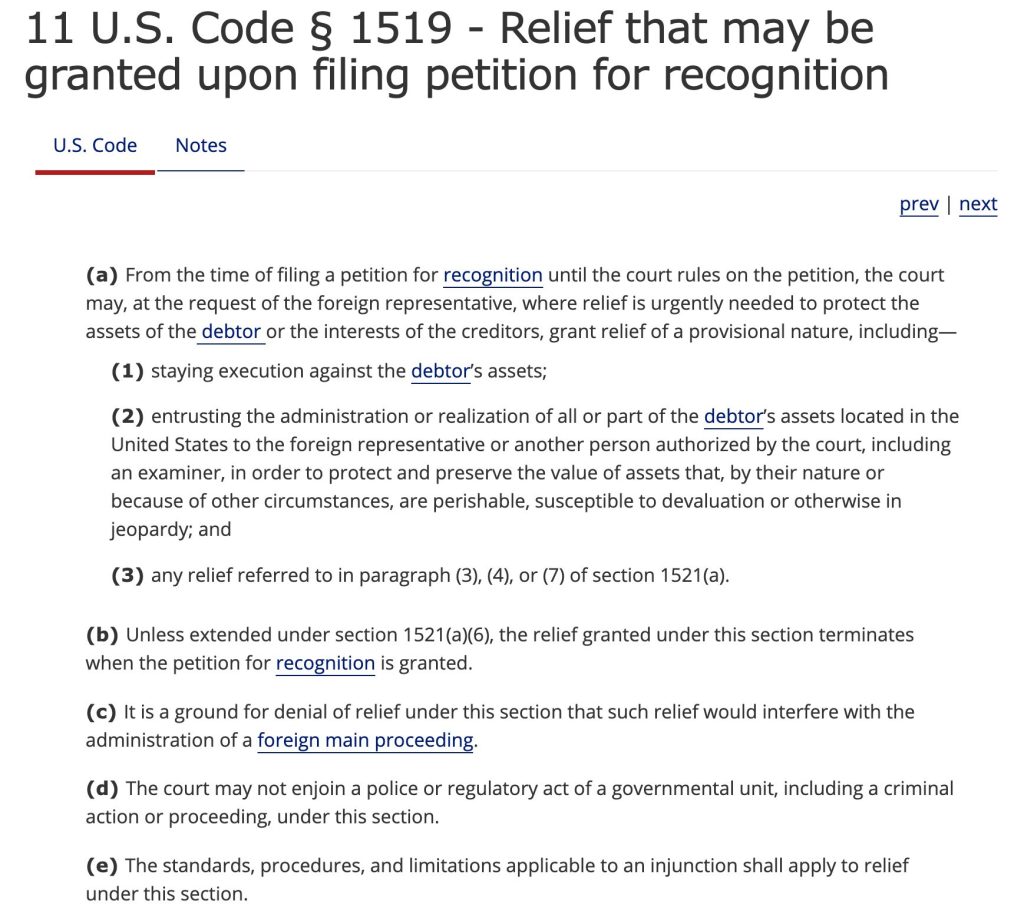
Source: Cornell Law School

Liquidators appointed in Singapore, from KPMG Services Pte. Ltd., filed for provisional relief on October 23, arguing that lifting Circle’s freeze could cause “immediate and irreparable harm” by allowing stolen assets to move beyond recovery.

The request sought to preserve the funds until the U.S. court determines whether to recognize the Singapore case as a “foreign main proceeding,” a designation that would allow the liquidators to pursue recovery efforts across jurisdictions.

Circle, which issues the U.S. dollar–pegged USDC stablecoin, typically enforces freezes by blacklisting addresses directly through the token’s smart contract, a feature that blocks any transfers involving those wallets.

The company first froze the three hacker-linked addresses in October 2023 at the direction of the U.S. Department of Justice (DOJ), which obtained a seizure warrant shortly after the exploit.

The DOJ later lifted the warrant after failing to identify the hackers, leaving Circle without a legal basis to keep the wallets locked. The latest order restores that authority.

According to the court filing, the freeze is necessary to prevent competing claims over the same funds. A group of U.S. investors had filed a separate class action lawsuit against Circle in New York State court, seeking control of the stolen USDC.

That case has now been paused following the federal court’s ruling. Circle moved the matter to the Southern District of New York under the Class Action Fairness Act, which allows large, multi-jurisdictional class actions to be heard in federal court.

After the $125M Hack, Multichain Faces Its Final Chapter in Court

The Multichain collapse, one of the most high-profile failures in the decentralized finance sector, stemmed from an exploit discovered in July 2023.

Unidentified attackers drained over $125 million from Multichain’s bridge contracts on Fantom, Moonriver, and Dogechain, transferring funds to unknown addresses.

Multichain, formerly known as Anyswap, operated as one of the largest cross-chain bridge protocols, allowing users to move assets across blockchains like Ethereum, BNB Chain, Avalanche, and Polygon.

The platform had a total value locked of about $9.2 billion in early 2022, according to data from DeFiLlama, before its troubles began in mid-2023.

Reports later surfaced that the company’s CEO, known as Zhaojun, had been detained in China, leaving the project in disarray.

Following the hack, affected projects, including the Fantom Foundation, launched legal actions in Singapore. In March 2024, the High Court of Singapore issued a default judgment in Fantom’s favor, finding that Multichain had breached contractual obligations.

By May 2025, the same court approved a winding-up order against Multichain Foundation Ltd., appointing KPMG’s Bob Yap Cheng Ghee, Toh Ai Ling, and Tan Yen Chiaw as joint liquidators to oversee asset recovery and dissolution.

The frozen $63 million in USDC represents a portion of the total $210 million stolen from Multichain. The liquidators are seeking to recover these assets as part of the broader winding-up process.

In their U.S. filing, they described the New York court’s provisional relief as “an effective mechanism to implement Chapter 15’s policies of promoting cooperation between courts of the United States and foreign courts involved in cross-border restructuring cases.”

Market Opportunity
WINK Logo
WINK Price(WIN)
$0.00002864
$0.00002864$0.00002864
+0.10%
USD
WINK (WIN) Live Price Chart
Disclaimer: The articles reposted on this site are sourced from public platforms and are provided for informational purposes only. They do not necessarily reflect the views of MEXC. All rights remain with the original authors. If you believe any content infringes on third-party rights, please contact service@support.mexc.com for removal. MEXC makes no guarantees regarding the accuracy, completeness, or timeliness of the content and is not responsible for any actions taken based on the information provided. The content does not constitute financial, legal, or other professional advice, nor should it be considered a recommendation or endorsement by MEXC.

You May Also Like

VivoPower To Load Up On XRP At 65% Discount: Here’s How

VivoPower To Load Up On XRP At 65% Discount: Here’s How

VivoPower International, a Nasdaq-listed B-Corp now pivoting to an XRP-centric treasury, said on September 16 it has structured its mining and treasury operations so that it can acquire the token “at up to a 65% discount” to prevailing market prices—by mining other proof-of-work assets and swapping those mined tokens. VivoPower Doubles Down On XRP The […]
Share
Bitcoinist2025/09/18 10:00
WIF price reclaims 200-day moving average

WIF price reclaims 200-day moving average

WIF (WIF) price is entering a critical technical phase as price action reclaims the 200-day moving average, a level that often separates bearish control from bullish
Share
Crypto.news2026/01/13 23:44
China Blocks Nvidia’s RTX Pro 6000D as Local Chips Rise

China Blocks Nvidia’s RTX Pro 6000D as Local Chips Rise

The post China Blocks Nvidia’s RTX Pro 6000D as Local Chips Rise appeared on BitcoinEthereumNews.com. China Blocks Nvidia’s RTX Pro 6000D as Local Chips Rise China’s internet regulator has ordered the country’s biggest technology firms, including Alibaba and ByteDance, to stop purchasing Nvidia’s RTX Pro 6000D GPUs. According to the Financial Times, the move shuts down the last major channel for mass supplies of American chips to the Chinese market. Why Beijing Halted Nvidia Purchases Chinese companies had planned to buy tens of thousands of RTX Pro 6000D accelerators and had already begun testing them in servers. But regulators intervened, halting the purchases and signaling stricter controls than earlier measures placed on Nvidia’s H20 chip. Image: Nvidia An audit compared Huawei and Cambricon processors, along with chips developed by Alibaba and Baidu, against Nvidia’s export-approved products. Regulators concluded that Chinese chips had reached performance levels comparable to the restricted U.S. models. This assessment pushed authorities to advise firms to rely more heavily on domestic processors, further tightening Nvidia’s already limited position in China. China’s Drive Toward Tech Independence The decision highlights Beijing’s focus on import substitution — developing self-sufficient chip production to reduce reliance on U.S. supplies. “The signal is now clear: all attention is focused on building a domestic ecosystem,” said a representative of a leading Chinese tech company. Nvidia had unveiled the RTX Pro 6000D in July 2025 during CEO Jensen Huang’s visit to Beijing, in an attempt to keep a foothold in China after Washington restricted exports of its most advanced chips. But momentum is shifting. Industry sources told the Financial Times that Chinese manufacturers plan to triple AI chip production next year to meet growing demand. They believe “domestic supply will now be sufficient without Nvidia.” What It Means for the Future With Huawei, Cambricon, Alibaba, and Baidu stepping up, China is positioning itself for long-term technological independence. Nvidia, meanwhile, faces…
Share
BitcoinEthereumNews2025/09/18 01:37