An exchange on X between Polygon’s CTO Mudit Gupta and Zcash founder Zooko Wilcox reignited a long-simmering debate over whether privacy-preserving shielded pools can be perfectly audited — and, by extension, whether ZEC’s 21 million cap can be trusted under all conceivable failure modes. The dispute hinged on a familiar fault line in privacy-coin design: […]An exchange on X between Polygon’s CTO Mudit Gupta and Zcash founder Zooko Wilcox reignited a long-simmering debate over whether privacy-preserving shielded pools can be perfectly audited — and, by extension, whether ZEC’s 21 million cap can be trusted under all conceivable failure modes. The dispute hinged on a familiar fault line in privacy-coin design: […]

Polygon CTO Vs. Zcash: Clash Erupts Over 21 Million Coin Integrity

An exchange on X between Polygon’s CTO Mudit Gupta and Zcash founder Zooko Wilcox reignited a long-simmering debate over whether privacy-preserving shielded pools can be perfectly audited — and, by extension, whether ZEC’s 21 million cap can be trusted under all conceivable failure modes. The dispute hinged on a familiar fault line in privacy-coin design: zero-knowledge protocols can obfuscate individual balances and flows, but they still must preserve a hard monetary base.

Polygon CTO Attacks Zcash

Gupta opened with a stark framing: “Nobody knows how many Zcash tokens actually exist. Shielded assets like Zcash are hard to audit. In March 2019, an infinite mint bug was detected in Zcash shielded assets. It was fixed in October 2019 but there is no guaranteed way to tell if the bug was ever exploited.”

He later softened the immediate risk assessment — “Based on heuristic, it’s unlikely the bug was exploited so no reason to panic” — while stressing what he called an enduring category risk: “I’m just highlighting an attack vector with Zcash and similar privacy pools… I’m not claiming any bug was exploited, just mentioning the possibility and risk.”

Wilcox pushed back, calling the initial post “not accurate,” and pointed Gupta to “publicly-verifiable on-chain audits” that track the monetary base. “They show the integrity of the Zcash monetary base. A straightforward game-theoretic analysis further shows zero counterfeiting,” he wrote, linking to community dashboards and documentation.

In a follow-on, Wilcox encapsulated the ZEC position with a thought experiment about the legacy Sprout pool: “Suppose someone counterfeited ZEC in the Sprout pool before October 28, 2018. Then there is a ‘race to the exits’ between the counterfeiter and his victims. Whoever moves their ZEC out of the Sprout pool first gets to keep all the money. Conclusion: there was no counterfeiting.” He added that “even if there was counterfeiting… there would still be only 16,355,911 ZEC in existence, and still only 21 M ever. Thanks, turnstiles!”

Stripped to its essentials, the technical disagreement is less about Zcash’s intended monetary policy and more about the edge-case guarantees when privacy meets auditability. Zcash’s published economics mirror Bitcoin’s: a fixed 21 million upper bound and a halving-style issuance schedule. That cap is unambiguous in official materials.

The Backstory

The controversy traces back to the counterfeiting vulnerability affecting ZEC’s earliest shielded pool, Sprout. According to the Electric Coin Company (ECC) and the Zcash Foundation, the flaw was discovered privately in 2018 and publicly disclosed on February 5, 2019; critically, the Sapling upgrade that activated on October 28, 2018 removed the vulnerable construction, and Zcash introduced “turnstile” accounting to constrain exits from shielded pools to, at most, the amount verifiably entered.

ECC reported at disclosure that it had seen “no evidence that counterfeiting has occurred,” a stance it has reiterated, and it described turnstile enforcement as a defense to preserve the monetary base even under hypothetical counterfeiting.

This is the heart of Wilcox’s argument. Because ZEC can only enter or leave a shielded pool via transfers that reveal values at the boundary, the chain can compute an expected pool balance. If more value tries to exit than has ever entered, the discrepancy becomes observable at the turnstile.

The “race to the exits” intuition — while informal — captures the idea that any attacker who minted bogus ZEC inside Sprout would be competing against legitimate holders to withdraw before the turnstile constraint bites; absent an unexplained drain to zero or a negative reconciliation, long-lived counterfeiting is inconsistent with observed pool totals. Zcash’s documentation describes these value-pool turnstiles and their role in monitoring pool integrity, and community discussions dating back years have treated them as the canonical mitigation.

Gupta’s rejoinder is about epistemic certainty, not policy intent. “Perhaps I should have been clearer,” he wrote. “Due to [the] possibility of bugs, there’s no guarantee that the shielded pools have the same amount of Zcash circulating inside them as transparent Zcash that went in. Therefore, you can’t be 100% sure of the actual total supply… [though] the likelihood of a bug like this being exploited is essentially 0.”

At press time, ZEC traded at $325.
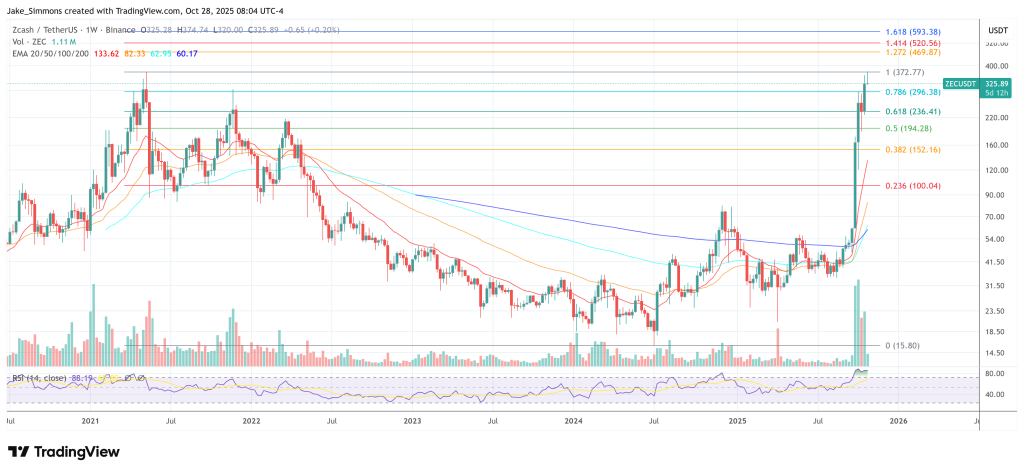
Zcash price
Market Opportunity
Clash Logo
Clash Price(CLASH)
$0.015369
$0.015369$0.015369
+2.33%
USD
Clash (CLASH) Live Price Chart
Disclaimer: The articles reposted on this site are sourced from public platforms and are provided for informational purposes only. They do not necessarily reflect the views of MEXC. All rights remain with the original authors. If you believe any content infringes on third-party rights, please contact service@support.mexc.com for removal. MEXC makes no guarantees regarding the accuracy, completeness, or timeliness of the content and is not responsible for any actions taken based on the information provided. The content does not constitute financial, legal, or other professional advice, nor should it be considered a recommendation or endorsement by MEXC.

You May Also Like

Why This New Trending Meme Coin Is Being Dubbed The New PEPE After Record Presale

Why This New Trending Meme Coin Is Being Dubbed The New PEPE After Record Presale

The post Why This New Trending Meme Coin Is Being Dubbed The New PEPE After Record Presale appeared on BitcoinEthereumNews.com. Crypto News 17 September 2025 | 20:13 The meme coin market is heating up once again as traders look for the next breakout token. While Shiba Inu (SHIB) continues to build its ecosystem and PEPE holds onto its viral roots, a new contender, Layer Brett (LBRETT), is gaining attention after raising more than $3.7 million in its presale. With a live staking system, fast-growing community, and real tech backing, some analysts are already calling it “the next PEPE.” Here’s the latest on the Shiba Inu price forecast, what’s going on with PEPE, and why Layer Brett is drawing in new investors fast. Shiba Inu price forecast: Ecosystem builds, but retail looks elsewhere Shiba Inu (SHIB) continues to develop its broader ecosystem with Shibarium, the project’s Layer 2 network built to improve speed and lower gas fees. While the community remains strong, the price hasn’t followed suit lately. SHIB is currently trading around $0.00001298, and while that’s a decent jump from its earlier lows, it still falls short of triggering any major excitement across the market. The project includes additional tokens like BONE and LEASH, and also has ongoing initiatives in DeFi and NFTs. However, even with all this development, many investors feel the hype that once surrounded SHIB has shifted elsewhere, particularly toward newer, more dynamic meme coins offering better entry points and incentives. PEPE: Can it rebound or is the momentum gone? PEPE saw a parabolic rise during the last meme coin surge, catching fire on social media and delivering massive short-term gains for early adopters. However, like most meme tokens driven largely by hype, it has since cooled off. PEPE is currently trading around $0.00001076, down significantly from its peak. While the token still enjoys a loyal community, analysts believe its best days may be behind it unless…
Share
BitcoinEthereumNews2025/09/18 02:50
Real estate, crypto, bonds, AI stocks and gold defined global market trades in 2025

Real estate, crypto, bonds, AI stocks and gold defined global market trades in 2025

The post Real estate, crypto, bonds, AI stocks and gold defined global market trades in 2025 appeared on BitcoinEthereumNews.com. 2025 was packed with high-stakes
Share
BitcoinEthereumNews2025/12/29 06:12
Headwind Helps Best Wallet Token

Headwind Helps Best Wallet Token

The post Headwind Helps Best Wallet Token appeared on BitcoinEthereumNews.com. Google has announced the launch of a new open-source protocol called Agent Payments Protocol (AP2) in partnership with Coinbase, the Ethereum Foundation, and 60 other organizations. This allows AI agents to make payments on behalf of users using various methods such as real-time bank transfers, credit and debit cards, and, most importantly, stablecoins. Let’s explore in detail what this could mean for the broader cryptocurrency markets, and also highlight a presale crypto (Best Wallet Token) that could explode as a result of this development. Google’s Push for Stablecoins Agent Payments Protocol (AP2) uses digital contracts known as ‘Intent Mandates’ and ‘Verifiable Credentials’ to ensure that AI agents undertake only those payments authorized by the user. Mandates, by the way, are cryptographically signed, tamper-proof digital contracts that act as verifiable proof of a user’s instruction. For example, let’s say you instruct an AI agent to never spend more than $200 in a single transaction. This instruction is written into an Intent Mandate, which serves as a digital contract. Now, whenever the AI agent tries to make a payment, it must present this mandate as proof of authorization, which will then be verified via the AP2 protocol. Alongside this, Google has also launched the A2A x402 extension to accelerate support for the Web3 ecosystem. This production-ready solution enables agent-based crypto payments and will help reshape the growth of cryptocurrency integration within the AP2 protocol. Google’s inclusion of stablecoins in AP2 is a massive vote of confidence in dollar-pegged cryptocurrencies and a huge step toward making them a mainstream payment option. This widens stablecoin usage beyond trading and speculation, positioning them at the center of the consumption economy. The recent enactment of the GENIUS Act in the U.S. gives stablecoins more structure and legal support. Imagine paying for things like data crawls, per-task…
Share
BitcoinEthereumNews2025/09/18 01:27