An analyst has pointed out how a sort of supply “air gap” exists for Solana below $144, with no major on-chain support levels until much lower. Solana URPD Reveals Supply Chasm Below $144 In a new post on X, analyst Ali Martinez has talked about how Solana support is looking from an on-chain lens. In on-chain analysis, the potential of any price level to act as support or resistance lies in the amount of coins that investors last purchased at it. Related Reading: Bitcoin Crashes To $98,000 As HODLer Selling Accelerates The reasoning behind this is that holders look at their cost basis as a special level and are sensitive to retests of it. The more holders that have their cost basis at a particular level, the larger the reaction from a retest could theoretically be. As for what the nature of this reaction is likely to be, it comes down to the direction of the retest, as well as the mood in the market. When the retest occurs from above, holders might decide to accumulate more, thinking that the decline is a temporary dip and they would return in profit again. Retests of major supply levels from above can, for this reason, provide support to the cryptocurrency. Similarly, retests in the opposite direction may be met with resistance, as holders panic exit at their break-even level, fearing going underwater again. To showcase how the supply cost basis distribution on the Solana network is like right now, Martinez has shared the data of the UTXO Realized Price Distribution (URPD) from Glassnode. As is visible in the above graph, the largest Solana supply zones on this indicator are all located above $144. Below this level, the cryptocurrency has relatively thin clusters. “There’s barely any meaningful demand until $24,” noted the analyst. SOL has already started slipping under the last major support level of $144, so it only remains to be seen how the cryptocurrency will develop in the near future, considering the lack of any meaningful on-chain support cushions. Related Reading: Bitcoin Sentiment Most Fearful Since March: Is A Bottom Near? In a separate X post, Martinez has also shared the URPD data for Bitcoin. Unlike Solana, the number one cryptocurrency’s supply distribution is more even, meaning the asset has levels to rely on below the current range. In particular, $82,000 and $67,000 are two levels below $95,000 that hold the cost basis of a significant amount of supply, and thus, could potentially be support barriers on the way down. SOL Price Solana dropped to $135 during its latest plunge, but the coin has since recovered back to $141. Featured image from Dall-E, Glassnode.com, chart from TradingView.comAn analyst has pointed out how a sort of supply “air gap” exists for Solana below $144, with no major on-chain support levels until much lower. Solana URPD Reveals Supply Chasm Below $144 In a new post on X, analyst Ali Martinez has talked about how Solana support is looking from an on-chain lens. In on-chain analysis, the potential of any price level to act as support or resistance lies in the amount of coins that investors last purchased at it. Related Reading: Bitcoin Crashes To $98,000 As HODLer Selling Accelerates The reasoning behind this is that holders look at their cost basis as a special level and are sensitive to retests of it. The more holders that have their cost basis at a particular level, the larger the reaction from a retest could theoretically be. As for what the nature of this reaction is likely to be, it comes down to the direction of the retest, as well as the mood in the market. When the retest occurs from above, holders might decide to accumulate more, thinking that the decline is a temporary dip and they would return in profit again. Retests of major supply levels from above can, for this reason, provide support to the cryptocurrency. Similarly, retests in the opposite direction may be met with resistance, as holders panic exit at their break-even level, fearing going underwater again. To showcase how the supply cost basis distribution on the Solana network is like right now, Martinez has shared the data of the UTXO Realized Price Distribution (URPD) from Glassnode. As is visible in the above graph, the largest Solana supply zones on this indicator are all located above $144. Below this level, the cryptocurrency has relatively thin clusters. “There’s barely any meaningful demand until $24,” noted the analyst. SOL has already started slipping under the last major support level of $144, so it only remains to be seen how the cryptocurrency will develop in the near future, considering the lack of any meaningful on-chain support cushions. Related Reading: Bitcoin Sentiment Most Fearful Since March: Is A Bottom Near? In a separate X post, Martinez has also shared the URPD data for Bitcoin. Unlike Solana, the number one cryptocurrency’s supply distribution is more even, meaning the asset has levels to rely on below the current range. In particular, $82,000 and $67,000 are two levels below $95,000 that hold the cost basis of a significant amount of supply, and thus, could potentially be support barriers on the way down. SOL Price Solana dropped to $135 during its latest plunge, but the coin has since recovered back to $141. Featured image from Dall-E, Glassnode.com, chart from TradingView.com

Solana Air Gap: Analyst Says No Major Support Level Until $24

2025/11/15 08:00

An analyst has pointed out how a sort of supply “air gap” exists for Solana below $144, with no major on-chain support levels until much lower.

Solana URPD Reveals Supply Chasm Below $144

In a new post on X, analyst Ali Martinez has talked about how Solana support is looking from an on-chain lens. In on-chain analysis, the potential of any price level to act as support or resistance lies in the amount of coins that investors last purchased at it.

The reasoning behind this is that holders look at their cost basis as a special level and are sensitive to retests of it. The more holders that have their cost basis at a particular level, the larger the reaction from a retest could theoretically be.

As for what the nature of this reaction is likely to be, it comes down to the direction of the retest, as well as the mood in the market. When the retest occurs from above, holders might decide to accumulate more, thinking that the decline is a temporary dip and they would return in profit again.

Retests of major supply levels from above can, for this reason, provide support to the cryptocurrency. Similarly, retests in the opposite direction may be met with resistance, as holders panic exit at their break-even level, fearing going underwater again.

To showcase how the supply cost basis distribution on the Solana network is like right now, Martinez has shared the data of the UTXO Realized Price Distribution (URPD) from Glassnode.

Solana URPD

As is visible in the above graph, the largest Solana supply zones on this indicator are all located above $144. Below this level, the cryptocurrency has relatively thin clusters. “There’s barely any meaningful demand until $24,” noted the analyst.

SOL has already started slipping under the last major support level of $144, so it only remains to be seen how the cryptocurrency will develop in the near future, considering the lack of any meaningful on-chain support cushions.

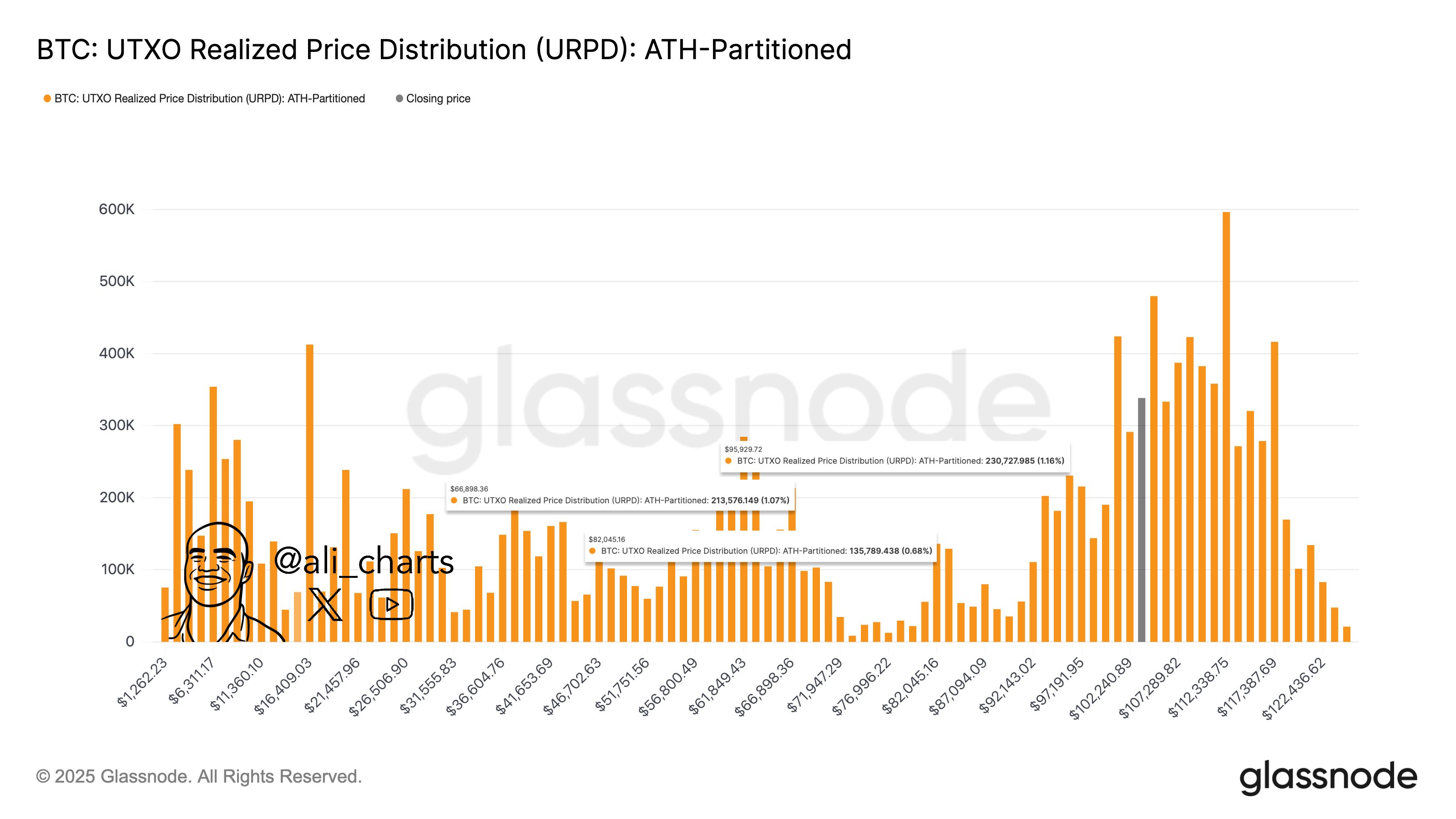
In a separate X post, Martinez has also shared the URPD data for Bitcoin. Unlike Solana, the number one cryptocurrency’s supply distribution is more even, meaning the asset has levels to rely on below the current range.
Bitcoin URPD

In particular, $82,000 and $67,000 are two levels below $95,000 that hold the cost basis of a significant amount of supply, and thus, could potentially be support barriers on the way down.

SOL Price

Solana dropped to $135 during its latest plunge, but the coin has since recovered back to $141.

Solana Price Chart
Market Opportunity
Major Logo
Major Price(MAJOR)
$0.11451
$0.11451$0.11451
+1.30%
USD
Major (MAJOR) Live Price Chart
Disclaimer: The articles reposted on this site are sourced from public platforms and are provided for informational purposes only. They do not necessarily reflect the views of MEXC. All rights remain with the original authors. If you believe any content infringes on third-party rights, please contact service@support.mexc.com for removal. MEXC makes no guarantees regarding the accuracy, completeness, or timeliness of the content and is not responsible for any actions taken based on the information provided. The content does not constitute financial, legal, or other professional advice, nor should it be considered a recommendation or endorsement by MEXC.

You May Also Like

Gold edges higher as Fed easing outlook cushions downside

Gold edges higher as Fed easing outlook cushions downside

The post Gold edges higher as Fed easing outlook cushions downside appeared on BitcoinEthereumNews.com. Gold trades near $3,670 on Friday, snapping a two-day losing streak after the Fed’s interest rate cut. The US Dollar and Treasury yields extend post-Fed rebound as Powell’s tone proved less dovish than expected. Gold remains cushioned as markets anticipate two more Fed rate cuts by year-end. Gold (XAU/USD) regains ground on Friday, snapping a two-day losing streak after a volatile midweek reaction to the Federal Reserve’s (Fed) interest rate decision. At the time of writing, XAU/USD is trading around $3,668 during the American session, up nearly 0.65%. On Wednesday, the US central bank lowered the federal funds rate by 25 basis points (bps) to the 4.00%-4.25% range, a move that was fully priced in. The metal briefly spiked to a fresh all-time high near $3,707 in the immediate aftermath, but the gains quickly faded as Fed Chair Jerome Powell’s press conference struck a less dovish tone, triggering a sharp recovery in the US Dollar (USD) and Treasury yields. Chair Jerome Powell said the Fed does not feel the need to move quickly on rates, describing the latest move as a “risk-management cut” aimed at cushioning the economy amid signs of a slowing labor market. He added that policy is “not on a preset course” and will remain data-dependent, signaling a cautious approach rather than an aggressive easing cycle. Friday’s rebound in XAU/USD comes in spite of a firmer US Dollar and rising Treasury yields, as traders weigh the implications of the Fed’s monetary policy outlook. Markets are already pricing in the possibility of two more cuts by year-end, which in turn cushions downside risks for bullion, but elevated yields and a resilient Greenback keep the near-term outlook capped, limiting room for further gains. Market movers: US Dollar firms with higher yields, Fed projects gradual easing Minneapolis Fed President Neel…
Share
BitcoinEthereumNews2025/09/20 04:28
Flare Mainnet Launches FXRP, Bringing XRP Into DeFi

Flare Mainnet Launches FXRP, Bringing XRP Into DeFi

The post Flare Mainnet Launches FXRP, Bringing XRP Into DeFi appeared on BitcoinEthereumNews.com. Flare’s FAssets protocol converts cryptocurrencies like XRP that aren’t smart contract enabled into assets that can be utilized in DeFi on Flare and other applications. To guarantee FAssets maintain the highest levels of safety, trust, and dependability for both institutions and the XRP community, the Flare Foundation will keep making investments in strong, scalable security mechanisms. FAssets, beginning with FXRP v1.2, are now live on the Flare mainnet. Now that the first FAsset has finally been launched, holders of XRP may mint FXRP on Flare and begin using XRP throughout Flare DeFi. The XRP DeFi awakening is just getting started. A quick refresher on FAssets Flare’s FAssets protocol converts cryptocurrencies like XRP that aren’t smart contract enabled into assets that can be utilized in DeFi on Flare and other applications. They are one-to-one copies of the original asset (XRP to FXRP, for example), protected by Flare’s codified data standards and an overcollateralized structure of independent agents. As a consequence, Flare’s composable decentralized financial ecosystem, which includes DEX trading, lending, stablecoin minting, liquid staking, and other use cases, becomes fully accessible to non-smart contract assets. FAssets are built for composability. FXRP may travel freely within Flare’s DeFi ecosystem when it is minted. This eliminates the need for unique workarounds and enables protocols to use FXRP directly as a native building block. How is FXRP secured? FAsset security is a continuous effort rather than a one-time achievement. In addition to Immunefi-powered bug bounties and community-driven evaluations like Code4rena, the system has already completed at least four independent audits by reputable companies like Zellic and Coinspect. Additionally, Hypernative keeps a close eye on the FAssets system and the DeFi apps on Flare around-the-clock. Comprehensive security and fast reaction procedures are also in place. Why are there so many layers? Because FAssets oversee high-value, intricate processes…
Share
BitcoinEthereumNews2025/09/25 04:24
FET Price Prediction: Can Bulls Break $0.70 Resistance to Approach $1.60?

FET Price Prediction: Can Bulls Break $0.70 Resistance to Approach $1.60?

Artificial Superintelligence Alliance (FET) is trading under increasing bearish pressure with the overall market. The FET price over the last 24 hours is down by 4.58%, and over the last week it is also down by 4.66%. At the time of writing, FET is trading at $0.6479 with a 24-hour trading volume of $105.46 million, […]
Share
Tronweekly2025/09/20 20:00