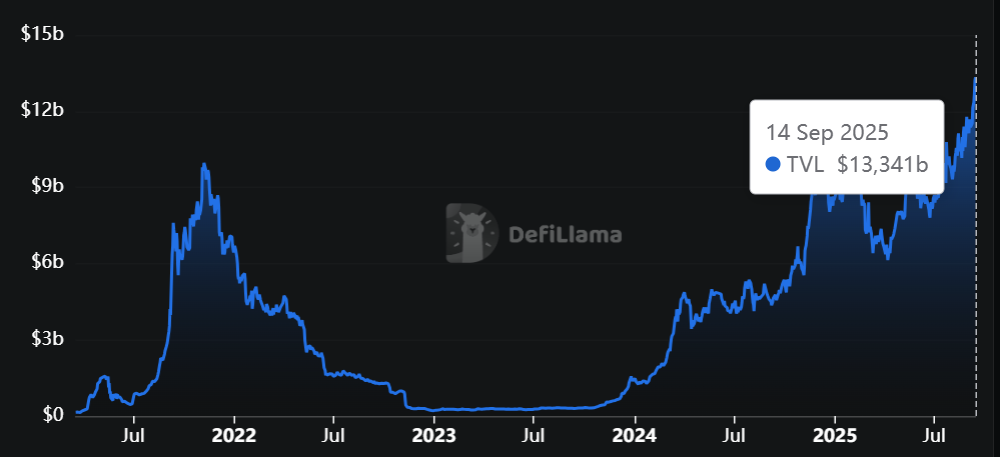
Solana's DeFi total value locked just hit $13.34 billion, marking its highest level ever as ecosystem growth accelerates.]]>Solana's DeFi total value locked just hit $13.34 billion, marking its highest level ever as ecosystem growth accelerates.]]>

Solana DeFi TVL Hits $13.34B, Breaking All-Time Records

  • Solana’s DeFi TVL just reached an all-time high of $13.34 billion, signaling deeper ecosystem engagement and on-chain activity.
  • Institutional interest and rising staking demand are pushing Solana’s DeFi ecosystem to unprecedented total value locked levels.

Solana’s DeFi ecosystem has hit a new milestone, with total value locked (TVL) reaching $13.34 billion, according to DefiLlama. This figure not only reflects growth in terms of volume but also marks a significant shift in the flow of liquidity into this Proof-of-History based blockchain ecosystem.

This surge is driven by increased interest in staking, yield farming, and trading activities across various Solana-based decentralized exchange protocols.
Source: DefiLlama

Furthermore, the rise in the tokenization sector and the emergence of new DeFi protocols have also contributed to the accumulation of locked funds.

Some market participants even consider this achievement a real validation of Solana’s resilience, after it was previously criticized for experiencing downtime in the past.

Institutional Demand and Network Power Fuel Solana’s Momentum

Interestingly, this TVL surge coincides with increased interest from publicly traded companies. A previous CNF report indicated that 13 companies currently publicly hold SOL tokens, with a total accumulated holding approaching $1.8 billion. Of the listed, Upexi is listed as the largest holder with 2,000,518 SOL.

Meanwhile, whale participation has not abated. Many large investors have chosen to maintain their positions and even increase their holdings, especially after the SOL price broke through the $240 level.

Furthermore, the technical performance of the Solana network has also attracted attention. In mid-August, Mert Mumtaz revealed that the network was capable of recording a throughput of up to 107,540 transactions per second (TPS) in a stress test simulation.

This performance further confirms that Solana’s architecture is not just a gimmick. Furthermore, the network is now also home to a number of meme coins such as BONK, WIF, and MEW, further adding to the transaction frenzy within it.

Weekly Breakout: Could SOL Soar Again?

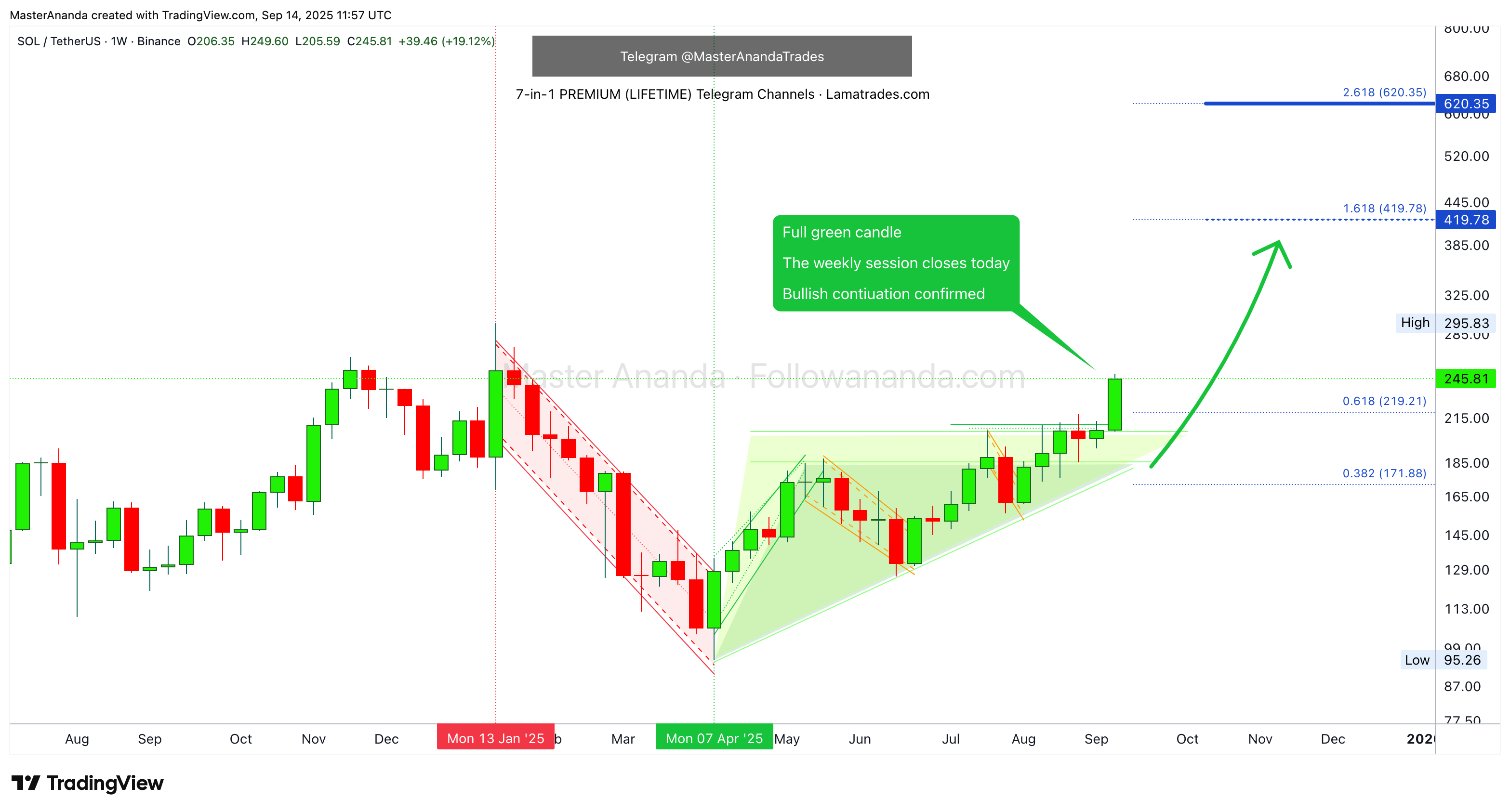
Technically, the SOL price is also attractive. At the time of writing, SOL is trading at about $246, recording a 1.98% increase in 24 hours and 20.88% in the last 7 days. The weekly candlestick will soon close in full green.

According to analyst Master Ananda, this pattern is usually not a closing pattern, but rather a precursor to a major movement to come.
Source: Master Ananda on TradingView

There are several observable signs: first, the price has broken through the medium-term resistance pattern. Second, confirmation of the breakout is just waiting for the close of today’s active session. Third, the continuation phase will soon begin.

While this doesn’t mean the chart will rise straight up without correction, small fluctuations over one to three days are considered part of normal market noise. In this type of pattern, additional waves of growth usually emerge after a temporary red phase.

Ananda projects a price target of $419 and even $620 in the next rally. But of course, this all depends on how the market absorbs the current momentum.

]]>
Market Opportunity
DeFi Logo
DeFi Price(DEFI)
$0.00053
$0.00053$0.00053
-2.03%
USD
DeFi (DEFI) Live Price Chart
Disclaimer: The articles reposted on this site are sourced from public platforms and are provided for informational purposes only. They do not necessarily reflect the views of MEXC. All rights remain with the original authors. If you believe any content infringes on third-party rights, please contact service@support.mexc.com for removal. MEXC makes no guarantees regarding the accuracy, completeness, or timeliness of the content and is not responsible for any actions taken based on the information provided. The content does not constitute financial, legal, or other professional advice, nor should it be considered a recommendation or endorsement by MEXC.

You May Also Like

Trust Wallet’s Decisive Move: Full Compensation for $7M Hack Victims

Trust Wallet’s Decisive Move: Full Compensation for $7M Hack Victims

BitcoinWorld Trust Wallet’s Decisive Move: Full Compensation for $7M Hack Victims In a significant move for cryptocurrency security, Trust Wallet has committed
Share
bitcoinworld2025/12/26 17:40
Cashing In On University Patents Means Giving Up On Our Innovation Future

Cashing In On University Patents Means Giving Up On Our Innovation Future

The post Cashing In On University Patents Means Giving Up On Our Innovation Future appeared on BitcoinEthereumNews.com. “It’s a raid on American innovation that would deliver pennies to the Treasury while kneecapping the very engine of our economic and medical progress,” writes Pipes. Getty Images Washington is addicted to taxing success. Now, Commerce Secretary Howard Lutnick is floating a plan to skim half the patent earnings from inventions developed at universities with federal funding. It’s being sold as a way to shore up programs like Social Security. In reality, it’s a raid on American innovation that would deliver pennies to the Treasury while kneecapping the very engine of our economic and medical progress. Yes, taxpayer dollars support early-stage research. But the real payoff comes later—in the jobs created, cures discovered, and industries launched when universities and private industry turn those discoveries into real products. By comparison, the sums at stake in patent licensing are trivial. Universities collectively earn only about $3.6 billion annually in patent income—less than the federal government spends on Social Security in a single day. Even confiscating half would barely register against a $6 trillion federal budget. And yet the damage from such a policy would be anything but trivial. The true return on taxpayer investment isn’t in licensing checks sent to Washington, but in the downstream economic activity that federally supported research unleashes. Thanks to the bipartisan Bayh-Dole Act of 1980, universities and private industry have powerful incentives to translate early-stage discoveries into real-world products. Before Bayh-Dole, the government hoarded patents from federally funded research, and fewer than 5% were ever licensed. Once universities could own and license their own inventions, innovation exploded. The result has been one of the best returns on investment in government history. Since 1996, university research has added nearly $2 trillion to U.S. industrial output, supported 6.5 million jobs, and launched more than 19,000 startups. Those companies pay…
Share
BitcoinEthereumNews2025/09/18 03:26
Trust Wallet Hack Hits $7M: CZ Hints at Possible Insider Role

Trust Wallet Hack Hits $7M: CZ Hints at Possible Insider Role

CZ hinted at possible insider involvement in the Trust Wallet incident while assuring users that their funds would be reimbursed.
Share
CryptoPotato2025/12/26 16:48