Helius says it has re-engineered how Solana’s historical data is stored and retrieved, introducing a new archival backend and an RPC method that collapses today’s multi-call workflows into a single request. CEO Mert Mumtaz framed the change in sweeping terms: “today, Solana changes forever… we’ve solved the biggest data/RPC problem that exists,” he wrote, arguing […]Helius says it has re-engineered how Solana’s historical data is stored and retrieved, introducing a new archival backend and an RPC method that collapses today’s multi-call workflows into a single request. CEO Mert Mumtaz framed the change in sweeping terms: “today, Solana changes forever… we’ve solved the biggest data/RPC problem that exists,” he wrote, arguing […]

Solana Just Solved Its Biggest Data Problem, Says Helius CEO

2025/10/29 20:00

Helius says it has re-engineered how Solana’s historical data is stored and retrieved, introducing a new archival backend and an RPC method that collapses today’s multi-call workflows into a single request.

CEO Mert Mumtaz framed the change in sweeping terms: “today, Solana changes forever… we’ve solved the biggest data/RPC problem that exists,” he wrote, arguing that the status quo—historical queries hitting Google Bigtable—has been “slow,” “expensive,” and “inflexible.”

What This Means For Solana

Mumtaz highlighted the practical pain point every Solana indexer or wallet developer knows: getting the “first tx for a Solana address without looping back endlessly” and pulling the “most recent 100 txs for an address” both require chaining calls and traversals that can balloon into “thousands of RPC calls.” “Not anymore,” Mumtaz said.

At the heart of the release is a Helius-exclusive RPC method, getTransactionsForAddress, backed by a distributed archival storage layer that the company claims is “1,000x faster, more flexible, and more scalable.” Functionally, the method merges today’s common two-step pattern—getSignaturesForAddress to enumerate signatures, then getTransaction to hydrate details—into one call that can return fully decoded transactions, with bidirectional time ordering and range filters by slot or timestamp.

Helius’ documentation spells out that it enables reverse search without back-traversal and supports pagination tuned for large, active accounts. The company also emphasizes that this is not a core Solana RPC addition; it’s a proprietary extension available on Helius nodes, priced at 100 credits per request on Developer plans and above. Performance claims span both the new method and legacy endpoints, with Helius saying getBlock, getTransaction, and getSignaturesForAddress are now “10x faster,” while the archival system under the hood delivers the headline throughput improvements for historical queries.

The framing is squarely aimed at eliminating Bigtable-bound latency spikes and reducing call counts by “100x” alongside “10x lower latency” and “1000x less code.” Those assertions track with common developer complaints documented across Solana forums about slow historical hydration on busy addresses, but the hard numbers here are Helius’ own benchmarks.

The strategic context matters. Solana’s on-chain activity continues to skew toward high-throughput consumer and payments use cases, which punish inefficient data access patterns.

The launch landed the same day the first US spot Solana ETF went live on the NYSE—Bitwise’s BSOL. According to Bloomberg’s senior ETF analyst Eric Balchunas, BSOL recorded a volume of $56 million on day one. “BSOL’s $56m is the MOST of any launch this year.. More than XRPR, SSK, Ives and $MNU. And what’s amazing is it seeded with $220m. It could have invested seed on Day One, which would have resulted in $280m-ish, would be even more than ETHA’s debut. Strong start either way,” Balchunas wrote.

Another macro backdrop piece: Western Union announced plans to introduce a dollar-backed stablecoin, USDPT, on Solana, issued by Anchorage Digital Bank, with availability targeted for the first half of 2026.

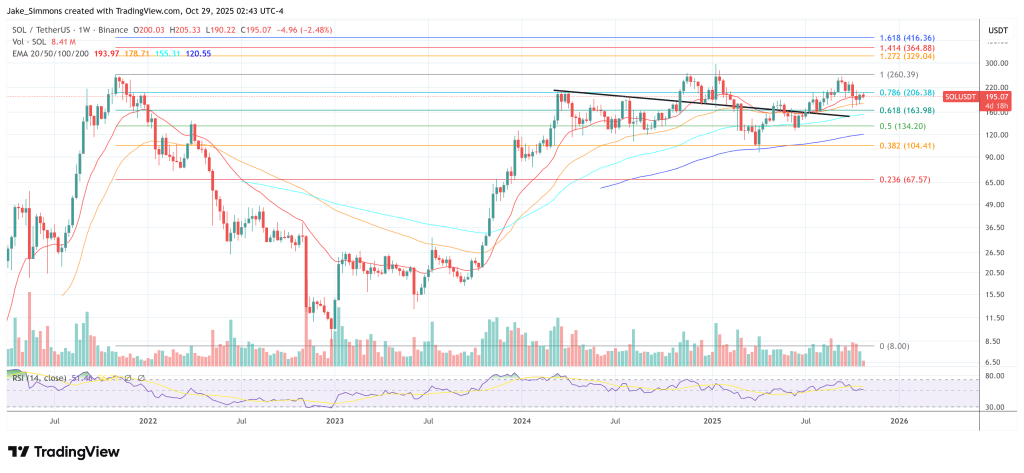
At press time, SOL traded at $195.
Solana price
Market Opportunity
Multichain Logo
Multichain Price(MULTI)
$0.03662
$0.03662$0.03662
-7.12%
USD
Multichain (MULTI) Live Price Chart
Disclaimer: The articles reposted on this site are sourced from public platforms and are provided for informational purposes only. They do not necessarily reflect the views of MEXC. All rights remain with the original authors. If you believe any content infringes on third-party rights, please contact service@support.mexc.com for removal. MEXC makes no guarantees regarding the accuracy, completeness, or timeliness of the content and is not responsible for any actions taken based on the information provided. The content does not constitute financial, legal, or other professional advice, nor should it be considered a recommendation or endorsement by MEXC.

You May Also Like

Shocking OpenVPP Partnership Claim Draws Urgent Scrutiny

Shocking OpenVPP Partnership Claim Draws Urgent Scrutiny

The post Shocking OpenVPP Partnership Claim Draws Urgent Scrutiny appeared on BitcoinEthereumNews.com. The cryptocurrency world is buzzing with a recent controversy surrounding a bold OpenVPP partnership claim. This week, OpenVPP (OVPP) announced what it presented as a significant collaboration with the U.S. government in the innovative field of energy tokenization. However, this claim quickly drew the sharp eye of on-chain analyst ZachXBT, who highlighted a swift and official rebuttal that has sent ripples through the digital asset community. What Sparked the OpenVPP Partnership Claim Controversy? The core of the issue revolves around OpenVPP’s assertion of a U.S. government partnership. This kind of collaboration would typically be a monumental endorsement for any private cryptocurrency project, especially given the current regulatory climate. Such a partnership could signify a new era of mainstream adoption and legitimacy for energy tokenization initiatives. OpenVPP initially claimed cooperation with the U.S. government. This alleged partnership was said to be in the domain of energy tokenization. The announcement generated considerable interest and discussion online. ZachXBT, known for his diligent on-chain investigations, was quick to flag the development. He brought attention to the fact that U.S. Securities and Exchange Commission (SEC) Commissioner Hester Peirce had directly addressed the OpenVPP partnership claim. Her response, delivered within hours, was unequivocal and starkly contradicted OpenVPP’s narrative. How Did Regulatory Authorities Respond to the OpenVPP Partnership Claim? Commissioner Hester Peirce’s statement was a crucial turning point in this unfolding story. She clearly stated that the SEC, as an agency, does not engage in partnerships with private cryptocurrency projects. This response effectively dismantled the credibility of OpenVPP’s initial announcement regarding their supposed government collaboration. Peirce’s swift clarification underscores a fundamental principle of regulatory bodies: maintaining impartiality and avoiding endorsements of private entities. Her statement serves as a vital reminder to the crypto community about the official stance of government agencies concerning private ventures. Moreover, ZachXBT’s analysis…
Share
BitcoinEthereumNews2025/09/18 02:13
South African lawmakers put Starlink launch on hold over policy clash

South African lawmakers put Starlink launch on hold over policy clash

Elon Musk’s Starlink may face delays in delivering satellite internet to South Africa. Lawmakers are opposing a recent…
Share
Technext2025/12/15 20:31
Logitech G Drops a Wide Array Of New Products And Innovations At Logitech G PLAY 2025

Logitech G Drops a Wide Array Of New Products And Innovations At Logitech G PLAY 2025

Logitech G PLAY 2025 is a live-streamed global gaming event that brings together press, partners, creators, and fans to explore the future of gaming. The array of products and experiences included major innovations across PC and console gaming, esports, sim racing, and streaming tools, along with partnerships with McLaren Racing, NVIDIA and more.
Share
Hackernoon2025/09/18 05:42
