TLDR Spanish authorities arrested Álvaro Romillo, known as “CryptoSpain,” for allegedly running a €260 million ($300 million) Ponzi scheme through Madeira Invest Club The scheme attracted over 3,000 victims by promising guaranteed returns of about 20% annually on investments in digital art, luxury vehicles, whisky, real estate, and cryptocurrencies Investigators found no real economic activity [...] The post Spanish Authorities Arrest Crypto Influencer in €260 Million Ponzi Scheme Investigation appeared first on CoinCentral.TLDR Spanish authorities arrested Álvaro Romillo, known as “CryptoSpain,” for allegedly running a €260 million ($300 million) Ponzi scheme through Madeira Invest Club The scheme attracted over 3,000 victims by promising guaranteed returns of about 20% annually on investments in digital art, luxury vehicles, whisky, real estate, and cryptocurrencies Investigators found no real economic activity [...] The post Spanish Authorities Arrest Crypto Influencer in €260 Million Ponzi Scheme Investigation appeared first on CoinCentral.

Spanish Authorities Arrest Crypto Influencer in €260 Million Ponzi Scheme Investigation

2025/11/10 17:15
4 min read

TLDR

  • Spanish authorities arrested Álvaro Romillo, known as “CryptoSpain,” for allegedly running a €260 million ($300 million) Ponzi scheme through Madeira Invest Club
  • The scheme attracted over 3,000 victims by promising guaranteed returns of about 20% annually on investments in digital art, luxury vehicles, whisky, real estate, and cryptocurrencies
  • Investigators found no real economic activity took place, with early investors paid using funds from new participants
  • The operation used a complex network of shell companies and bank accounts across at least 10 countries including the U.S., UK, Portugal, Malaysia, and Hong Kong
  • Romillo was arrested after authorities discovered a Singapore bank account containing €29 million linked to his businesses and was detained without bail as a flight risk

Spanish police arrested crypto influencer Álvaro Romillo on Thursday in connection with an alleged €260 million ($300 million) investment fraud. Romillo, who operates under the online name “CryptoSpain,” faces charges related to running the Madeira Invest Club.

The Civil Guard’s Central Operational Unit accuses Romillo of orchestrating a Ponzi scheme that defrauded approximately 3,000 victims. The club began operations in early 2023 and marketed itself as a private investment group. Members were required to deposit a minimum of around €2,000 to participate.

The scheme offered contracts for various assets including digital artwork, luxury vehicles, whisky, real estate, and cryptocurrencies. Investors were promised guaranteed buyback options and fixed annual returns of approximately 20%. These unusually high returns attracted thousands of participants across multiple countries.

Spanish authorities state that no legitimate economic activity or investments occurred through the club. Instead, the operation functioned as a classic Ponzi scheme. Early participants received payments funded by deposits from newer investors rather than actual investment returns.

International Network of Shell Companies

The investigation, called Operation PONEI, uncovered a complex financial structure spanning at least 10 countries. This network included shell companies and bank accounts in Portugal, the United Kingdom, the United States, Malaysia, and Hong Kong. The operation involved cooperation from Europol and law enforcement agencies in the U.S., Singapore, Malaysia, and Thailand.

Romillo had been cooperating with authorities since late 2024 when Spanish officials first announced three complaints against Madeira Invest Club. He appeared at court hearings while law enforcement seized assets including dozens of luxury cars. Throughout this period, Romillo was not detained and continued to move freely.

Flight Risk Concerns Lead to Arrest

The situation changed when prosecutors discovered foreign bank accounts linked to Romillo’s businesses. Authorities found a Singapore bank account containing €29 million connected to companies associated with Romillo. This discovery raised concerns that he might flee the country.

National Court judge José Luis Calama ordered Romillo detained without bail after he testified for two hours before the court on Friday. The judge determined Romillo posed a flight risk given the foreign assets. Romillo could face between 9 and 18 years in prison if convicted, with the higher sentence possible if prosecutors prove the offense affected a large number of victims.

During his court appearance, Romillo claimed he intended to repay investors. He stated he had already returned money to approximately 2,700 parties. However, Romillo said these payments were made in cash and he had no documentation to verify the transactions.

Political Connections Surface

Separate from the fraud investigation, Romillo admitted to making an unreported €100,000 cash donation to Spanish MEP Luis “Alvise” Pérez during the 2024 election campaign. Pérez leads the far-right SALF party and is under investigation in a separate case unrelated to the larger Madeira Invest Club probe.

The Ministry of Interior announced Romillo’s arrest and provided details about the alleged scheme’s operations. The investigation continues as authorities work to trace additional assets and identify other potential victims across the international network.

The post Spanish Authorities Arrest Crypto Influencer in €260 Million Ponzi Scheme Investigation appeared first on CoinCentral.

Market Opportunity
Pixel Canvas Logo
Pixel Canvas Price(CLUB)
$0.01009
$0.01009$0.01009
+1.54%
USD
Pixel Canvas (CLUB) Live Price Chart
Disclaimer: The articles reposted on this site are sourced from public platforms and are provided for informational purposes only. They do not necessarily reflect the views of MEXC. All rights remain with the original authors. If you believe any content infringes on third-party rights, please contact service@support.mexc.com for removal. MEXC makes no guarantees regarding the accuracy, completeness, or timeliness of the content and is not responsible for any actions taken based on the information provided. The content does not constitute financial, legal, or other professional advice, nor should it be considered a recommendation or endorsement by MEXC.

You May Also Like

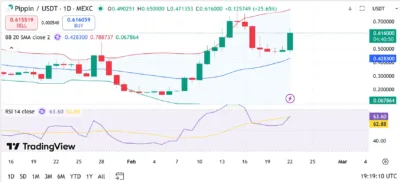
Pippin (PIPPIN) Price Prediction 2026–2030: Can PIPPIN Hit $0.70 Soon?

Pippin (PIPPIN) Price Prediction 2026–2030: Can PIPPIN Hit $0.70 Soon?

PIPPIN has surged sharply on the daily timeframe, printing a powerful bullish candle with over 25% gains. RSI is holding above 60, signaling strengthening momentum
Share
Coinstats2026/02/23 04:29
Will Cardano Reach $10 by 2030? Analysts Break Down ADA’s Growth Cycles

Will Cardano Reach $10 by 2030? Analysts Break Down ADA’s Growth Cycles

The post Will Cardano Reach $10 by 2030? Analysts Break Down ADA’s Growth Cycles appeared first on Coinpedia Fintech News Cardano (ADA) is trading at $0.9024 with a market cap of $32.91 billion. Experts say ADA has the potential to climb much higher, with some placing long-term targets as high as $10. The token continues to benefit from stronger visibility, rising liquidity, and increasing inflows from both institutional and retail markets. Can Cardano Hit $10 …
Share
CoinPedia2025/09/18 17:19
Crypto whale loses $6M to sneaky phishing scheme targeting staked Ethereum

Crypto whale loses $6M to sneaky phishing scheme targeting staked Ethereum

The post Crypto whale loses $6M to sneaky phishing scheme targeting staked Ethereum appeared on BitcoinEthereumNews.com. A crypto whale lost more than $6 million in staked Ethereum (stETH) and Aave-wrapped Bitcoin (aEthWBTC) after approving malicious signatures in a phishing scheme on Sept. 18, according to blockchain security firm Scam Sniffer. According to the firm, the attackers disguised their move as a routine wallet confirmation through “Permit” signatures, which tricked the victim into authorizing fund transfers without triggering obvious red flags. Yu Xian, founder of blockchain security company SlowMist, noted that the victim did not recognize the danger because the transaction required no gas fees. He wrote: “From the victim’s perspective, he just clicked a few times to confirm the wallet’s pop-up signature requests, didn’t spend a single penny of gas, and $6.28 million was gone.” How Permit exploits work Permit approvals were originally designed to simplify token transfers. Instead of submitting an on-chain approval and paying fees, a user can sign an off-chain message authorizing a spender. That efficiency, however, has created a new attack surface for malicious players. Once a user signs such a permit, attackers can combine two functions—Permit and TransferFrom—to drain assets directly. Because the authorization takes place off-chain, wallet dashboards show no unusual activity until the funds move. As a result, the assets are gone when the approval executes on-chain, and tokens are redirected to the attacker’s wallet. This loophole has made permit exploits increasingly attractive for malicious actors, who can siphon millions without needing complex hacks or high-cost gas wars. Phishing losses The latest theft highlights a wider trend of escalating phishing campaigns. Scam Sniffer reported that in August alone, attackers stole $12.17 million from more than 15,200 victims. That figure represented a 72% jump in losses compared with July. According to the firm, the most significant share of August’s damages came from three large accounts that accounted for nearly half…
Share
BitcoinEthereumNews2025/09/19 02:31