Stablecoin settlement volumes have expanded sharply this year, climbing 70% from $6 billion in February to more than $10 billion by August 2025. According to a report from Artemis, the surge reflects how digital dollars are leaving the trading arena and entering mainstream commerce, with business-to-business transfers emerging as the dominant growth driver. B2B Transactions Power Stablecoins Payment Growth Artemis’ figures show that corporate usage of stablecoins now accounts for nearly two-thirds of total payments. According to the firm, monthly B2B volume has more than doubled since February, rising 113% to about $6.4 billion. The expansion lifted the cumulative value of stablecoin payments since 2023 to over $136 billion, representing that on-chain money is no longer a niche settlement tool. Stablecoins Payment Growth This Year. Source: Artemis Meanwhile, consumer channels are following the same trajectory of growth. Card-based crypto payments have increased by about 36%, while business-to-consumer transactions are up 32%. Prefunding, often used by merchants to maintain instant liquidity, also jumped 61% during the reporting period. David Alexander, partner at venture firm Anagram, said the numbers show how on-chain liquidity is being turned into spendable cash in the real world. For context, he noted crypto card payments now process more than $1.5 billion each month, up 50% year-to-date. He pointed out that these mechanisms allow users to earn yields on idle assets through decentralized finance (DeFi) protocols and then spend those assets in real time. This seamless flow effectively converts blockchain-based liquidity into usable cash, merging the yield opportunities of DeFi with the familiarity of traditional payment networks. “One of the earliest use cases for stablecoins was simple peer-to-peer transfers. The appeal was sending money faster and cheaper, and making fiat more accessible, particularly for regions with limited access to traditional forms of banking. But that’s where the path of onchain money traditionally ended: users couldn’t spend it offchain. Now, that same money has evolved into programmable capital: assets that live onchain, earn yield, and function as direct equivalents to traditional payment instruments, usable anywhere in the world,” Alexander said. Tron’s Market Share Shrinks as Tether Consolidates Power While the Tron network remains the largest blockchain for stablecoin settlement, its lead is narrowing. According to Artemis data, Tron’s share dropped from 66% in late 2024 to 48% by August 2025, as newer, faster networks like Base, Codex, Plasma, and Solana began capturing liquidity. Stablecoin Volume by Blockchain. Source: Artemis Dragonfly partner Omar Kanji said this trend marks the “beginning of a structural rotation,” where lower-cost and high-throughput alternatives gradually eat into Tron’s dominance. On the asset side, Tether’s USDT continues to dominate the stablecoin ecosystem with roughly 79% of all payment volume, driven by deep liquidity and unmatched accessibility across Africa and Latin America. Yet Circle’s USDC is quietly expanding its footprint as its share rose from 14% to 21% since February. Stablecoins Payments by Token. Source: Artemis Data from DeFiLlama shows that USDT’s market capitalization stands at $183 billion, while USDC hovers near $76 billion. Together, they anchor the over $300-billion network of digital dollars that now move with the speed of code and the reach of global finance.Stablecoin settlement volumes have expanded sharply this year, climbing 70% from $6 billion in February to more than $10 billion by August 2025. According to a report from Artemis, the surge reflects how digital dollars are leaving the trading arena and entering mainstream commerce, with business-to-business transfers emerging as the dominant growth driver. B2B Transactions Power Stablecoins Payment Growth Artemis’ figures show that corporate usage of stablecoins now accounts for nearly two-thirds of total payments. According to the firm, monthly B2B volume has more than doubled since February, rising 113% to about $6.4 billion. The expansion lifted the cumulative value of stablecoin payments since 2023 to over $136 billion, representing that on-chain money is no longer a niche settlement tool. Stablecoins Payment Growth This Year. Source: Artemis Meanwhile, consumer channels are following the same trajectory of growth. Card-based crypto payments have increased by about 36%, while business-to-consumer transactions are up 32%. Prefunding, often used by merchants to maintain instant liquidity, also jumped 61% during the reporting period. David Alexander, partner at venture firm Anagram, said the numbers show how on-chain liquidity is being turned into spendable cash in the real world. For context, he noted crypto card payments now process more than $1.5 billion each month, up 50% year-to-date. He pointed out that these mechanisms allow users to earn yields on idle assets through decentralized finance (DeFi) protocols and then spend those assets in real time. This seamless flow effectively converts blockchain-based liquidity into usable cash, merging the yield opportunities of DeFi with the familiarity of traditional payment networks. “One of the earliest use cases for stablecoins was simple peer-to-peer transfers. The appeal was sending money faster and cheaper, and making fiat more accessible, particularly for regions with limited access to traditional forms of banking. But that’s where the path of onchain money traditionally ended: users couldn’t spend it offchain. Now, that same money has evolved into programmable capital: assets that live onchain, earn yield, and function as direct equivalents to traditional payment instruments, usable anywhere in the world,” Alexander said. Tron’s Market Share Shrinks as Tether Consolidates Power While the Tron network remains the largest blockchain for stablecoin settlement, its lead is narrowing. According to Artemis data, Tron’s share dropped from 66% in late 2024 to 48% by August 2025, as newer, faster networks like Base, Codex, Plasma, and Solana began capturing liquidity. Stablecoin Volume by Blockchain. Source: Artemis Dragonfly partner Omar Kanji said this trend marks the “beginning of a structural rotation,” where lower-cost and high-throughput alternatives gradually eat into Tron’s dominance. On the asset side, Tether’s USDT continues to dominate the stablecoin ecosystem with roughly 79% of all payment volume, driven by deep liquidity and unmatched accessibility across Africa and Latin America. Yet Circle’s USDC is quietly expanding its footprint as its share rose from 14% to 21% since February. Stablecoins Payments by Token. Source: Artemis Data from DeFiLlama shows that USDT’s market capitalization stands at $183 billion, while USDC hovers near $76 billion. Together, they anchor the over $300-billion network of digital dollars that now move with the speed of code and the reach of global finance.

Stablecoin Payments Hit a New Record As Real-World Crypto Spending Accelerates

Stablecoin settlement volumes have expanded sharply this year, climbing 70% from $6 billion in February to more than $10 billion by August 2025.

According to a report from Artemis, the surge reflects how digital dollars are leaving the trading arena and entering mainstream commerce, with business-to-business transfers emerging as the dominant growth driver.

B2B Transactions Power Stablecoins Payment Growth

Artemis’ figures show that corporate usage of stablecoins now accounts for nearly two-thirds of total payments.

According to the firm, monthly B2B volume has more than doubled since February, rising 113% to about $6.4 billion. The expansion lifted the cumulative value of stablecoin payments since 2023 to over $136 billion, representing that on-chain money is no longer a niche settlement tool.
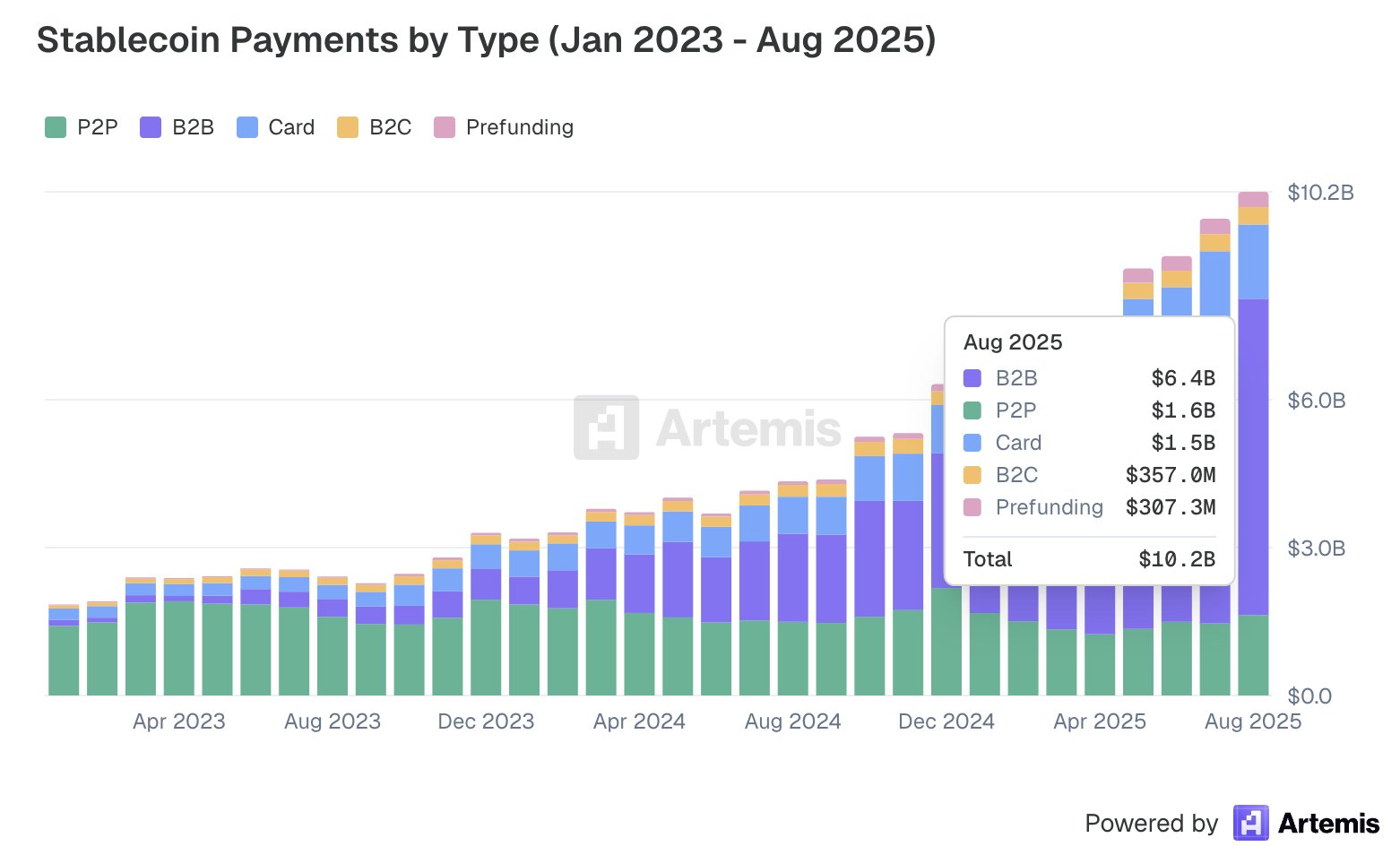
Stablecoins Payment Growth This Year.Stablecoins Payment Growth This Year. Source: Artemis

Meanwhile, consumer channels are following the same trajectory of growth.

Card-based crypto payments have increased by about 36%, while business-to-consumer transactions are up 32%. Prefunding, often used by merchants to maintain instant liquidity, also jumped 61% during the reporting period.

David Alexander, partner at venture firm Anagram, said the numbers show how on-chain liquidity is being turned into spendable cash in the real world. For context, he noted crypto card payments now process more than $1.5 billion each month, up 50% year-to-date.

He pointed out that these mechanisms allow users to earn yields on idle assets through decentralized finance (DeFi) protocols and then spend those assets in real time.

This seamless flow effectively converts blockchain-based liquidity into usable cash, merging the yield opportunities of DeFi with the familiarity of traditional payment networks.

Tron’s Market Share Shrinks as Tether Consolidates Power

While the Tron network remains the largest blockchain for stablecoin settlement, its lead is narrowing.

According to Artemis data, Tron’s share dropped from 66% in late 2024 to 48% by August 2025, as newer, faster networks like Base, Codex, Plasma, and Solana began capturing liquidity.
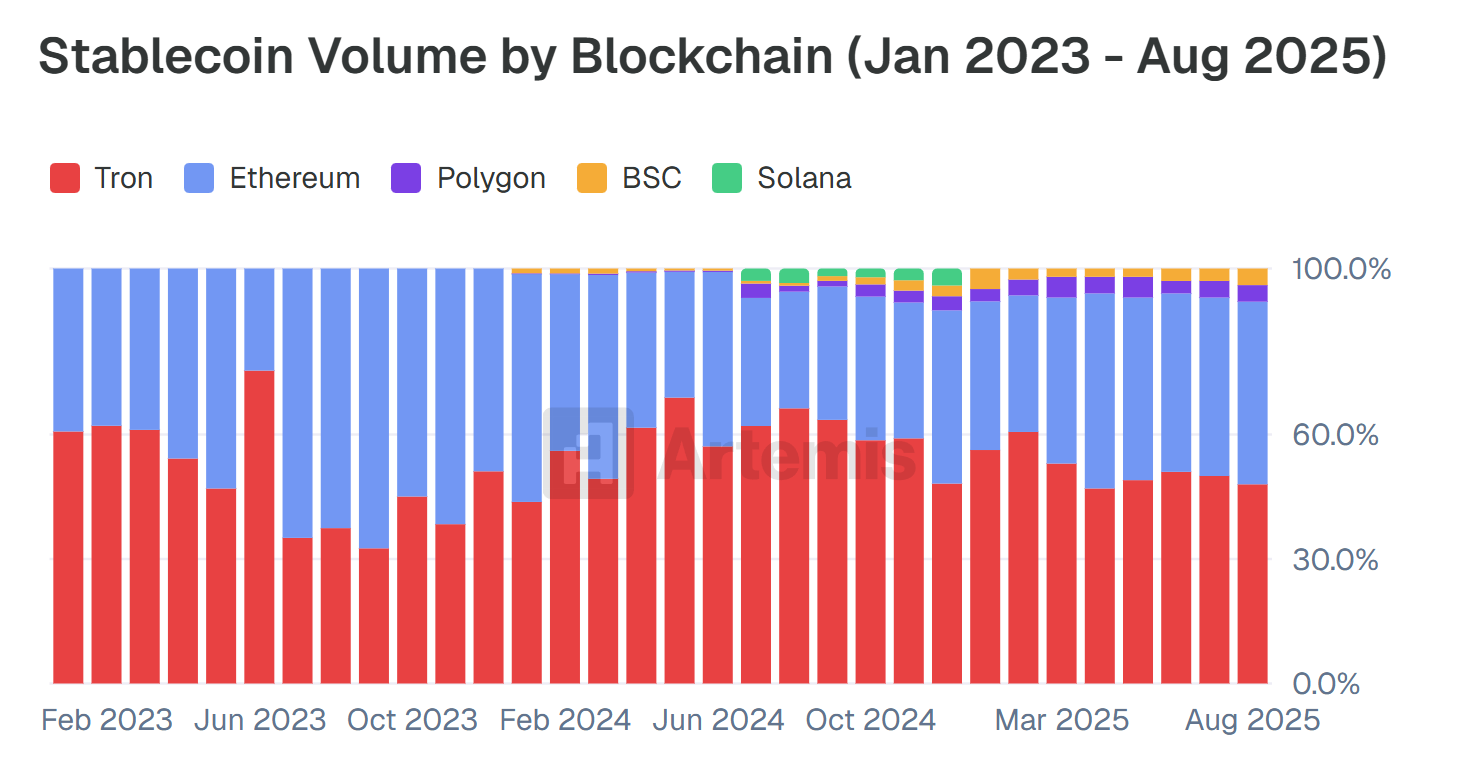
Stablecoin Volume by Blockchain.Stablecoin Volume by Blockchain. Source: Artemis

Dragonfly partner Omar Kanji said this trend marks the “beginning of a structural rotation,” where lower-cost and high-throughput alternatives gradually eat into Tron’s dominance.

On the asset side, Tether’s USDT continues to dominate the stablecoin ecosystem with roughly 79% of all payment volume, driven by deep liquidity and unmatched accessibility across Africa and Latin America.

Yet Circle’s USDC is quietly expanding its footprint as its share rose from 14% to 21% since February.
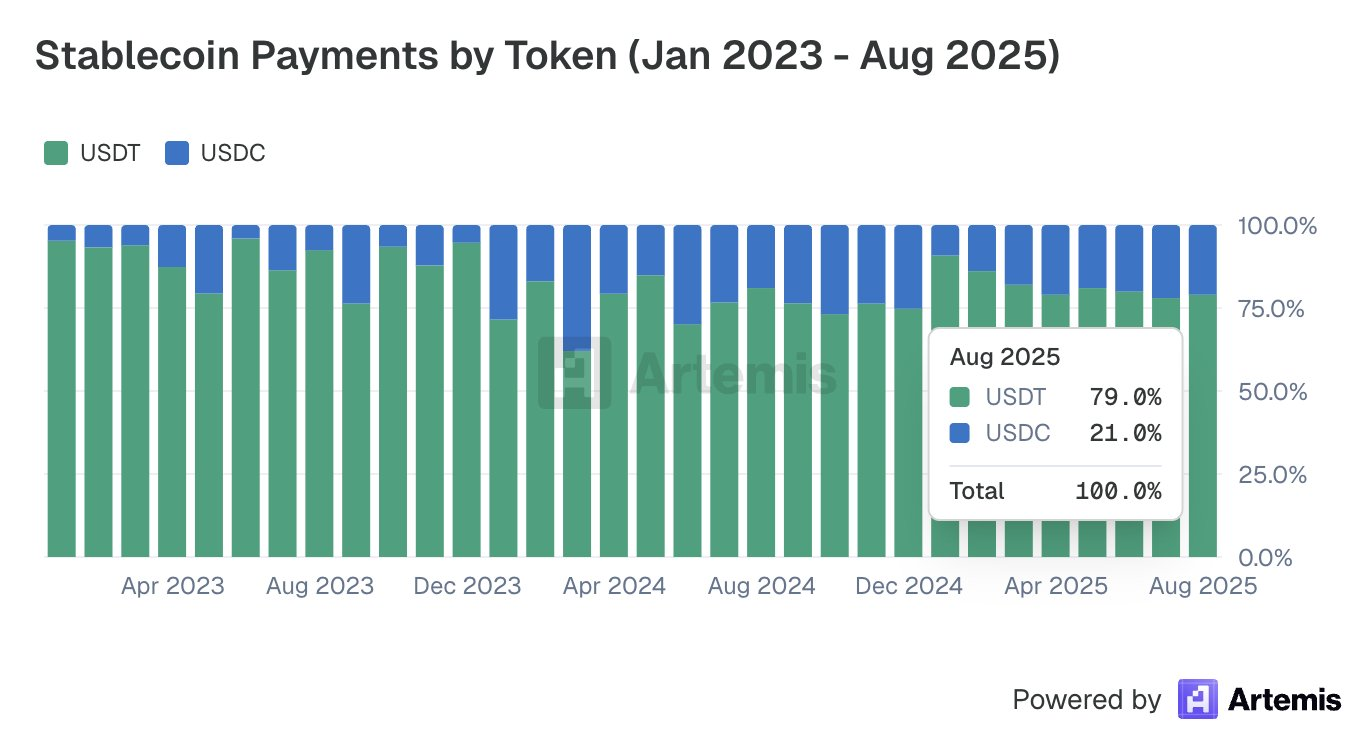
Stablecoins Payments by Token.Stablecoins Payments by Token. Source: Artemis

Data from DeFiLlama shows that USDT’s market capitalization stands at $183 billion, while USDC hovers near $76 billion. Together, they anchor the over $300-billion network of digital dollars that now move with the speed of code and the reach of global finance.

Market Opportunity
RealLink Logo
RealLink Price(REAL)
$0.07471
$0.07471$0.07471
+1.24%
USD
RealLink (REAL) Live Price Chart
Disclaimer: The articles reposted on this site are sourced from public platforms and are provided for informational purposes only. They do not necessarily reflect the views of MEXC. All rights remain with the original authors. If you believe any content infringes on third-party rights, please contact service@support.mexc.com for removal. MEXC makes no guarantees regarding the accuracy, completeness, or timeliness of the content and is not responsible for any actions taken based on the information provided. The content does not constitute financial, legal, or other professional advice, nor should it be considered a recommendation or endorsement by MEXC.

You May Also Like

Japan’s Rate Hike Puts Bitcoin on Edge

Japan’s Rate Hike Puts Bitcoin on Edge

Japan's rate hike ends ultra-loose policies, impacting Bitcoin prices and global markets.
Share
CoinLive2025/12/22 07:43
How to earn from cloud mining: IeByte’s upgraded auto-cloud mining platform unlocks genuine passive earnings

How to earn from cloud mining: IeByte’s upgraded auto-cloud mining platform unlocks genuine passive earnings

The post How to earn from cloud mining: IeByte’s upgraded auto-cloud mining platform unlocks genuine passive earnings appeared on BitcoinEthereumNews.com. contributor Posted: September 17, 2025 As digital assets continue to reshape global finance, cloud mining has become one of the most effective ways for investors to generate stable passive income. Addressing the growing demand for simplicity, security, and profitability, IeByte has officially upgraded its fully automated cloud mining platform, empowering both beginners and experienced investors to earn Bitcoin, Dogecoin, and other mainstream cryptocurrencies without the need for hardware or technical expertise. Why cloud mining in 2025? Traditional crypto mining requires expensive hardware, high electricity costs, and constant maintenance. In 2025, with blockchain networks becoming more competitive, these barriers have grown even higher. Cloud mining solves this by allowing users to lease professional mining power remotely, eliminating the upfront costs and complexity. IeByte stands at the forefront of this transformation, offering investors a transparent and seamless path to daily earnings. IeByte’s upgraded auto-cloud mining platform With its latest upgrade, IeByte introduces: Full Automation: Mining contracts can be activated in just one click, with all processes handled by IeByte’s servers. Enhanced Security: Bank-grade encryption, cold wallets, and real-time monitoring protect every transaction. Scalable Options: From starter packages to high-level investment contracts, investors can choose the plan that matches their goals. Global Reach: Already trusted by users in over 100 countries. Mining contracts for 2025 IeByte offers a wide range of contracts tailored for every investor level. From entry-level plans with daily returns to premium high-yield packages, the platform ensures maximum accessibility. Contract Type Duration Price Daily Reward Total Earnings (Principal + Profit) Starter Contract 1 Day $200 $6 $200 + $6 + $10 bonus Bronze Basic Contract 2 Days $500 $13.5 $500 + $27 Bronze Basic Contract 3 Days $1,200 $36 $1,200 + $108 Silver Advanced Contract 1 Day $5,000 $175 $5,000 + $175 Silver Advanced Contract 2 Days $8,000 $320 $8,000 + $640 Silver…
Share
BitcoinEthereumNews2025/09/17 23:48
Stablecoins Get A Break? US Lawmakers Propose Tax Relief

Stablecoins Get A Break? US Lawmakers Propose Tax Relief

Lawmakers in the US have put forward a discussion draft that would ease tax reporting for small stablecoin payments and let some crypto earners delay taxes on staking
Share
Bitcoinist2025/12/22 07:00