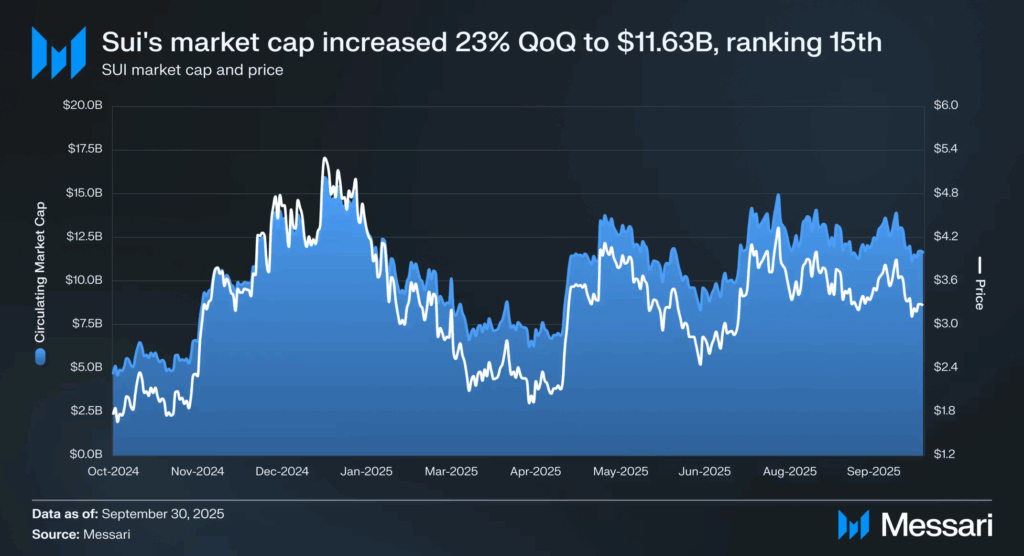
Sui Network saw a notable increase in market value in Q3 2025, with its circulating market cap rising 23.3% quarter-over-quarter to $11.63 billion. This growth outpaced the broader cryptocurrency market, which advanced 20.7% during the same period, as per report by Messari. Despite the market gains, SUI fell three positions from Q2 to rank as […]Sui Network saw a notable increase in market value in Q3 2025, with its circulating market cap rising 23.3% quarter-over-quarter to $11.63 billion. This growth outpaced the broader cryptocurrency market, which advanced 20.7% during the same period, as per report by Messari. Despite the market gains, SUI fell three positions from Q2 to rank as […]

Sui Network Market Cap Climbs $11.6 Billion Despite Declining Daily Transactions


sui
  1. SUI’s market cap rose 23.3% QoQ to $11.63B, though network activity slowed.
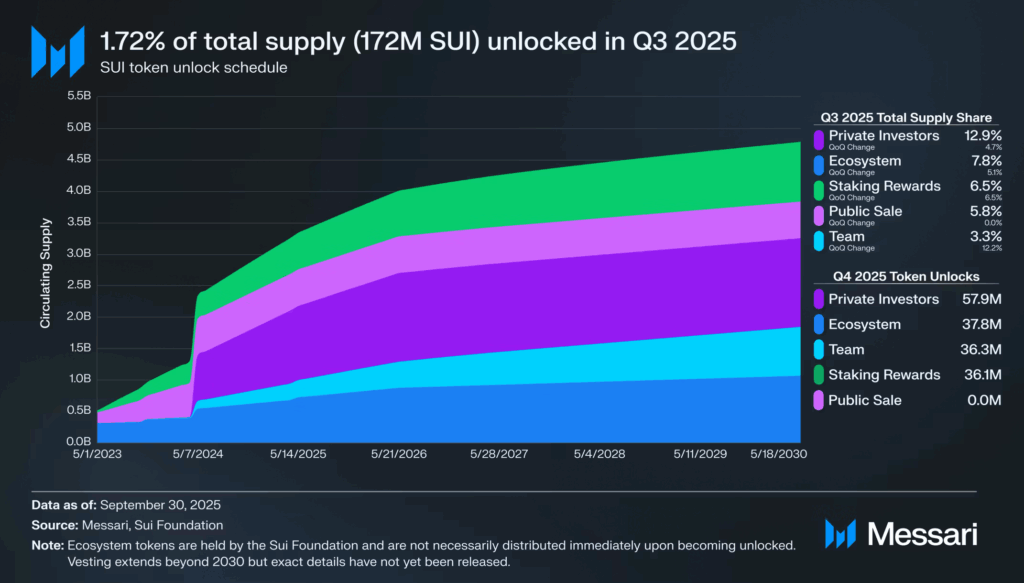
  2. 172.1M SUI ($561M) unlocked in Q3, increasing circulating supply to 35.7%.
  3. Staking remains high at 75.4% of the eligible supply, with a slightly negative real yield.

Sui Network saw a notable increase in market value in Q3 2025, with its circulating market cap rising 23.3% quarter-over-quarter to $11.63 billion. This growth outpaced the broader cryptocurrency market, which advanced 20.7% during the same period, as per report by Messari.
Source: Messari

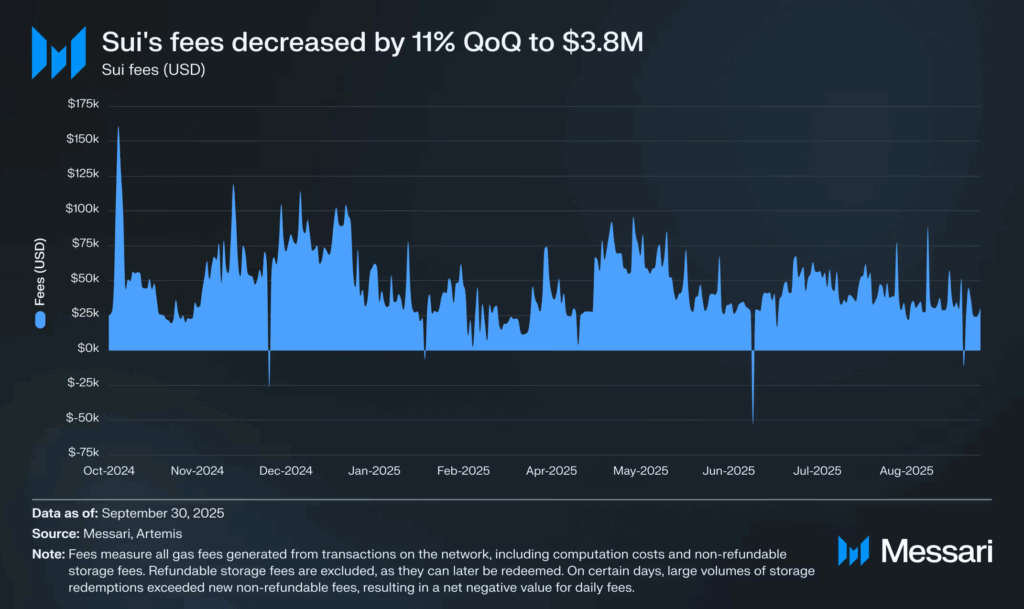
Despite the market gains, SUI fell three positions from Q2 to rank as the 15th largest cryptocurrency by market cap. Transaction fees on the network, which include computation costs and non-refundable storage fees distributed to validators, fell in both USD and token terms.

Total fees decreased 11.1% to $3.8 million, while fees denominated in SUI dropped 22.3% to 1.1 million tokens. Analysts attribute this decline to a slowdown in transaction demand and network activity, despite the token’s price appreciation over the quarter.
Source: Messari

Q3 Token Unlocks Increase SUI Circulating Supply

Q3 saw a series of token unlocks that expanded SUI’s circulating supply. Across July, August, and September, 172.1 million SUI tokens, valued at $561.1 million, were released from reserves, team allocations, private investors, and staking rewards. This represented 1.72% of the total supply, pushing distributed tokens to 35.7% of the network’s maximum supply.
Source: Messari

The network’s staking mechanism, designed to distribute 1 billion tokens over time, continues to impact inflation. At the end of Q3, the annualized staking reward inflation rate stood at 0.20%, decreasing by 10% every quarter until full distribution.

A high proportion of tokens remains staked, with 75.4% of the eligible supply locked for rewards, slightly down from Q2. Due to price gains in SUI, the USD value of staked tokens rose 15.8% to $24.58 billion, although the network’s real annualized yield is slightly negative at -0.09%.

Sui Foundation Supports Decentralized Staking

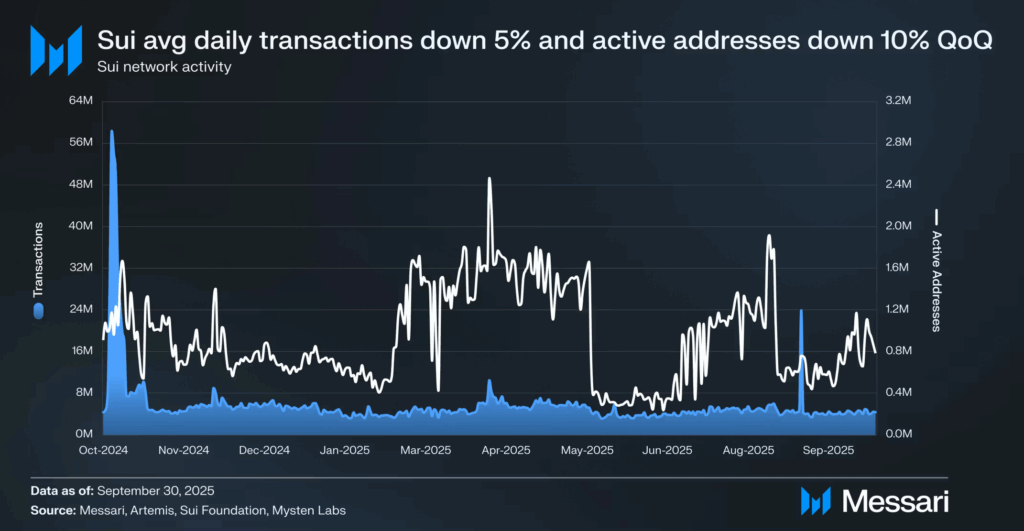
Network usage declined in Q3, with average daily transactions down 4.7% to 4.7 million and average daily active addresses falling 9.5% to 895,800. Average transaction fees decreased 17.3% to 0.0025 token ($0.0088), with sponsored transactions covering about 32.1% of total activity.
Source: Messari

On the security front, the number of active validators continued to expand, increasing from 104 to 122. The Foundation, holding a significant portion of the token supply, helps distribute stakes evenly across validators, supporting network decentralization.

Despite slower activity, the network maintains strong staking participation and a robust validator network, laying the groundwork for continued growth as the ecosystem matures.

Related Reading: SUI Rally Potential: Historical Patterns Could Drive Price to $20

Market Opportunity
SUI Logo
SUI Price(SUI)
$1.4071
$1.4071$1.4071
-0.59%
USD
SUI (SUI) Live Price Chart
Disclaimer: The articles reposted on this site are sourced from public platforms and are provided for informational purposes only. They do not necessarily reflect the views of MEXC. All rights remain with the original authors. If you believe any content infringes on third-party rights, please contact service@support.mexc.com for removal. MEXC makes no guarantees regarding the accuracy, completeness, or timeliness of the content and is not responsible for any actions taken based on the information provided. The content does not constitute financial, legal, or other professional advice, nor should it be considered a recommendation or endorsement by MEXC.

You May Also Like

Trust Wallet’s Decisive Move: Full Compensation for $7M Hack Victims

Trust Wallet’s Decisive Move: Full Compensation for $7M Hack Victims

BitcoinWorld Trust Wallet’s Decisive Move: Full Compensation for $7M Hack Victims In a significant move for cryptocurrency security, Trust Wallet has committed
Share
bitcoinworld2025/12/26 17:40
Cashing In On University Patents Means Giving Up On Our Innovation Future

Cashing In On University Patents Means Giving Up On Our Innovation Future

The post Cashing In On University Patents Means Giving Up On Our Innovation Future appeared on BitcoinEthereumNews.com. “It’s a raid on American innovation that would deliver pennies to the Treasury while kneecapping the very engine of our economic and medical progress,” writes Pipes. Getty Images Washington is addicted to taxing success. Now, Commerce Secretary Howard Lutnick is floating a plan to skim half the patent earnings from inventions developed at universities with federal funding. It’s being sold as a way to shore up programs like Social Security. In reality, it’s a raid on American innovation that would deliver pennies to the Treasury while kneecapping the very engine of our economic and medical progress. Yes, taxpayer dollars support early-stage research. But the real payoff comes later—in the jobs created, cures discovered, and industries launched when universities and private industry turn those discoveries into real products. By comparison, the sums at stake in patent licensing are trivial. Universities collectively earn only about $3.6 billion annually in patent income—less than the federal government spends on Social Security in a single day. Even confiscating half would barely register against a $6 trillion federal budget. And yet the damage from such a policy would be anything but trivial. The true return on taxpayer investment isn’t in licensing checks sent to Washington, but in the downstream economic activity that federally supported research unleashes. Thanks to the bipartisan Bayh-Dole Act of 1980, universities and private industry have powerful incentives to translate early-stage discoveries into real-world products. Before Bayh-Dole, the government hoarded patents from federally funded research, and fewer than 5% were ever licensed. Once universities could own and license their own inventions, innovation exploded. The result has been one of the best returns on investment in government history. Since 1996, university research has added nearly $2 trillion to U.S. industrial output, supported 6.5 million jobs, and launched more than 19,000 startups. Those companies pay…
Share
BitcoinEthereumNews2025/09/18 03:26
Trust Wallet Hack Hits $7M: CZ Hints at Possible Insider Role

Trust Wallet Hack Hits $7M: CZ Hints at Possible Insider Role

CZ hinted at possible insider involvement in the Trust Wallet incident while assuring users that their funds would be reimbursed.
Share
CryptoPotato2025/12/26 16:48