By Yuliya, PANews September 16th, a seemingly ordinary day, could become a pivotal turning point in the history of AI. On that day, Google officially released the Agent Payments Protocol (AP2) , an open standard designed for AI agents to securely execute financial transactions on behalf of users. AP2 is not a one-man show for Google. It is not only a technical agreement, but also a rallying cry, announcing the beginning of a new business era driven by AI and connecting traditional finance and the crypto world. The list includes payment giants like Mastercard, American Express, PayPal, and UnionPay International; technology/AI companies like Salesforce, Adobe, and ServiceNow; and key players in the crypto world like Coinbase, MetaMask, the Ethereum Foundation, and Mysten Labs. This suggests that empowering AI agents with the ability to spend money has become an industry-wide consensus. Why does the world need AP2? Three major trust challenges in AI payments The rise of AI agents has shattered a fundamental assumption: in the past, all payment systems assumed a human being was behind the screen clicking the "buy" button. But when AI began to autonomously book flights, snap up goods, and even manage our investments , three core issues emerged: Authorization : How to prove that "the user really allows AI to spend this money"? Authenticity : How can businesses confirm that “AI requests” truly reflect user wishes? Responsibility : If AI buys the wrong thing or is even cheated, who is responsible? AP2's mission is to address these issues through "Digital Mandates ." These are cryptographically signed, tamper-proof contracts that transform every user's intent (e.g., "Buy me concert tickets") and final approval (e.g., confirming shopping cart items and prices) into a verifiable chain of evidence . Whether it's a real-time purchase or a pre-determined task, the entire process—from intent to shopping cart to payment—is fully documented, creating a clear, undeniable audit trail and providing a solid foundation for addressing the three major trust challenges. The trilogy from MCP, A2A to AP2 AP2 is not an isolated product, but a key component of Google's AI agent protocol portfolio. Together with the previous A2A (Agent2Agent Protocol) and the industry-driven MCP (Model Context Protocol), it forms a "trilogy" for AI agents to interact with the external world: MCP : Driven by companies like Anthropic, this initiative addresses how AI interacts with external data and tools (such as databases, software, and blockchains). It acts like a universal adapter, enabling AI to read and write data in a unified language . This is fundamental to obtaining real-time information and executing actions. A2A : Released by Google in April 2025, it aims to enable AI agents from different companies and platforms to communicate and collaborate securely. If MCP enables AI to "see" and "touch," A2A enables AI to "talk" and "collaborate." AP2 : After enabling global connectivity and collaboration, AP2 empowers AI agents with the most critical capability: "transaction." It extends the A2A protocol, enabling closed-loop collaboration between agents through value exchange. Together, these three elements outline a grand vision: future AI agents will no longer be isolated chatbots, but will become intelligent economic participants that can access real-time data, work collaboratively with other agents, and ultimately complete complex business tasks (including payments). The "tipping point" of the crypto world: How the top ten projects are planning AI payments AP2 was designed from the outset for universal access, supporting not only traditional payment methods like credit cards and bank transfers, but also stablecoins and cryptocurrencies as native payment options. Google, in collaboration with Coinbase, the Ethereum Foundation, MetaMask, and others, has launched the A2A x402 extension, a production-grade solution specifically for crypto payments. This creates unprecedented opportunities for crypto projects cultivating the AI agent economy. The following 10 projects are playing a key role in this effort: 1. Coinbase: A promoter and practitioner of AI payment standards As Google's most important strategic ally in the crypto space, Coinbase's role goes far beyond a simple partner. It is not only the original proponent of the x402 payment standard , but also actively promotes the realization of this vision. Designed specifically for stablecoin payments, x402 supports cryptocurrency micropayments and instant settlement between AI agents. Coinbase Engineering Director Erik Reppel called it "a natural proving ground for agents to begin transacting with each other and testing the crypto landscape." In collaboration with Google, a shopping demo Coinbase created for Lowe's clearly demonstrated this: with a single prompt, an AI agent seamlessly completed the entire process of product research, inventory verification, shopping cart creation, and final payment using x402 and stablecoins. Internally, Coinbase has long leveraged AI to improve operational efficiency. For example, its NodeSmith system uses AI to automate node upgrades for over 60 blockchains, reducing repetitive work for engineers by 30%. Coinbase is also exploring cutting-edge areas, including integrating the Bitcoin Lightning Network to reduce payment costs. In terms of external development, Coinbase has deeply integrated its business with the broader on-chain economy and AI applications by acquiring the DeFi consumer application team Sensible and serving as the crypto infrastructure partner for the U.S. Department of Commerce's "GDP Data on-chain" project. Its goal is to become a "one-stop trading platform" for the future AI agent economy. 2. MetaMask: Building a Self-Hosted AI-Powered Proxy Wallet MetaMask, a crypto wallet used by hundreds of millions of users worldwide, is focused on ensuring users retain absolute control over their assets and data while enjoying the convenience of AI. Its vision is to achieve "self-custody in the age of agents." Marco De Rossi, Head of MetaMask AI, emphasized, "Blockchain is the natural payment layer for agents, and Ethereum will be its backbone." To this end, MetaMask actively embraces the x402 standard and AP2 protocol, and works with Stripe's Bridge platform and M0 to launch the stablecoin MetaMask USD (mUSD), which is deeply integrated with the ecosystem. In terms of security, MetaMask launched the Delegation Toolkit, which allows users to set granular permissions for AI agents, such as budget caps, available asset ranges, and validity time windows, enabling secure automation through "delegation rather than handing over private keys." MetaMask and the Ethereum Foundation are also jointly promoting the ERC-8004 trusted agent standard, establishing an open and verifiable agent registration and reputation system, allowing anyone to query the capabilities and reputation of AI agents. On August 26th, MetaMask announced the launch of social login, allowing users to quickly create, backup, and restore wallets using their Google or Apple accounts while maintaining self-custody. This not only improves the user experience but also further establishes MetaMask as a secure and convenient entry point into the AI agent economy. 3. Ethereum Foundation: Building the underlying trust network for the AI economy With its robust network effects and liquidity, Ethereum serves as a neutral, trusted settlement and coordination network for the global AI agent economy. Currently, the circulating supply of stablecoins on Ethereum has exceeded $171 billion, with the mainnet holding $152.8 billion, a significant year-on-year increase of 78%, firmly establishing it as the global center of stablecoin liquidity. To capitalize on the historic opportunity presented by AI, its mission is to "make Ethereum the preferred settlement and coordination layer for AI and the machine economy." The team is working on two main fronts: first, building an "AI economy on Ethereum," providing a middleman-free payment and coordination mechanism for AI agents; and second, promoting a "decentralized AI stack" to ensure that the future of AI is not reliant on a handful of tech giants. In this process, the Foundation is actively promoting the development of protocols such as ERC-8004 (Trusted Agent Standard) and working closely with ecological projects to enable AI agents to securely make payments, coordinate, and follow rules on Ethereum, thereby breaking away from dependence on centralized platforms and building an open, censorship-resistant, decentralized AI ecosystem. 4. Mysten Labs (Sui): High-performance AI business infrastructure The AI agent economy demands extremely fast and programmable payments and transactions, which are key strengths of Mysten Labs and its Sui blockchain. As a launch partner of AP2, Sui's unique architecture compresses transaction confirmation speeds to under 400 milliseconds, ensuring the performance required for real-time AI agent interactions . Its signature feature is Programmable Transaction Blocks (PTBs), which bundle multiple complex operations into a single atomic transaction. For example, a shopping agent can simultaneously initiate six independent purchases from three different merchant agents and settle them in a single transaction, significantly improving efficiency. In addition, Mysten Labs has built a complete technology stack to support the future of AI agents: Walrus is used to decentralize data storage and record provenance, Seal provides programmable data access control, and zkLogin allows users to interact with the blockchain in a privacy-preserving manner through traditional Web2 accounts (such as Google accounts), providing an innovative solution to the identity and data privacy issues of AI agents. 5. EigenCloud: The Verifiable Foundation of the AI Agent Economy In an environment where AI agents autonomously perform high-risk tasks, "trust" becomes core. EigenCloud is committed to providing verifiability for all actions of AI agents , thereby building a global verifiable economy. Founder Sreeram Kannan noted that the AP2 protocol creates a "global verifiable economy where agents can coordinate, transact, and prove their actions to humans and each other," while EigenCloud provides the underlying infrastructure to ensure their accountability. At the core of EigenCloud is its "encrypted cloud" concept, which extends Ethereum's security to a variety of services, including AI computing, data availability (EigenDA), and dispute resolution (EigenVerify) through the restaking mechanism of EIGEN tokens. This vision has garnered strong support from top-tier capital, with a16z investing an additional $70 million in EIGEN tokens, following their $100 million investment. To accelerate ecosystem development, Eigen Labs has launched a series of developer tools including DevKit, Hourglass, and Multichain, which reduce the time required to build an AVS (Active Verification Service) from weeks to minutes, laying a solid foundation for the trust layer of the AI agent economy. 6. Crossmint: A universal socket connecting businesses to the AI economy For many traditional enterprises, integrating complex blockchain technology is extremely challenging. Crossmint acts as an enterprise-level "translator" and "adapter," encapsulating complex blockchain backends into simple APIs, enabling businesses to quickly embrace the AI agent economy . As a partner of Google AP2, Crossmint provides one-stop solutions such as wallet-as-a-service and stablecoin payments, while supporting credit card and cryptocurrency payments, greatly lowering the entry threshold for businesses and users. Its powerful capabilities have been demonstrated in numerous real-world cases. For example, it helped global remittance giant MoneyGram launch a USDC-based cross-border payment service in Colombia, allowing users to receive stablecoins in their wallets via SMS. It also built an AI-powered on-chain loyalty program based on Solana for the renowned American milk tea brand Boba Guys, resulting in loyalty members spending 3.5 times more than non-members and a 244% increase in store visits. Its current client base includes 40,000 businesses and developers, including Adidas, Red Bull, and Coinbase. Its stablecoin API and AI bot payment capabilities have proven highly popular, with subscriptions expected to grow 1,100% in 2024. Crossmint is becoming a key enabler of the commercialization of AI agents. 7. BVNK: A full-stack provider of enterprise-grade stablecoin payments BVNK specializes in providing end-to-end stablecoin payment solutions for global businesses. Its role is to provide a comprehensive, mature, and intelligent financial infrastructure for businesses to utilize stablecoins for payment, collection, and fund management . As a partner of Google AP2 and a recipient of investment from Visa, BVNK has experienced rapid business growth, processing over $15 billion in annual transaction volume and serving global companies such as Deel, Worldpay, and LianLian Global. Through its partnership with Paxos, BVNK is expanding its services to all 50 states. Furthermore, BVNK has integrated AI into its core products, launching an AI Assistant and Smart Treasury. The AI Assistant uses natural language processing to help customers check balances and generate addresses. The Smart Treasury, on the other hand, leverages machine learning to predict liquidity needs and automatically complete operations such as fund rebalancing and gas fee management. This transforms traditional passive, manual financial management into a proactive, intelligent, automated system, perfectly suited to the 24/7 operation of stablecoins. 8. Mesh: AI Agent's "Universal Payment Connector" In a complex network of countless AI agents, wallets, and exchanges, how can payments always be completed in the most efficient and cost-effective manner? Mesh is committed to solving the fragmentation problem of the crypto payment ecosystem and providing a unified entry point for AI agents . Its CEO, Bam Azizi, said that Mesh's technology "abstracts the complexity of the crypto ecosystem." As a supporter of the AP2 protocol, Mesh's API seamlessly connects to over 300 wallets and exchanges, supporting hundreds of tokens. When an AI agent needs to make a payment, Mesh's technology automatically analyzes and finds the optimal payment path, ensuring transaction success and speed. It acts as a "smart payment GPS" in the AI economy, guiding every transaction. In August, Mesh secured a new round of investment from PayPal Ventures, Coinbase Ventures, and other institutions, bringing its total funding to over $130 million. Furthermore, it launched Wallet-as-a-Service, further solidifying its position as the underlying infrastructure for AI-powered payments. 9. Questflow: The "Orchestration and Distribution Center" for the AI Agent Economy While other projects provide "parts," Questflow is building the "assembly line" and "app store." As a launch partner of AP2, Questflow positions itself as the orchestration layer for the multi-agent economy. It allows users to describe their needs in natural language and then automatically coordinates multiple AI agents with diverse functionalities (such as content generation, data analysis, and transaction execution) to collaboratively complete complex tasks . Since the release of AP2, Questflow's transaction volume has doubled weekly, demonstrating rapid growth. Its core is the Multi-Agent Orchestration Protocol (MAOP) and TARS platform, which allow users to describe their needs in natural language (for example, "Help me organize the latest developments on AI+Crypto"). The platform can then automatically coordinate multiple AI agents with different functions (such as news aggregation agents, on-chain data analysis agents, etc.) to collaboratively complete complex tasks. Questflow has built-in Coinbase's x402 micropayment system, allowing agents to be paid based on task results and usage (pay-as-you-go), thereby building an open and composable AI labor market. Leveraging its $6.5 million seed round funding and deep partnerships with numerous top platforms such as Google, Coinbase, and Circle, it has also launched the A2A.build portal, aiming to become a central hub for discovering and using all AP2 and x402 protocol-compatible agents. The platform brings together 40 active AI agents, 106 A2A integrations, and 66 developers, aiming to become the "App Store" of the AI era, managing the traffic and economic distribution of AI agents. 10. Lightspark: Using Bitcoin Lightning Network to Enable AI-Powered Real-Time Payments Among the many Ethereum-based solutions, Lightspark stands out by bringing the near-instant, ultra-low-cost payment capabilities of the Bitcoin Lightning Network to the AI agent economy . As a partner in the AP2 protocol, the company, founded by former PayPal President David Marcus, is focused on building an open, interoperable global payments network. It has partnered with fintech giant SoFi and digital bank Revolut to integrate its technology into mainstream financial applications. By promoting its Universal Money Address (UMA) standard and aligning with Lightning Network integrations with exchanges like Coinbase, Lightspark offers a new, efficient, and cost-effective Bitcoin-based option for AI-powered payments. Building an AI encrypted payment technology foundation The release of Google's AP2 protocol is far more than just a technological update. In the future, AP2 could become the underlying infrastructure for AI, e-commerce, and encrypted payments . It's a clear signal that AI is evolving from an information processing tool to a true economic player. This process is interwoven with two main threads: The power of Web2 : Giants such as Google, Mastercard, and Salesforce provide a huge application scenario, user base, and business network. The genes of Web3 : Crypto native forces such as Ethereum, Coinbase, and MetaMask provide the underlying philosophy and technical implementation (stablecoins, smart contracts, and non-custodial wallets) of decentralization, trustlessness, and user autonomy. AP2 and the alliance behind it represent the first large-scale convergence of these two forces. It will give rise to a new, autonomous economy driven by AI agents, spanning the boundaries between traditional and cryptocurrencies. The ten crypto projects mentioned above are not just participants; they are shaping this major economic transformation. By Yuliya, PANews September 16th, a seemingly ordinary day, could become a pivotal turning point in the history of AI. On that day, Google officially released the Agent Payments Protocol (AP2) , an open standard designed for AI agents to securely execute financial transactions on behalf of users. AP2 is not a one-man show for Google. It is not only a technical agreement, but also a rallying cry, announcing the beginning of a new business era driven by AI and connecting traditional finance and the crypto world. The list includes payment giants like Mastercard, American Express, PayPal, and UnionPay International; technology/AI companies like Salesforce, Adobe, and ServiceNow; and key players in the crypto world like Coinbase, MetaMask, the Ethereum Foundation, and Mysten Labs. This suggests that empowering AI agents with the ability to spend money has become an industry-wide consensus. Why does the world need AP2? Three major trust challenges in AI payments The rise of AI agents has shattered a fundamental assumption: in the past, all payment systems assumed a human being was behind the screen clicking the "buy" button. But when AI began to autonomously book flights, snap up goods, and even manage our investments , three core issues emerged: Authorization : How to prove that "the user really allows AI to spend this money"? Authenticity : How can businesses confirm that “AI requests” truly reflect user wishes? Responsibility : If AI buys the wrong thing or is even cheated, who is responsible? AP2's mission is to address these issues through "Digital Mandates ." These are cryptographically signed, tamper-proof contracts that transform every user's intent (e.g., "Buy me concert tickets") and final approval (e.g., confirming shopping cart items and prices) into a verifiable chain of evidence . Whether it's a real-time purchase or a pre-determined task, the entire process—from intent to shopping cart to payment—is fully documented, creating a clear, undeniable audit trail and providing a solid foundation for addressing the three major trust challenges. The trilogy from MCP, A2A to AP2 AP2 is not an isolated product, but a key component of Google's AI agent protocol portfolio. Together with the previous A2A (Agent2Agent Protocol) and the industry-driven MCP (Model Context Protocol), it forms a "trilogy" for AI agents to interact with the external world: MCP : Driven by companies like Anthropic, this initiative addresses how AI interacts with external data and tools (such as databases, software, and blockchains). It acts like a universal adapter, enabling AI to read and write data in a unified language . This is fundamental to obtaining real-time information and executing actions. A2A : Released by Google in April 2025, it aims to enable AI agents from different companies and platforms to communicate and collaborate securely. If MCP enables AI to "see" and "touch," A2A enables AI to "talk" and "collaborate." AP2 : After enabling global connectivity and collaboration, AP2 empowers AI agents with the most critical capability: "transaction." It extends the A2A protocol, enabling closed-loop collaboration between agents through value exchange. Together, these three elements outline a grand vision: future AI agents will no longer be isolated chatbots, but will become intelligent economic participants that can access real-time data, work collaboratively with other agents, and ultimately complete complex business tasks (including payments). The "tipping point" of the crypto world: How the top ten projects are planning AI payments AP2 was designed from the outset for universal access, supporting not only traditional payment methods like credit cards and bank transfers, but also stablecoins and cryptocurrencies as native payment options. Google, in collaboration with Coinbase, the Ethereum Foundation, MetaMask, and others, has launched the A2A x402 extension, a production-grade solution specifically for crypto payments. This creates unprecedented opportunities for crypto projects cultivating the AI agent economy. The following 10 projects are playing a key role in this effort: 1. Coinbase: A promoter and practitioner of AI payment standards As Google's most important strategic ally in the crypto space, Coinbase's role goes far beyond a simple partner. It is not only the original proponent of the x402 payment standard , but also actively promotes the realization of this vision. Designed specifically for stablecoin payments, x402 supports cryptocurrency micropayments and instant settlement between AI agents. Coinbase Engineering Director Erik Reppel called it "a natural proving ground for agents to begin transacting with each other and testing the crypto landscape." In collaboration with Google, a shopping demo Coinbase created for Lowe's clearly demonstrated this: with a single prompt, an AI agent seamlessly completed the entire process of product research, inventory verification, shopping cart creation, and final payment using x402 and stablecoins. Internally, Coinbase has long leveraged AI to improve operational efficiency. For example, its NodeSmith system uses AI to automate node upgrades for over 60 blockchains, reducing repetitive work for engineers by 30%. Coinbase is also exploring cutting-edge areas, including integrating the Bitcoin Lightning Network to reduce payment costs. In terms of external development, Coinbase has deeply integrated its business with the broader on-chain economy and AI applications by acquiring the DeFi consumer application team Sensible and serving as the crypto infrastructure partner for the U.S. Department of Commerce's "GDP Data on-chain" project. Its goal is to become a "one-stop trading platform" for the future AI agent economy. 2. MetaMask: Building a Self-Hosted AI-Powered Proxy Wallet MetaMask, a crypto wallet used by hundreds of millions of users worldwide, is focused on ensuring users retain absolute control over their assets and data while enjoying the convenience of AI. Its vision is to achieve "self-custody in the age of agents." Marco De Rossi, Head of MetaMask AI, emphasized, "Blockchain is the natural payment layer for agents, and Ethereum will be its backbone." To this end, MetaMask actively embraces the x402 standard and AP2 protocol, and works with Stripe's Bridge platform and M0 to launch the stablecoin MetaMask USD (mUSD), which is deeply integrated with the ecosystem. In terms of security, MetaMask launched the Delegation Toolkit, which allows users to set granular permissions for AI agents, such as budget caps, available asset ranges, and validity time windows, enabling secure automation through "delegation rather than handing over private keys." MetaMask and the Ethereum Foundation are also jointly promoting the ERC-8004 trusted agent standard, establishing an open and verifiable agent registration and reputation system, allowing anyone to query the capabilities and reputation of AI agents. On August 26th, MetaMask announced the launch of social login, allowing users to quickly create, backup, and restore wallets using their Google or Apple accounts while maintaining self-custody. This not only improves the user experience but also further establishes MetaMask as a secure and convenient entry point into the AI agent economy. 3. Ethereum Foundation: Building the underlying trust network for the AI economy With its robust network effects and liquidity, Ethereum serves as a neutral, trusted settlement and coordination network for the global AI agent economy. Currently, the circulating supply of stablecoins on Ethereum has exceeded $171 billion, with the mainnet holding $152.8 billion, a significant year-on-year increase of 78%, firmly establishing it as the global center of stablecoin liquidity. To capitalize on the historic opportunity presented by AI, its mission is to "make Ethereum the preferred settlement and coordination layer for AI and the machine economy." The team is working on two main fronts: first, building an "AI economy on Ethereum," providing a middleman-free payment and coordination mechanism for AI agents; and second, promoting a "decentralized AI stack" to ensure that the future of AI is not reliant on a handful of tech giants. In this process, the Foundation is actively promoting the development of protocols such as ERC-8004 (Trusted Agent Standard) and working closely with ecological projects to enable AI agents to securely make payments, coordinate, and follow rules on Ethereum, thereby breaking away from dependence on centralized platforms and building an open, censorship-resistant, decentralized AI ecosystem. 4. Mysten Labs (Sui): High-performance AI business infrastructure The AI agent economy demands extremely fast and programmable payments and transactions, which are key strengths of Mysten Labs and its Sui blockchain. As a launch partner of AP2, Sui's unique architecture compresses transaction confirmation speeds to under 400 milliseconds, ensuring the performance required for real-time AI agent interactions . Its signature feature is Programmable Transaction Blocks (PTBs), which bundle multiple complex operations into a single atomic transaction. For example, a shopping agent can simultaneously initiate six independent purchases from three different merchant agents and settle them in a single transaction, significantly improving efficiency. In addition, Mysten Labs has built a complete technology stack to support the future of AI agents: Walrus is used to decentralize data storage and record provenance, Seal provides programmable data access control, and zkLogin allows users to interact with the blockchain in a privacy-preserving manner through traditional Web2 accounts (such as Google accounts), providing an innovative solution to the identity and data privacy issues of AI agents. 5. EigenCloud: The Verifiable Foundation of the AI Agent Economy In an environment where AI agents autonomously perform high-risk tasks, "trust" becomes core. EigenCloud is committed to providing verifiability for all actions of AI agents , thereby building a global verifiable economy. Founder Sreeram Kannan noted that the AP2 protocol creates a "global verifiable economy where agents can coordinate, transact, and prove their actions to humans and each other," while EigenCloud provides the underlying infrastructure to ensure their accountability. At the core of EigenCloud is its "encrypted cloud" concept, which extends Ethereum's security to a variety of services, including AI computing, data availability (EigenDA), and dispute resolution (EigenVerify) through the restaking mechanism of EIGEN tokens. This vision has garnered strong support from top-tier capital, with a16z investing an additional $70 million in EIGEN tokens, following their $100 million investment. To accelerate ecosystem development, Eigen Labs has launched a series of developer tools including DevKit, Hourglass, and Multichain, which reduce the time required to build an AVS (Active Verification Service) from weeks to minutes, laying a solid foundation for the trust layer of the AI agent economy. 6. Crossmint: A universal socket connecting businesses to the AI economy For many traditional enterprises, integrating complex blockchain technology is extremely challenging. Crossmint acts as an enterprise-level "translator" and "adapter," encapsulating complex blockchain backends into simple APIs, enabling businesses to quickly embrace the AI agent economy . As a partner of Google AP2, Crossmint provides one-stop solutions such as wallet-as-a-service and stablecoin payments, while supporting credit card and cryptocurrency payments, greatly lowering the entry threshold for businesses and users. Its powerful capabilities have been demonstrated in numerous real-world cases. For example, it helped global remittance giant MoneyGram launch a USDC-based cross-border payment service in Colombia, allowing users to receive stablecoins in their wallets via SMS. It also built an AI-powered on-chain loyalty program based on Solana for the renowned American milk tea brand Boba Guys, resulting in loyalty members spending 3.5 times more than non-members and a 244% increase in store visits. Its current client base includes 40,000 businesses and developers, including Adidas, Red Bull, and Coinbase. Its stablecoin API and AI bot payment capabilities have proven highly popular, with subscriptions expected to grow 1,100% in 2024. Crossmint is becoming a key enabler of the commercialization of AI agents. 7. BVNK: A full-stack provider of enterprise-grade stablecoin payments BVNK specializes in providing end-to-end stablecoin payment solutions for global businesses. Its role is to provide a comprehensive, mature, and intelligent financial infrastructure for businesses to utilize stablecoins for payment, collection, and fund management . As a partner of Google AP2 and a recipient of investment from Visa, BVNK has experienced rapid business growth, processing over $15 billion in annual transaction volume and serving global companies such as Deel, Worldpay, and LianLian Global. Through its partnership with Paxos, BVNK is expanding its services to all 50 states. Furthermore, BVNK has integrated AI into its core products, launching an AI Assistant and Smart Treasury. The AI Assistant uses natural language processing to help customers check balances and generate addresses. The Smart Treasury, on the other hand, leverages machine learning to predict liquidity needs and automatically complete operations such as fund rebalancing and gas fee management. This transforms traditional passive, manual financial management into a proactive, intelligent, automated system, perfectly suited to the 24/7 operation of stablecoins. 8. Mesh: AI Agent's "Universal Payment Connector" In a complex network of countless AI agents, wallets, and exchanges, how can payments always be completed in the most efficient and cost-effective manner? Mesh is committed to solving the fragmentation problem of the crypto payment ecosystem and providing a unified entry point for AI agents . Its CEO, Bam Azizi, said that Mesh's technology "abstracts the complexity of the crypto ecosystem." As a supporter of the AP2 protocol, Mesh's API seamlessly connects to over 300 wallets and exchanges, supporting hundreds of tokens. When an AI agent needs to make a payment, Mesh's technology automatically analyzes and finds the optimal payment path, ensuring transaction success and speed. It acts as a "smart payment GPS" in the AI economy, guiding every transaction. In August, Mesh secured a new round of investment from PayPal Ventures, Coinbase Ventures, and other institutions, bringing its total funding to over $130 million. Furthermore, it launched Wallet-as-a-Service, further solidifying its position as the underlying infrastructure for AI-powered payments. 9. Questflow: The "Orchestration and Distribution Center" for the AI Agent Economy While other projects provide "parts," Questflow is building the "assembly line" and "app store." As a launch partner of AP2, Questflow positions itself as the orchestration layer for the multi-agent economy. It allows users to describe their needs in natural language and then automatically coordinates multiple AI agents with diverse functionalities (such as content generation, data analysis, and transaction execution) to collaboratively complete complex tasks . Since the release of AP2, Questflow's transaction volume has doubled weekly, demonstrating rapid growth. Its core is the Multi-Agent Orchestration Protocol (MAOP) and TARS platform, which allow users to describe their needs in natural language (for example, "Help me organize the latest developments on AI+Crypto"). The platform can then automatically coordinate multiple AI agents with different functions (such as news aggregation agents, on-chain data analysis agents, etc.) to collaboratively complete complex tasks. Questflow has built-in Coinbase's x402 micropayment system, allowing agents to be paid based on task results and usage (pay-as-you-go), thereby building an open and composable AI labor market. Leveraging its $6.5 million seed round funding and deep partnerships with numerous top platforms such as Google, Coinbase, and Circle, it has also launched the A2A.build portal, aiming to become a central hub for discovering and using all AP2 and x402 protocol-compatible agents. The platform brings together 40 active AI agents, 106 A2A integrations, and 66 developers, aiming to become the "App Store" of the AI era, managing the traffic and economic distribution of AI agents. 10. Lightspark: Using Bitcoin Lightning Network to Enable AI-Powered Real-Time Payments Among the many Ethereum-based solutions, Lightspark stands out by bringing the near-instant, ultra-low-cost payment capabilities of the Bitcoin Lightning Network to the AI agent economy . As a partner in the AP2 protocol, the company, founded by former PayPal President David Marcus, is focused on building an open, interoperable global payments network. It has partnered with fintech giant SoFi and digital bank Revolut to integrate its technology into mainstream financial applications. By promoting its Universal Money Address (UMA) standard and aligning with Lightning Network integrations with exchanges like Coinbase, Lightspark offers a new, efficient, and cost-effective Bitcoin-based option for AI-powered payments. Building an AI encrypted payment technology foundation The release of Google's AP2 protocol is far more than just a technological update. In the future, AP2 could become the underlying infrastructure for AI, e-commerce, and encrypted payments . It's a clear signal that AI is evolving from an information processing tool to a true economic player. This process is interwoven with two main threads: The power of Web2 : Giants such as Google, Mastercard, and Salesforce provide a huge application scenario, user base, and business network. The genes of Web3 : Crypto native forces such as Ethereum, Coinbase, and MetaMask provide the underlying philosophy and technical implementation (stablecoins, smart contracts, and non-custodial wallets) of decentralization, trustlessness, and user autonomy. AP2 and the alliance behind it represent the first large-scale convergence of these two forces. It will give rise to a new, autonomous economy driven by AI agents, spanning the boundaries between traditional and cryptocurrencies. The ten crypto projects mentioned above are not just participants; they are shaping this major economic transformation.

The AI Payment Proxy Era: Google's AP2 Protocol Ignites Competition, Ten Crypto Projects Scramble for New Market

2025/09/19 09:53

By Yuliya, PANews

September 16th, a seemingly ordinary day, could become a pivotal turning point in the history of AI. On that day, Google officially released the Agent Payments Protocol (AP2) , an open standard designed for AI agents to securely execute financial transactions on behalf of users.

AP2 is not a one-man show for Google. It is not only a technical agreement, but also a rallying cry, announcing the beginning of a new business era driven by AI and connecting traditional finance and the crypto world.

The list includes payment giants like Mastercard, American Express, PayPal, and UnionPay International; technology/AI companies like Salesforce, Adobe, and ServiceNow; and key players in the crypto world like Coinbase, MetaMask, the Ethereum Foundation, and Mysten Labs. This suggests that empowering AI agents with the ability to spend money has become an industry-wide consensus.

Why does the world need AP2? Three major trust challenges in AI payments
The rise of AI agents has shattered a fundamental assumption: in the past, all payment systems assumed a human being was behind the screen clicking the "buy" button. But when AI began to autonomously book flights, snap up goods, and even manage our investments , three core issues emerged:

  • Authorization : How to prove that "the user really allows AI to spend this money"?
  • Authenticity : How can businesses confirm that “AI requests” truly reflect user wishes?
  • Responsibility : If AI buys the wrong thing or is even cheated, who is responsible?

AP2's mission is to address these issues through "Digital Mandates ." These are cryptographically signed, tamper-proof contracts that transform every user's intent (e.g., "Buy me concert tickets") and final approval (e.g., confirming shopping cart items and prices) into a verifiable chain of evidence . Whether it's a real-time purchase or a pre-determined task, the entire process—from intent to shopping cart to payment—is fully documented, creating a clear, undeniable audit trail and providing a solid foundation for addressing the three major trust challenges.

The trilogy from MCP, A2A to AP2

AP2 is not an isolated product, but a key component of Google's AI agent protocol portfolio. Together with the previous A2A (Agent2Agent Protocol) and the industry-driven MCP (Model Context Protocol), it forms a "trilogy" for AI agents to interact with the external world:

  • MCP : Driven by companies like Anthropic, this initiative addresses how AI interacts with external data and tools (such as databases, software, and blockchains). It acts like a universal adapter, enabling AI to read and write data in a unified language . This is fundamental to obtaining real-time information and executing actions.
  • A2A : Released by Google in April 2025, it aims to enable AI agents from different companies and platforms to communicate and collaborate securely. If MCP enables AI to "see" and "touch," A2A enables AI to "talk" and "collaborate."
  • AP2 : After enabling global connectivity and collaboration, AP2 empowers AI agents with the most critical capability: "transaction." It extends the A2A protocol, enabling closed-loop collaboration between agents through value exchange.

Together, these three elements outline a grand vision: future AI agents will no longer be isolated chatbots, but will become intelligent economic participants that can access real-time data, work collaboratively with other agents, and ultimately complete complex business tasks (including payments).

The "tipping point" of the crypto world: How the top ten projects are planning AI payments
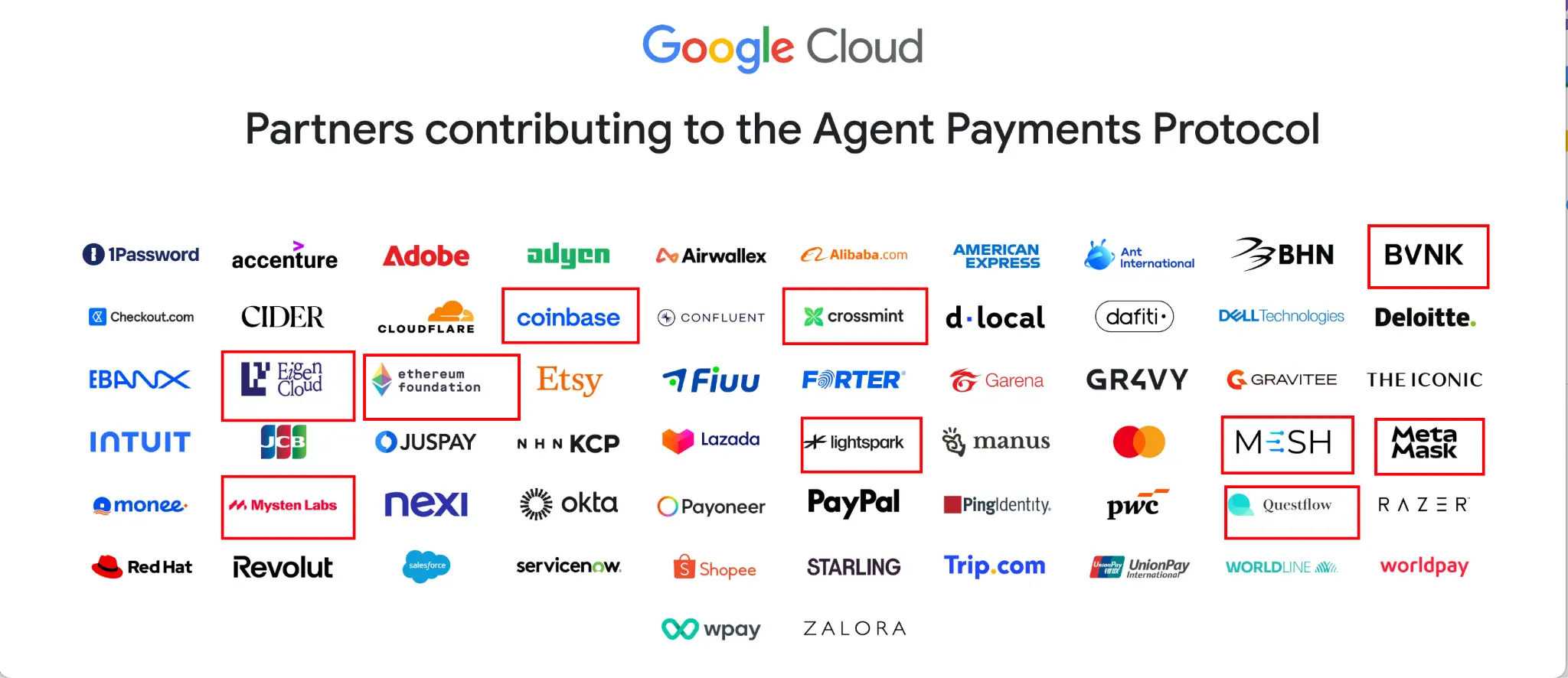
AP2 was designed from the outset for universal access, supporting not only traditional payment methods like credit cards and bank transfers, but also stablecoins and cryptocurrencies as native payment options. Google, in collaboration with Coinbase, the Ethereum Foundation, MetaMask, and others, has launched the A2A x402 extension, a production-grade solution specifically for crypto payments. This creates unprecedented opportunities for crypto projects cultivating the AI agent economy. The following 10 projects are playing a key role in this effort:

1. Coinbase: A promoter and practitioner of AI payment standards

As Google's most important strategic ally in the crypto space, Coinbase's role goes far beyond a simple partner. It is not only the original proponent of the x402 payment standard , but also actively promotes the realization of this vision.

Designed specifically for stablecoin payments, x402 supports cryptocurrency micropayments and instant settlement between AI agents. Coinbase Engineering Director Erik Reppel called it "a natural proving ground for agents to begin transacting with each other and testing the crypto landscape." In collaboration with Google, a shopping demo Coinbase created for Lowe's clearly demonstrated this: with a single prompt, an AI agent seamlessly completed the entire process of product research, inventory verification, shopping cart creation, and final payment using x402 and stablecoins.

Internally, Coinbase has long leveraged AI to improve operational efficiency. For example, its NodeSmith system uses AI to automate node upgrades for over 60 blockchains, reducing repetitive work for engineers by 30%. Coinbase is also exploring cutting-edge areas, including integrating the Bitcoin Lightning Network to reduce payment costs.

In terms of external development, Coinbase has deeply integrated its business with the broader on-chain economy and AI applications by acquiring the DeFi consumer application team Sensible and serving as the crypto infrastructure partner for the U.S. Department of Commerce's "GDP Data on-chain" project. Its goal is to become a "one-stop trading platform" for the future AI agent economy.

2. MetaMask: Building a Self-Hosted AI-Powered Proxy Wallet

MetaMask, a crypto wallet used by hundreds of millions of users worldwide, is focused on ensuring users retain absolute control over their assets and data while enjoying the convenience of AI. Its vision is to achieve "self-custody in the age of agents." Marco De Rossi, Head of MetaMask AI, emphasized, "Blockchain is the natural payment layer for agents, and Ethereum will be its backbone."

To this end, MetaMask actively embraces the x402 standard and AP2 protocol, and works with Stripe's Bridge platform and M0 to launch the stablecoin MetaMask USD (mUSD), which is deeply integrated with the ecosystem.

In terms of security, MetaMask launched the Delegation Toolkit, which allows users to set granular permissions for AI agents, such as budget caps, available asset ranges, and validity time windows, enabling secure automation through "delegation rather than handing over private keys." MetaMask and the Ethereum Foundation are also jointly promoting the ERC-8004 trusted agent standard, establishing an open and verifiable agent registration and reputation system, allowing anyone to query the capabilities and reputation of AI agents.

On August 26th, MetaMask announced the launch of social login, allowing users to quickly create, backup, and restore wallets using their Google or Apple accounts while maintaining self-custody. This not only improves the user experience but also further establishes MetaMask as a secure and convenient entry point into the AI agent economy.

3. Ethereum Foundation: Building the underlying trust network for the AI economy

With its robust network effects and liquidity, Ethereum serves as a neutral, trusted settlement and coordination network for the global AI agent economy. Currently, the circulating supply of stablecoins on Ethereum has exceeded $171 billion, with the mainnet holding $152.8 billion, a significant year-on-year increase of 78%, firmly establishing it as the global center of stablecoin liquidity.

To capitalize on the historic opportunity presented by AI, its mission is to "make Ethereum the preferred settlement and coordination layer for AI and the machine economy." The team is working on two main fronts: first, building an "AI economy on Ethereum," providing a middleman-free payment and coordination mechanism for AI agents; and second, promoting a "decentralized AI stack" to ensure that the future of AI is not reliant on a handful of tech giants.

In this process, the Foundation is actively promoting the development of protocols such as ERC-8004 (Trusted Agent Standard) and working closely with ecological projects to enable AI agents to securely make payments, coordinate, and follow rules on Ethereum, thereby breaking away from dependence on centralized platforms and building an open, censorship-resistant, decentralized AI ecosystem.

4. Mysten Labs (Sui): High-performance AI business infrastructure

The AI agent economy demands extremely fast and programmable payments and transactions, which are key strengths of Mysten Labs and its Sui blockchain. As a launch partner of AP2, Sui's unique architecture compresses transaction confirmation speeds to under 400 milliseconds, ensuring the performance required for real-time AI agent interactions .

Its signature feature is Programmable Transaction Blocks (PTBs), which bundle multiple complex operations into a single atomic transaction. For example, a shopping agent can simultaneously initiate six independent purchases from three different merchant agents and settle them in a single transaction, significantly improving efficiency.

In addition, Mysten Labs has built a complete technology stack to support the future of AI agents: Walrus is used to decentralize data storage and record provenance, Seal provides programmable data access control, and zkLogin allows users to interact with the blockchain in a privacy-preserving manner through traditional Web2 accounts (such as Google accounts), providing an innovative solution to the identity and data privacy issues of AI agents.

5. EigenCloud: The Verifiable Foundation of the AI Agent Economy

In an environment where AI agents autonomously perform high-risk tasks, "trust" becomes core. EigenCloud is committed to providing verifiability for all actions of AI agents , thereby building a global verifiable economy. Founder Sreeram Kannan noted that the AP2 protocol creates a "global verifiable economy where agents can coordinate, transact, and prove their actions to humans and each other," while EigenCloud provides the underlying infrastructure to ensure their accountability.

At the core of EigenCloud is its "encrypted cloud" concept, which extends Ethereum's security to a variety of services, including AI computing, data availability (EigenDA), and dispute resolution (EigenVerify) through the restaking mechanism of EIGEN tokens. This vision has garnered strong support from top-tier capital, with a16z investing an additional $70 million in EIGEN tokens, following their $100 million investment.

To accelerate ecosystem development, Eigen Labs has launched a series of developer tools including DevKit, Hourglass, and Multichain, which reduce the time required to build an AVS (Active Verification Service) from weeks to minutes, laying a solid foundation for the trust layer of the AI agent economy.

6. Crossmint: A universal socket connecting businesses to the AI economy

For many traditional enterprises, integrating complex blockchain technology is extremely challenging. Crossmint acts as an enterprise-level "translator" and "adapter," encapsulating complex blockchain backends into simple APIs, enabling businesses to quickly embrace the AI agent economy .

As a partner of Google AP2, Crossmint provides one-stop solutions such as wallet-as-a-service and stablecoin payments, while supporting credit card and cryptocurrency payments, greatly lowering the entry threshold for businesses and users.

Its powerful capabilities have been demonstrated in numerous real-world cases. For example, it helped global remittance giant MoneyGram launch a USDC-based cross-border payment service in Colombia, allowing users to receive stablecoins in their wallets via SMS. It also built an AI-powered on-chain loyalty program based on Solana for the renowned American milk tea brand Boba Guys, resulting in loyalty members spending 3.5 times more than non-members and a 244% increase in store visits. Its current client base includes 40,000 businesses and developers, including Adidas, Red Bull, and Coinbase. Its stablecoin API and AI bot payment capabilities have proven highly popular, with subscriptions expected to grow 1,100% in 2024. Crossmint is becoming a key enabler of the commercialization of AI agents.

7. BVNK: A full-stack provider of enterprise-grade stablecoin payments

BVNK specializes in providing end-to-end stablecoin payment solutions for global businesses. Its role is to provide a comprehensive, mature, and intelligent financial infrastructure for businesses to utilize stablecoins for payment, collection, and fund management . As a partner of Google AP2 and a recipient of investment from Visa, BVNK has experienced rapid business growth, processing over $15 billion in annual transaction volume and serving global companies such as Deel, Worldpay, and LianLian Global. Through its partnership with Paxos, BVNK is expanding its services to all 50 states.

Furthermore, BVNK has integrated AI into its core products, launching an AI Assistant and Smart Treasury. The AI Assistant uses natural language processing to help customers check balances and generate addresses. The Smart Treasury, on the other hand, leverages machine learning to predict liquidity needs and automatically complete operations such as fund rebalancing and gas fee management. This transforms traditional passive, manual financial management into a proactive, intelligent, automated system, perfectly suited to the 24/7 operation of stablecoins.

8. Mesh: AI Agent's "Universal Payment Connector"

In a complex network of countless AI agents, wallets, and exchanges, how can payments always be completed in the most efficient and cost-effective manner? Mesh is committed to solving the fragmentation problem of the crypto payment ecosystem and providing a unified entry point for AI agents . Its CEO, Bam Azizi, said that Mesh's technology "abstracts the complexity of the crypto ecosystem."

As a supporter of the AP2 protocol, Mesh's API seamlessly connects to over 300 wallets and exchanges, supporting hundreds of tokens. When an AI agent needs to make a payment, Mesh's technology automatically analyzes and finds the optimal payment path, ensuring transaction success and speed. It acts as a "smart payment GPS" in the AI economy, guiding every transaction.

In August, Mesh secured a new round of investment from PayPal Ventures, Coinbase Ventures, and other institutions, bringing its total funding to over $130 million. Furthermore, it launched Wallet-as-a-Service, further solidifying its position as the underlying infrastructure for AI-powered payments.

9. Questflow: The "Orchestration and Distribution Center" for the AI Agent Economy

While other projects provide "parts," Questflow is building the "assembly line" and "app store." As a launch partner of AP2, Questflow positions itself as the orchestration layer for the multi-agent economy. It allows users to describe their needs in natural language and then automatically coordinates multiple AI agents with diverse functionalities (such as content generation, data analysis, and transaction execution) to collaboratively complete complex tasks . Since the release of AP2, Questflow's transaction volume has doubled weekly, demonstrating rapid growth.

Its core is the Multi-Agent Orchestration Protocol (MAOP) and TARS platform, which allow users to describe their needs in natural language (for example, "Help me organize the latest developments on AI+Crypto"). The platform can then automatically coordinate multiple AI agents with different functions (such as news aggregation agents, on-chain data analysis agents, etc.) to collaboratively complete complex tasks.

Questflow has built-in Coinbase's x402 micropayment system, allowing agents to be paid based on task results and usage (pay-as-you-go), thereby building an open and composable AI labor market. Leveraging its $6.5 million seed round funding and deep partnerships with numerous top platforms such as Google, Coinbase, and Circle, it has also launched the A2A.build portal, aiming to become a central hub for discovering and using all AP2 and x402 protocol-compatible agents. The platform brings together 40 active AI agents, 106 A2A integrations, and 66 developers, aiming to become the "App Store" of the AI era, managing the traffic and economic distribution of AI agents.

10. Lightspark: Using Bitcoin Lightning Network to Enable AI-Powered Real-Time Payments

Among the many Ethereum-based solutions, Lightspark stands out by bringing the near-instant, ultra-low-cost payment capabilities of the Bitcoin Lightning Network to the AI agent economy . As a partner in the AP2 protocol, the company, founded by former PayPal President David Marcus, is focused on building an open, interoperable global payments network.

It has partnered with fintech giant SoFi and digital bank Revolut to integrate its technology into mainstream financial applications. By promoting its Universal Money Address (UMA) standard and aligning with Lightning Network integrations with exchanges like Coinbase, Lightspark offers a new, efficient, and cost-effective Bitcoin-based option for AI-powered payments.

Building an AI encrypted payment technology foundation

The release of Google's AP2 protocol is far more than just a technological update. In the future, AP2 could become the underlying infrastructure for AI, e-commerce, and encrypted payments . It's a clear signal that AI is evolving from an information processing tool to a true economic player.

This process is interwoven with two main threads:

  • The power of Web2 : Giants such as Google, Mastercard, and Salesforce provide a huge application scenario, user base, and business network.
  • The genes of Web3 : Crypto native forces such as Ethereum, Coinbase, and MetaMask provide the underlying philosophy and technical implementation (stablecoins, smart contracts, and non-custodial wallets) of decentralization, trustlessness, and user autonomy.

AP2 and the alliance behind it represent the first large-scale convergence of these two forces. It will give rise to a new, autonomous economy driven by AI agents, spanning the boundaries between traditional and cryptocurrencies. The ten crypto projects mentioned above are not just participants; they are shaping this major economic transformation.

Market Opportunity
NEAR Logo
NEAR Price(NEAR)
$1.525
$1.525$1.525
+0.79%
USD
NEAR (NEAR) Live Price Chart
Disclaimer: The articles reposted on this site are sourced from public platforms and are provided for informational purposes only. They do not necessarily reflect the views of MEXC. All rights remain with the original authors. If you believe any content infringes on third-party rights, please contact service@support.mexc.com for removal. MEXC makes no guarantees regarding the accuracy, completeness, or timeliness of the content and is not responsible for any actions taken based on the information provided. The content does not constitute financial, legal, or other professional advice, nor should it be considered a recommendation or endorsement by MEXC.

You May Also Like

The Old Bitcoin Rules No Longer Apply, Arthur Hayes Warns

The Old Bitcoin Rules No Longer Apply, Arthur Hayes Warns

The post The Old Bitcoin Rules No Longer Apply, Arthur Hayes Warns appeared on BitcoinEthereumNews.com. Jake Simmons, a dedicated crypto journalist, has been passionate about Bitcoin since 2016 when he first learned about it. Through his extensive work with NewsBTC.com and Bitcoinist.com, Jake has become a trusted voice in the crypto community, guiding newcomers and seasoned enthusiasts alike towards a deeper understanding of this dynamic field. His mission is simple yet profound: to demystify Bitcoin and cryptocurrencies and make them accessible to everyone.With a professional career in the Bitcoin and crypto scene that began right after graduating with a degree in Information Systems in 2017, Jake has immersed himself in the industry. Jake joined the NewsBTC Group in late 2022. His educational background provides him with the technical prowess and analytical skills necessary to dissect complex topics and present them in an understandable format. Whether you are a casual reader curious about Bitcoin or an investor seeking to navigate the latest market trends, Jake’s insights offer valuable perspectives that bridge the gap between complex technology and everyday usage. Jake is not just a reporter on technological trends; he is a firm believer in the transformative potential of Bitcoin over traditional fiat currencies. To him, the current financial system is on the brink of chaos, propelled by unchecked government actions and flawed Keynesian economic policies. Drawing from the principles of the Austrian school of economics, Jake views Bitcoin not merely as a digital asset but as a crucial step towards rectifying a failing monetary system. His libertarian views reinforce his stance that just as the church was separated from the state, so too should money be freed from governmental control. For Jake, Bitcoin represents more than just an investment; it’s a peaceful revolution. He envisions a future where Bitcoin fosters a sustainable and responsible financial framework for generations to come. His advocacy is not about opposition…
Share
BitcoinEthereumNews2025/10/09 23:38
Is A $10,000 Ethereum Price Within Reach? Here’s What Experts Are Forecasting Next

Is A $10,000 Ethereum Price Within Reach? Here’s What Experts Are Forecasting Next

The post Is A $10,000 Ethereum Price Within Reach? Here’s What Experts Are Forecasting Next appeared on BitcoinEthereumNews.com. Ronaldo is an experienced crypto enthusiast dedicated to the nascent and ever-evolving industry. With over five years of extensive research and unwavering dedication, he has cultivated a profound interest in the world of cryptocurrencies. Ronaldo’s journey began with a spark of curiosity, which soon transformed into a deep passion for understanding the intricacies of this groundbreaking technology. Driven by an insatiable thirst for knowledge, Ronaldo has delved into the depths of the crypto space, exploring its various facets, from blockchain fundamentals to market trends and investment strategies. His tireless exploration and commitment to staying up-to-date with the latest developments have granted him a unique perspective on the industry. One of Ronaldo’s defining areas of expertise lies in technical analysis. He firmly believes that studying charts and deciphering price movements provides valuable insights into the market. Ronaldo recognizes that patterns exist within the chaos of crypto charts, and by utilizing technical analysis tools and indicators, he can unlock hidden opportunities and make informed investment decisions. His dedication to mastering this analytical approach has allowed him to navigate the volatile crypto market with confidence and precision. Ronaldo’s commitment to his craft goes beyond personal gain. He is passionate about sharing his knowledge and insights with others, empowering them to make well-informed decisions in the crypto space. Ronaldo’s writing is a testament to his dedication, providing readers with meaningful analysis and up-to-date news. He strives to offer a comprehensive understanding of the crypto industry, helping readers navigate its complexities and seize opportunities. Outside of the crypto realm, Ronaldo enjoys indulging in other passions. As an avid sports fan, he finds joy in watching exhilarating sporting events, witnessing the triumphs and challenges of athletes pushing their limits. Furthermore, His passion for languages extends beyond mere communication; he aspires to master German, French, Italian, and…
Share
BitcoinEthereumNews2025/10/07 15:37
The Contrarian Truth: Why Bitcoin and Ethereum Prices Defy Social Media Sentiment

The Contrarian Truth: Why Bitcoin and Ethereum Prices Defy Social Media Sentiment

BitcoinWorld The Contrarian Truth: Why Bitcoin and Ethereum Prices Defy Social Media Sentiment Have you ever noticed that when everyone on social media is screaming
Share
bitcoinworld2025/12/20 07:45