By Eric, Foresight News Yesterday morning Beijing time, Ethereum co-founder Vitalik Buterin posted a screenshot of an article written by Peter Thiel in 2009 on X, with the caption: "Reminder that Peter Thiel is, to put it mildly, not a cypherpunk." If Vitalik's concerns two months ago about the risks of over-leverage in Ethereum DATs were merely a "friendly reminder," then this time, his direct criticism of Peter Thiel, a backer of BitMine and ETHZilla, two publicly traded Ethereum DATs, can be seen as a "direct challenge." However, this challenge doesn't appear to be solely directed at DAT companies. Vitalik's real concerns may be related to Peter Thiel's extreme political views, which are precisely the opposite of the cypherpunk ideologies that uphold decentralization. Peter Thiel: I no longer believe freedom and democracy are compatible Last October, Polymarket refuted the New York Times' report that it had political leanings. In its response, it stated that although Peter Thiel is the founder of Founders Fund, an investor in Polymarket, his political leanings will not affect the operation of the platform. Peter Thiel’s extreme political leanings are no longer news, but this seems to be the first time it has been widely discussed in the Web3 world. The screenshot Vitalik posted is from Peter Thiel’s 2009 article “The Education of a Libertarian”. In the article, Peter Thiel expressed his extreme disappointment with politics and believed that liberals at the time should find a way out of all forms of politics. He said, “Since there is no longer any truly free place in our world, I suspect that the way to escape must involve some new and hitherto untried method, leading us to some unknown country; for this reason, I am committed to studying new technologies that may create new spaces for freedom.” The new technologies mentioned by Peter Thiel include three possible areas: cyberspace, space and oceans. This article was published shortly after Bitcoin's launch, against the backdrop of a global financial crisis unleashed by Wall Street's greed. Peter Thiel advocates for using technology to bypass politics and create an absolute libertarian utopia. However, he rejects the "techno-utopianism" that assumes technology possesses its own power and will. Instead, he believes technology should confront politics, creating a new world free from political control. In this description, it seems that Peter Thiel's propositions are similar to those of the early cypherpunks. They believe that technology can create a better world, and they also believe that the development of technology will one day break the constraints of politics and give birth to a truly free country. Founders Fund, of which Peter Thiel serves as managing partner, has invested in a wide range of Web3 projects, including in recent years Polymarket, Avail, Igloo (the parent company of Pudgy Penguins), and Caldera, a Rollup-as-a-Service platform. While Peter Thiel shares the same belief in "technology changing the world" as crypto fundamentalists, his approach to achieving this goal has been quite different. In "The Education of a Libertarian," Peter Thiel's disillusionment with democracy is actually a disappointment with egalitarianism. Since the expansion of universal suffrage (especially women's suffrage) and the expansion of the welfare state in the United States in the 20th century, "capitalist democracy" has become a self-contradictory fantasy. In his view, the egalitarian tendencies of the general electorate hinder a truly free market, and therefore liberals should "escape politics" rather than try to convince the majority of voters. Peter Thiel and his followers, known for their superior understanding of technology and their foresight into future development, place greater trust in the "best minds"—technological and capital elites—to govern society, rather than relying on democratic procedures based on one person, one vote. Companies he has invested in, such as Palantir and Anduril, have undertaken numerous government surveillance and border enforcement projects, drawing criticism for "using algorithms and big data to replace democratic decision-making," essentially outsourcing public power to opaque private high-tech companies. Frankfurt-born Peter Thiel's reading list includes works by Nazi jurist Carl Schmitt, civilizational decline theorist Oswald Spengler, and The Sovereign Individual. These ideologies share a disdain for universal suffrage, a reverence for power, and a belief in historical cycles and a "state of exception." Peter Thiel combines Schmitt's "friend-and-enemy" political perspective and Spengler's "good times-bad times" authoritarian fatalism with Silicon Valley's "technological acceleration" discourse, creating a hybrid ideology of "hyper-neoliberalism + anti-democracy" that scholars have called fascist inflection. Renowned American journalist and historian Eoin Higgins, in his book "Owned: How Tech Billionaires on the Right Bought the Loudest Voice on the Left," published in February of this year, describes how tech leaders flocked to Trump after his 2016 election victory. On December 14, 2016, Thiel attended a Trump campaign meeting. The billionaire investor also brought along allies Elon Musk and Alex Karp, even though their respective companies, Tesla and Palantir, were not on the same level as companies like Google, Microsoft, and Apple at the time. During Trump's second term, Peter Thiel was behind Vice President Vance and David Sacks, the White House director of cryptocurrency and artificial intelligence and the so-called "Crypto Czar." Elon Musk, his protégé brought to the White House during Trump's first term, has become another symbol of Silicon Valley elitism. The world's richest man, even considering the noise of rocket launches, has developed a near-insane hatred of the government, or more precisely, bureaucracy. This hatred has manifested in DOGE's frantic purge of certain government departments. Clearly, this extreme ideological confrontation has left Vitalik feeling a sense of unease. Whose freedom is true freedom? While both advocated for using technology to change the world, Peter Thiel chose to allow the elite to master technology and rule over the "mortals." Satoshi Nakamoto and Vitalik, on the other hand, were more committed to equal rights in technology, creating a stark ideological opposition. Vitalik's real concern was that a group of tech elites, armed with vast amounts of capital, would exploit their power and influence to transform Ethereum into a decentralized network controlled by extreme totalitarians. While Ethereum might still be the world's computer and handle the majority of transactions for stablecoins and tokenized RWAs, it would no longer be the Ethereum that cypherpunks envisioned. Vitalik's direct motivation for developing Ethereum came from Blizzard nerfing his favorite World of Warcraft character. However, Vitalik isn't opposed to nerfs; he simply believes the decision should be made in a more democratic manner, and even if the final vote still results in a nerf, he's still okay with it. Peter Thiel, on the other hand, would arbitrarily choose not to nerf a character. This is perhaps the biggest difference between the two. In the comments section of the tweet, Vitalik agreed with the view that "Ethereum needs to be like Bitcoin eventually, where development should stop/shut down at some point, or maintenance should be minimized." He supports gradual rigidification and a more cautious approach to major changes to the protocol after short-term expansion, streamlining of Ethereum, and clearing of technical debt. This view actually corresponds to the "technological utopianism" mentioned by Peter Thiel. However, for Peter Thiel, who combines the denial of democracy, technological authoritarianism, and capital seizure of power, and goes beyond the boundaries of conventional conservatism or libertarianism, his view of freedom seems to be to restrict the freedom of the majority for the sake of absolute freedom for a few. This proposition with absolute "right" and "wrong" seems to bring "absolute political rule" to the other extreme of "absolute technological elite rule." Interestingly, Vitalik received $100,000 in funding from Peter Thiel in 2014 to develop Ethereum. Eleven years later, while the then-innocent teenager has shed his crypto fundamentalism and become a leading figure in the decentralized world, Peter Thiel still clings to his extreme ideology, which I struggle to find the right words to describe. In the next ten years, will Ethereum become a weapon of absolute freedom for a small number of people, or a tool of relative freedom for the majority?By Eric, Foresight News Yesterday morning Beijing time, Ethereum co-founder Vitalik Buterin posted a screenshot of an article written by Peter Thiel in 2009 on X, with the caption: "Reminder that Peter Thiel is, to put it mildly, not a cypherpunk." If Vitalik's concerns two months ago about the risks of over-leverage in Ethereum DATs were merely a "friendly reminder," then this time, his direct criticism of Peter Thiel, a backer of BitMine and ETHZilla, two publicly traded Ethereum DATs, can be seen as a "direct challenge." However, this challenge doesn't appear to be solely directed at DAT companies. Vitalik's real concerns may be related to Peter Thiel's extreme political views, which are precisely the opposite of the cypherpunk ideologies that uphold decentralization. Peter Thiel: I no longer believe freedom and democracy are compatible Last October, Polymarket refuted the New York Times' report that it had political leanings. In its response, it stated that although Peter Thiel is the founder of Founders Fund, an investor in Polymarket, his political leanings will not affect the operation of the platform. Peter Thiel’s extreme political leanings are no longer news, but this seems to be the first time it has been widely discussed in the Web3 world. The screenshot Vitalik posted is from Peter Thiel’s 2009 article “The Education of a Libertarian”. In the article, Peter Thiel expressed his extreme disappointment with politics and believed that liberals at the time should find a way out of all forms of politics. He said, “Since there is no longer any truly free place in our world, I suspect that the way to escape must involve some new and hitherto untried method, leading us to some unknown country; for this reason, I am committed to studying new technologies that may create new spaces for freedom.” The new technologies mentioned by Peter Thiel include three possible areas: cyberspace, space and oceans. This article was published shortly after Bitcoin's launch, against the backdrop of a global financial crisis unleashed by Wall Street's greed. Peter Thiel advocates for using technology to bypass politics and create an absolute libertarian utopia. However, he rejects the "techno-utopianism" that assumes technology possesses its own power and will. Instead, he believes technology should confront politics, creating a new world free from political control. In this description, it seems that Peter Thiel's propositions are similar to those of the early cypherpunks. They believe that technology can create a better world, and they also believe that the development of technology will one day break the constraints of politics and give birth to a truly free country. Founders Fund, of which Peter Thiel serves as managing partner, has invested in a wide range of Web3 projects, including in recent years Polymarket, Avail, Igloo (the parent company of Pudgy Penguins), and Caldera, a Rollup-as-a-Service platform. While Peter Thiel shares the same belief in "technology changing the world" as crypto fundamentalists, his approach to achieving this goal has been quite different. In "The Education of a Libertarian," Peter Thiel's disillusionment with democracy is actually a disappointment with egalitarianism. Since the expansion of universal suffrage (especially women's suffrage) and the expansion of the welfare state in the United States in the 20th century, "capitalist democracy" has become a self-contradictory fantasy. In his view, the egalitarian tendencies of the general electorate hinder a truly free market, and therefore liberals should "escape politics" rather than try to convince the majority of voters. Peter Thiel and his followers, known for their superior understanding of technology and their foresight into future development, place greater trust in the "best minds"—technological and capital elites—to govern society, rather than relying on democratic procedures based on one person, one vote. Companies he has invested in, such as Palantir and Anduril, have undertaken numerous government surveillance and border enforcement projects, drawing criticism for "using algorithms and big data to replace democratic decision-making," essentially outsourcing public power to opaque private high-tech companies. Frankfurt-born Peter Thiel's reading list includes works by Nazi jurist Carl Schmitt, civilizational decline theorist Oswald Spengler, and The Sovereign Individual. These ideologies share a disdain for universal suffrage, a reverence for power, and a belief in historical cycles and a "state of exception." Peter Thiel combines Schmitt's "friend-and-enemy" political perspective and Spengler's "good times-bad times" authoritarian fatalism with Silicon Valley's "technological acceleration" discourse, creating a hybrid ideology of "hyper-neoliberalism + anti-democracy" that scholars have called fascist inflection. Renowned American journalist and historian Eoin Higgins, in his book "Owned: How Tech Billionaires on the Right Bought the Loudest Voice on the Left," published in February of this year, describes how tech leaders flocked to Trump after his 2016 election victory. On December 14, 2016, Thiel attended a Trump campaign meeting. The billionaire investor also brought along allies Elon Musk and Alex Karp, even though their respective companies, Tesla and Palantir, were not on the same level as companies like Google, Microsoft, and Apple at the time. During Trump's second term, Peter Thiel was behind Vice President Vance and David Sacks, the White House director of cryptocurrency and artificial intelligence and the so-called "Crypto Czar." Elon Musk, his protégé brought to the White House during Trump's first term, has become another symbol of Silicon Valley elitism. The world's richest man, even considering the noise of rocket launches, has developed a near-insane hatred of the government, or more precisely, bureaucracy. This hatred has manifested in DOGE's frantic purge of certain government departments. Clearly, this extreme ideological confrontation has left Vitalik feeling a sense of unease. Whose freedom is true freedom? While both advocated for using technology to change the world, Peter Thiel chose to allow the elite to master technology and rule over the "mortals." Satoshi Nakamoto and Vitalik, on the other hand, were more committed to equal rights in technology, creating a stark ideological opposition. Vitalik's real concern was that a group of tech elites, armed with vast amounts of capital, would exploit their power and influence to transform Ethereum into a decentralized network controlled by extreme totalitarians. While Ethereum might still be the world's computer and handle the majority of transactions for stablecoins and tokenized RWAs, it would no longer be the Ethereum that cypherpunks envisioned. Vitalik's direct motivation for developing Ethereum came from Blizzard nerfing his favorite World of Warcraft character. However, Vitalik isn't opposed to nerfs; he simply believes the decision should be made in a more democratic manner, and even if the final vote still results in a nerf, he's still okay with it. Peter Thiel, on the other hand, would arbitrarily choose not to nerf a character. This is perhaps the biggest difference between the two. In the comments section of the tweet, Vitalik agreed with the view that "Ethereum needs to be like Bitcoin eventually, where development should stop/shut down at some point, or maintenance should be minimized." He supports gradual rigidification and a more cautious approach to major changes to the protocol after short-term expansion, streamlining of Ethereum, and clearing of technical debt. This view actually corresponds to the "technological utopianism" mentioned by Peter Thiel. However, for Peter Thiel, who combines the denial of democracy, technological authoritarianism, and capital seizure of power, and goes beyond the boundaries of conventional conservatism or libertarianism, his view of freedom seems to be to restrict the freedom of the majority for the sake of absolute freedom for a few. This proposition with absolute "right" and "wrong" seems to bring "absolute political rule" to the other extreme of "absolute technological elite rule." Interestingly, Vitalik received $100,000 in funding from Peter Thiel in 2014 to develop Ethereum. Eleven years later, while the then-innocent teenager has shed his crypto fundamentalism and become a leading figure in the decentralized world, Peter Thiel still clings to his extreme ideology, which I struggle to find the right words to describe. In the next ten years, will Ethereum become a weapon of absolute freedom for a small number of people, or a tool of relative freedom for the majority?

Vitalik publicly questioned Peter Thiel's "non-cyberpunk" stance, which is a factional struggle in technological thought.

2025/10/04 19:57

By Eric, Foresight News

Yesterday morning Beijing time, Ethereum co-founder Vitalik Buterin posted a screenshot of an article written by Peter Thiel in 2009 on X, with the caption: "Reminder that Peter Thiel is, to put it mildly, not a cypherpunk."
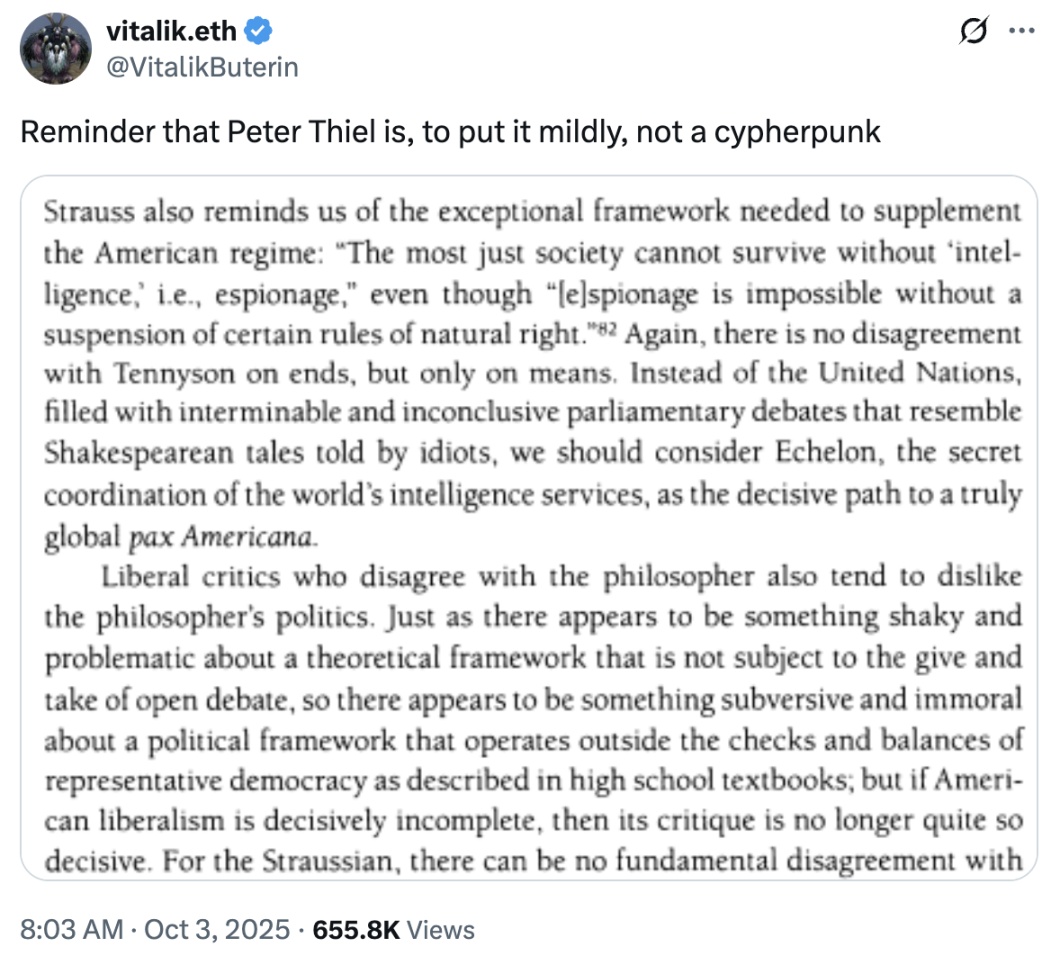
If Vitalik's concerns two months ago about the risks of over-leverage in Ethereum DATs were merely a "friendly reminder," then this time, his direct criticism of Peter Thiel, a backer of BitMine and ETHZilla, two publicly traded Ethereum DATs, can be seen as a "direct challenge." However, this challenge doesn't appear to be solely directed at DAT companies. Vitalik's real concerns may be related to Peter Thiel's extreme political views, which are precisely the opposite of the cypherpunk ideologies that uphold decentralization.

Peter Thiel: I no longer believe freedom and democracy are compatible

Last October, Polymarket refuted the New York Times' report that it had political leanings. In its response, it stated that although Peter Thiel is the founder of Founders Fund, an investor in Polymarket, his political leanings will not affect the operation of the platform.

Peter Thiel’s extreme political leanings are no longer news, but this seems to be the first time it has been widely discussed in the Web3 world.

The screenshot Vitalik posted is from Peter Thiel’s 2009 article “The Education of a Libertarian”. In the article, Peter Thiel expressed his extreme disappointment with politics and believed that liberals at the time should find a way out of all forms of politics. He said, “Since there is no longer any truly free place in our world, I suspect that the way to escape must involve some new and hitherto untried method, leading us to some unknown country; for this reason, I am committed to studying new technologies that may create new spaces for freedom.”

The new technologies mentioned by Peter Thiel include three possible areas: cyberspace, space and oceans.

This article was published shortly after Bitcoin's launch, against the backdrop of a global financial crisis unleashed by Wall Street's greed. Peter Thiel advocates for using technology to bypass politics and create an absolute libertarian utopia. However, he rejects the "techno-utopianism" that assumes technology possesses its own power and will. Instead, he believes technology should confront politics, creating a new world free from political control.

In this description, it seems that Peter Thiel's propositions are similar to those of the early cypherpunks. They believe that technology can create a better world, and they also believe that the development of technology will one day break the constraints of politics and give birth to a truly free country.

Founders Fund, of which Peter Thiel serves as managing partner, has invested in a wide range of Web3 projects, including in recent years Polymarket, Avail, Igloo (the parent company of Pudgy Penguins), and Caldera, a Rollup-as-a-Service platform. While Peter Thiel shares the same belief in "technology changing the world" as crypto fundamentalists, his approach to achieving this goal has been quite different.

In "The Education of a Libertarian," Peter Thiel's disillusionment with democracy is actually a disappointment with egalitarianism. Since the expansion of universal suffrage (especially women's suffrage) and the expansion of the welfare state in the United States in the 20th century, "capitalist democracy" has become a self-contradictory fantasy. In his view, the egalitarian tendencies of the general electorate hinder a truly free market, and therefore liberals should "escape politics" rather than try to convince the majority of voters.

Peter Thiel and his followers, known for their superior understanding of technology and their foresight into future development, place greater trust in the "best minds"—technological and capital elites—to govern society, rather than relying on democratic procedures based on one person, one vote. Companies he has invested in, such as Palantir and Anduril, have undertaken numerous government surveillance and border enforcement projects, drawing criticism for "using algorithms and big data to replace democratic decision-making," essentially outsourcing public power to opaque private high-tech companies.

Frankfurt-born Peter Thiel's reading list includes works by Nazi jurist Carl Schmitt, civilizational decline theorist Oswald Spengler, and The Sovereign Individual. These ideologies share a disdain for universal suffrage, a reverence for power, and a belief in historical cycles and a "state of exception." Peter Thiel combines Schmitt's "friend-and-enemy" political perspective and Spengler's "good times-bad times" authoritarian fatalism with Silicon Valley's "technological acceleration" discourse, creating a hybrid ideology of "hyper-neoliberalism + anti-democracy" that scholars have called fascist inflection.

Renowned American journalist and historian Eoin Higgins, in his book "Owned: How Tech Billionaires on the Right Bought the Loudest Voice on the Left," published in February of this year, describes how tech leaders flocked to Trump after his 2016 election victory. On December 14, 2016, Thiel attended a Trump campaign meeting. The billionaire investor also brought along allies Elon Musk and Alex Karp, even though their respective companies, Tesla and Palantir, were not on the same level as companies like Google, Microsoft, and Apple at the time.

During Trump's second term, Peter Thiel was behind Vice President Vance and David Sacks, the White House director of cryptocurrency and artificial intelligence and the so-called "Crypto Czar." Elon Musk, his protégé brought to the White House during Trump's first term, has become another symbol of Silicon Valley elitism. The world's richest man, even considering the noise of rocket launches, has developed a near-insane hatred of the government, or more precisely, bureaucracy. This hatred has manifested in DOGE's frantic purge of certain government departments. Clearly, this extreme ideological confrontation has left Vitalik feeling a sense of unease.

Whose freedom is true freedom?

While both advocated for using technology to change the world, Peter Thiel chose to allow the elite to master technology and rule over the "mortals." Satoshi Nakamoto and Vitalik, on the other hand, were more committed to equal rights in technology, creating a stark ideological opposition. Vitalik's real concern was that a group of tech elites, armed with vast amounts of capital, would exploit their power and influence to transform Ethereum into a decentralized network controlled by extreme totalitarians. While Ethereum might still be the world's computer and handle the majority of transactions for stablecoins and tokenized RWAs, it would no longer be the Ethereum that cypherpunks envisioned.

Vitalik's direct motivation for developing Ethereum came from Blizzard nerfing his favorite World of Warcraft character. However, Vitalik isn't opposed to nerfs; he simply believes the decision should be made in a more democratic manner, and even if the final vote still results in a nerf, he's still okay with it. Peter Thiel, on the other hand, would arbitrarily choose not to nerf a character. This is perhaps the biggest difference between the two.

In the comments section of the tweet, Vitalik agreed with the view that "Ethereum needs to be like Bitcoin eventually, where development should stop/shut down at some point, or maintenance should be minimized." He supports gradual rigidification and a more cautious approach to major changes to the protocol after short-term expansion, streamlining of Ethereum, and clearing of technical debt.

This view actually corresponds to the "technological utopianism" mentioned by Peter Thiel. However, for Peter Thiel, who combines the denial of democracy, technological authoritarianism, and capital seizure of power, and goes beyond the boundaries of conventional conservatism or libertarianism, his view of freedom seems to be to restrict the freedom of the majority for the sake of absolute freedom for a few. This proposition with absolute "right" and "wrong" seems to bring "absolute political rule" to the other extreme of "absolute technological elite rule."
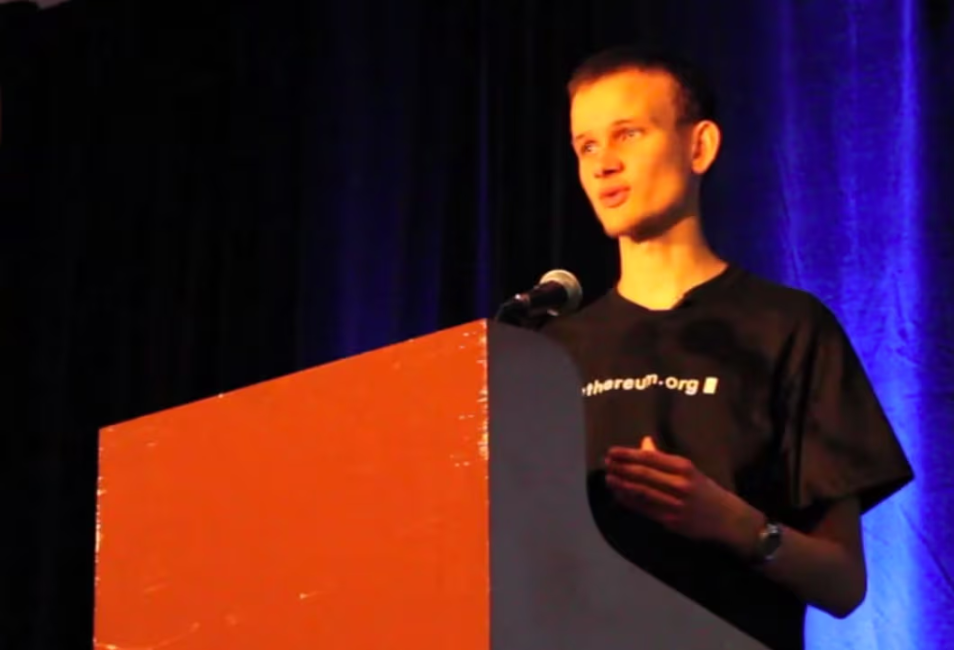
Interestingly, Vitalik received $100,000 in funding from Peter Thiel in 2014 to develop Ethereum. Eleven years later, while the then-innocent teenager has shed his crypto fundamentalism and become a leading figure in the decentralized world, Peter Thiel still clings to his extreme ideology, which I struggle to find the right words to describe.

In the next ten years, will Ethereum become a weapon of absolute freedom for a small number of people, or a tool of relative freedom for the majority?

Market Opportunity
Notcoin Logo
Notcoin Price(NOT)
$0.0005226
$0.0005226$0.0005226
-0.01%
USD
Notcoin (NOT) Live Price Chart
Disclaimer: The articles reposted on this site are sourced from public platforms and are provided for informational purposes only. They do not necessarily reflect the views of MEXC. All rights remain with the original authors. If you believe any content infringes on third-party rights, please contact service@support.mexc.com for removal. MEXC makes no guarantees regarding the accuracy, completeness, or timeliness of the content and is not responsible for any actions taken based on the information provided. The content does not constitute financial, legal, or other professional advice, nor should it be considered a recommendation or endorsement by MEXC.

You May Also Like

FTX Trust Sues Genesis Digital for $1.15B Clawback Over Alleged Fraudulent Transfers

FTX Trust Sues Genesis Digital for $1.15B Clawback Over Alleged Fraudulent Transfers

The FTX Recovery Trust has filed a $1.15 billion lawsuit against the Bitcoin mining firm Genesis Digital Assets, alleging fraudulent transfers. The complaint, filed on Monday in U.S. Bankruptcy Court for the District of Delaware, alleges that Sam Bankman-Fried used misappropriated FTX customer funds to purchase Genesis Digital shares at “outrageously inflated prices” through his hedge fund, Alameda Research, between August 2021 and April 2022. Genesis Digital co-founders Rashit Makhat and Marco Krohn received $470 million and $80.9 million, respectively, for their shares in February 2022, according to court documents. The trust contends that only Alameda, and by extension Bankman-Fried, as its 90% owner, benefited from the investments, while FTX customers and creditors suffered losses from the diverted exchange funds.Court Document (Source: Bloomberg Law) Genesis Investment Timeline Reveals Systematic Fund Diversion Court documents reveal that discussions between Bankman-Fried and Genesis Digital began in July 2021, when the Kazakhstan-based mining company was seeking capital to expand its operations into the United States. Bankman-Fried joined Genesis Digital’s board in October 2021, according to Bloomberg, positioning himself to oversee what would become one of Alameda’s largest venture investments. The complaint describes how the FTX founder caused Alameda to purchase multiple tranches of Genesis shares over an eight-month period, with the lawsuit characterizing Genesis as “one of Bankman-Fried’s most reckless investments with commingled and misappropriated funds.“ Between August 2021 and April 2022, Alameda invested $1.15 billion across four distinct funding rounds: $100 million in August 2021, $550 million in January 2022, $250 million in February, and $250 million in April 2022. The trust alleges that FTX insiders regularly caused Alameda to “borrow” billions from the FTX.com exchange to fund “profligate lifestyles and vanity investments” while hiding the source of these funds from investors and creditors. Bankman-Fried resigned from Genesis Digital’s board one day before FTX filed for bankruptcy in November 2022, according to the court filing. Mining Sector Faces Renewed Scrutiny Amid FTX Fallout The Genesis Digital lawsuit is the latest effort by FTX’s bankruptcy estate to recover assets for creditors, with the trust having already distributed $6.2 billion across two previous rounds of payments. The trust completed a $1.2 billion distribution in February, followed by a larger $5 billion payout in May, with an additional $1.6 billion distribution scheduled for September 30, bringing total recoveries to nearly half of the $16.5 billion earmarked for victims. These recovery efforts come as Genesis Digital, which operates over 500 megawatts of mining capacity across 20 data centers on four continents, saw its valuation reach $5.5 billion during an April 2022 fundraising round shortly before cryptocurrency prices collapsed later that year. The mining company was exploring an initial public offering in the United States as recently as July 2024, working with advisors to evaluate a potential listing and planning a pre-IPO funding round amid the crypto industry’s recovery from the 2022 market downturn. However, the FTX lawsuit adds another layer of complexity to Genesis Digital’s corporate structure, which includes an extensive network of U.S. subsidiaries with names like Dog House TX-1, Mother Whale LLC, and White Deer LLC. The complaint alleges that these U.S. subsidiaries operate as “alter egos” of the parent company, potentially exposing the entire corporate structure to clawback claims under both federal bankruptcy law and Delaware state fraudulent transfer statutes. Meanwhile, Bankman-Fried continues to serve his 25-year prison sentence following his conviction on seven felony charges, with oral arguments for his appeal scheduled for November 4, 2025. The lawsuit adds to the complex web of litigation following the $175 million settlement earlier this year with Genesis Global, a subsidiary of Digital Currency Group, as creditors and bankruptcy trustees pursue recovery efforts across multiple jurisdictions and corporate entities tied to the failed exchange
Share
CryptoNews2025/09/24 03:14
Ripple-Backed Evernorth Faces $220M Loss on XRP Holdings Amid Market Slump

Ripple-Backed Evernorth Faces $220M Loss on XRP Holdings Amid Market Slump

TLDR Evernorth invested $947M in XRP, now valued at $724M, a loss of over $220M. XRP’s price dropped 16% in the last 30 days, leading to Evernorth’s paper losses
Share
Coincentral2025/12/26 03:56
New Trump appointee Miran calls for half-point cut in only dissent as rest of Fed bands together

New Trump appointee Miran calls for half-point cut in only dissent as rest of Fed bands together

The post New Trump appointee Miran calls for half-point cut in only dissent as rest of Fed bands together appeared on BitcoinEthereumNews.com. Stephen Miran, chairman of the Council of Economic Advisers and US Federal Reserve governor nominee for US President Donald Trump, arrives for a Senate Banking, Housing, and Urban Affairs Committee confirmation hearing in Washington, DC, US, on Thursday, Sept. 4, 2025. The Senate Banking Committee’s examination of Stephen Miran’s appointment will provide the first extended look at how prominent Republican senators balance their long-standing support of an independent central bank against loyalty to their party leader. Photographer: Daniel Heuer/Bloomberg via Getty Images Daniel Heuer | Bloomberg | Getty Images Newly-confirmed Federal Reserve Governor Stephen Miran dissented from the central bank’s decision to lower the federal funds rate by a quarter percentage point on Wednesday, choosing instead to call for a half-point cut. Miran, who was confirmed by the Senate to the Fed Board of Governors on Monday, was the sole dissenter in the Federal Open Market Committee’s statement. Governors Michelle Bowman and Christopher Waller, who had dissented at the Fed’s prior meeting in favor of a quarter-point move, were aligned with Fed Chair Jerome Powell and the others besides Miran this time. Miran was selected by Trump back in August to fill the seat that was vacated by former Governor Adriana Kugler after she suddenly announced her resignation without stating a reason for doing so. He has said that he will take an unpaid leave of absence as chair of the White House’s Council of Economic Advisors rather than fully resign from the position. Miran’s place on the board, which will last until Jan. 31, 2026 when Kugler’s term was due to end, has been viewed by critics as a threat from Trump to the Fed’s independence, as the president has nominated three of the seven members. Trump also said in August that he had fired Federal Reserve Board Governor…
Share
BitcoinEthereumNews2025/09/18 02:26