

Web3 Testers Have a Bleak Future (Unless We Fix This)
In the world of Web3, testnets are supposed to be a playground for innovation. Developers launch them to test scalability, uncover bugs, and measure real user behavior. Testers jump in with enthusiasm, spending hours interacting with dApps, setting up nodes, or stress-testing new features. On paper, it looks like a win-win. Developers get free QA, and testers hope for rewards or airdrops.
But here’s the dirty secret nobody likes to admit: once the testnet is over, testers often become disposable. Like used batteries, their effort gets drained, their contributions are forgotten, and they’re tossed aside as if they never mattered.
Why Testers Matter More Than Anyone Admits
\ Testers are the first real users of any protocol. They bring the chaos of the real world into controlled experiments. Every failed transaction, bug report, and workaround they attempt becomes valuable data for developers.
Without testers, projects would launch blind, risking millions in bugs and vulnerabilities. With testers, projects can prove traction to investors. Metrics like wallet addresses, transactions, or retention rates often appear in pitch decks. Investors love these numbers, and testers unknowingly supply them.
Here’s the irony: before a token launches, developers proudly call testers “the community.” They praise them in AMAs, promise rewards, and highlight their role in the project’s growth. But once the token generation event (TGE) fills the treasury, the tune changes. Suddenly, testers are no longer heroes, they’re treated like trash. This is happened in many projects, not only this one below
The Story That Pulled the Curtain Back
This is a story from the 0Glabs project. I tried the testnet, but I didn’t finish it until the end because I prioritized other projects.
\

sources: X post
A recent drama on X showed just how ugly this cycle can get. It involved two voices: @Gautamguptagg and @michaelh_0g. Their clash revealed what happens when transparency is missing after a project dangles huge rewards during a testnet.
The @0G_Foundation announced a $5M distribution for running storage nodes in its testnet. Sounds generous, right? But here’s where it gets dirty.
- Gautam’s Claim: He argued that the foundation only gave out a maximum of $500K. According to him, the rest of the $5M vanished into thin air. He demanded on-chain proof and accused the project of scamming. His words cut deep: “share me where these $5M distributed.”
- Michael’s Response: Michael fired back, insisting that the “full $5M” was distributed. But instead of sharing transaction links, he dismissed Gautam’s concerns and shifted the blame toward “testnet farmers” who allegedly gamed the system with bots.
What started as a simple request for transparency turned into a shouting match, with insults and deflections replacing evidence.
When Testers Turn Into Trash
\

\ And that’s the dirty secret of Web3 testnets. Testers start as heroes, powering statistics and stress-testing systems. They are called “the community” when their activity helps raise funds. But once the TGE fills project coffers, those same testers are treated like trash—discarded, blamed, and forgotten.
\
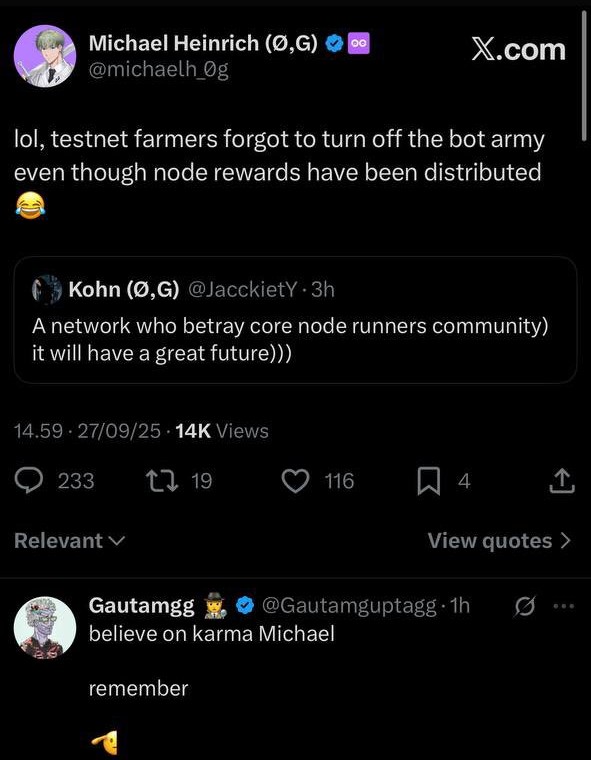
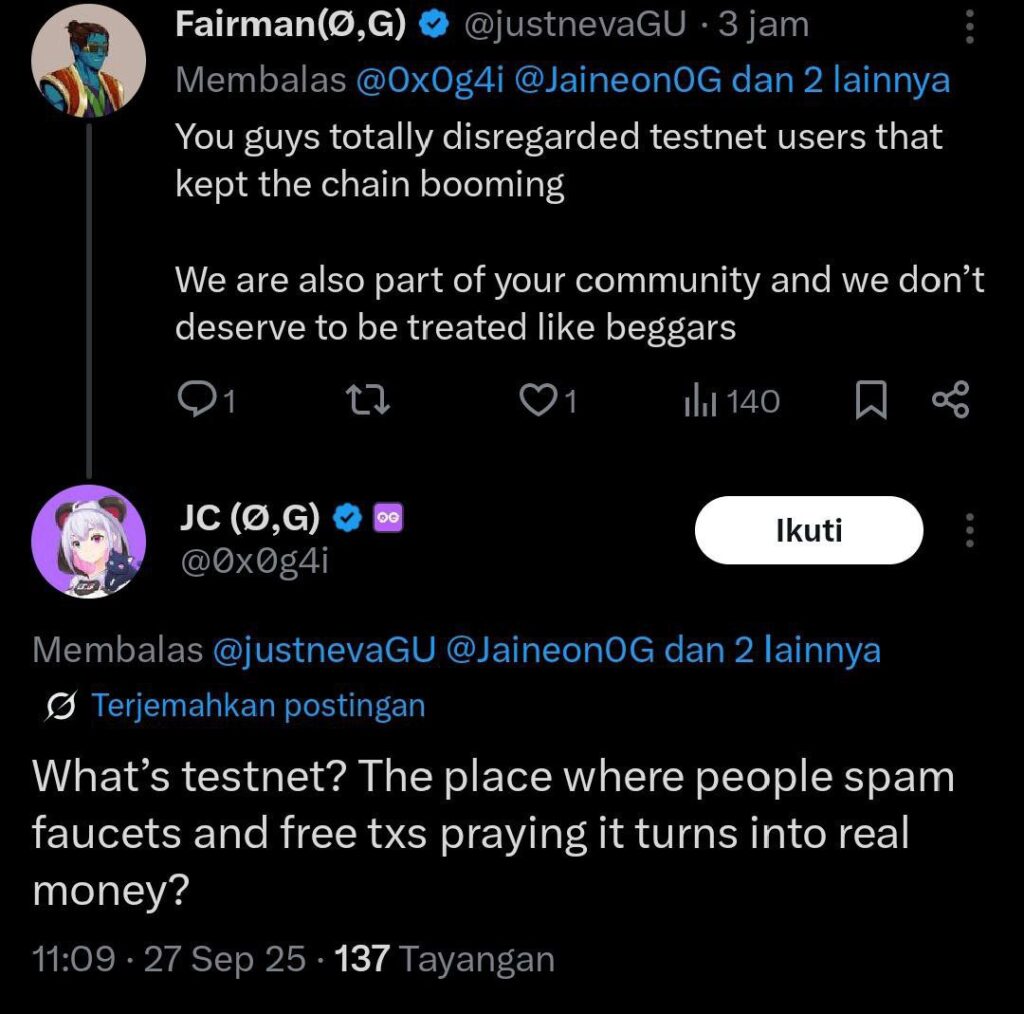
\ And what makes it worse is that all of the above statements were made directly by the CEO and head of growth. Honestly, that’s very bad public relations for a project that is rumored to have raised more than $300 million in funding.
This spat wasn’t just personal drama. It exposed how projects can exploit their testers. Let’s be real: if a foundation claims $5M went to testers, the blockchain should prove it. But when no proof comes, who ends up looking like trash? The testers.
Here’s why:
- Their effort is questioned, with accusations of botting and farming used to discredit them.
- Their rewards are minimized or withheld entirely.
- Their voices are silenced by vague statements like “trust the foundation.”
And the cruelest part? These are the same testers who were once hailed as the backbone of the “community.” Once the TGE fills the project’s treasury, that praise disappears. Testers, who once gave life to the protocol, suddenly become unwanted baggage.
Why Transparency Matters
The dirty secret only thrives when transparency is missing. Web3 promised us a world where don’t trust, verify is the rule. Yet here we are, watching projects raise millions while their testers fight for proof of even basic payouts.
Without transparency, projects risk three massive problems:
- Loss of community trust: Testers walk away feeling cheated.
- Accusations of scams: Rumors spread faster than facts in crypto.
- Investor hesitation: Smart money avoids projects that can’t back up claims.
And all of this could be solved if projects simply published on-chain data about distributions. But too often, they don’t.
If you’re in crypto in any way, this dirty cycle affects you.
- Testers: You are the most vulnerable. You give time, energy, and creativity, only to be treated as trash once the spotlight moves on.
- Investors: You base decisions on testnet activity. But if testers are discarded and numbers are inflated, your investment is built on sand.
So..
\

\ That’s the dirty secret of Web3 testnets. Testers start as heroes, powering statistics and stress-testing systems. They are called “the community” when their activity helps raise funds. But once the TGE fills project coffers, those same testers are treated like trash—discarded, blamed, and forgotten.
Web3 can do better. Transparency isn’t optional. Testers deserve recognition, rewards, and proof that their effort wasn’t wasted. Because in crypto, words fade fast, but the blockchain never lies.
The truth is on-chain. It’s time projects stop treating testers as trash and start honoring the people who make their systems real.
and last
\
\ This is to avoid disappointment after spending a lot of time in front of the computer.
You May Also Like

The Channel Factories We’ve Been Waiting For

XRP Price Prediction: Can Ripple Rally Past $2 Before the End of 2025?
