2026-02-10 Tuesday
Crypto News
Indulge in the Hottest Crypto News and Market Updates

BNB completed its 33rd quarterly burn, burning $1.208 billion.
PANews reported on October 30th that, according to an official announcement from the BNB Foundation, BNB Chain has successfully completed its 33rd quarterly BNB token burn. A total of 1,441,281.413 BNB were burned, with a value of approximately $1.208 billion USD at the time of the burn. The burn transaction has been recorded on the blockchain, and the remaining total amount of BNB to be burned can be queried in real time. The current total supply of BNB is 137,738,379.26. BNB is the native token of the BNB Chain ecosystem, supporting transactions on the BNB Smart Chain (BSC), opBNB L2, and the BNB Greenfield blockchain. Furthermore, BNB functions as a governance token, allowing holders to participate in the decentralized on-chain governance of the BNB Chain. It also serves as a strategic reserve asset, driving ecosystem development and adoption by mainstream financial institutions. BNB employs an Auto-Burn mechanism, which gradually reduces the total supply to 100 million coins using a formula based on price and the number of blocks generated. In addition, BNB has implemented a real-time burning mechanism based on BSC transaction fees. Since the BEP95 proposal was launched, approximately 276,000 BNB have been burned. Previously, it was reported that BNB completed its 32nd quarterly burn, worth approximately $1.024 billion .
Share
Author: PANews2025/10/30 16:43

CryptoQuant: US investor demand for Bitcoin and Ethereum has slowed significantly; the market awaits a new catalyst.
PANews reported on October 30th that, according to a CryptoQuant report, US investor demand for Bitcoin and Ethereum has weakened significantly in both the spot and derivatives markets. Bitcoin prices briefly surpassed $126,000 and Ethereum approached $5,000 at the end of September, but market sentiment subsequently cooled, and investor interest in further accumulation diminished. ETF inflows, spot exchange premiums, and futures basis indicators all suggest a decline in enthusiasm among US institutional and retail investors, who are currently more inclined to take profits and cautiously position themselves rather than accumulate new holdings. Specific data shows: The US spot Bitcoin ETF has turned net sold, with a seven-day average outflow of 281 BTC, the weakest level since April. Inflows into the Ethereum ETF have almost stagnated since mid-August, reflecting a lack of investor confidence. Spot demand on US cryptocurrency exchanges has slowed, with the price premium for Bitcoin and Ethereum on Coinbase nearing zero, indicating reduced buying pressure in the US spot market. Historical data shows that price increases are typically accompanied by positive premiums, while a flattening premium suggests weak domestic demand. The futures market showed a similar trend. The annualized basis for CME Bitcoin futures fell to 1.98%, the lowest level in more than two years; the basis for Ethereum six-month futures fell to 3.0%, the lowest since July, indicating weakening demand for leveraged investments. Overall data suggests that US investor sentiment has cooled after reaching its September highs, and market participants may be waiting for new catalysts to re-engage in risk investment.
Share
Author: PANews2025/10/30 16:32

Official Trump ($TRUMP) Soars 40%, Powering up the Best Meme Coins like Maxi Doge
Takeaways: Reports suggesting that the US and China might soon return to trade negotiations have sent OFFICIAL TRUMP ($TRUMP) flying. […] The post Official Trump ($TRUMP) Soars 40%, Powering up the Best Meme Coins like Maxi Doge appeared first on Coindoo.
Share
Author: Coindoo2025/10/30 16:31
Stablecoin Rules Clarified as ASIC Defines New Crypto Guidelines: Report
The financial regulator in Australia has made a historic step to regulate the digital asset market. The Australian Securities and Investment Commission (ASIC) has regarded stablecoins, wrapped tokens, tokenized securities and digital wallets as a financial product in its jurisdiction. Recent developments Service providers must now become licensed as the AFS licensee. The transition period […]
Share
Author: Tronweekly2025/10/30 16:30

Cardano price analysis: Whale sell-off triggers renewed pressure
Cardano price is facing renewed downside after heavy whale selling triggers short-term pressure. At press time, Cardano was trading at $0.6404, down 0.7% over the previous day. Although ADA has increased by roughly 1.7% in the past week, it remains…
Share
Author: Crypto.news2025/10/30 16:24

Building Africa’s Trust Layer for Crypto
The Market Gap: Africa’s Financial Friction
Africa’s financial systems are a paradox. Across the continent, millions of people own smartphones but lack stable access to banking. Currency depreciation erodes savings, and cross-border payments remain slow and expensive.
In Nigeria, for instance, the naira has lost 75% of its value since 2016, with inflation soaring to 24% in 2023, leaving ordinary savers desperate for stability. Africa in general received $96.4 billion in remittances in 2024, yet traditional transfers still cost up to 8% per transaction.
Busha entered this uncertainty with a bold premise: trust can be a product.
The goal, as founder Michael Adeyeri often emphasizes, isn’t just to help Africans trade crypto — it’s to empower them to live with it.
They are doing this by designing products specific to the needs of Africans, including:
Busha Earn
Busha Spend
Busha Business
Busha Connect
Product Architecture: Building for African Realities
Busha Earn was designed for the inflation-weary saver. By offering up to 7.5% annual yields on stablecoins, it gives users a secure, transparent way to preserve wealth.
Beyond savings, Busha’s stablecoin rails cut traditional remittance costs — from up to 8% per transaction down to 1–3%, making cross-border payments faster, cheaper, and transparent.
For everyday needs, Busha Spend turns crypto into airtime, shopping vouchers, and cashback rewards — bringing digital money into daily use.
Then there’s Busha Business, the B2B arm designed for companies handling large volumes of digital transactions. Businesses can use Busha to receive payments in crypto, instantly convert volatile assets into stablecoins, and manage treasury flows without worrying about price swings or chargeback fraud.
But the true breakout product is Busha Connect, a white-label infrastructure-as-a-service (IaaS). Busha commercializes the regulatory and liquidity infrastructure it built for itself — allowing fintech startups, payment gateways, and remittance platforms to plug into Busha’s rails instead of building their own.
That IaaS model represents Busha’s shift from consumer product to regional infrastructure provider — a move that could make it the “Plaid for crypto” in Africa.
How Busha Is Redefining Financial Access for a Volatile Continent
When the founders of Busha first started sketching their ideas in 2019, Africa’s crypto scene was a frontier — bustling, chaotic, and deeply mistrustful.
Speculative trading dominated conversations, but few were asking harder questions:
Could digital assets actually solve real problems? Could they give ordinary people stability in economies where national currencies were anything but stable?
That question became Busha’s north star.
Today, from its headquarters in Lagos, Busha has grown from a retail trading app into one of Africa’s most trusted digital asset platforms — a regulated bridge between volatile crypto markets and the everyday realities of African finance.
With 800,000+ verified users, 8 million executed trades, and a provisional SEC license in Nigeria, Busha is quietly defining what responsible innovation in African crypto looks like.
Its ambition is simple but audacious: to onboard the next one million Africans into the crypto economy — not through hype, but through utility, security, and inclusion.
The Founding Journey: From E-Commerce to Financial Empowerment
Behind Busha’s steady ascent stand two founders who have spent a decade building Africa’s digital economy from the ground up: Michael Adeyeri and Moyo Sodipo.
Both witnessed firsthand how the internet transformed commerce across Africa.
Sodipo, an Electrical and Electronic Engineering graduate from the University of Lagos, was among the early technologists who helped build Jumia, the e-commerce pioneer often dubbed “Africa’s Amazon.”
There, he saw how technology could leapfrog broken infrastructure — but also how fragile digital trust could be in a cash-based economy.
After Jumia, Sodipo led product and business development at Suregifts, a digital voucher platform that helped users access goods and services through e-vouchers instead of cash — again bridging digital tools with everyday needs.
Those experiences became the blueprint for Busha.
Together with Adeyeri, he set out not to create another speculative exchange, but to design a platform where crypto would serve everyday functions — paying bills, saving money, managing inflation.
In an ecosystem dominated by volatility and hype, Busha’s founding philosophy was radical in its simplicity: Make crypto useful.
Funding and the Regulatory Moat
In November 2021, Busha raised $4.2 million in seed funding, led by Jump Capital and joined by Cadenza Ventures, Blockwall Capital, CMT Digital, Greenhouse Capital, and Raba Capital.
But unlike most early-stage exchanges, the funds weren’t used to chase user numbers through marketing.
Instead, Busha invested heavily in regulatory compliance and security infrastructure — a calculated move that would soon pay off.
When Nigeria’s SEC rolled out its Virtual Asset Service Provider (VASP) framework, Busha became one of the first to secure a provisional license, instantly separating itself from the shadowy gray market that many competitors operated in.
That license became Busha’s most valuable moat.
In a market where trust is scarce, regulatory clarity is currency. For institutional clients, fintech partners, and corporate treasuries, Busha’s compliance posture transformed it from just another exchange into a credible financial intermediary.
Turning Regulation Into Advantage
Africa’s crypto sector has long been defined by regulatory uncertainty. Central banks, wary of volatility, have often restricted bank-crypto interactions.
In Nigeria, for instance, the Central Bank’s 2021 directive froze out many exchanges from formal banking channels.
Busha chose a different path — rather than resist regulation, it embraced it.
By aligning with the SEC’s framework early, the company effectively de-risked itself. That decision now allows Busha to operate where others hesitate, offering institutional partners and consumers alike a sense of permanence in a fast-moving market.
This compliance-first stance is what investors describe as Busha’s “regulatory moat” — a hard-to-replicate advantage now attracting enterprise clients seeking licensed liquidity infrastructure in West Africa.
The Strategic Tensions Ahead
Yet Busha’s path hasn’t been friction-free.
The same compliance rigor that earns it credibility also introduces cost. Because it operates within formal, regulated channels, fiat withdrawals can be expensive, frustrating retail users accustomed to cheaper, informal routes.
This creates a delicate balance: preserving institutional-grade trust while remaining accessible to everyday users.
Busha’s leadership knows solving this tension is key to scaling sustainably.
The company is now exploring more efficient fiat pathways and automation tools to reduce overhead while maintaining strict KYC/AML standards — an approach that mirrors how it solved previous technical challenges in e-commerce and digital vouchers.
The Vision Ahead
Busha’s next chapter is about infrastructure and scale.
The company is already laying groundwork for expansion across East and West Africa, targeting countries with strong mobile penetration but unstable currencies.
Its long-term ambition mirrors a continental dream: to build a stable, open financial network where Africans can save in dollars, transact in crypto, and settle instantly in local currency — all from one trusted platform.
The company’s Connect platform also positions it as a critical layer in Africa’s emerging crypto-fintech infrastructure — the invisible engine that powers compliant, digital liquidity behind the scenes.
As Africa’s economies modernize and regulation catches up, Busha’s quiet discipline — compliance, security, and real-world utility — will prove its greatest competitive edge.
Because in a market flooded with noise, Busha’s message remains refreshingly clear:
Financial freedom isn’t a buzzword. It’s infrastructure.
Building Africa’s Trust Layer for Crypto was originally published in Coinmonks on Medium, where people are continuing the conversation by highlighting and responding to this story
Share
Author: Medium2025/10/30 16:20
Morning Market Update (30.10.2025)
🤝 Trump–Xi Meeting:
The meeting between Donald Trump and Xi Jinping ended on a positive note, yielding concrete results. Trump announced an immediate reduction of fentanyl tariffs from 20% to 10%, bringing the overall tariff level down to 47%.
🇨🇳 China agreed to purchase chips from Nvidia and other U.S. firms (but not Blackwell chips), and all issues concerning rare earth exports were resolved — exports to the U.S. will continue without previous restrictions.
🌾 Beijing will also resume soybean imports, nearly frozen since April, and conditionally agreed to sell TikTok.
🗣️ Trump said many topics remain open but both sides committed to improving trade ties. Sensitive issues like Taiwan and Russian oil were not discussed. The new agreement will last one year with potential for extension, and Trump announced plans to visit China next April.
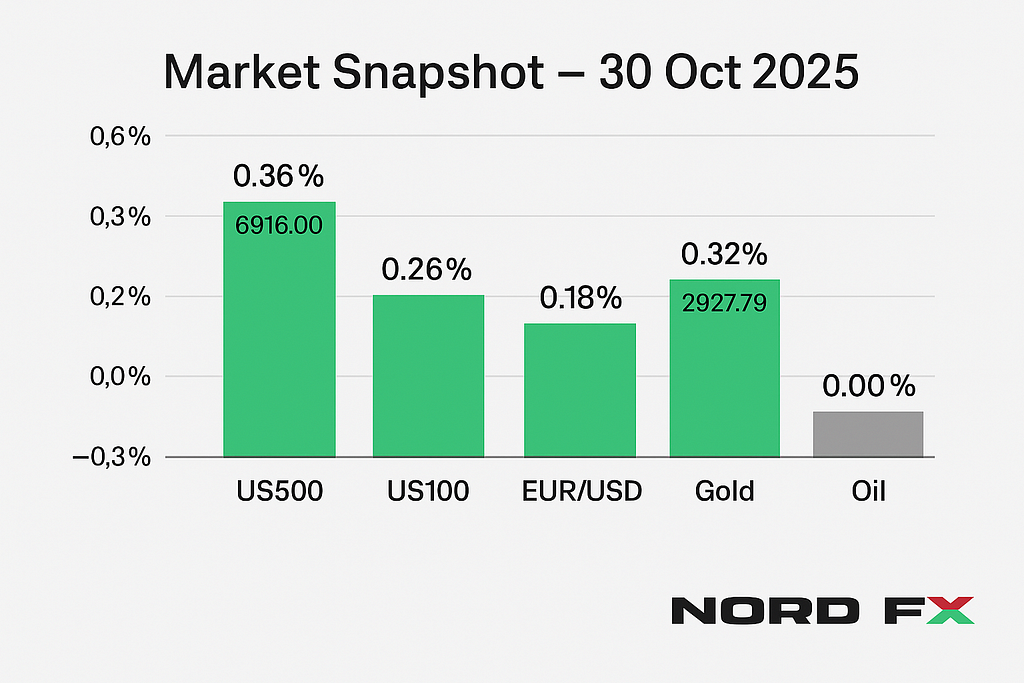
📈 Markets reacted positively after initial hesitation:
US500 +0.15%
US100 +0.2%
EUR/USD +0.25%
Gold +0.6%, while oil stays flat.
Overall, this signals a partial return to the status quo, with slight advantages for China and renewed optimism for global trade.
💹 Other key updates:
🇯🇵 BoJ left rates unchanged, noting moderate growth and inflation near 2%. USD/JPY rebounded to around 153.
🇺🇸 Fed cut rates by 25 bps and will pause QT from December. Powell hinted at uncertainty ahead of the December meeting.
☢️ Trump also announced the resumption of U.S. nuclear tests, citing similar moves by Russia and China.
💻 Earnings highlights:
Alphabet 📈 revenues exceeded $100B, shares +7% after hours.
Microsoft 💼 beat forecasts but lower CapEx worried investors.
Meta 💸 disappointed due to tax issues and high spending, shares fell.
OpenAI 🚀 targets a $1T IPO in 2027, potentially the largest in history.
🇪🇺 Today’s focus: the ECB decision (no surprises expected) and earnings from Amazon and Apple after the session.
✨ Markets remain cautiously optimistic — trade thaw, central bank shifts, and tech giants all setting the tone for Q4.
🌅 Morning Market Update (30.10.2025) was originally published in Coinmonks on Medium, where people are continuing the conversation by highlighting and responding to this story
Share
Author: Medium2025/10/30 16:20
Media: Consensys Plans IPO with JPMorgan and Goldman Sachs as Lead Underwriters
Consensys, the developer of the MetaMask cryptocurrency wallet, is planning an initial public offering (IPO). According to publication Axios, JPMorgan Chase and Goldman Sachs will act as underwriters. When asked by CoinDesk for comment, the company said there are no official announcements yet, but Consensys is constantly evaluating growth opportunities and exploring ways to expand […] Сообщение Media: Consensys Plans IPO with JPMorgan and Goldman Sachs as Lead Underwriters появились сначала на INCRYPTED.
Share
Author: Incrypted2025/10/30 16:01
Cardano (ADA) Price Outlook: Is a Break Above $0.80 the Gateway to $1.70?
Cardano (ADA) is facing downward pressure, indicating a slight decline in its market value. Over the past 24 hours, the token has fallen by nearly 3.02%, reflecting short-term selling pressure and market volatility, but over the last week, it still maintains a 1.65% gain, showing signs of resilience and potential investor confidence. At the time […]
Share
Author: Tronweekly2025/10/30 16:00