On-chain analyst Willy Woo issued a guide urging Bitcoin holders to move coins from Taproot addresses to older formats that conceal public keys behind cryptographic hashes, warning that quantum computers could compromise exposed keys as the technology matures. The Bitcoin community remains divided over the urgency and effectiveness of migration strategies as quantum computing timelines compress toward the late 2020s. Woo’s post on X outlined a six-step process for holders to protect their Bitcoin during what he called the “age of big scary quantum computers.” Taproot addresses beginning with “bc1p” embed public keys directly into addresses, making them vulnerable once quantum machines develop enough processing power to derive private keys from public ones. Meanwhile, he explained that older SegWit formats, starting with “bc1q,” and legacy addresses, beginning with “1” or “3,” conceal public keys behind hashing algorithms that provide temporary protection until transactions are broadcast, exposing the keys in mempools. Migration Strategy Sparks Technical Debate Among Developers Former Bitcoin Core developer Jonas Schnelli acknowledged that Pay-to-Public-Key-Hash addresses offer “years of protection” compared to Taproot’s immediate public key exposure. However, Schnelli warned against calling Woo’s approach “quantum safe,” stating, “the moment you broadcast a spend, your pubkey hits the mempool. A quantum attacker could crack your key and RBF double-spend before your transaction confirms.“ Anakun from Open BTC offered detailed commentary highlighting Bitcoin Improvement Proposal BIP-360, which implements quantum-resistant ML-DSA signatures approved by the National Institute of Standards and Technology in 2024. The migration plan developed by developer Jameson Lopp proposes a phased timeline spanning five years, with Phase A stopping payments to legacy addresses 160,000 blocks after the launch of BIP-360 and Phase B invalidating all non-quantum signatures 110,000 blocks later. Anakun explained this proactive approach “prevents quantum computers from stealing vulnerable coins by making them unspendable before quantum computers can access them.“ Anakun contrasted Bitcoin’s adaptable UTXO architecture with Ethereum and Solana’s immutable smart contracts that permanently verify ownership through ECDSA signatures. “When quantum computers break ECDSA, these contracts become vulnerable—Uniswap with $4B locked, AAVE with $12B, Compound with $2B,” Anakun wrote. While Vitalik Buterin’s emergency hard fork plan could save ETH in regular accounts, Anakun noted “every smart contract deployed before the fork remains vulnerable forever” because “they all check ECDSA signatures at the contract level, not the protocol level.“ Industry Split on Timeline and Preparedness Capital Markets analyst Charles Edwards sharply criticized Woo’s strategy, stating, “this ain’t quantum safe and if this is the model Bitcoin is doomed.” Edwards warned that the approach requires “perfect, meticulous operations from users” while failing to prevent quantum attacks. He argued it would “kill adoption completely, like send traffic to zero” and “doesn’t solve the 30% of lost/p2pk coins that will be stolen and market dumped.” Edwards insisted “Bitcoin’s only hope is a consensus upgrade to the network, agreed in 2026,” advocating for immediate protocol changes rather than user-initiated migrations. Woo defended his guide as an “intermediary measure,” responding to Edwards that “BTC remains the best monetary asset if you take a long time horizon beyond the next 10 years. Quantum will not break BTC because BTC will adapt.” He explained that “general consensus among the experts is 2030+” for when quantum computers may threaten Bitcoin, with developers proposing “a 2-year intermediary plan and a 7-year plan.“ MicroStrategy Chairman Michael Saylor also recently dismissed quantum concerns as “mainly marketing by people who want to sell you their next quantum yo-yo token.” Saylor argued that “Google and Microsoft aren’t going to sell you a quantum computer that cracks modern cryptography because it would destroy Google and Microsoft and the U.S. government.” He estimated the threat timeline to be “sometime 10-20 years out” and compared Bitcoin upgrades to routine software updates, stating, “Bitcoin’s a protocol like the English language and base 10 math.” Saylor emphasized that phishing attacks exploiting quantum fears pose greater immediate risks, noting, “if I wanted to hack your Bitcoin, I’d send you an email saying a quantum computer can hack your Bitcoin. Click on the link to upgrade now.“Source: a16z This divide and discovery comes as A16z recently declared that $750 billion worth of Bitcoin sits in quantum-vulnerable addresses, with the US government already preparing to transition federal systems to post-quantum cryptographic algorithms by 2035On-chain analyst Willy Woo issued a guide urging Bitcoin holders to move coins from Taproot addresses to older formats that conceal public keys behind cryptographic hashes, warning that quantum computers could compromise exposed keys as the technology matures. The Bitcoin community remains divided over the urgency and effectiveness of migration strategies as quantum computing timelines compress toward the late 2020s. Woo’s post on X outlined a six-step process for holders to protect their Bitcoin during what he called the “age of big scary quantum computers.” Taproot addresses beginning with “bc1p” embed public keys directly into addresses, making them vulnerable once quantum machines develop enough processing power to derive private keys from public ones. Meanwhile, he explained that older SegWit formats, starting with “bc1q,” and legacy addresses, beginning with “1” or “3,” conceal public keys behind hashing algorithms that provide temporary protection until transactions are broadcast, exposing the keys in mempools. Migration Strategy Sparks Technical Debate Among Developers Former Bitcoin Core developer Jonas Schnelli acknowledged that Pay-to-Public-Key-Hash addresses offer “years of protection” compared to Taproot’s immediate public key exposure. However, Schnelli warned against calling Woo’s approach “quantum safe,” stating, “the moment you broadcast a spend, your pubkey hits the mempool. A quantum attacker could crack your key and RBF double-spend before your transaction confirms.“ Anakun from Open BTC offered detailed commentary highlighting Bitcoin Improvement Proposal BIP-360, which implements quantum-resistant ML-DSA signatures approved by the National Institute of Standards and Technology in 2024. The migration plan developed by developer Jameson Lopp proposes a phased timeline spanning five years, with Phase A stopping payments to legacy addresses 160,000 blocks after the launch of BIP-360 and Phase B invalidating all non-quantum signatures 110,000 blocks later. Anakun explained this proactive approach “prevents quantum computers from stealing vulnerable coins by making them unspendable before quantum computers can access them.“ Anakun contrasted Bitcoin’s adaptable UTXO architecture with Ethereum and Solana’s immutable smart contracts that permanently verify ownership through ECDSA signatures. “When quantum computers break ECDSA, these contracts become vulnerable—Uniswap with $4B locked, AAVE with $12B, Compound with $2B,” Anakun wrote. While Vitalik Buterin’s emergency hard fork plan could save ETH in regular accounts, Anakun noted “every smart contract deployed before the fork remains vulnerable forever” because “they all check ECDSA signatures at the contract level, not the protocol level.“ Industry Split on Timeline and Preparedness Capital Markets analyst Charles Edwards sharply criticized Woo’s strategy, stating, “this ain’t quantum safe and if this is the model Bitcoin is doomed.” Edwards warned that the approach requires “perfect, meticulous operations from users” while failing to prevent quantum attacks. He argued it would “kill adoption completely, like send traffic to zero” and “doesn’t solve the 30% of lost/p2pk coins that will be stolen and market dumped.” Edwards insisted “Bitcoin’s only hope is a consensus upgrade to the network, agreed in 2026,” advocating for immediate protocol changes rather than user-initiated migrations. Woo defended his guide as an “intermediary measure,” responding to Edwards that “BTC remains the best monetary asset if you take a long time horizon beyond the next 10 years. Quantum will not break BTC because BTC will adapt.” He explained that “general consensus among the experts is 2030+” for when quantum computers may threaten Bitcoin, with developers proposing “a 2-year intermediary plan and a 7-year plan.“ MicroStrategy Chairman Michael Saylor also recently dismissed quantum concerns as “mainly marketing by people who want to sell you their next quantum yo-yo token.” Saylor argued that “Google and Microsoft aren’t going to sell you a quantum computer that cracks modern cryptography because it would destroy Google and Microsoft and the U.S. government.” He estimated the threat timeline to be “sometime 10-20 years out” and compared Bitcoin upgrades to routine software updates, stating, “Bitcoin’s a protocol like the English language and base 10 math.” Saylor emphasized that phishing attacks exploiting quantum fears pose greater immediate risks, noting, “if I wanted to hack your Bitcoin, I’d send you an email saying a quantum computer can hack your Bitcoin. Click on the link to upgrade now.“Source: a16z This divide and discovery comes as A16z recently declared that $750 billion worth of Bitcoin sits in quantum-vulnerable addresses, with the US government already preparing to transition federal systems to post-quantum cryptographic algorithms by 2035

Willy Woo Urges Bitcoin Holders to Migrate from Taproot Before Quantum Era

2025/11/11 20:54
4분 읽기
이 콘텐츠에 대한 의견이나 우려 사항이 있으시면 crypto.news@mexc.com으로 연락주시기 바랍니다

On-chain analyst Willy Woo issued a guide urging Bitcoin holders to move coins from Taproot addresses to older formats that conceal public keys behind cryptographic hashes, warning that quantum computers could compromise exposed keys as the technology matures.

The Bitcoin community remains divided over the urgency and effectiveness of migration strategies as quantum computing timelines compress toward the late 2020s.

Woo’s post on X outlined a six-step process for holders to protect their Bitcoin during what he called the “age of big scary quantum computers.”

Taproot addresses beginning with “bc1p” embed public keys directly into addresses, making them vulnerable once quantum machines develop enough processing power to derive private keys from public ones.

Meanwhile, he explained that older SegWit formats, starting with “bc1q,” and legacy addresses, beginning with “1” or “3,” conceal public keys behind hashing algorithms that provide temporary protection until transactions are broadcast, exposing the keys in mempools.

Migration Strategy Sparks Technical Debate Among Developers

Former Bitcoin Core developer Jonas Schnelli acknowledged that Pay-to-Public-Key-Hash addresses offer “years of protection” compared to Taproot’s immediate public key exposure.

However, Schnelli warned against calling Woo’s approach “quantum safe,” stating, “the moment you broadcast a spend, your pubkey hits the mempool. A quantum attacker could crack your key and RBF double-spend before your transaction confirms.

Anakun from Open BTC offered detailed commentary highlighting Bitcoin Improvement Proposal BIP-360, which implements quantum-resistant ML-DSA signatures approved by the National Institute of Standards and Technology in 2024.

The migration plan developed by developer Jameson Lopp proposes a phased timeline spanning five years, with Phase A stopping payments to legacy addresses 160,000 blocks after the launch of BIP-360 and Phase B invalidating all non-quantum signatures 110,000 blocks later.

Anakun explained this proactive approach “prevents quantum computers from stealing vulnerable coins by making them unspendable before quantum computers can access them.

Anakun contrasted Bitcoin’s adaptable UTXO architecture with Ethereum and Solana’s immutable smart contracts that permanently verify ownership through ECDSA signatures.

When quantum computers break ECDSA, these contracts become vulnerable—Uniswap with $4B locked, AAVE with $12B, Compound with $2B,” Anakun wrote.

While Vitalik Buterin’s emergency hard fork plan could save ETH in regular accounts, Anakun noted “every smart contract deployed before the fork remains vulnerable forever” because “they all check ECDSA signatures at the contract level, not the protocol level.

Industry Split on Timeline and Preparedness

Capital Markets analyst Charles Edwards sharply criticized Woo’s strategy, stating, “this ain’t quantum safe and if this is the model Bitcoin is doomed.

Edwards warned that the approach requires “perfect, meticulous operations from users” while failing to prevent quantum attacks.

He argued it would “kill adoption completely, like send traffic to zero” and “doesn’t solve the 30% of lost/p2pk coins that will be stolen and market dumped.

Edwards insisted “Bitcoin’s only hope is a consensus upgrade to the network, agreed in 2026,” advocating for immediate protocol changes rather than user-initiated migrations.

Woo defended his guide as an “intermediary measure,” responding to Edwards that “BTC remains the best monetary asset if you take a long time horizon beyond the next 10 years. Quantum will not break BTC because BTC will adapt.

He explained that “general consensus among the experts is 2030+” for when quantum computers may threaten Bitcoin, with developers proposing “a 2-year intermediary plan and a 7-year plan.

MicroStrategy Chairman Michael Saylor also recently dismissed quantum concerns as “mainly marketing by people who want to sell you their next quantum yo-yo token.

Saylor argued that “Google and Microsoft aren’t going to sell you a quantum computer that cracks modern cryptography because it would destroy Google and Microsoft and the U.S. government.

He estimated the threat timeline to be “sometime 10-20 years out” and compared Bitcoin upgrades to routine software updates, stating, “Bitcoin’s a protocol like the English language and base 10 math.

Saylor emphasized that phishing attacks exploiting quantum fears pose greater immediate risks, noting, “if I wanted to hack your Bitcoin, I’d send you an email saying a quantum computer can hack your Bitcoin. Click on the link to upgrade now.

Willy Woo Urges Bitcoin Holders to Migrate from Taproot Before Quantum EraSource: a16z

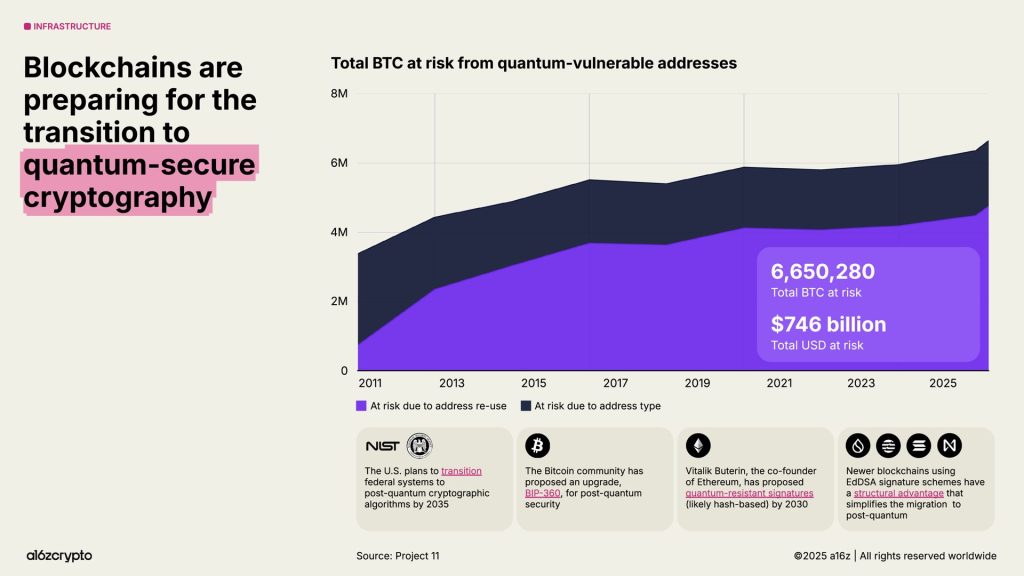
This divide and discovery comes as A16z recently declared that $750 billion worth of Bitcoin sits in quantum-vulnerable addresses, with the US government already preparing to transition federal systems to post-quantum cryptographic algorithms by 2035.


면책 조항: 본 사이트에 재게시된 글들은 공개 플랫폼에서 가져온 것으로 정보 제공 목적으로만 제공됩니다. 이는 반드시 MEXC의 견해를 반영하는 것은 아닙니다. 모든 권리는 원저자에게 있습니다. 제3자의 권리를 침해하는 콘텐츠가 있다고 판단될 경우, crypto.news@mexc.com으로 연락하여 삭제 요청을 해주시기 바랍니다. MEXC는 콘텐츠의 정확성, 완전성 또는 시의적절성에 대해 어떠한 보증도 하지 않으며, 제공된 정보에 기반하여 취해진 어떠한 조치에 대해서도 책임을 지지 않습니다. 본 콘텐츠는 금융, 법률 또는 기타 전문적인 조언을 구성하지 않으며, MEXC의 추천이나 보증으로 간주되어서는 안 됩니다.

$30,000 in PRL + 15,000 USDT

$30,000 in PRL + 15,000 USDT$30,000 in PRL + 15,000 USDT

Deposit & trade PRL to boost your rewards!