Privacy Is Key for Institutional Blockchain Adoption — Insights from Matter Labs CEO


- Privacy tokens like Zcash are experiencing renewed interest, driven by institutional demand for confidential transactions.
- Zero-knowledge (ZK) proofs are central to enabling private, scalable, and system-level privacy solutions on Ethereum and other blockchains.
- Financial institutions seek privacy layers that allow internal transaction visibility without exposing data publicly, facilitating blockchain-based settlement and payments.
- Emerging blockchain solutions aim to bridge private enterprise networks with public liquidity, maintaining confidentiality while ensuring compliance.
- Institutional use cases in DeFi are gaining traction, with layer-2 solutions like ZKsync leading the charge in fee growth and adoption.
Privacy Tokens and Institutional Focus Gain Momentum
Despite a slowdown in retail crypto speculation, privacy tokens have historically bucked the trend by gaining popularity during market downturns. While projects like Zcash are in the spotlight, the primary driver now stems from the needs of financial institutions and corporations. Banks and asset managers require confidential transaction channels on blockchain to meet regulatory standards and safeguard sensitive data, prompting a shift towards system-level privacy solutions.
Gluchowski’s interest in blockchain started with Bitcoin in 2014, but his focus shifted during Ethereum’s ICO boom, when smart contracts unlocked new use cases. His company, Matter Labs, is key in developing ZKsync, an Ethereum layer-2 network leveraging zero-knowledge proofs to enable scalable and private transactions—fostering a new era of privacy-focused enterprise blockchain solutions.
As of early November, many companies—totaling over 140—held around $137 billion in crypto assets. Yet, the future lies in moving payment or settlement flows onto public blockchains, which requires robust privacy layers for confidentiality, Gluchowski emphasized.
The next stage of institutional adoption involves using blockchain for transactions and settlements. Source: CoinGeckoShifting Perspectives on Privacy and Regulation
While crypto cycles have often been characterized by speculation—such as memecoins with little real utility—the focus on privacy distinguishes itself through its direct functional role in financial systems. Regulatory pressures previously led to privacy coin delistings and sanctions like those against Tornado Cash. However, recent policy shifts, particularly under the current U.S. administration, suggest a more nuanced view, recognizing privacy as a technical capability rather than solely an enabler of illicit activity.
 US sanctions against Tornado Cash have been relaxed. Source: US Department of the Treasury
Gluchowski notes that the attitude has shifted from taboo to strategic necessity: “We need to embrace this technology, or we risk falling behind.” The resurgence of privacy tokens like Zcash signals an increased institutional focus, driven by the need for confidential operations on shared infrastructure without exposing internal data on transparent public ledgers.
This evolving approach is reflected within the Ethereum ecosystem, where privacy solutions are being integrated as system-level requirements. Unlike consumer privacy, the privacy requirements for institutional finance involve private execution environments where data remains under the control of the organization, with external visibility restricted.
Bridging Privacy and Connectivity in Blockchain
Historically, private enterprise blockchains faced a trade-off: they maintained internal confidentiality but remained disconnected from broader liquidity pools. Today, solutions like ZK proofs and locally operated private chains seek to resolve this dilemma, enabling institutions to uphold privacy while interacting seamlessly with public markets.
Gluchowski highlights that incorporating zero-knowledge proofs into these private chains allows for transaction validation without revealing sensitive data, creating a hybrid model of privacy and interoperability. This approach stands to significantly enhance the adoption of blockchain in regulated sectors like finance and corporate settlement.
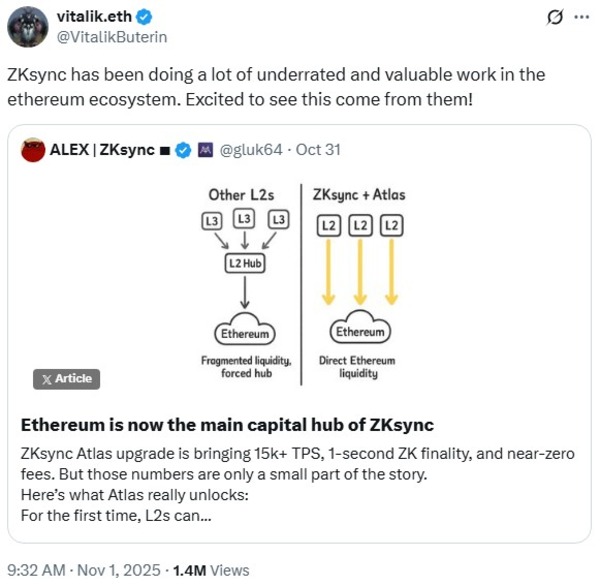 Vitalik Buterin praised ZKsync’s method for enabling shared liquidity across Ethereum Layer 2 solutions. Source: Vitalik Buterin/Alex Gluchowski
The Growing Institutional Privacy Layer
Recent data shows increased fee activity on ZKsync, driven by new tokenomics and staking initiatives, signaling broader institutional interest. Gluchowski attributes this surge to market readiness and the deployment of new economic models, not retail speculation.
While consumer crypto use cases continue to grow rapidly, the next major phase of blockchain adoption will center on institutional participation, where privacy and confidentiality are operational imperatives. ZKsync’s expansion into a multi-chain network with private system deployments exemplifies this trend, with several implementations already in testing stages, poised for mainstream production before year-end.
As the industry evolves, privacy layers embedded within blockchain infrastructure are becoming critical for compliance, confidentiality, and the seamless operation of institutional DeFi strategies.
This article was originally published as Privacy Is Key for Institutional Blockchain Adoption — Insights from Matter Labs CEO on Crypto Breaking News – your trusted source for crypto news, Bitcoin news, and blockchain updates.


추천 콘텐츠

Lawmaker Demands Polymarket Remove 219 War Bets After Airman Market Controversy – Bitcoin News

Critical USDT0 Response to Drift Hack Exposes Stark Contrast in Stablecoin Security Protocols