Ethereum is the second-largest cryptocurrency in the world by market cap, yet it has seen some of the most brutal price collapses in crypto history. If you've been watching ETH drop and askingEthereum is the second-largest cryptocurrency in the world by market cap, yet it has seen some of the most brutal price collapses in crypto history. If you've been watching ETH drop and asking
Learn/Cryptocurrency Knowledge/Hot Concepts/Ethereum Cr...ry Tells Us

Ethereum Crash Reasons: Why ETH Falls and What History Tells Us

Intermediate
Apr 15, 2026James Mitchell
0m
Ethereum
ETH$2,338.99-0.42%
Capverse
CAP$0.09621+0.76%
Farcana
FAR$0.002674-4.05%
Ethereum is the second-largest cryptocurrency in the world by market cap, yet it has seen some of the most brutal price collapses in crypto history.
If you've been watching ETH drop and asking yourself why did Ethereum crash — or whether it will happen again — you're not alone.
This article breaks down the real reasons behind every Ethereum price crash, what makes ETH structurally more vulnerable than other assets, and what history says about what comes next.

Key Takeaways
  • Ethereum crashes are rarely caused by a single event — they are typically the result of macroeconomic pressure, Bitcoin correlation, and leveraged liquidation cascades happening at the same time.
  • When interest rates rise and investors move toward safer assets, ETH tends to fall harder than most other cryptocurrencies due to its higher volatility profile.
  • The Dencun upgrade in March 2024 significantly reduced Ethereum's mainnet fee revenue, weakening a key driver of ETH's deflationary supply mechanism.
  • Every major Ethereum crash in history — including the 94% drop in 2018 and the 82% drop in 2022 — was eventually followed by a recovery to new highs.
  • During price downturns, large ETH holders have historically accumulated rather than sold, a pattern that has often preceded significant recoveries.
  • Ethereum's ongoing development roadmap, including planned network upgrades targeting higher throughput and lower fees, continues regardless of short-term price action.

What Triggers an Ethereum Crash


1. Macro Pressure Pulls the Trigger


When the broader economy turns ugly, ETH is usually the first major crypto to feel it.
Rising interest rates make bonds and cash more attractive than risk assets like crypto.
When the Federal Reserve holds rates high, investors rotate out of volatile assets — and ETH, being more volatile than Bitcoin, takes a harder hit than most.
High interest rates push investors toward safer assets like bonds and cash — a dynamic that consistently reduces demand for volatile assets like ETH.


2. Bitcoin Drags ETH Down With It


Ethereum almost never crashes alone.
When Bitcoin falls sharply, ETH typically falls harder — because ETH is treated as a higher-risk, higher-volatility asset in the same category.
As Bitcoin fell sharply in Q1 2026, capital fled volatile assets in favor of traditional safe havens — pulling the entire altcoin market down with it.
Retail and institutional investors selling Bitcoin often liquidate ETH in the same move, compressing the price faster than most people expect.


3. Leverage Makes Every Ethereum Crash Worse


One of the most overlooked reasons for the Ethereum crash is how much borrowed money is in the market at any given time.
When ETH drops past a key support level, traders who borrowed money to buy ETH get automatically liquidated — their positions are force-sold, pushing the price down further.
On April 6–7, 2025, one whale had 67,570 ETH worth approximately $106 million wiped out on MakerDAO after Ether plunged over 10% from above $1,800 to around $1,500 — a single liquidation that accelerated the crash further.
This cascade effect turns a normal ETH price correction into a full Ethereum flash crash.


Ethereum-Specific Factors That Make ETH More Vulnerable


1. The Dencun Upgrade Created an Unexpected Problem


In March 2024, Ethereum launched the Dencun upgrade to make the network cheaper for Layer-2 solutions like Arbitrum and Optimism.
It worked — but it had an unintended side effect.
Less fee revenue means less ETH is burned — which means ETH becomes more inflationary, adding to selling pressure during downturns.


2. ETF Outflows Signal Institutional Retreat


Ethereum ETFs launched in 2024 gave large institutions a regulated way to buy ETH — but they also created a new channel for large-scale selling.
US-traded Ethereum ETFs experienced notable net outflows in mid-2025, signaling a period of institutional repositioning away from ETH. Some institutional players reduced their ETH exposure during this period, contributing to sustained selling pressure that retail demand alone could not offset.
When institutions exit ETH through ETF redemptions, it creates sustained downward pressure that retail buying alone cannot absorb.


3. ETH Has an Identity Problem the Market Hasn't Fully Resolved


Bitcoin is digital gold. ETH is… harder to explain.
Is it a tech platform? DeFi infrastructure? A store of value? An internet bond?
That lack of a clear, simple narrative makes it harder to defend during panic sell-offs.
Ethereum's crash reflects converging pressures from institutional distribution, macroeconomic tightening, and technical breakdowns — rather than a fundamental project failure.
But when headlines scream "crash," most retail investors don't stop to read that nuance.


Ethereum Crash vs. Long-Term Recovery — What History Shows


1. ETH Has Survived Far Worse


Every time people asked if Ethereum would crash again, it already had — and recovered.
Each crash felt permanent at the time. None of them were.
The investors who fared best weren't the ones who timed the bottom perfectly — they were the ones who didn't panic sell.


2. Whales Buy When Retail Sells


One pattern that repeats in every recent Ethereum crash: large holders accumulate while retail panics.
On-chain data has historically shown large holders accumulating ETH quietly during major downturns, even as retail sentiment remains in extreme fear — a divergence that has preceded past recoveries.
This divergence between price dropping and quiet accumulation has historically preceded major recoveries.
That doesn't mean the bottom is in — but it does mean not everyone is selling.


3. Upcoming Upgrades Could Shift the Narrative


Price follows fundamentals eventually — and Ethereum's development roadmap is still active.
Ethereum's development roadmap includes upcoming network upgrades targeting higher gas limits and improved scalability — progress that has historically supported long-term price recovery.
Major network improvements have historically acted as catalysts for ETH price recoveries.
Whether the timing aligns with the next rally depends on broader market conditions — but the building continues regardless of price.


FAQ

Q: Will Ethereum crash again?
A: Ethereum has crashed multiple times in its history and has always recovered — but future crashes cannot be ruled out, as ETH remains a high-volatility asset tied to macro conditions and market sentiment.


Q: Why did Ethereum crash?
A: The most common causes are macroeconomic pressure (rising interest rates, risk-off sentiment), Bitcoin correlation, leveraged liquidation cascades, and ETH-specific factors like reduced mainnet fee revenue following the Dencun upgrade.


Q: Why did Ethereum crash today?
A: Short-term ETH price crashes are typically triggered by a combination of macro news (Fed decisions, tariff announcements), Bitcoin-led selloffs, or sudden liquidations of leveraged positions — check live market data on MEXC for real-time context.


Q: Is Ethereum about to crash?
A: No one can predict this with certainty — ETH's short-term direction depends on macroeconomic conditions, Bitcoin's price action, and market sentiment, none of which are predictable.


Q: When will Ethereum crash?
A: Ethereum crashes cannot be timed reliably; historically, they have coincided with macro tightening cycles, broad risk-off events, or periods of excessive market leverage.


Q: Should I buy Ethereum after a recent crypto crash?
A: This is a personal financial decision — historically, ETH has recovered after every major crash, but there is no guarantee of timing or outcome, and you should only invest what you can afford to lose.


Q: Did Ethereum crash?
A: ETH dropped over 57% from its August 2025 peak of approximately $4,900 to around $1,850 by early 2026, representing one of the most significant drawdowns of recent cycles, per CoinMarketCap data.


Conclusion

Ethereum crashes are painful — but they are also structurally explainable.
Macro pressure, Bitcoin correlation, leverage, and ETH-specific issues like post-Dencun fee revenue decline all play a role in driving the Ethereum price crash cycle.
History shows that ETH has recovered from every crash it has faced — though the timeline and magnitude of each recovery varies.
If you want to track ETH's price in real time, monitor live data and trading activity at MEXC.
Market Opportunity
Ethereum Logo
Ethereum Price(ETH)
$2,339.74
$2,339.74$2,339.74
+0.32%
USD
Ethereum (ETH) Live Price Chart

Popular Articles

View More
Ethereum Virtual Machine (EVM): Definition, Architecture, and How It Works

Ethereum Virtual Machine (EVM): Definition, Architecture, and How It Works

Most people buy ETH without ever asking what actually makes Ethereum run. The answer is the Ethereum Virtual Machine — the engine behind smart contracts, decentralized apps, and DeFi protocols across

ETH Blockchain: How It Works, What Runs on It, and How to Use an Explorer

ETH Blockchain: How It Works, What Runs on It, and How to Use an Explorer

The ETH blockchain is more than just a place to send and receive crypto. It's a global network of computers running smart contracts, decentralized apps, and thousands of tokens — all without a

ETH Fees: How They Work, Why They Spike, and How to Reduce Them

ETH Fees: How They Work, Why They Spike, and How to Reduce Them

Every time you send ETH or use an app on Ethereum, you pay a small charge called an ETH fee — and if you've ever been surprised by the amount, you're not alone. This guide breaks down exactly what

Ethereum Mainnet: What It Is, How It Works, and Why It Matters

Ethereum Mainnet: What It Is, How It Works, and Why It Matters

If you've ever sent ETH, used a DeFi app, or held an ERC-20 token, you've already interacted with the Ethereum Mainnet — whether you knew it or not. This guide breaks down exactly what the Ethereum

Hot Crypto Updates

View More
ETH Price Prediction 2026: Will ETH Break $5,000 or Stay Range-Bound? A Complete Analysis

ETH Price Prediction 2026: Will ETH Break $5,000 or Stay Range-Bound? A Complete Analysis

Published: March 24, 2026 Reading Time: ~12 minutes Overview Ethereum in 2026 finds itself at a pivotal crossroads. Two landmark upgrades—Glamsterdam and Hegotá—are poised to push the network toward

Ethereum (ETH) Price Prediction: Market Forecast and Analysis

Ethereum (ETH) Price Prediction: Market Forecast and Analysis

Understanding the price prediction of Ethereum (ETH) gives traders and investors a forward-looking perspective on potential market trends. Ethereum price predictions aren't guarantees, but they


Ethereum (ETH) Price Prediction: Market Forecast and Analysis

Ethereum (ETH) Price Prediction: Market Forecast and Analysis

Understanding the price prediction of Ethereum (ETH) gives traders and investors a forward-looking perspective on potential market trends and cryptocurrency forecasts. Ethereum price predictions

Ethereum (ETH) 7-day Price Change

Ethereum (ETH) 7-day Price Change

The latest Ethereum (ETH) price has demonstrated notable volatility and recovery momentum over the past week. In this article, we'll examine the current Ethereum price, 7-day performance, and the

Trending News

View More
If You Put $5,000 Into Ethereum (ETH) Today, What Happens by 2027?

If You Put $5,000 Into Ethereum (ETH) Today, What Happens by 2027?

Ethereum feels a bit mixed right now. Big players are coming in, but the risks are still there. One firm just reported a huge $3.8 billion loss tied to its ETH

Ethereum flips $2.3K, but selling pressure is quietly building

Ethereum flips $2.3K, but selling pressure is quietly building

The post Ethereum flips $2.3K, but selling pressure is quietly building appeared on BitcoinEthereumNews.com. Ethereum [ETH] moves above the $2,300 Short-Term Holder
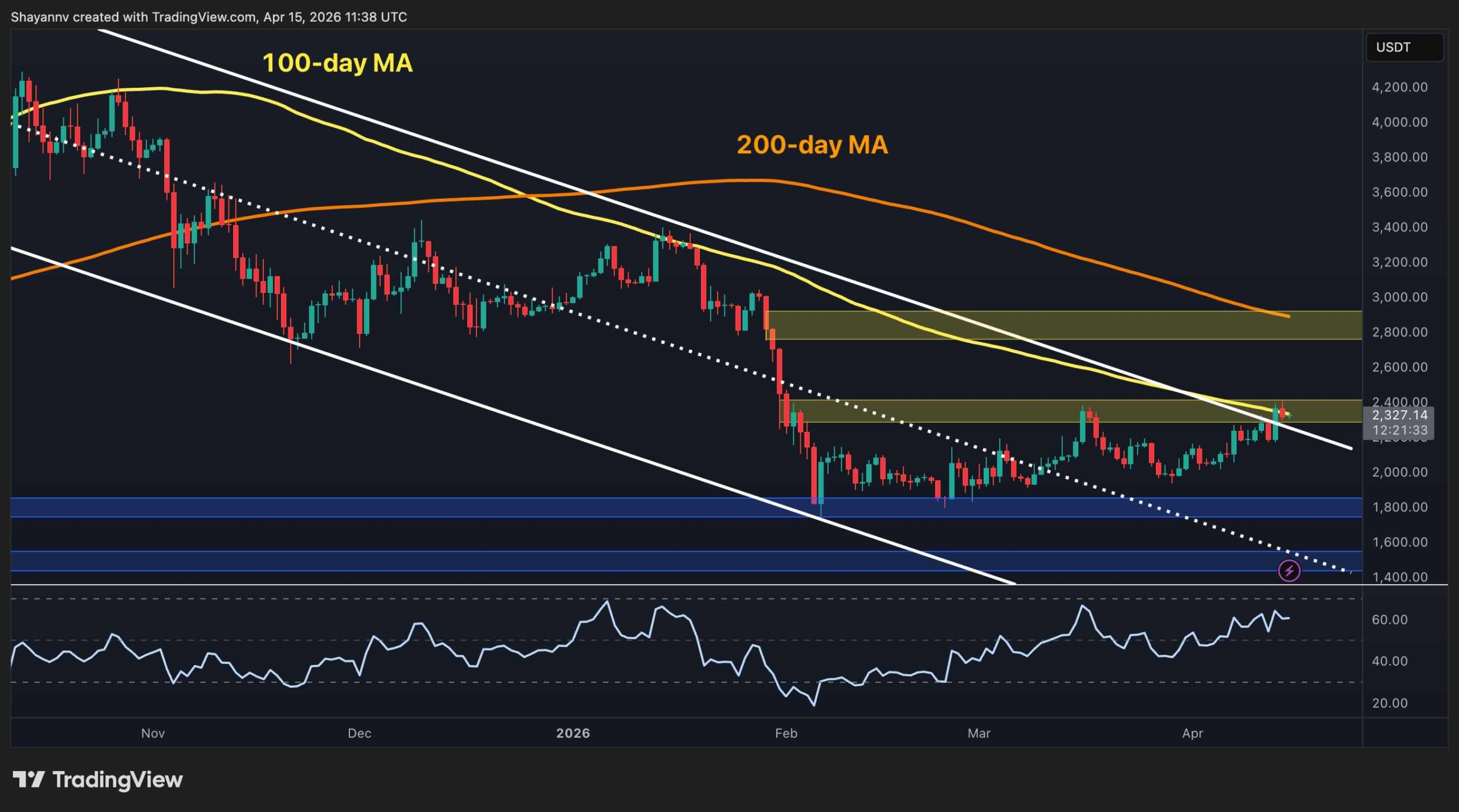

Ethereum Price Analysis: What’s Next for ETH After the Most Constructive Gains in Months?

Ethereum Price Analysis: What’s Next for ETH After the Most Constructive Gains in Months?

Ethereum is trading around $2.3k, posting its most constructive price action in months. For the first time since the correction began, ETH is showing genuine signs

ETHGas and ether.fi Launch $3B Bet on Ethereum Infrastructure

ETHGas and ether.fi Launch $3B Bet on Ethereum Infrastructure

TLDR ETHGas and ether.fi commit $3B to reshape Ethereum blockspace markets Ethereum gains forward pricing layer with $3B ETHGas and ether.fi deal $3B ETH commitment

Related Articles

View More
What is RLUSD? Complete Guide to Ripple’s Stablecoin – Price, XRP Relationship & Use Cases

What is RLUSD? Complete Guide to Ripple’s Stablecoin – Price, XRP Relationship & Use Cases

Interested in Ripple’s latest stablecoin that’s attracting attention across the crypto industry? This in-depth guide covers everything you need to know about RLUSD, from its definition and mechanics t

Ethereum Virtual Machine (EVM): Definition, Architecture, and How It Works

Ethereum Virtual Machine (EVM): Definition, Architecture, and How It Works

Most people buy ETH without ever asking what actually makes Ethereum run.The answer is the Ethereum Virtual Machine — the engine behind smart contracts, decentralized apps, and DeFi protocols across t

Ethereum Network: What It Is, How It Works, and Why It Matters

Ethereum Network: What It Is, How It Works, and Why It Matters

The Ethereum network is one of the most important technologies in crypto — and it does far more than move money.Whether you're curious about what powers USDT and USDC, how smart contracts work, or why


Ethereum Circulating Supply Explained: Total Supply, Max Supply, and Market Cap

Ethereum Circulating Supply Explained: Total Supply, Max Supply, and Market Cap

If you've ever looked up Ethereum on a price tracker and wondered what "circulating supply" actually means — and why it matters — you're not alone.This guide breaks down what Ethereum's circulating su

Sign Up on MEXC
Sign Up & Receive Up to 10,000 USDT Bonus