Tether’s push to expand Bitcoin mining in Uruguay has stalled after the state utility cut power to its local partner.  UTE, the national electricity provider, halted supply in late July over unpaid bills totaling nearly $5 million. The dispute also froze expansion efforts in the country’s Flores and Florida regions. Tether’s LATAM Bitcoin Mining Expansion Plan Hits Major Roadblock The USDT stablecoin operator entered Uruguay in 2023, promising renewable-powered Bitcoin mining. Uruguay’s abundant wind and hydro capacity made it a prime site for sustainable energy projects.  Tether partnered with a licensed operator, Microfin, to build facilities and secure long-term electricity deals. However, tension grew as costs and guarantees mounted. UTE required large deposits to secure the energy contracts, while Microfin sought tariff adjustments.  Negotiations led to a memorandum of understanding in June, but arrears remained unresolved. The failure to settle debts triggered the shutdown. Crypto Twitter Criticizing Tether’s Uruguay Backtrack. Source: X Tether had announced broader plans to control about 1% of the global Bitcoin network. The firm pledged hundreds of millions of dollars in South American mining projects, including sites in Paraguay.  The Uruguayan expansion was meant to anchor those ambitions. The company has emphasized that USDT reserves remain separate from its operational ventures. Mining revenue and energy assets are intended to diversify Tether’s business beyond stablecoin issuance.  Earlier this year, it also acquired a stake in Latin American agribusiness to link stablecoin use to commodity trade. The setback in Uruguay raises questions about the viability of energy-intensive mining in high-cost markets. While Paraguay and Texas have attracted miners with cheaper electricity, Uruguay’s grid is stricter on guarantees.  For now, Tether’s talks with UTE continue, but the timeline for restarting operations is unclear. Overall, this highlights the risks in tying stablecoin companies to volatile mining ventures. Tether has not confirmed whether it will scale back or abandon its Uruguay expansion.Tether’s push to expand Bitcoin mining in Uruguay has stalled after the state utility cut power to its local partner.  UTE, the national electricity provider, halted supply in late July over unpaid bills totaling nearly $5 million. The dispute also froze expansion efforts in the country’s Flores and Florida regions. Tether’s LATAM Bitcoin Mining Expansion Plan Hits Major Roadblock The USDT stablecoin operator entered Uruguay in 2023, promising renewable-powered Bitcoin mining. Uruguay’s abundant wind and hydro capacity made it a prime site for sustainable energy projects.  Tether partnered with a licensed operator, Microfin, to build facilities and secure long-term electricity deals. However, tension grew as costs and guarantees mounted. UTE required large deposits to secure the energy contracts, while Microfin sought tariff adjustments.  Negotiations led to a memorandum of understanding in June, but arrears remained unresolved. The failure to settle debts triggered the shutdown. Crypto Twitter Criticizing Tether’s Uruguay Backtrack. Source: X Tether had announced broader plans to control about 1% of the global Bitcoin network. The firm pledged hundreds of millions of dollars in South American mining projects, including sites in Paraguay.  The Uruguayan expansion was meant to anchor those ambitions. The company has emphasized that USDT reserves remain separate from its operational ventures. Mining revenue and energy assets are intended to diversify Tether’s business beyond stablecoin issuance.  Earlier this year, it also acquired a stake in Latin American agribusiness to link stablecoin use to commodity trade. The setback in Uruguay raises questions about the viability of energy-intensive mining in high-cost markets. While Paraguay and Texas have attracted miners with cheaper electricity, Uruguay’s grid is stricter on guarantees.  For now, Tether’s talks with UTE continue, but the timeline for restarting operations is unclear. Overall, this highlights the risks in tying stablecoin companies to volatile mining ventures. Tether has not confirmed whether it will scale back or abandon its Uruguay expansion.

Tether’s Uruguay Mining Plans Hit Setback Amid Energy Dispute

2025/09/20 05:51
2 min read
For feedback or concerns regarding this content, please contact us at crypto.news@mexc.com

Tether’s push to expand Bitcoin mining in Uruguay has stalled after the state utility cut power to its local partner. 

UTE, the national electricity provider, halted supply in late July over unpaid bills totaling nearly $5 million. The dispute also froze expansion efforts in the country’s Flores and Florida regions.

Tether’s LATAM Bitcoin Mining Expansion Plan Hits Major Roadblock

The USDT stablecoin operator entered Uruguay in 2023, promising renewable-powered Bitcoin mining. Uruguay’s abundant wind and hydro capacity made it a prime site for sustainable energy projects. 

Tether partnered with a licensed operator, Microfin, to build facilities and secure long-term electricity deals.

However, tension grew as costs and guarantees mounted. UTE required large deposits to secure the energy contracts, while Microfin sought tariff adjustments. 

Negotiations led to a memorandum of understanding in June, but arrears remained unresolved. The failure to settle debts triggered the shutdown.
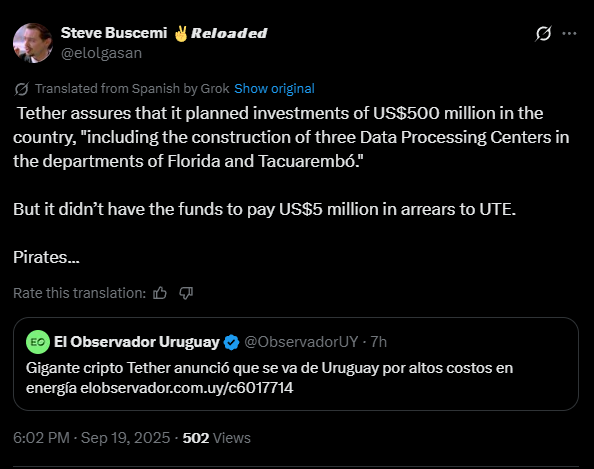
Crypto Twitter Criticizing Tether’s Uruguay Backtrack. Source: X

Tether had announced broader plans to control about 1% of the global Bitcoin network. The firm pledged hundreds of millions of dollars in South American mining projects, including sites in Paraguay. 

The Uruguayan expansion was meant to anchor those ambitions.

The company has emphasized that USDT reserves remain separate from its operational ventures. Mining revenue and energy assets are intended to diversify Tether’s business beyond stablecoin issuance. 

Earlier this year, it also acquired a stake in Latin American agribusiness to link stablecoin use to commodity trade.

The setback in Uruguay raises questions about the viability of energy-intensive mining in high-cost markets. While Paraguay and Texas have attracted miners with cheaper electricity, Uruguay’s grid is stricter on guarantees. 

For now, Tether’s talks with UTE continue, but the timeline for restarting operations is unclear.

Overall, this highlights the risks in tying stablecoin companies to volatile mining ventures. Tether has not confirmed whether it will scale back or abandon its Uruguay expansion.

Market Opportunity
EPNS Logo
EPNS Price(PUSH)
$0.01202
$0.01202$0.01202
-0.22%
USD
EPNS (PUSH) Live Price Chart
Disclaimer: The articles reposted on this site are sourced from public platforms and are provided for informational purposes only. They do not necessarily reflect the views of MEXC. All rights remain with the original authors. If you believe any content infringes on third-party rights, please contact crypto.news@mexc.com for removal. MEXC makes no guarantees regarding the accuracy, completeness, or timeliness of the content and is not responsible for any actions taken based on the information provided. The content does not constitute financial, legal, or other professional advice, nor should it be considered a recommendation or endorsement by MEXC.

You May Also Like

Why AVAX Traders Are Watching $11.50 and $8.00 Right Now

Why AVAX Traders Are Watching $11.50 and $8.00 Right Now

Avalanche gained 2.77% on March 4, reaching $9.64 by 15:50 UTC on volume of 327,810 AVAX, the highest single-hour reading on the chart. The move came after six
Share
Ethnews2026/03/05 00:16
Best Crypto to Buy as Saylor & Crypto Execs Meet in US Treasury Council

Best Crypto to Buy as Saylor & Crypto Execs Meet in US Treasury Council

The post Best Crypto to Buy as Saylor & Crypto Execs Meet in US Treasury Council appeared on BitcoinEthereumNews.com. Michael Saylor and a group of crypto executives met in Washington, D.C. yesterday to push for the Strategic Bitcoin Reserve Bill (the BITCOIN Act), which would see the U.S. acquire up to 1M $BTC over five years. With Bitcoin being positioned yet again as a cornerstone of national monetary policy, many investors are turning their eyes to projects that lean into this narrative – altcoins, meme coins, and presales that could ride on the same wave. Read on for three of the best crypto projects that seem especially well‐suited to benefit from this macro shift:  Bitcoin Hyper, Best Wallet Token, and Remittix. These projects stand out for having a strong use case and high adoption potential, especially given the push for a U.S. Bitcoin reserve.   Why the Bitcoin Reserve Bill Matters for Crypto Markets The strategic Bitcoin Reserve Bill could mark a turning point for the U.S. approach to digital assets. The proposal would see America build a long-term Bitcoin reserve by acquiring up to one million $BTC over five years. To make this happen, lawmakers are exploring creative funding methods such as revaluing old gold certificates. The plan also leans on confiscated Bitcoin already held by the government, worth an estimated $15–20B. This isn’t just a headline for policy wonks. It signals that Bitcoin is moving from the margins into the core of financial strategy. Industry figures like Michael Saylor, Senator Cynthia Lummis, and Marathon Digital’s Fred Thiel are all backing the bill. They see Bitcoin not just as an investment, but as a hedge against systemic risks. For the wider crypto market, this opens the door for projects tied to Bitcoin and the infrastructure that supports it. 1. Bitcoin Hyper ($HYPER) – Turning Bitcoin Into More Than Just Digital Gold The U.S. may soon treat Bitcoin as…
Share
BitcoinEthereumNews2025/09/18 00:27
USDsui debuts as Treasury yield is routed to Sui DeFi

USDsui debuts as Treasury yield is routed to Sui DeFi

USDsui stablecoin launches on Sui with reserves in bonds and liquid assets; yield from holdings is recycled to support SUI and DeFi pools via Bridge’s platform.
Share
CoinLive2026/03/04 23:57