This article explores how physics-informed neural networks (PINNs) can simulate shock wave generation, interactions, and entropy solutions. Using Burgers’ equation as a test case, the models accurately handle wave formation, collisions, and rarefaction without prior knowledge of origin points. The results highlight how deep learning can advance computational fluid dynamics by tackling problems once limited to traditional numerical methods.This article explores how physics-informed neural networks (PINNs) can simulate shock wave generation, interactions, and entropy solutions. Using Burgers’ equation as a test case, the models accurately handle wave formation, collisions, and rarefaction without prior knowledge of origin points. The results highlight how deep learning can advance computational fluid dynamics by tackling problems once limited to traditional numerical methods.

Shocks, Collisions, and Entropy—Neural Networks Handle It All

2025/09/20 19:00

Abstract and 1. Introduction

1.1. Introductory remarks

1.2. Basics of neural networks

1.3. About the entropy of direct PINN methods

1.4. Organization of the paper

  1. Non-diffusive neural network solver for one dimensional scalar HCLs

    2.1. One shock wave

    2.2. Arbitrary number of shock waves

    2.3. Shock wave generation

    2.4. Shock wave interaction

    2.5. Non-diffusive neural network solver for one dimensional systems of CLs

    2.6. Efficient initial wave decomposition

  2. Gradient descent algorithm and efficient implementation

    3.1. Classical gradient descent algorithm for HCLs

    3.2. Gradient descent and domain decomposition methods

  3. Numerics

    4.1. Practical implementations

    4.2. Basic tests and convergence for 1 and 2 shock wave problems

    4.3. Shock wave generation

    4.4. Shock-Shock interaction

    4.5. Entropy solution

    4.6. Domain decomposition

    4.7. Nonlinear systems

  4. Conclusion and References

4.3. Shock wave generation

In this section, we demonstrate the potential of our algorithms to handle shock wave generation, as described in Subsection 2.3. One of the strengths of the proposed algorithm

\
\ is that it does not require to know the initial position&time of birth, in order to accurately track the DLs. Recall that the principle is to assume that in a given (sub)domain and from a smooth function a shock wave will eventually be generated. Hence we decompose the corresponding (sub)domain in two subdomains and consider three neural networks: two neural networks will approximate the solution in each subdomain, and one neural network will approximate the DL. As long as the shock wave is not generated (say for t < t∗ ), the global solution remains smooth and the Rankine-Hugoniot condition is trivially satisfied (null jump); hence the DL for t < t∗ does not have any meaning.

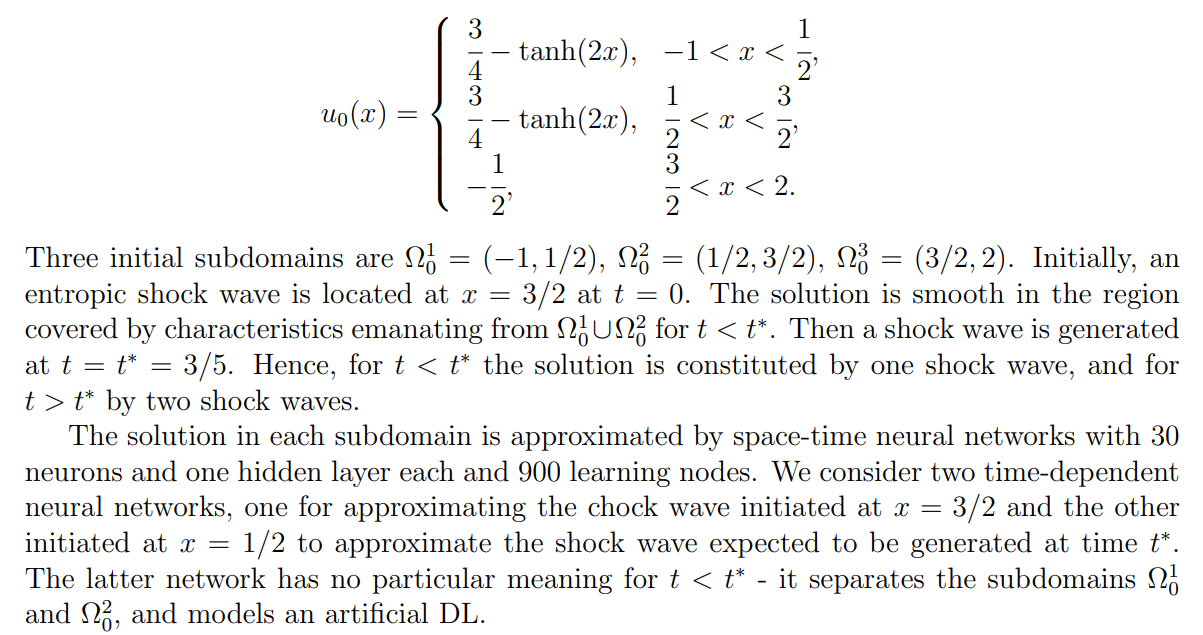
\ Experiment 4. We again consider the inviscid Burgers’ equation, Ω × [0, T] = (−1, 2) × [0, 0.5] and the initial condition

\
\
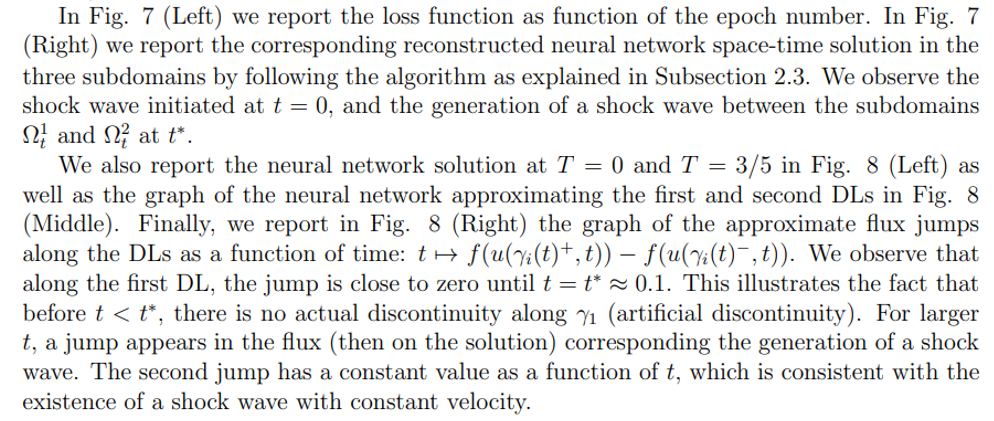
\ Figure 7: Experiment 4. (Left) Loss function. (Right) Space-time solution
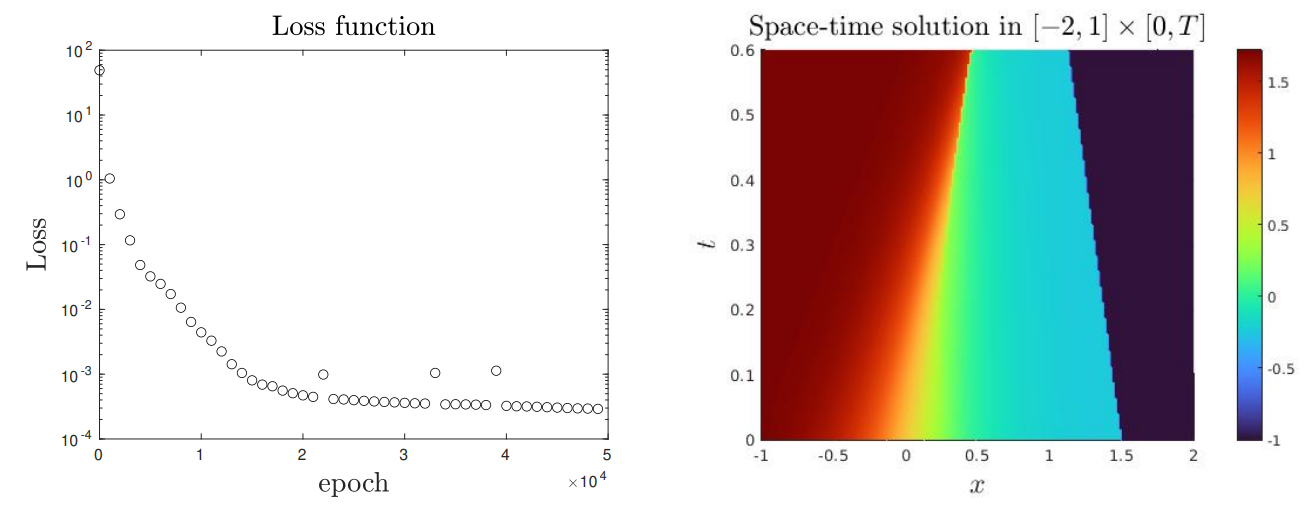
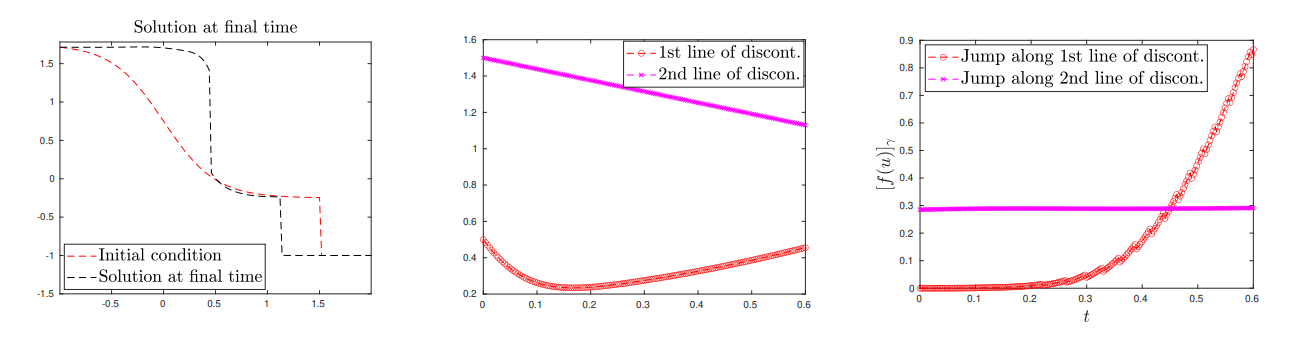
\ Figure 8: Experiment 4. (Left) Graph of the solution at T = 3/5. (Middle) Discontinuity lines. (Right) Flux jump along the DLs.

\

4.4. Shock-Shock interaction

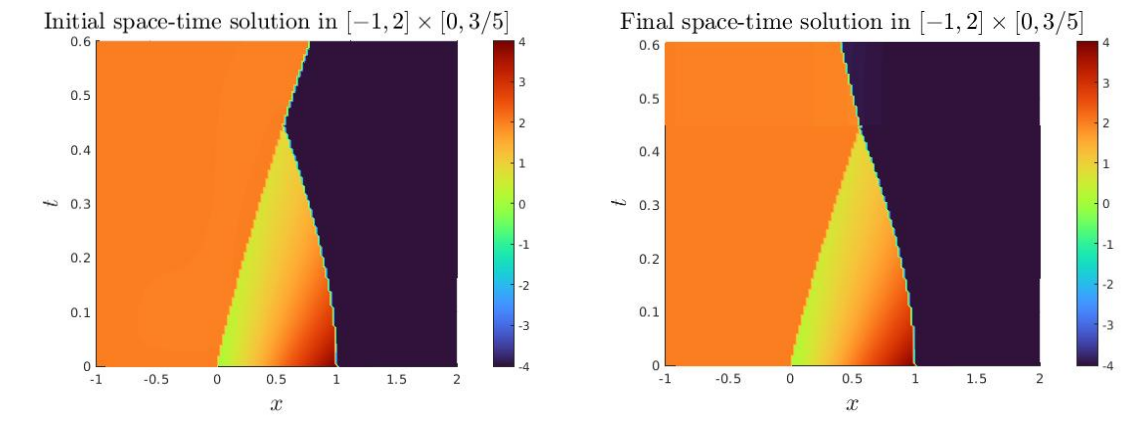
In this subsection, we are proposing a test involving the interaction of two shock waves merging to generate a third shock wave. As explained in Subsection 2.4, in this case it is necessary re-decompose the full domain once the two shock waves have interacted.

\ \
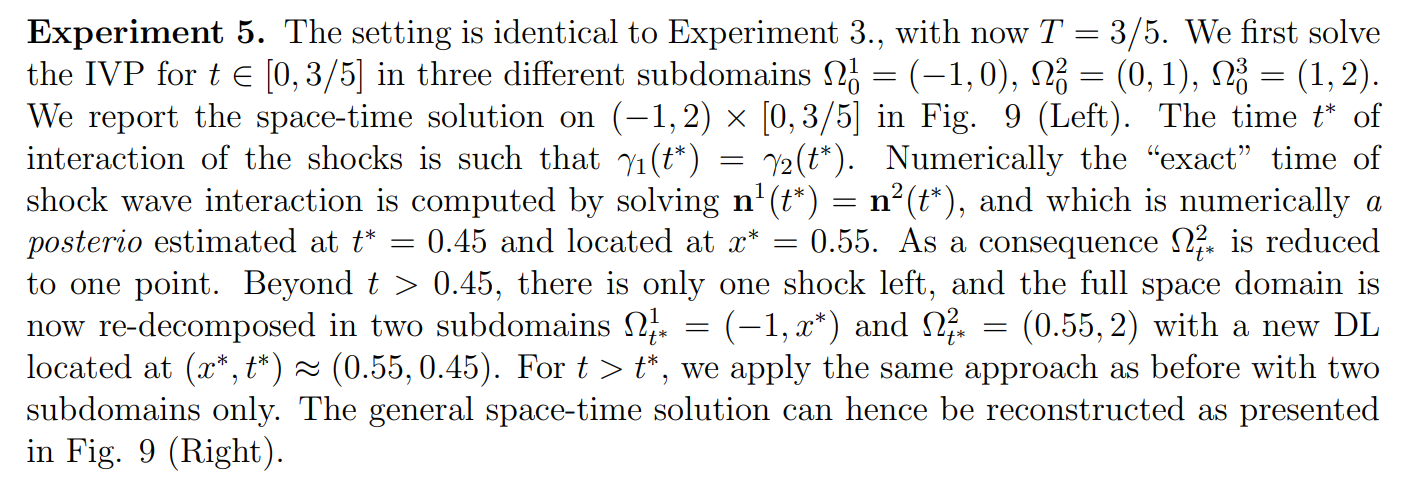
\ \ \ Figure 9: Experiment 5. (Left) Space-time solution without shock interaction (artificial for t > t∗ = 0.45. (Right) Space-time solution with shock interaction.
\

4.5. Entropy solution

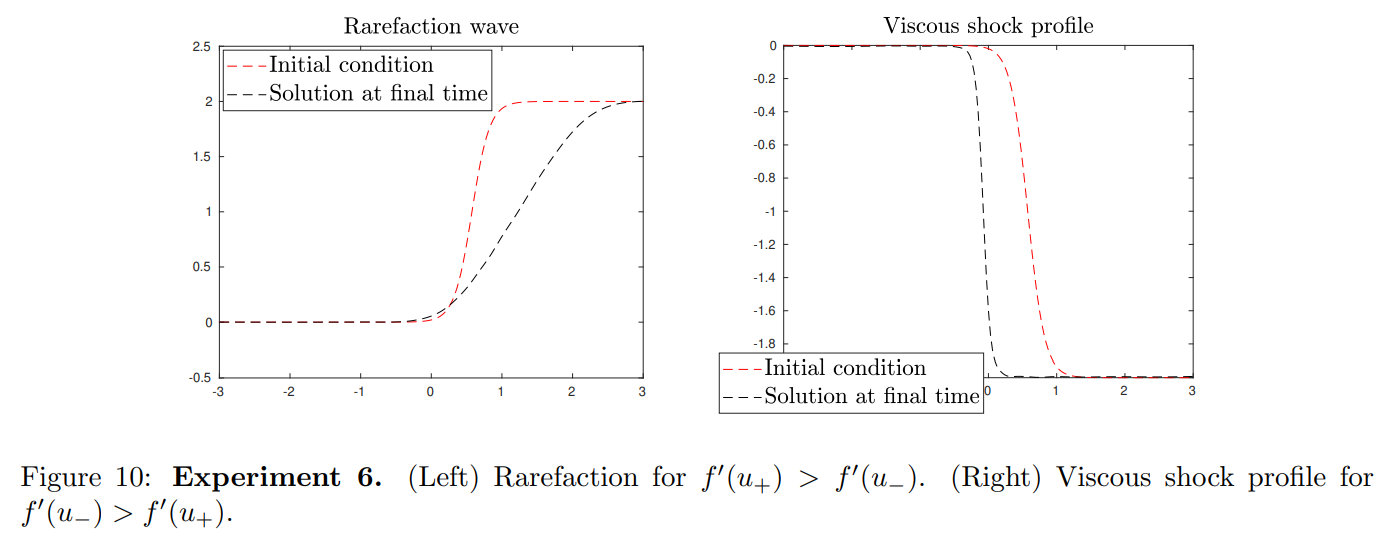
We propose here an experiment dedicated to the computation of the viscous shock profiles and rarefaction waves and illustrating the discussion from Subsection 1.3. In this example, a regularized non-entropic shock is shown to be “destabilized” into rarefaction wave by the direct PINN method.

\ \

\ \ \ \

\ \ \
\ \

:::info Authors:

(1) Emmanuel LORIN, School of Mathematics and Statistics, Carleton University, Ottawa, Canada, K1S 5B6 and Centre de Recherches Mathematiques, Universit´e de Montr´eal, Montreal, Canada, H3T 1J4 (elorin@math.carleton.ca);

(2) Arian NOVRUZI, a Corresponding Author from Department of Mathematics and Statistics, University of Ottawa, Ottawa, ON K1N 6N5, Canada (novruzi@uottawa.ca).

:::


:::info This paper is available on arxiv under CC by 4.0 Deed (Attribution 4.0 International) license.

:::

\

Market Opportunity
Instadapp Logo
Instadapp Price(FLUID)
$2.8648
$2.8648$2.8648
-2.98%
USD
Instadapp (FLUID) Live Price Chart
Disclaimer: The articles reposted on this site are sourced from public platforms and are provided for informational purposes only. They do not necessarily reflect the views of MEXC. All rights remain with the original authors. If you believe any content infringes on third-party rights, please contact service@support.mexc.com for removal. MEXC makes no guarantees regarding the accuracy, completeness, or timeliness of the content and is not responsible for any actions taken based on the information provided. The content does not constitute financial, legal, or other professional advice, nor should it be considered a recommendation or endorsement by MEXC.

You May Also Like

The Channel Factories We’ve Been Waiting For

The Channel Factories We’ve Been Waiting For

The post The Channel Factories We’ve Been Waiting For appeared on BitcoinEthereumNews.com. Visions of future technology are often prescient about the broad strokes while flubbing the details. The tablets in “2001: A Space Odyssey” do indeed look like iPads, but you never see the astronauts paying for subscriptions or wasting hours on Candy Crush.  Channel factories are one vision that arose early in the history of the Lightning Network to address some challenges that Lightning has faced from the beginning. Despite having grown to become Bitcoin’s most successful layer-2 scaling solution, with instant and low-fee payments, Lightning’s scale is limited by its reliance on payment channels. Although Lightning shifts most transactions off-chain, each payment channel still requires an on-chain transaction to open and (usually) another to close. As adoption grows, pressure on the blockchain grows with it. The need for a more scalable approach to managing channels is clear. Channel factories were supposed to meet this need, but where are they? In 2025, subnetworks are emerging that revive the impetus of channel factories with some new details that vastly increase their potential. They are natively interoperable with Lightning and achieve greater scale by allowing a group of participants to open a shared multisig UTXO and create multiple bilateral channels, which reduces the number of on-chain transactions and improves capital efficiency. Achieving greater scale by reducing complexity, Ark and Spark perform the same function as traditional channel factories with new designs and additional capabilities based on shared UTXOs.  Channel Factories 101 Channel factories have been around since the inception of Lightning. A factory is a multiparty contract where multiple users (not just two, as in a Dryja-Poon channel) cooperatively lock funds in a single multisig UTXO. They can open, close and update channels off-chain without updating the blockchain for each operation. Only when participants leave or the factory dissolves is an on-chain transaction…
Share
BitcoinEthereumNews2025/09/18 00:09
XRP ETF’s bereiken belangrijke mijlpaal: $1 miljard aan netto instroom

XRP ETF’s bereiken belangrijke mijlpaal: $1 miljard aan netto instroom

De markt voor crypto-exchange-traded funds (ETF’s) heeft opnieuw een belangrijke mijlpaal bereikt. XRP ETF’s hebben gezamenlijk meer dan 1 miljard dollar aan netto
Share
Coinstats2025/12/16 21:01
XSGD And XUSD Launch On Solana’s Blazing Network In 2025

XSGD And XUSD Launch On Solana’s Blazing Network In 2025

The post XSGD And XUSD Launch On Solana’s Blazing Network In 2025 appeared on BitcoinEthereumNews.com. StraitsX Stablecoins Unleash Power: XSGD And XUSD Launch
Share
BitcoinEthereumNews2025/12/16 20:59