In 2010, This Bitcoin Faucet Gave Away 5 BTC Per CAPTCHA
In 2010, a website called the Bitcoin Faucet handed out 5 BTC to anyone who solved a simple CAPTCHA. At today’s prices, that single claim would be worth roughly $369,450. The site was not a scam or a promotion; it was a deliberate experiment to get Bitcoin into the hands of people who had never used it.
What Was the 2010 Bitcoin Faucet That Paid 5 BTC Per CAPTCHA?
KEY TAKEAWAYS
- The Bitcoin Faucet, created by early Bitcoin developer Gavin Andresen, gave 5 BTC per visitor after completing a CAPTCHA.
- Andresen initially stocked the faucet with 1,100 BTC and accepted donations to keep it running.
- At current prices, each 5 BTC claim would be worth over $369,000, illustrating how radically Bitcoin’s market perception has shifted.
A Bitcoin faucet is a website that distributes small amounts of BTC for free, typically to introduce new users to the network. The original Bitcoin Faucet, hosted at freebitcoins.appspot.com, rewarded 5 BTC per completed CAPTCHA.
An archived snapshot from July 3, 2010 shows the faucet still held 750 BTC at that point. The page identified Gavin Andresen as its creator and listed a donation address so community members could replenish the supply.
Andresen announced the project on Bitcointalk on June 11, 2010, explaining that he had loaded it with 1,100 BTC. He later clarified in the same thread that the faucet was limited to 5 BTC per IP address, not per Bitcoin address, to prevent simple abuse.
Why Giving Away 5 BTC Made Sense in Bitcoin’s Early Days
In mid-2010, Bitcoin had no meaningful market price. The network was experimental, wallets were clunky, and almost nobody outside a small developer community had heard of BTC. There was no exchange infrastructure, no ETF debate, and no institutional interest.
Against that backdrop, 5 BTC was essentially worthless in dollar terms. The faucet’s purpose was distribution, education, and network growth. Andresen wanted people to own a small amount of Bitcoin so they could try sending and receiving it, experiencing the protocol firsthand.
This was a fundamentally different era from today’s market, where Bitcoin whales have accumulated hundreds of thousands of BTC and custody is handled by regulated institutions. In 2010, getting Bitcoin into any new pair of hands was the priority, and giving it away was the most direct solution.
The contrast with modern custody infrastructure is striking. Today, over 80% of U.S. Bitcoin ETFs rely on a single custodian, reflecting an asset class that institutions now take seriously enough to build compliance frameworks around.
What the 5 BTC Faucet Story Reveals About Bitcoin Markets Today
Bitcoin traded at $73,890 at the time of this article’s research, putting the value of a single faucet claim at $369,450. The Fear and Greed Index sat at 27, classified as “Fear,” meaning the market backdrop is cautious even as the numbers behind the faucet story look extraordinary in hindsight.
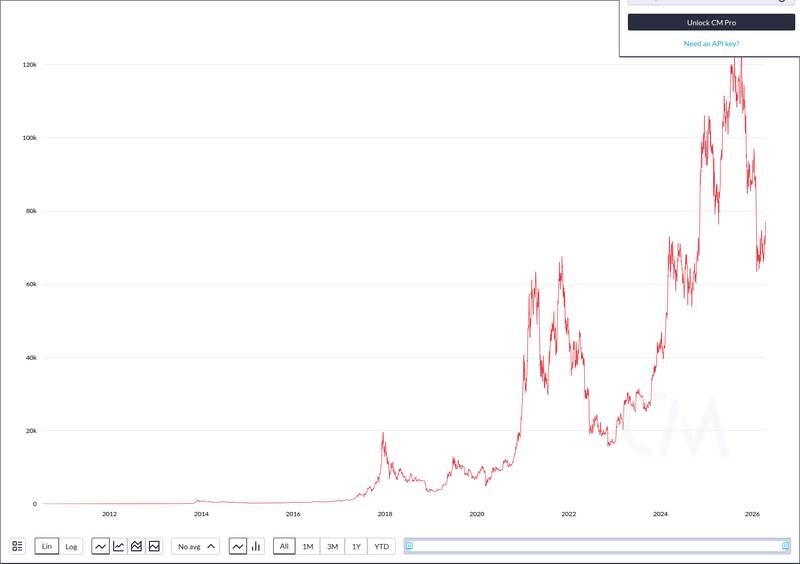 CoinMetrics blockchain-data panel highlighting the structural trend discussed for bitcoin.
The faucet story endures because it captures something specific about Bitcoin’s trajectory: the same asset that was given away to generate curiosity is now scarce enough to anchor a $1.48 trillion market cap. The halving mechanism that cuts new supply every four years has only deepened that scarcity narrative over time.
Early incentive experiments like Andresen’s faucet also reveal how dependent Bitcoin’s initial adoption was on generosity and community effort rather than financial speculation. The faucet burned through roughly 350 BTC in its first three weeks, based on the gap between the 1,100 BTC launch supply and the 750 BTC remaining in the July 3 snapshot.
That kind of grassroots distribution has no modern equivalent. Today’s onboarding happens through regulated exchanges, ETF wrappers, and institutional allocations. The faucet era is over, but its legacy is embedded in Bitcoin’s origin story as evidence of how far the asset has traveled from experimental internet money to a major financial instrument.
Disclaimer: This article is for informational purposes only and does not constitute financial or investment advice. Cryptocurrency and digital asset markets carry significant risk. Always do your own research before making decisions.


You May Also Like

The changing face of elder care in Malaysia — Sayed Mohammad Reza Yamani Sayed Umar

Not a loophole: Singapore AI export controls let China tap US AI legally

CoreWeave (CRWV) Stock Surges 12% on $8.5B GPU-Backed Financing Deal — Here’s the Full Picture