TLDR Vitalik Buterin believes low-risk DeFi could serve as Ethereum’s stable revenue source, similar to how Google Search funds Google’s other ventures He sees low-risk protocols like stablecoin lending as a way to balance profit generation with Ethereum’s founding values Current stablecoin lending yields around 5% for blue-chip assets, providing reliable returns without high speculation [...] The post Why Vitalik Thinks Low-Risk DeFi Could Be Ethereum’s Secret Weapon appeared first on CoinCentral.TLDR Vitalik Buterin believes low-risk DeFi could serve as Ethereum’s stable revenue source, similar to how Google Search funds Google’s other ventures He sees low-risk protocols like stablecoin lending as a way to balance profit generation with Ethereum’s founding values Current stablecoin lending yields around 5% for blue-chip assets, providing reliable returns without high speculation [...] The post Why Vitalik Thinks Low-Risk DeFi Could Be Ethereum’s Secret Weapon appeared first on CoinCentral.

Why Vitalik Thinks Low-Risk DeFi Could Be Ethereum’s Secret Weapon

2025/09/22 15:14
3 min read
For feedback or concerns regarding this content, please contact us at crypto.news@mexc.com

TLDR

  • Vitalik Buterin believes low-risk DeFi could serve as Ethereum’s stable revenue source, similar to how Google Search funds Google’s other ventures
  • He sees low-risk protocols like stablecoin lending as a way to balance profit generation with Ethereum’s founding values
  • Current stablecoin lending yields around 5% for blue-chip assets, providing reliable returns without high speculation
  • Ethereum’s DeFi ecosystem has rebounded with total value locked crossing $100 billion for the first time since early 2022
  • Buterin also promotes basket currencies and flatcoins as alternatives to dollar-denominated financial tools

Ethereum co-founder Vitalik Buterin has outlined a vision where low-risk decentralized finance protocols could become the network’s primary revenue driver. He compares this model to Google Search, which generates steady ad revenue that funds the company’s broader ecosystem.

In a recent blog post, Buterin argued that Ethereum needs a stable income source that doesn’t compromise its founding principles. The current ecosystem faces a split between high-fee speculative products and value-aligned applications that struggle financially.

Low-risk DeFi protocols offer a middle ground. These include basic financial services like payments, savings accounts, and collateralized lending that have matured since DeFi’s volatile early days.

Buterin points to Aave’s lending rates as a concrete example. Blue-chip stablecoins like USDT and USDC currently yield around 5% through these platforms. Higher-risk assets offer returns exceeding 10%.

The Ethereum founder believes these returns represent a reliable base layer of income. Unlike speculative trading or NFT markets, low-risk lending aligns with the network’s decentralized values while generating consistent fees.

DeFi Market Shows Recovery Signs

Ethereum’s DeFi ecosystem has shown recent strength. Total value locked across protocols has crossed $100 billion for the first time since early 2022.
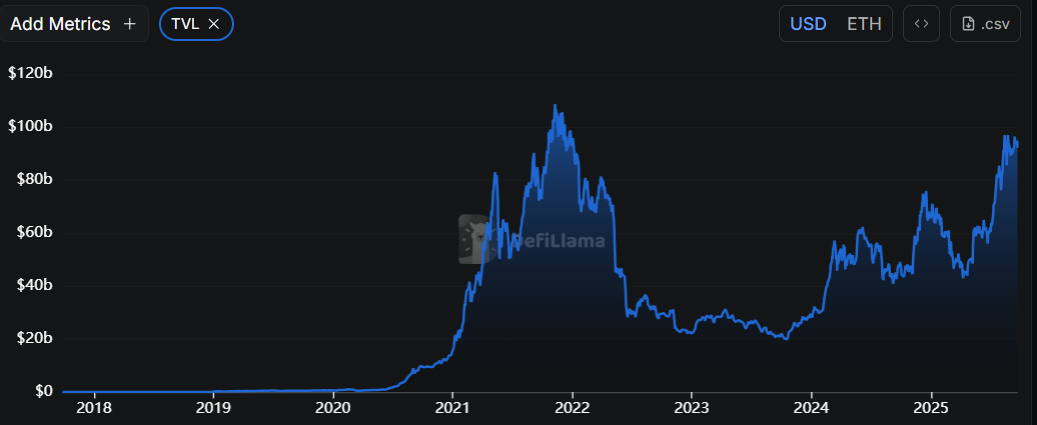
Source: DefiLlama

This recovery comes after TVL lagged during the 2022-2023 bear market. Recent regulatory developments, including the Digital Asset Market Clarity Act, have helped revive institutional interest.

A survey from the DeFi Education Fund found that over 40% of Americans would consider using DeFi under stronger regulatory frameworks. This suggests potential for mainstream adoption of low-risk protocols.

Buterin contrasts Ethereum’s approach with Google’s advertising-dependent model. While Google provides valuable open-source tools like Chromium, its reliance on ads compromises user privacy.

Ethereum’s decentralized design could align financial performance with ethical outcomes. The network can generate revenue without sacrificing user data or control.

Revenue Challenges Persist

Despite the optimistic outlook, Ethereum faces current revenue challenges. On-chain revenue dropped 44% in August to $14.1 million, down from $25.6 million in July.

Network fees also fell 20% month-over-month. The Dencun upgrade, which reduced layer-2 transaction costs, has cut into Ethereum’s base-layer revenue long-term.

Some analysts describe August’s figures as among the weakest since early 2021. Critics worry that shrinking fee revenue could threaten ETH’s value proposition.

However, supporters argue Ethereum is evolving into a foundational layer for global finance. Lower costs could fuel broader adoption of DeFi services.

Buterin also promoted basket currencies and flatcoins as part of this stable foundation. These digital assets peg to consumer price indices or multiple fiat currencies rather than single dollar-denominated tools.

The Ethereum co-founder envisions future innovations like reputation-based lending and prediction markets. These would build on the stable base of low-risk protocols.

Ethereum’s DeFi total value locked currently stands above $100 billion, marking its highest level since early 2022.

The post Why Vitalik Thinks Low-Risk DeFi Could Be Ethereum’s Secret Weapon appeared first on CoinCentral.

Disclaimer: The articles reposted on this site are sourced from public platforms and are provided for informational purposes only. They do not necessarily reflect the views of MEXC. All rights remain with the original authors. If you believe any content infringes on third-party rights, please contact crypto.news@mexc.com for removal. MEXC makes no guarantees regarding the accuracy, completeness, or timeliness of the content and is not responsible for any actions taken based on the information provided. The content does not constitute financial, legal, or other professional advice, nor should it be considered a recommendation or endorsement by MEXC.

You May Also Like

Big Day for Ripple and XRP ETFs: Everything You Need to Know

Big Day for Ripple and XRP ETFs: Everything You Need to Know

Check out everything most interesting surrounding Ripple and its native token.
Share
CryptoPotato2025/09/18 20:58
US SEC approves options tied to Grayscale Digital Large Cap Fund and Cboe Bitcoin US ETF Index

US SEC approves options tied to Grayscale Digital Large Cap Fund and Cboe Bitcoin US ETF Index

PANews reported on September 18th that the U.S. Securities and Exchange Commission (SEC) announced that, in addition to approving universal listing standards for commodity-based trust units , the SEC has also approved the listing and trading of the Grayscale Digital Large Cap Fund, which holds spot digital assets based on the CoinDesk 5 index. The SEC also approved the listing and trading of PM-settled options on the Cboe Bitcoin US ETF Index and the Mini-Cboe Bitcoin US ETF Index, with expiration dates including third Fridays, non-standard expiration dates, and quarterly index expiration dates.
Share
PANews2025/09/18 07:18
Whales Dump 200 Million XRP in Just 2 Weeks – Is XRP’s Price on the Verge of Collapse?

Whales Dump 200 Million XRP in Just 2 Weeks – Is XRP’s Price on the Verge of Collapse?

Whales offload 200 million XRP leaving market uncertainty behind. XRP faces potential collapse as whales drive major price shifts. Is XRP’s future in danger after massive sell-off by whales? XRP’s price has been under intense pressure recently as whales reportedly offloaded a staggering 200 million XRP over the past two weeks. This massive sell-off has raised alarms across the cryptocurrency community, as many wonder if the market is on the brink of collapse or just undergoing a temporary correction. According to crypto analyst Ali (@ali_charts), this surge in whale activity correlates directly with the price fluctuations seen in the past few weeks. XRP experienced a sharp spike in late July and early August, but the price quickly reversed as whales began to sell their holdings in large quantities. The increased volume during this period highlights the intensity of the sell-off, leaving many traders to question the future of XRP’s value. Whales have offloaded around 200 million $XRP in the last two weeks! pic.twitter.com/MiSQPpDwZM — Ali (@ali_charts) September 17, 2025 Also Read: Shiba Inu’s Price Is at a Tipping Point: Will It Break or Crash Soon? Can XRP Recover or Is a Bigger Decline Ahead? As the market absorbs the effects of the whale offload, technical indicators suggest that XRP may be facing a period of consolidation. The Relative Strength Index (RSI), currently sitting at 53.05, signals a neutral market stance, indicating that XRP could move in either direction. This leaves traders uncertain whether the XRP will break above its current resistance levels or continue to fall as more whales sell off their holdings. Source: Tradingview Additionally, the Bollinger Bands, suggest that XRP is nearing the upper limits of its range. This often points to a potential slowdown or pullback in price, further raising concerns about the future direction of the XRP. With the price currently around $3.02, many are questioning whether XRP can regain its footing or if it will continue to decline. The Aftermath of Whale Activity: Is XRP’s Future in Danger? Despite the large sell-off, XRP is not yet showing signs of total collapse. However, the market remains fragile, and the price is likely to remain volatile in the coming days. With whales continuing to influence price movements, many investors are watching closely to see if this trend will reverse or intensify. The coming weeks will be critical for determining whether XRP can stabilize or face further declines. The combination of whale offloading and technical indicators suggest that XRP’s price is at a crossroads. Traders and investors alike are waiting for clear signals to determine if the XRP will bounce back or continue its downward trajectory. Also Read: Metaplanet’s Bold Move: $15M U.S. Subsidiary to Supercharge Bitcoin Strategy The post Whales Dump 200 Million XRP in Just 2 Weeks – Is XRP’s Price on the Verge of Collapse? appeared first on 36Crypto.
Share
Coinstats2025/09/17 23:42